How to Track Your Brand's Visibility in AI Search Results
Last updated: 11 September 2026
AI brand visibility tools measure your presence across ChatGPT, Perplexity, Claude, and Gemini by running structured prompt tests, filtering GA4 for AI referral traffic, and tracking brand mentions in conversational outputs. These three steps establish a baseline you can automate once you understand what matters. The challenge is that most brands skip the manual testing phase and jump straight to tools, missing critical gaps in how their brand actually appears to AI users.
Table of Contents
- TL;DR
- Why Traditional Keyword Tracking Misses AI Search
- How AI Search Engines Index and Surface Brands
- Setting Up GA4 and Prompt Testing to Measure AI Visibility
- Choosing AI Brand Visibility Tools
- Frequently Asked Questions
- Can you actually track brand mentions inside AI-generated answers?
- How often should you run prompt tests?
- Does ranking on page one of Google help with AI visibility?
- What's the difference between AI referral traffic and direct traffic in GA4?
- Which AI engines should you prioritize for brand monitoring?
- How long does it take to see results from AI visibility optimization?
- Start Measuring Before Your Competitors Do
None of these methods are as clean as a Google Search Console report. AI engines don't expose citation data through an API, so tracking requires a combination of manual prompt logging, traffic-source filtering, and purpose-built tooling. The data is real, but the workflow takes setup.
This article follows a deliberate sequence. GA4 comes first because it tells you whether AI-referred visitors are already landing on your site, which gives you a concrete number to anchor everything else. Prompt tracking comes second because it shows you where your brand appears (or doesn't) in the actual answers buyers read. Tool selection comes last because the right tool depends on what gaps the first two steps expose. Jumping straight to a tool without that context is how teams end up paying for dashboards that measure the wrong prompts.
Integrate.io's breakdown of AI visibility tracking confirms that AI engines including ChatGPT, Perplexity, Claude, Gemini, and Google AI Overviews are now active surfaces where brand citations happen, and most analytics stacks aren't configured to see them yet. Getting your GA4 filters and prompt log in place before a competitor does is a straightforward structural advantage.
TL;DR
Tracking brand visibility in AI search requires four parallel approaches: manual prompt testing to catch direct mentions, GA4 referral filters to surface traffic from Perplexity and ChatGPT, branded search volume as a proxy signal, and dedicated monitoring tools to automate the process at scale.
- Prompt testing catches how AI engines describe your brand in real answers
- GA4 referral filters surface sessions arriving from Perplexity, ChatGPT, and similar AI interfaces
- Branded search volume acts as a downstream proxy when direct AI attribution is unavailable
- Dedicated ai brand visibility tools automate mention monitoring across multiple engines simultaneously
Cintra's 2026 AI search statistics show citation behavior and B2B buying decisions are increasingly shaped by what AI engines say about a brand, not just what Google ranks.
No single method covers everything. GA4 referral data only captures clicks that actually land on your site, so AI mentions that don't generate a click stay invisible. Manual prompt testing is time-intensive and produces a snapshot, not a trend line. Branded search volume can shift for reasons completely unrelated to AI visibility, making it a noisy signal on its own. Dedicated tools reduce that noise, but LLM tracking tool reviews consistently note that coverage gaps across engines remain a real limitation even for paid platforms. A layered approach using all four methods together is the only way to get a reasonably complete picture.
Why Traditional Keyword Tracking Misses AI Search
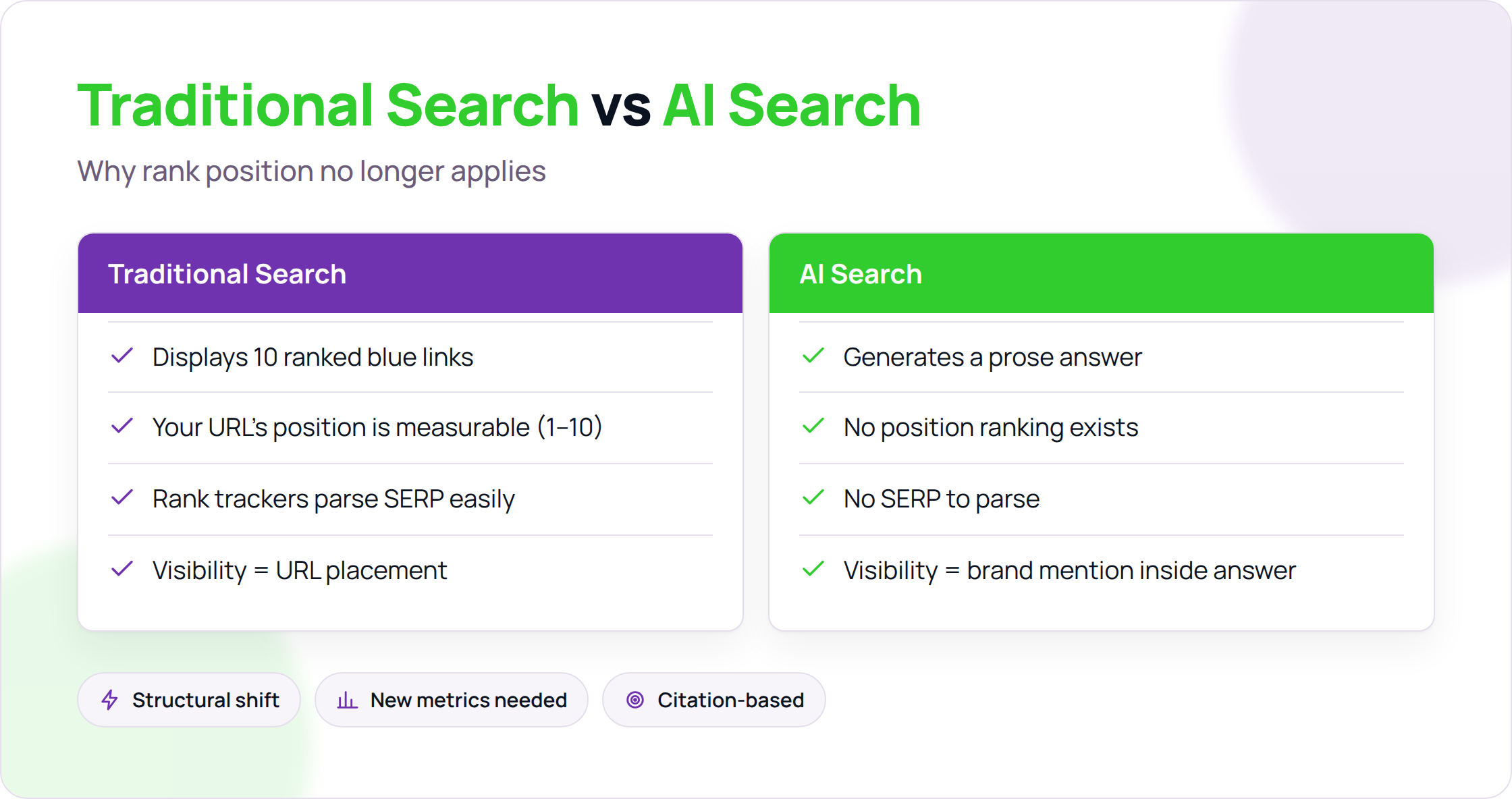
Traditional rank trackers measure where a URL appears in a list of ten blue links. AI search doesn't produce a list. It produces an answer, and your brand either gets named inside that answer or it doesn't. Position 1 through 10 is a concept that simply doesn't apply to a ChatGPT response, a Perplexity summary, or a Gemini overview. That structural difference is why your existing tracking stack can look healthy while your AI visibility is effectively zero.
Rank Trackers Can't See Inside a Chatbot Answer
A standard rank tracker sends a query to Google, parses the SERP, and logs your URL's position. When that same query fires inside an AI engine, there's no SERP to parse. The engine generates a prose response, sometimes with citations, sometimes without. Your tracker gets nothing back it can interpret.
Onely's 2026 practical guide on AI brand visibility found that over 73% of brands have zero mentions in AI-generated responses despite ranking on the first page of traditional search results. Ranking well and being cited are two separate outcomes, and most teams are only measuring one of them.
Prompt-Shaped Phrases vs. Head Terms
The query format matters more than most SEO practitioners expect. A head term like "project management software" behaves differently inside an AI engine than a prompt-shaped phrase like "best project management tool for remote teams with async workflows." The head term might trigger a generic category overview. The longer, intent-specific phrase is more likely to produce a named recommendation, which is where brand citations actually happen.
Semrush's AI search trends analysis documents this directly: visibility in AI surfaces depends on tracking citations, mentions, and on-platform engagement, not just keyword positions. If your keyword list is built around short head terms, you're monitoring the wrong query shape entirely. Prompt-style queries are how people actually talk to AI engines, and they fire different retrieval logic.
Branded Search Volume as a Proxy (and Where It Breaks Down)
One practical workaround is using branded search volume in Google Search Console as a proxy for AI-driven awareness. The logic: if someone reads a ChatGPT response that mentions your brand and then searches your name on Google, that branded query shows up in Search Console even though the AI referral doesn't. It's an indirect signal, but it's real and it's free.
The trade-off is significant. Branded search volume only captures the subset of users who act on an AI mention by searching your name. Someone who reads a Perplexity answer, clicks the cited URL directly, and lands on your site gets logged as direct traffic in GA4 with no connection to the AI citation that drove them there. The proxy understates your actual AI visibility, sometimes by a wide margin, and it can't tell you which specific prompts or AI engines are generating the awareness. Treat it as a useful early signal, not a measurement system.
How AI Search Engines Index and Surface Brands
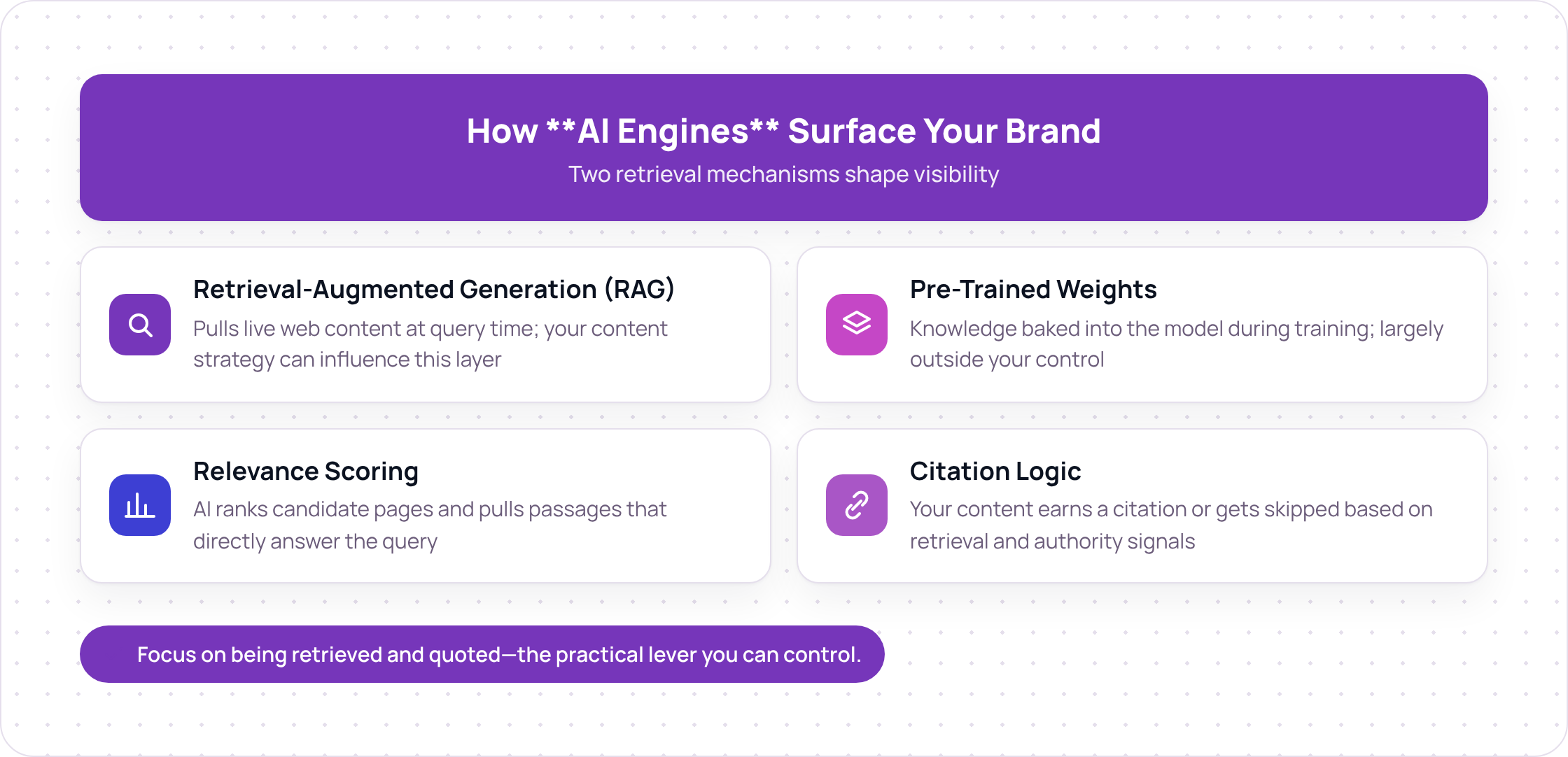
AI search engines surface brands through two distinct mechanisms: retrieval-augmented generation (RAG), which pulls live web content at query time, and pre-trained weights baked in during model training. Your content strategy can realistically influence the first. The second is largely outside your control. For most brands, the practical question is whether your pages are structured to be retrieved and quoted, not whether they shaped the model's base knowledge.
RAG vs. Training Data: Where Your Content Actually Lands
When Perplexity or Google's AI Overviews generate a response, they don't just recall memorized facts. They retrieve candidate pages, score them for relevance and authority, and pull passages that answer the query directly. That retrieval step is where your content either earns a citation or gets skipped.
Training data matters too, but the cycle time is long. GPT-4's training cutoff predates most of 2024's content entirely. Waiting for a model retrain to surface your brand is not a viable strategy. Optimizing for RAG retrieval is.
The Citation Loop
Perplexity and AI Overviews don't treat all pages equally. They weight pages that are already cited by authoritative sources, creating a compounding effect: the more your content is referenced by credible third parties, the more likely AI engines are to retrieve and quote it themselves.
Pew Research data, surfaced in a 2026 visibility analysis, found that users click traditional search results only 8% of the time when an AI summary appears. The citation, not the click, is the primary exposure event. If your brand isn't in the cited set, you're effectively invisible to a large share of that query's audience.
Building third-party citation authority takes time and depends partly on factors you can't fully control, like editorial decisions at publications you don't own. Brands in niche verticals with few authoritative linking domains face a harder path into the citation loop than brands in well-documented industries.
Why Passive Voice Gets Deprioritized
AI models selecting citation passages favor text that makes direct, attributable claims. Passive constructions ("it has been found that," "results were observed") obscure the agent and the mechanism, which makes them harder for a model to extract as a clean, quotable fact.
Active, subject-led sentences ("Our study of 400 SaaS companies found a 23% churn reduction") give the model a clear actor, a clear claim, and a clear number. That structure is easier to lift verbatim into a generated response. Passive voice doesn't disqualify a page from retrieval, but it does reduce the probability that any given sentence gets surfaced as the cited passage. Audit your most important pages for this specifically, not just for keyword density.
Setting Up GA4 and Prompt Testing to Measure AI Visibility
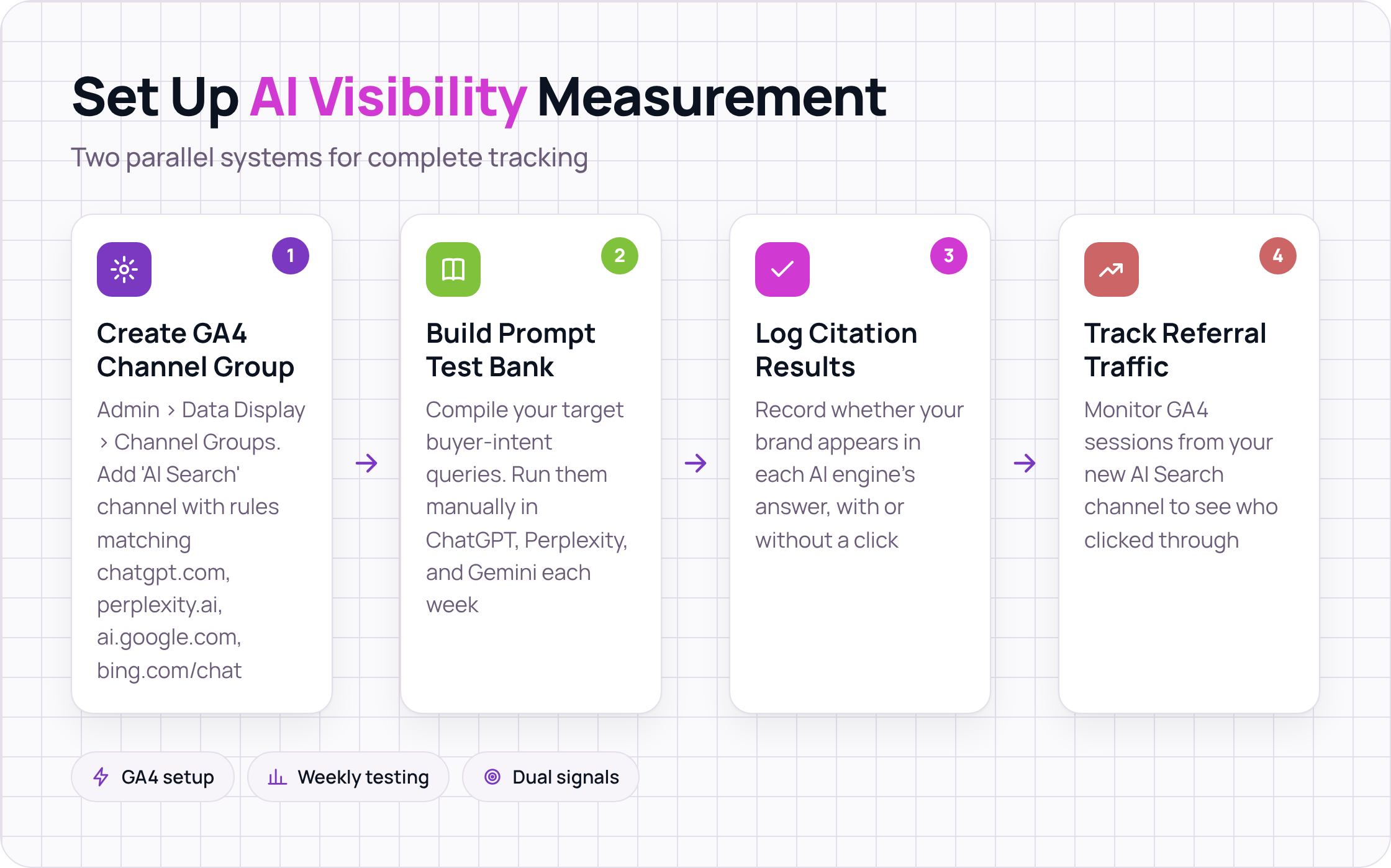
To measure AI search visibility, you need two parallel systems: a GA4 custom channel group that captures referral traffic from AI platforms, and a structured prompt test bank you run manually each week. Together they give you both the traffic signal (who clicked through) and the citation signal (whether your brand appeared at all, even without a click). Neither system alone tells the full story.
Step 1: Build the GA4 Channel Group
GA4 does not recognize ChatGPT or Perplexity as distinct traffic sources by default. Without a custom channel group, that traffic lands in "Referral" or "Direct" and disappears into the noise.
Fix this by creating a new channel group under Admin > Data Display > Channel Groups. Add a channel called "AI Search" and define rules that match session source containing any of these domains: chatgpt.com, perplexity.ai, ai.google.com, and bing.com/chat. Save it, then apply it as a secondary dimension in your Acquisition reports. From that point forward, you get a clean weekly traffic line for each AI platform, separated from organic and paid.
Keep in mind: this only captures sessions where a user actually clicked a cited link. AI engines frequently mention brands without linking to them, so a low referral count does not mean low visibility. The GA4 setup is a floor measurement, not a ceiling.
Step 2: Build a 20-30 Query Prompt Test Bank
The prompt bank is where you catch the citations GA4 misses. Write down 20 to 30 questions your buyers actually type, not keyword-style phrases but full conversational queries: "What's the best way to reduce SaaS churn?", "How do I pick a CRM for a 50-person team?", "Which project management tools work for remote agencies?"
Run each query weekly in ChatGPT, Perplexity, and Gemini. A step-by-step AI visibility guide published on LinkedIn recommends tracking brand mentions, citation position, and share of voice across platforms as the core measurement framework, which maps directly to what a structured prompt bank produces.
Rotate the queries slightly every few weeks. AI engines update their retrieval behavior, and a query that produced no mention last month may behave differently after a model update. Keeping the bank fresh prevents you from optimizing for a snapshot that no longer reflects current retrieval logic.
Step 3: Log Results in a Simple Tracking Sheet
For each query run, record the date, the engine, whether your brand was mentioned, the position of the mention (first, middle, or last third of the response), and whether a citation link was included. A plain spreadsheet works fine at this stage.
After four weeks you'll have enough data to spot patterns: which engines mention you most, which query types trigger citations, and whether your mention rate is trending up or down. That pattern is what tells you whether your content changes are working, and it's the input that helps you choose among ai brand visibility tools if you decide to automate.
Choosing AI Brand Visibility Tools
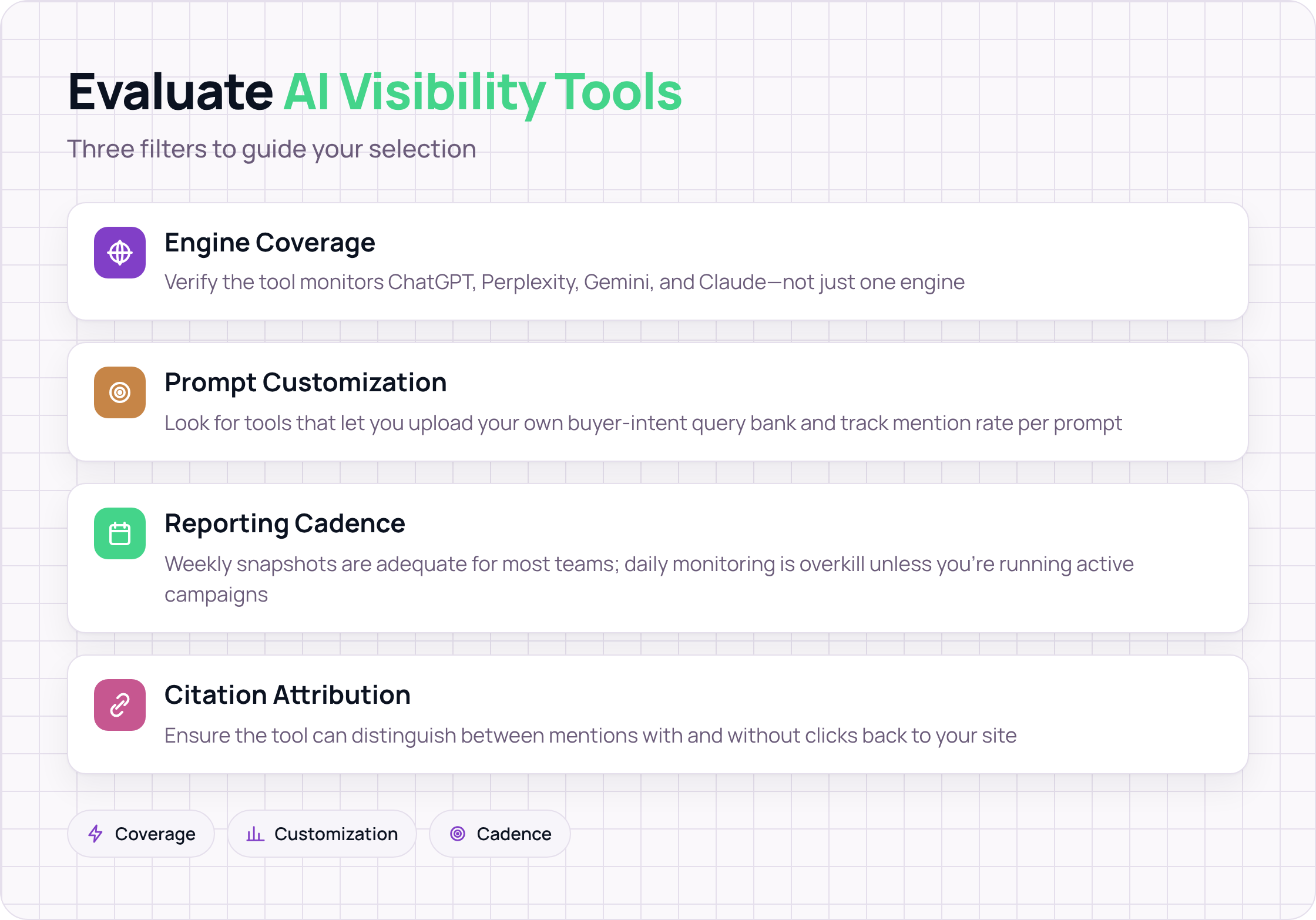
Once you've run manual prompt tests for a few weeks, you'll have a clear sense of where the gaps are. That's the right moment to evaluate dedicated ai brand visibility tools, because you'll know exactly what you need them to do.
What to Look for in a Monitoring Tool
Coverage is the first filter. A tool that only monitors ChatGPT misses Perplexity, Gemini, and Claude, which together account for a significant share of AI-referred traffic. Ask vendors specifically which engines they query and how often.
Prompt customization matters almost as much. Generic industry prompts won't surface your brand the way buyer-intent prompts do. Tools that let you upload your own query bank and track mention rate per prompt are meaningfully more useful than tools that run fixed keyword searches.
Reporting cadence is the third variable. Weekly snapshots are adequate for most teams. Daily monitoring is useful if you're running an active PR or content campaign and need to see citation changes in near real time.
The Coverage Gap Problem
LLM tracking tool reviews consistently flag one limitation across paid platforms: no tool currently achieves full coverage across all major AI engines simultaneously. Some tools have strong Perplexity coverage but lag on Gemini. Others handle ChatGPT well but don't yet support Claude's citation behavior.
Budget for this gap by keeping your manual prompt bank running even after you adopt a paid tool. The manual layer catches what the tool misses and gives you a sanity check on the automated data.
Frequently Asked Questions
Can you actually track brand mentions inside AI-generated answers?
Yes, though not through a single API or dashboard. The practical method combines manual prompt testing (running your target queries in ChatGPT, Perplexity, and Gemini and logging whether your brand appears) with GA4 referral filters that capture clicks from AI platforms. Dedicated ai brand visibility tools can automate the prompt-testing layer, but even paid platforms have coverage gaps across engines.
How often should you run prompt tests?
Weekly is the right cadence for most teams. AI engines update their retrieval behavior frequently, and a monthly schedule leaves too much time between data points to catch meaningful shifts. If you're running an active content or PR campaign, bump the frequency to twice a week so you can see whether new content is affecting your citation rate.
Does ranking on page one of Google help with AI visibility?
It helps, but it doesn't guarantee anything. Onely's 2026 research found that over 73% of brands ranking on Google's first page have zero mentions in AI-generated responses. The factors that drive AI citation, including direct attributable claims, third-party references, and structured content, are related to but distinct from traditional ranking signals. You need to optimize for both separately.
What's the difference between AI referral traffic and direct traffic in GA4?
AI referral traffic comes from users who clicked a cited link inside an AI engine's response, so the session source shows the AI platform's domain (perplexity.ai, chatgpt.com, etc.). Direct traffic in GA4 includes sessions where no referrer was passed, which happens when someone types your URL directly, uses a bookmark, or clicks a link in a non-browser context. Some AI-driven visits land as direct because the AI interface strips the referrer header before the click. This means GA4 referral counts for AI platforms undercount actual AI-driven visits.
Which AI engines should you prioritize for brand monitoring?
Start with Perplexity, ChatGPT, and Google AI Overviews. Perplexity drives the most measurable referral traffic among AI-native engines as of mid-2026. ChatGPT has the largest user base. Google AI Overviews appear on queries where traditional SEO already matters, so your existing content investments carry over more directly there. Claude is worth adding to your manual prompt bank but currently generates less measurable referral traffic than the other three.
How long does it take to see results from AI visibility optimization?
Content changes that improve RAG retrieval, such as adding direct attributable claims, building third-party citations, and restructuring passive-voice passages, typically take four to eight weeks to show up in prompt test results. Third-party citation building takes longer, often three to six months, because it depends on editorial cycles at external publications. GA4 referral traffic from AI platforms can shift faster if you're already being cited and a content update improves your citation position.
Start Measuring Before Your Competitors Do
Most teams are still running analytics stacks that were built for a ten-blue-links world. Setting up the GA4 channel group and prompt test bank described above takes a few hours, and it gives you a concrete baseline before a competitor claims the citation share in your category.
If you want help building that measurement layer and identifying which content changes will move your AI citation rate, visit Seorav's GEO service page to see how Seorav approaches AI brand visibility for B2B and SaaS teams.
Keep reading
Which LLM Citation Tracking Platform Actually Works for Your Brand
Compare the top llm citation tracking platforms by engine coverage, alert speed, and pricing. Find the right tool for your team size and budget.
Siteimprove for SEO: What It Does (and What It Doesn't)
A clear-eyed look at Siteimprove SEO features, pricing, and gaps versus AI-native platforms. Find out if it fits your team's workflow in 2026.
How AI Overviews Are Reshaping Organic Traffic (And What SEOs Must Do)
AI Overviews now trigger on 30%+ of Google queries. See how zero-click search AI impact on organic traffic is measured, and what SEOs can do about it.