How to Track Your Brand's Citations Across AI Chatbots and LLMs
Last updated: 7 November 2026
Prompt and citation tracking tools automate the process of querying ChatGPT, Perplexity, and Gemini with your target keywords, then logging which URLs each engine surfaces and aggregating results into a single dashboard. This turns manual citation hunting into a repeatable workflow you can run weekly or monthly. The trade-off: no tool captures every citation, since LLM responses shift by geography, session, and model version. You'll catch the patterns that matter most.
SparkToro's 2024 zero-click research found that 60% of AI-generated answers cite fewer than five unique domains. That concentration means a small number of sources capture most of the citation surface area. If your brand is not already in that pool, you are effectively invisible to a growing share of buyers who never click through to a search results page.
What this tutorial produces: a live monitoring setup that polls all three major AI engines on a recurring schedule, parses each response for cited URLs, and surfaces the data in a dashboard you can review weekly.
Before You Start: What You Need in Place
You need three things ready before you run a single query: access to the right prompt and citation tracking tools (some require paid tiers), a focused list of 10 to 20 prompts that reflect how real buyers ask about your category, and a clear record of which URLs you actually want cited.
Accounts and Access
Most serious tracking tools sit behind paid plans. Free tiers on platforms like Perplexity or ChatGPT let you run manual spot-checks, but they do not give you API access, response logging, or the ability to run queries at scale on a schedule. Budget for at least one paid account before you start, or your tracking will be a spreadsheet you update by hand every few weeks and then abandon.
The trade-off is real: automated polling costs money, and for smaller brands with thin query volume, the signal-to-noise ratio in early reports can be frustrating. If your brand appears in fewer than 5% of relevant AI responses right now, the first month of data will mostly show you what is missing, not what is working. That is still useful, but set expectations accordingly.
Building Your Seed Query List
Prompt specificity determines data quality. "Clarity and specificity are at the heart of effective prompting," notes the SJSU iSchool's research guidance, and the same principle applies when you are designing queries to test your own visibility.
Aim for 10 to 20 prompts across three categories:
- Branded queries: your company name, product names, and key personnel who publish under your brand
- Category queries: how a buyer describes the problem your product solves, without naming you ("best tools for tracking AI citations", "how do I know if ChatGPT mentions my brand")
- Comparison queries: "X vs. Y" or "alternatives to [competitor]" phrasing, since AI engines frequently cite third-party sources in these responses
SE Ranking's prompt selection framework recommends filtering your initial list by search intent before you commit to tracking, so you are not wasting cycles on informational queries that rarely produce brand citations anyway. Start broad, then cut anything that does not map to a stage in your actual buyer journey.
Baseline Content Audit
Before you track, you need to know what you want the engines to cite. Pull a list of your 10 to 15 highest-value URLs: product pages, comparison articles, original research, and any long-form guides that directly address your seed queries. These are your target citations.
If you start tracking without a target list, you will get data but no direction. You will see that ChatGPT cited a competitor's blog post for a query you care about, but you will not know whether you even have a page that could compete for that citation. The audit closes that gap. It also surfaces content you thought was strong but turns out to be thin on the specifics AI engines tend to pull from: concrete data, named mechanisms, and direct answers in the first paragraph.
Run this audit before your first tracking cycle, not after. Retrofitting a content strategy onto three months of citation data is harder than building one from a clean baseline.
Step 1: Understand Why AI Engines Cite Certain Sources
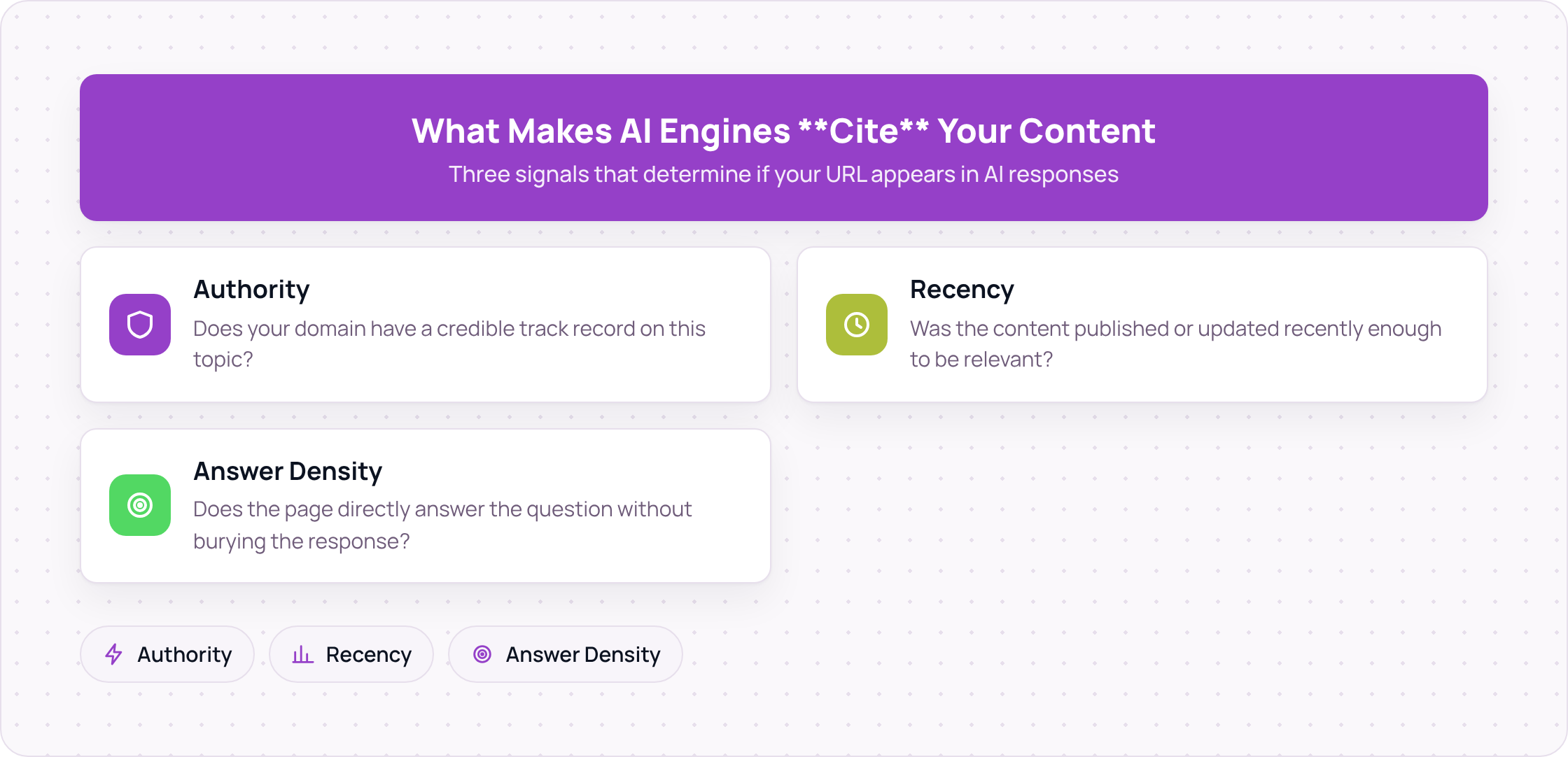
AI engines select sources at query time, not at crawl time. A page that ranks well in Google has no guaranteed advantage in a ChatGPT or Perplexity response. Citation probability depends on three content signals: authority (does the domain have a credible track record on this topic?), recency (was the content published or updated recently enough to be relevant?), and answer density (does the page directly answer the question without burying the response in preamble?).
How RAG Actually Selects Sources
Retrieval-augmented generation works by pulling candidate documents into the model's context window at query time, then generating a response that synthesizes those documents. The retrieval step is the gate. If your page does not surface during retrieval, the generation step never sees it. Tinuiti's analysis of AI citation patterns found that brands appearing in AI-generated answers tend to have structured, topically focused pages rather than broad, catch-all content.
The three signals matter in sequence. Authority gets your domain into the candidate pool. Recency determines whether the retrieval layer treats your content as current. Answer density is what converts a retrieved page into an actual citation: the model needs a clean, extractable passage it can quote or paraphrase with confidence.
Why Perplexity and Structured Data Create a Measurable Edge
Perplexity's architecture is more transparent than most: it shows cited URLs directly in the response, making it the easiest engine to audit manually. Pages that use structured data (FAQ schema, HowTo schema, Article schema) give the retrieval layer explicit signals about what a passage answers, which raises the probability that the right passage gets pulled for the right query. Useomnia's breakdown of AI citation tracking notes that pages with clear answer-first structures are consistently over-represented in LLM citations relative to their organic search rankings.
The trade-off is real, though. Structured data and answer-dense formatting help with retrieval, but they do not override domain authority. A well-formatted page on a low-authority domain will still lose to a thinner page on a domain the model has seen cited thousands of times in training. For highly contested queries, three or four high-authority domains tend to dominate citations regardless of how well any individual page is optimized. The ceiling for newer domains is lower than the ceiling for established ones, at least in the short term.
Step 2: Choose and Configure Your Prompt and Citation Tracking Tools
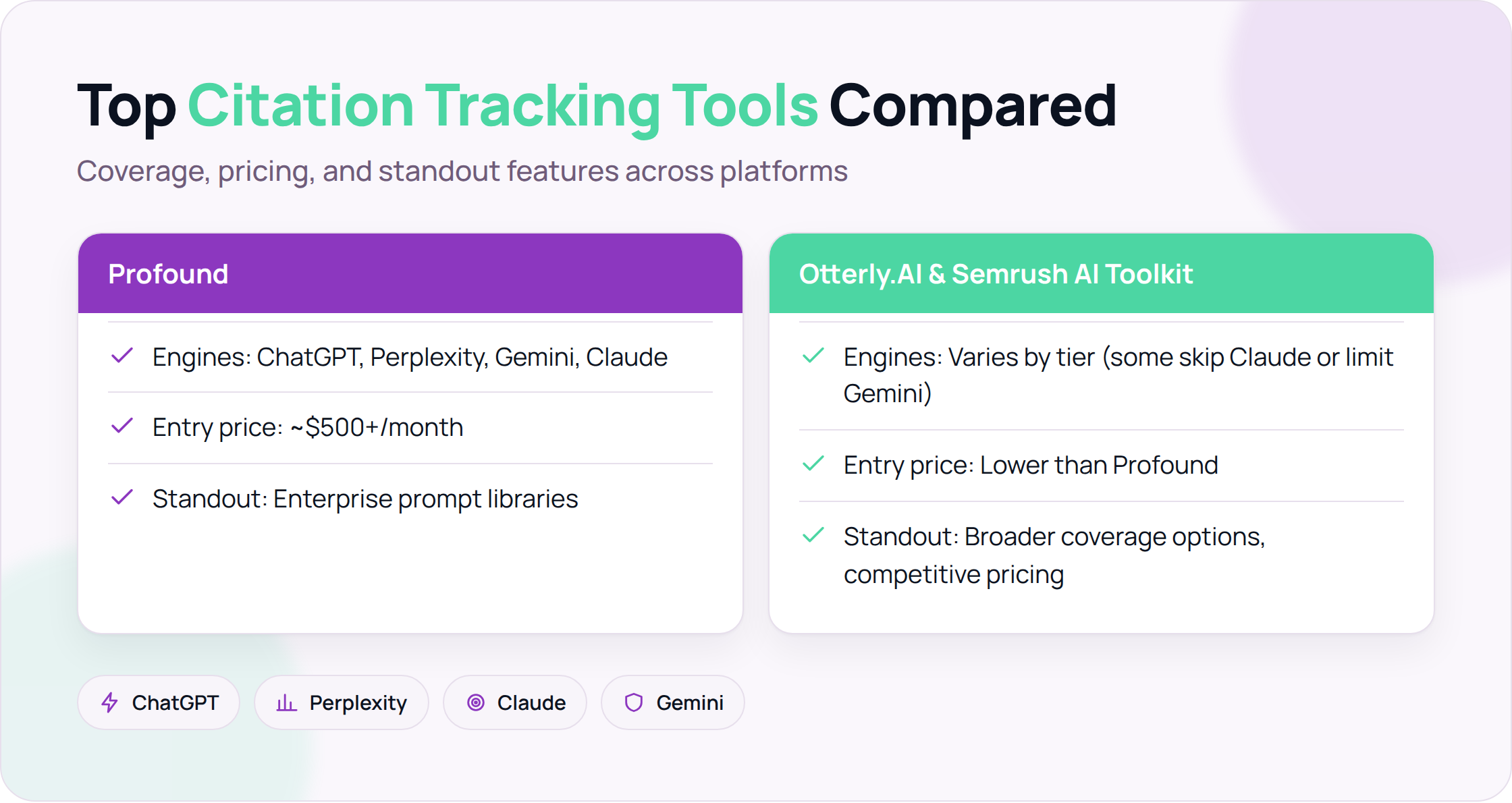
The right citation tracking tool polls major AI engines on a schedule, logs which URLs each engine cites, and surfaces competitor mentions alongside your own. Three platforms dominate this space right now: Profound, Otterly.AI, and Semrush's AI Toolkit. Each covers a different slice of the engine landscape, and the pricing gap between them is wide enough to matter for smaller teams.
Comparing the Main Options
A comparison of 11 platforms by Slatehq's ranking of AI citation trackers found that coverage varies sharply: some tools poll ChatGPT and Perplexity but skip Claude entirely, while others include Gemini only on higher-tier plans.
| Tool | Engines Covered | Entry Price (monthly) | Standout Feature |
|---|---|---|---|
| Profound | ChatGPT, Perplexity, Gemini, Claude | ~$500+ | Enterprise prompt libraries |
| Otterly.AI | ChatGPT, Perplexity, Bing AI | ~$99 | Fast setup, clean UI |
| Semrush AI Toolkit | ChatGPT, Perplexity | Add-on to existing plan | Integrated with existing SEO data |
Otterly.AI is the fastest to configure and the cheapest entry point, but its Claude and Gemini gaps mean you are watching roughly half the citation surface. Profound covers all four major engines, but the price puts it out of reach for most solo operators or early-stage teams. Semrush's add-on makes sense only if you are already paying for a Semrush subscription.
Setting Up Your Monitoring Project
Once you have picked a tool, the setup logic is the same across all three. You define seed queries first: the exact prompts your buyers are likely to type into ChatGPT or Perplexity. "Best project management software for remote teams" is a seed query. "Project management" is not. Specificity matters because AI engines return different citations for slightly different phrasings, and a vague query produces noisy, hard-to-act-on data.
After seed queries, enter your competitor domains. Most tools let you add five to fifteen domains and will flag any response where a competitor URL appears but yours does not. That gap list becomes your content backlog.
Qvery's AI citation tracking analysis found that teams who configured at least 20 seed queries in their first week surfaced 3x more actionable citation gaps than teams who started with fewer than five. Front-loading the query list pays off quickly.
Connecting Alerts
None of this works if you check the dashboard once a month. Every tool listed above supports either a Slack integration or email digest. Set the alert to trigger when a new citation appears for any tracked prompt, or when a competitor gets cited on a prompt where you currently do not appear. Weekly digest emails work for most teams; daily Slack pings are worth enabling only if you are running an active content sprint and can act on the data in real time.
One limitation worth flagging: alert volume scales with query count. Teams tracking 50 or more seed queries often find their Slack channel fills with low-signal notifications. The fix is to segment alerts by priority tier, flagging only high-intent, bottom-of-funnel queries for immediate notification and batching informational queries into the weekly digest.
Step 3: Run Structured Prompt Tests to Find Existing Citations
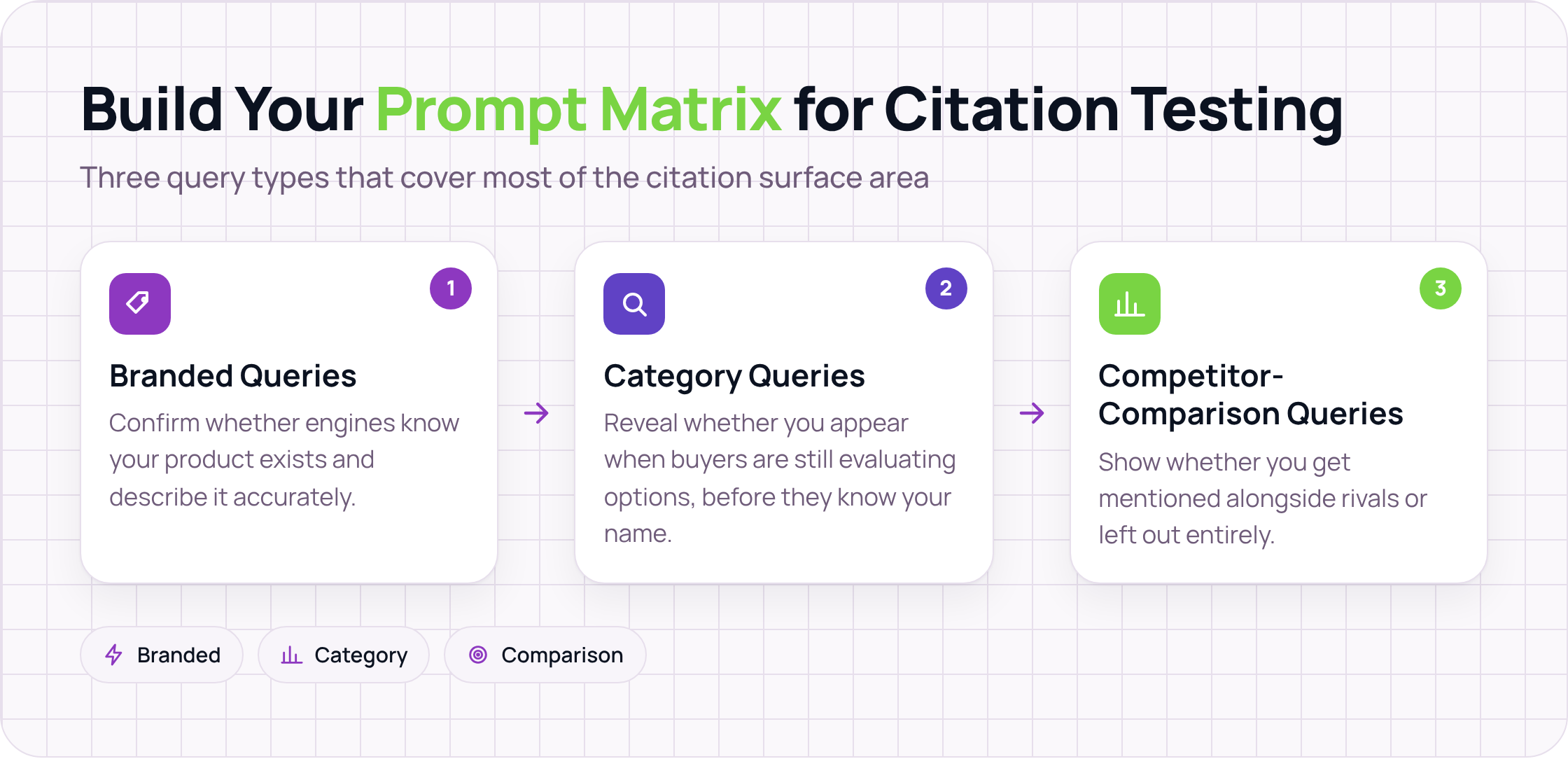
Structured prompt testing is the most direct way to find out whether AI engines are already citing your brand. Build a matrix of branded queries ("what is [your brand]?"), category queries ("best tools for [your use case]"), and competitor-comparison queries ("[your brand] vs [competitor]"). Run each prompt across ChatGPT, Perplexity, Claude, and Gemini. Log every response in a spreadsheet with columns for engine, prompt, cited URL, and date. That spreadsheet becomes your citation baseline.
Build a Prompt Matrix First
Three query types cover most of the citation surface area you care about:
- Branded queries confirm whether engines know your product exists and describe it accurately.
- Category queries reveal whether you appear when buyers are still evaluating options, before they know your name.
- Competitor-comparison queries show whether you get mentioned alongside rivals or left out entirely.
Run each query at least three times per engine on different days. AI engines are non-deterministic: the same prompt can return different citations in back-to-back sessions. Three runs per query gives you enough variation to distinguish a consistent citation from a one-off. If a URL appears in two out of three runs, treat it as a reliable citation. If it appears once, flag it for re-testing next week.
Log Everything in a Structured Format
A simple spreadsheet works fine for the first month. Use these columns: date, engine, prompt, cited URL, citation rank (position 1, 2, 3 in the response), and a notes field for anything unusual in the response text. Do not skip the citation rank column. Position 1 citations carry more weight than position 5 citations, and tracking rank over time tells you whether your content is moving up or down in the retrieval order.
After 30 days, you will have enough rows to spot patterns: which engines cite you most, which query types produce the most citations, and which competitor domains appear on prompts where you are absent. Those patterns drive your next content decisions.
What to Do When You Find a Citation Gap
A citation gap is any prompt where a competitor URL appears and yours does not. For each gap, ask two questions: do you have a page that directly addresses this query, and if so, does that page answer the question in the first paragraph with specific data?
If you do not have a page, add it to your content calendar. If you do have a page but it is not getting cited, the problem is almost always answer density. The page exists but buries the direct answer under background context, or it uses vague language where the competitor's page uses specific numbers and named mechanisms. Rewriting the introduction to lead with the direct answer, and adding at least one concrete data point in the first 100 words, is the single highest-leverage edit you can make to improve citation probability.
Step 4: Interpret Your Citation Data and Act on It
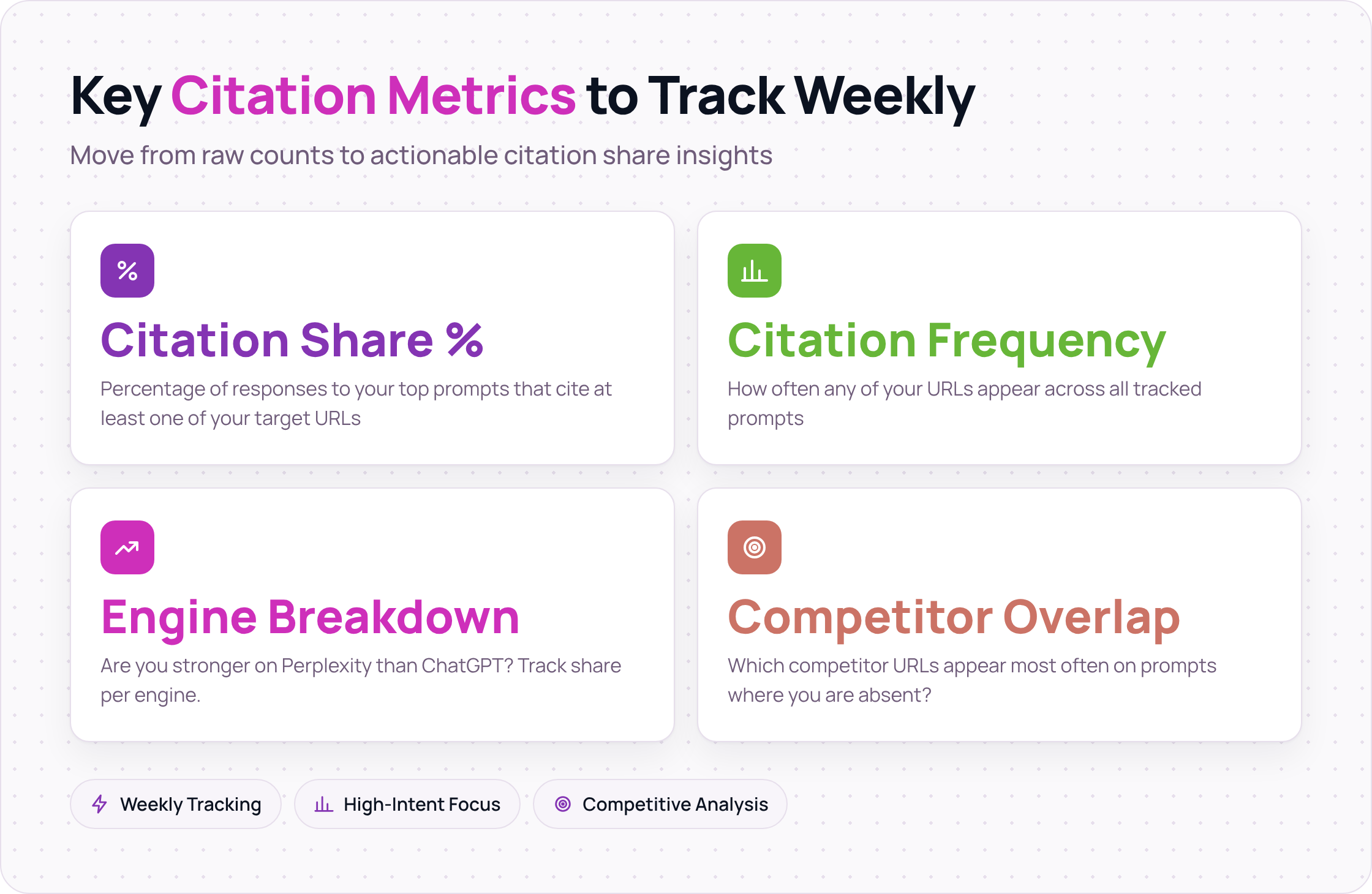
Raw citation counts are not the metric that matters. What matters is citation share on high-intent queries: the percentage of responses to your most important prompts that include at least one of your target URLs. Track that number weekly. A brand moving from 10% citation share to 25% on its top 10 queries over 90 days is making real progress, even if the absolute citation count looks small.
Reading the Dashboard
Most citation tracking tools display data in three views: citation frequency (how often any of your URLs appear across all tracked prompts), citation share by engine (are you stronger on Perplexity than ChatGPT?), and competitor overlap (which competitor URLs appear most often on prompts where you are absent?).
Start with competitor overlap. It tells you where the citation opportunity is largest and which domains you are competing against for retrieval. A competitor appearing on 80% of your tracked prompts is a signal worth investigating: look at their content structure, their schema markup, and how directly they answer the query in the opening paragraph.
Prioritizing Content Updates
Not all citation gaps are worth closing. Prioritize gaps on queries that map to your bottom-of-funnel buyer journey: comparison queries, pricing queries, and "best [category] for [specific use case]" queries. These are the prompts where a citation directly influences a purchase decision. Informational queries ("how does RAG work?") are worth tracking but lower priority for content investment unless your brand has a specific reason to own that topic.
A practical rule: if a query appears in your top 10 by search volume and you have zero citations across all four engines, that is a priority-one content gap. If a query is in your top 50 and you have citations on two out of four engines, that is a priority-two optimization. Work the priority-one list first.
Reporting Citation Progress to Stakeholders
Citation share is a new metric for most marketing teams, and stakeholders will ask how it relates to revenue. The honest answer is that the direct attribution chain is still being established across the industry. What you can show is directional correlation: as citation share on high-intent queries increases, branded search volume and direct traffic from AI-referred sessions tend to follow. Pull both metrics into your monthly report alongside citation share so the relationship becomes visible over time.
Frequently Asked Questions
How often should I run prompt tests across AI engines?
Run automated tests weekly at minimum. AI engines update their retrieval indexes and model weights on irregular schedules, so a citation you had last month may disappear without warning. Weekly polling catches those drops before they become a month-long blind spot. If you are running a content sprint or have just published a major piece, increase to daily for the first two weeks to see how quickly the engines pick it up.
Do I need to track all four major AI engines, or is Perplexity enough?
Perplexity is the easiest to audit because it shows cited URLs directly in the response, but limiting your tracking to one engine gives you an incomplete picture. ChatGPT and Gemini have different retrieval architectures and different user bases, so your citation share can vary significantly across engines. A brand that appears in 40% of Perplexity responses for a given query might appear in only 15% of ChatGPT responses for the same prompt. Track at least two engines from the start, and add Claude and Gemini as your budget allows.
What is the difference between a citation and a mention in AI responses?
A citation is a linked URL that the engine surfaces as a source for its answer. A mention is when the engine references your brand name in the response text without linking to a specific page. Both matter, but citations carry more weight: they signal that the engine's retrieval layer found your content credible enough to pull as a source document. Mentions without citations often indicate that your brand appears in the model's training data but your current content is not winning the retrieval competition at query time.
Can I improve my citation rate without publishing new content?
Yes, but the gains are smaller than publishing new content. The highest-leverage edits on existing pages are: moving the direct answer to the first paragraph, adding specific data points (percentages, dates, named studies) in the opening section, and implementing FAQ or HowTo schema so the retrieval layer can match your content to specific query types. These changes can improve citation probability on pages that are already in the retrieval pool but not getting pulled consistently. They will not help pages that are not being retrieved at all, which usually points to a domain authority or indexing problem.
How do I know if my content is in the retrieval pool for a given engine?
The most direct test is to run a prompt that closely matches your page's topic and check whether your URL appears in the cited sources. If it does not appear after five or more runs across different sessions, your page is likely not in the retrieval pool for that query. Check whether the page is indexed by the engine's web crawler (Perplexity and Bing AI use Bing's index; ChatGPT's browsing mode uses Bing as well), whether the page has sufficient inbound links to signal authority, and whether the content directly answers the query in the first 150 words. All three factors affect retrieval eligibility.
Start Tracking Before the Citation Gap Widens
The brands building citation share now are doing it by running structured prompt tests, logging results consistently, and updating content based on what the data shows. The window to establish a foothold in AI-generated answers is narrower than it looks: as more brands invest in this, the high-authority domains that already dominate citations will become harder to displace.
If you want to see how automated prompt and citation tracking tools work in practice, visit SEORav's GEO tracking page to explore how the platform handles polling, gap analysis, and reporting without requiring you to build the infrastructure yourself.
Keep reading
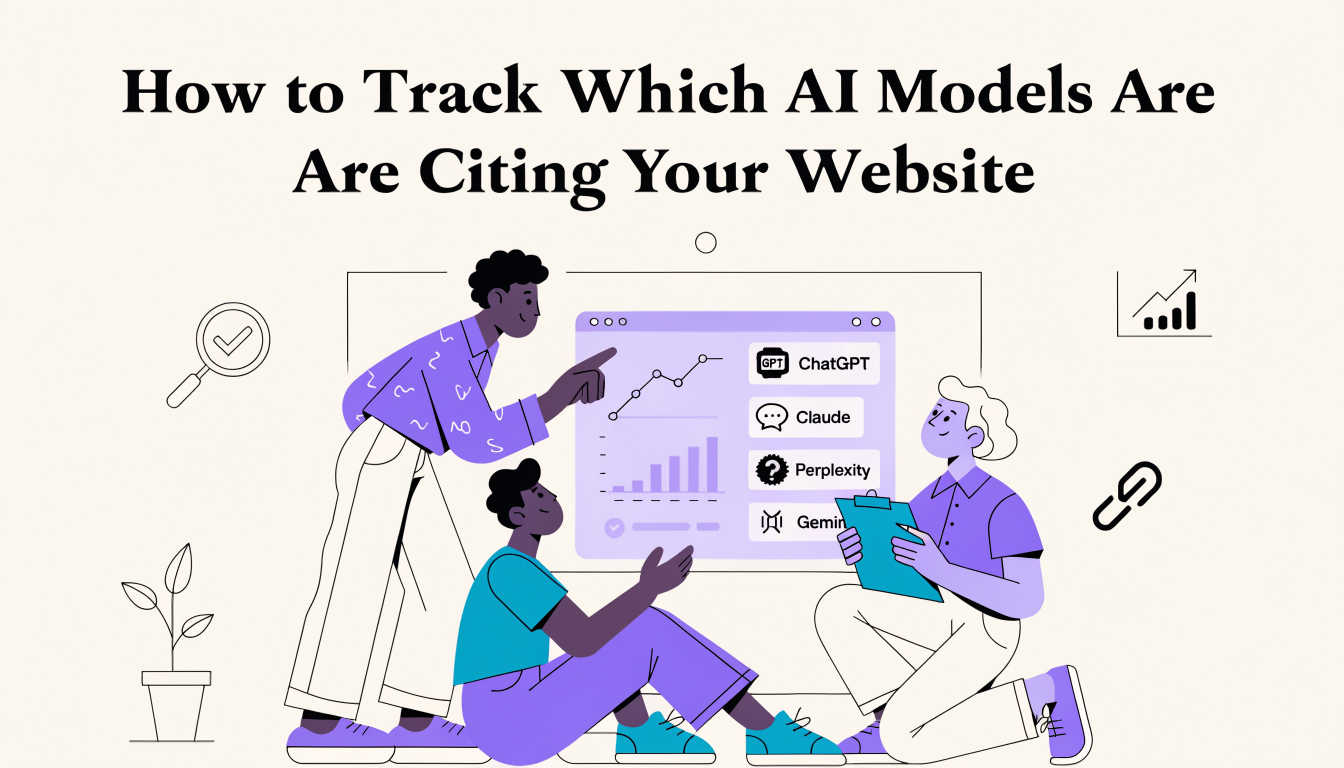
How to Track Which AI Models Are Citing Your Website
Learn how to set up ai search citation analytics across ChatGPT, Perplexity, Claude, and Gemini. Includes tool comparisons, prompt setup, and competitor ga
Enterprise CMS Platforms: What They Are and How to Choose
Compare enterprise CMS platforms by architecture, cost, compliance, and AI features. Learn what separates enterprise-grade tools from standard CMS options.
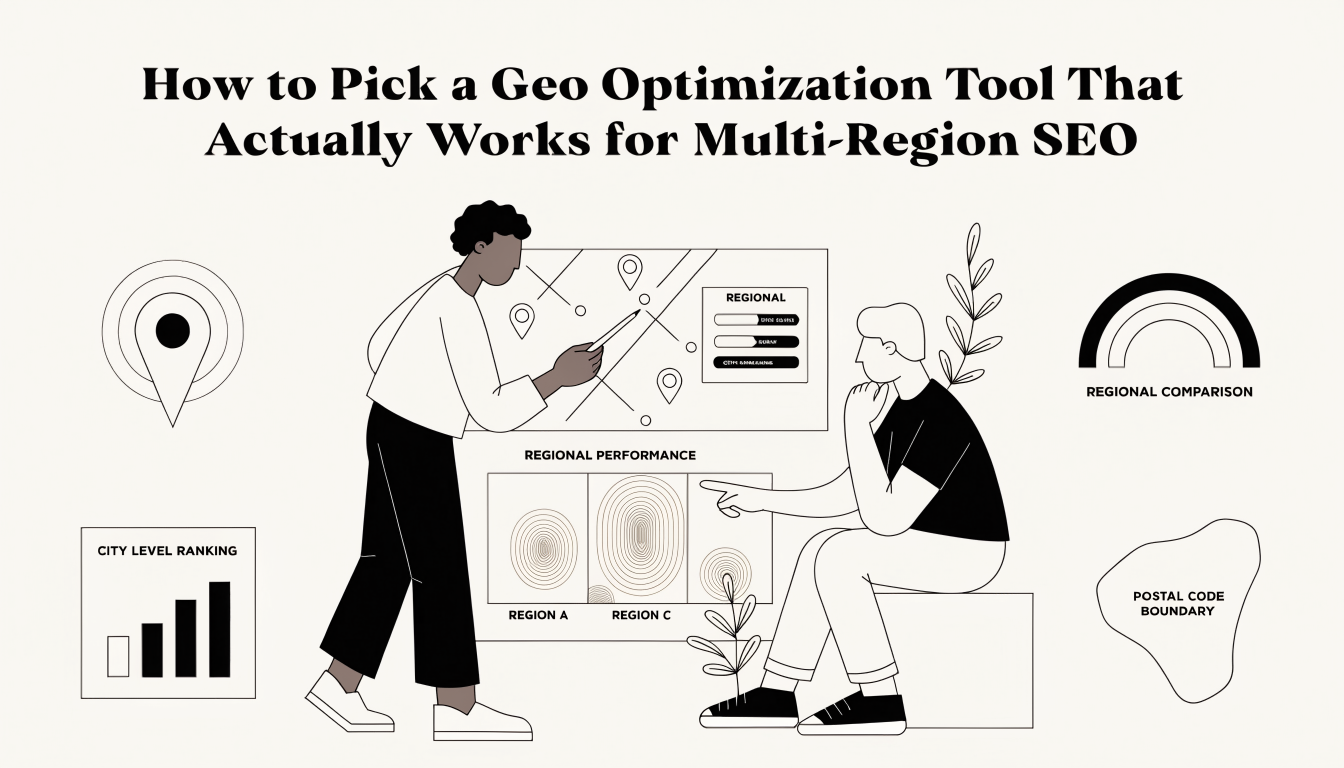
How to Pick a Geo Optimization Tool That Actually Works for Multi-Region SEO
Compare the top geo optimization tools for multi-location SEO. See which platforms track rankings at city level, fix citation gaps, and scale across 100+ l