How to Get Your Ecommerce Store Visible in AI Search Engines
Last updated: 17 November 2026
Ecommerce AI visibility depends on semantic relevance, entity completeness, and structured data markup, not keyword stuffing. When shoppers ask ChatGPT or Perplexity for product recommendations, these engines cite sources they can confidently parse and attribute to real merchants. Stores with thin catalogs, missing schema markup, or incomplete product information rarely appear in AI search results. The ranking factors differ sharply from traditional SEO, requiring a different optimization strategy.
The numbers make the stakes concrete: McKinsey's 2025 AI search analysis estimates AI-powered search could influence $750 billion in ecommerce revenue by 2028, with half of consumers already using it today. Ecommerce AI visibility is no longer a future concern for most store owners. It is already affecting which products get recommended and which get skipped entirely.
This article covers what store owners and ecommerce marketers need to do differently when AI engines, not Google's blue links, become the first point of product discovery. That means structured data, answer-ready product pages, and citation signals. It does not cover paid AI placements or platform-specific ad formats. If you run a product catalog and want to understand why some competitors keep appearing in AI-generated recommendations while your store does not, this is written for you.
Four Things That Move the Needle
Ecommerce stores get cited by AI engines when they combine machine-readable product data, authoritative on-site content, consistent brand mentions across the web, and measurement tools built for AI traffic. Each element reinforces the others. Missing one weakens your overall visibility.
Structured data makes products machine-readable. Product schema (name, price, availability, reviews) gives AI engines a clean signal about what you sell and whether your inventory is current. Without it, a language model has to infer product details from prose, and inference loses to explicit markup every time.
Authoritative content earns AI citations. Omnibound's 2026 AI SEO analysis shows AI Overviews are reshaping click-through rates across organic search, with cited sources pulling disproportionate traffic. Buying guides, comparison pages, and detailed product FAQs give AI engines something quotable. Generic category copy does not.
Citation signals and brand mentions build trust. Reviews, press coverage, and third-party references act as corroboration. AI engines weight sources that appear across multiple independent contexts, not just on your own domain.
Tracking AI-specific traffic requires new tools. Google Search Console does not log ChatGPT referrals. Standard analytics misses Perplexity entirely. You need dedicated AI visibility monitoring to know whether any of this is working.
One trade-off worth naming upfront: structured data and content investment take time to compound. Stores with thin catalogs or limited editorial resources will see slower returns, and there is no shortcut that substitutes for genuine depth on the page.
Why Ecommerce Visibility in AI Search Has Shifted
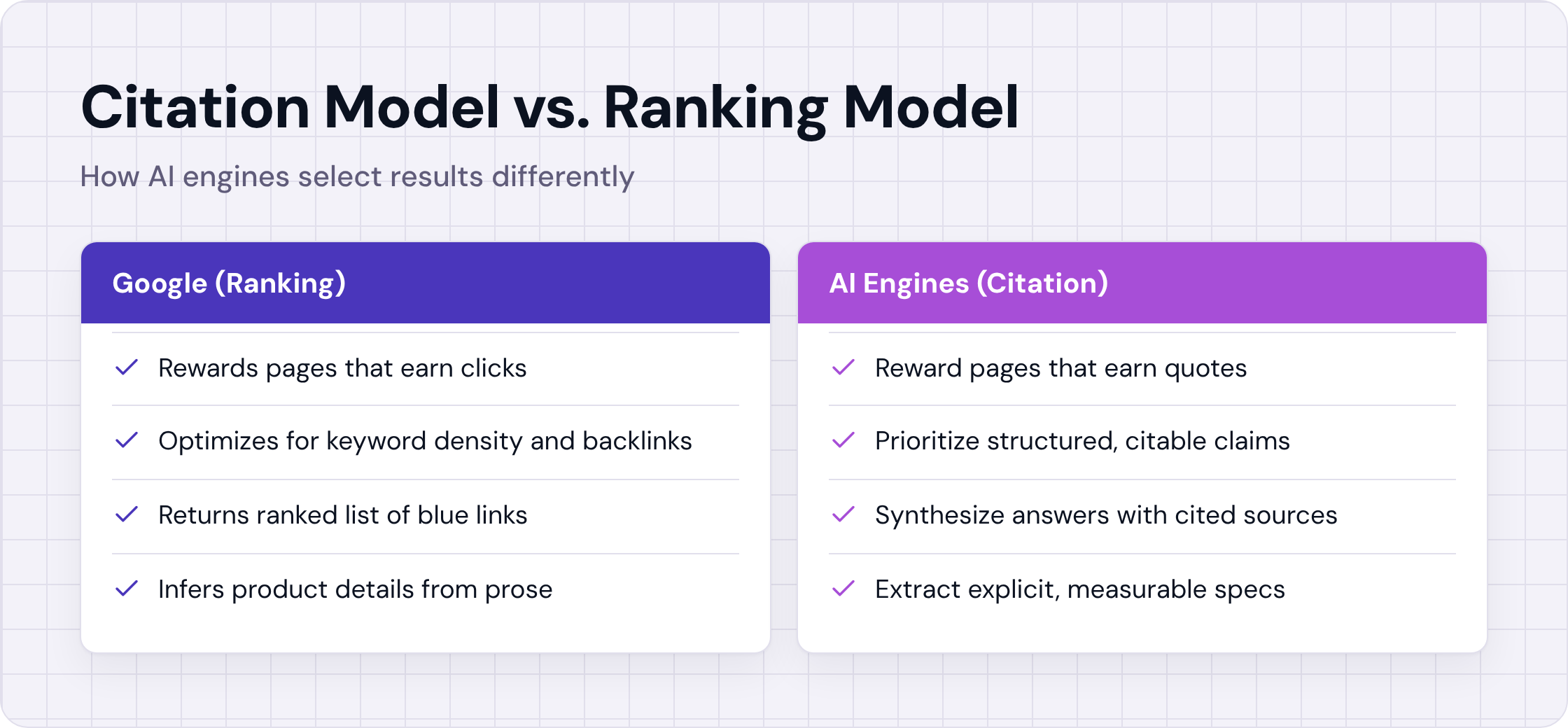
AI answer engines select product results differently from Google because they are not ranking pages, they are constructing answers. When a shopper asks "what's the best standing desk under $500," ChatGPT or Perplexity does not return ten blue links. It synthesizes a response and cites the sources it drew from. That structural difference changes how an ecommerce store needs to present itself online.
The Citation Model vs. the Ranking Model
Google's algorithm rewards pages that earn clicks. AI engines reward pages that earn quotes. A product page optimized for keyword density and backlink volume may rank on page one of Google and still never appear in a Perplexity answer, because Perplexity is looking for structured, citable claims. It wants a page that says "this desk supports up to 355 lbs and ships in two days" rather than a page that says "premium quality you can trust."
Perplexity describes itself as an "answer engine" rather than a search engine, and that framing is operationally accurate. It parses source content for factual density, then surfaces the sources it can quote with confidence. Thin product descriptions, vague brand copy, and pages without structured data rarely make the cut.
The trade-off is real: optimizing for AI citation sometimes pulls in a different direction from conversion-rate optimization. A product page written to be citable needs specific numbers, comparison language, and structured attributes. A page written to convert often leads with emotional hooks and lifestyle imagery. Teams managing both goals will need to find a middle ground, and some will find that AI-optimized pages convert slightly worse on direct traffic even as they gain citation share.
How AI Engines Pick What to Cite
The selection process is not random. AI engines weight sources by a combination of topical authority, content structure, and how directly the page answers the query. Pages with clear schema markup, explicit product specifications, and consistent brand mentions across third-party sources tend to get cited more often. A store that has been reviewed on five independent sites, has structured data on every product page, and publishes comparison content will outperform a store with a higher domain authority but thinner content architecture.
ChatGPT now processes over one billion queries per week, and a growing share of those queries carry commercial intent. That volume means the citation gap between stores that have adapted and stores that have not is compounding quickly.
Which Categories Are Moving Fastest
Adoption is not uniform across ecommerce. The categories seeing the fastest shift to AI-assisted shopping are those where the purchase decision involves comparison and specification: consumer electronics, home office furniture, supplements and wellness products, and software tools. Shoppers in these categories ask detailed questions ("does this monitor support 144Hz at 4K?") that AI engines are well-suited to answer, and they trust a synthesized response more than a sponsored product listing.
Apparel and highly visual categories are moving more slowly. AI engines struggle to replicate the role of imagery in fashion decisions, and fit or aesthetic preference is hard to encode in a citable claim. If your store sells clothing, AI search visibility is still worth pursuing, but the urgency is lower than it is for a store selling ergonomic chairs or protein powder.
Optimizing Product Pages So AI Engines Can Read Them
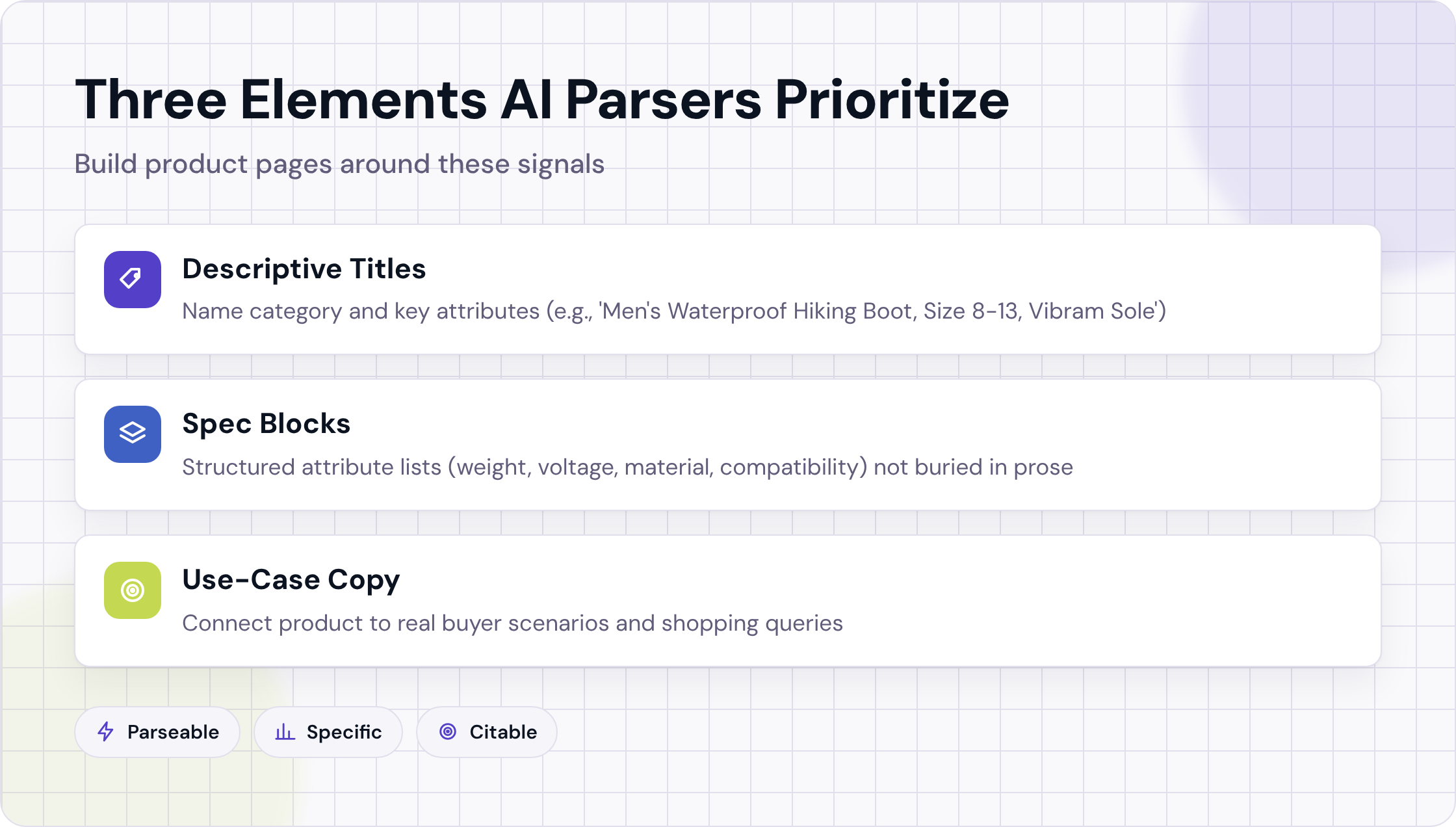
AI engines parse product pages differently from traditional crawlers. They prioritize structured, specific content: descriptive titles that name the product category and key attributes, spec blocks that answer measurable questions (dimensions, materials, compatibility), and use-case copy that connects the product to a real buyer scenario. Pages built around those three elements give AI retrieval systems enough signal to quote your catalog confidently in a response.
What AI Parsers Actually Look For
Start with the title. A title like "Men's Waterproof Hiking Boot, Size 8-13, Vibram Sole" gives an AI parser four parseable facts. "Boot - Style 4421" gives it none. The same logic applies to spec blocks: structured attribute lists (weight, voltage, material grade, compatibility) are far easier for a retrieval model to extract than prose that buries specs inside marketing copy.
Use-case copy matters more than most product teams expect. A retrieval model answering "best hiking boot for wet trails" needs a sentence that explicitly connects your product to that scenario. "Designed for wet-weather trail use, with a sealed seam and drainage port" is citable. "Built for adventure" is not.
Yotpo's AI visibility research for ecommerce projects AI search traffic reaching 40% of total search traffic by 2027, which means product pages that cannot be parsed by AI engines are being written off a growing share of discovery before a buyer ever clicks.
Why Thin Descriptions Fail Even With Good Schema
Schema markup is the entry ticket, not the finish line. A product page can carry complete JSON-LD and still get ignored by AI engines if the underlying text is thin. A 40-word description with no specifics gives a retrieval model nothing to quote. The schema tells the engine what type of content exists. The prose is what actually gets surfaced in a response.
The failure mode is common in large catalogs where descriptions are templated or duplicated across variants. An AI engine encountering 200 near-identical pages for color variants of the same jacket will not cite any of them with confidence. It needs differentiated, specific content to treat a page as authoritative.
The trade-off here is real: writing genuinely specific copy for a catalog of 10,000 SKUs is expensive. Prioritizing by category (start with your top 20% of revenue-generating products) is a more practical approach than trying to rewrite everything at once. This approach also breaks down for commodity products where differentiation is genuinely minimal. In those cases, editorial content like buying guides and comparison pages often carries more AI citation weight than the product page itself.
Page-Level Signals That Build Authority
Beyond content, AI engines read page-level signals to assess whether a source is worth citing. A few that matter:
- Review volume and recency. Pages with recent, specific customer reviews give AI engines third-party corroboration of your product claims. A review that says "held up through three days of rain in the Cascades" is the kind of use-case confirmation a retrieval model can use.
- Internal linking from editorial content. A buying guide that links to your product page transfers topical authority. AI engines treat that editorial context as a signal that your page belongs in a broader knowledge structure, not just a catalog.
- Clear author or brand attribution. Pages that identify who stands behind the content (a brand, a named expert, a manufacturer) score higher on the trust signals AI engines use to filter sources.
Structured product feeds using schema.org and JSON-LD remain the baseline requirement, but the pages that consistently get cited combine that markup with content depth that gives the engine something specific to extract and repeat.
Structured Data, Schema, and Content Strategy: A Step-by-Step Setup
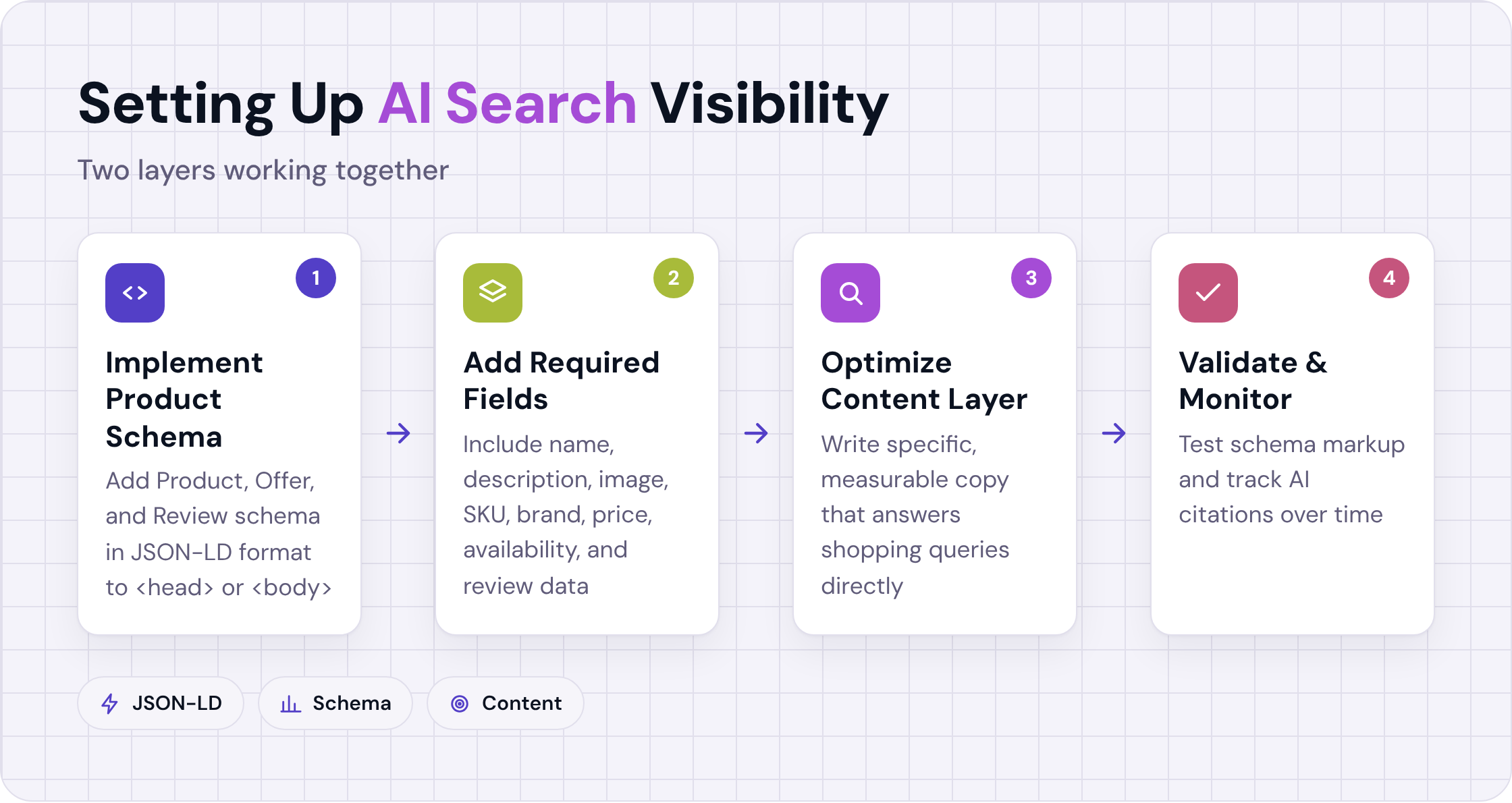
Getting your ecommerce store visible in AI search requires two things working together: machine-readable markup that tells AI retrieval systems exactly what a product page contains, and a content layer that answers the shopping queries those systems are asked to resolve. Implement both correctly and your pages become citable sources, not just indexed URLs. Skip either one and you are competing on luck.
Step 1: Implement Product, Offer, and Review Schema with JSON-LD
Start with the three schema types that matter most for ecommerce: Product, Offer, and Review. JSON-LD is the right format. Drop it in the <head> or at the bottom of the <body> as a <script type="application/ld+json"> block, separate from your HTML content so it survives CMS updates cleanly.
Your Product schema should include name, description, image, sku, and brand. Nest an Offer object inside it with price, priceCurrency, availability, and url. If you have review data, add an aggregateRating with ratingValue and reviewCount. These fields are not optional extras. Google's AI optimization guide lists structured data as a direct signal for generative AI features in Search, and incomplete schema is treated the same as no schema by most retrieval pipelines.
A minimal but complete JSON-LD block for a product page looks like this:
{
  "@context": "https://schema.org/",
  "@type": "Product",
  "name": "Men's Waterproof Hiking Boot",
  "image": "https://example.com/images/hiking-boot.jpg",
  "description": "Waterproof hiking boot with Vibram sole, sealed seams, and drainage port. Sizes 8-13.",
  "sku": "HB-4421",
  "brand": {
    "@type": "Brand",
    "name": "YourBrandName"
  },
  "aggregateRating": {
    "@type": "AggregateRating",
    "ratingValue": "4.7",
    "reviewCount": "312"
  },
  "offers": {
    "@type": "Offer",
    "url": "https://example.com/products/hiking-boot-4421",
    "priceCurrency": "USD",
    "price": "149.00",
    "availability": "https://schema.org/InStock"
  }
}
Validate every implementation with Google's Rich Results Test before pushing to production. Errors in schema syntax are silent failures: the markup exists, but the engine ignores it.
Step 2: Write Answer-Ready Product Copy
Schema tells AI engines what your page is about. Your copy is what they actually quote. For each product page, write at least one sentence that directly answers the most common purchase question for that category. For electronics, that is usually compatibility or performance specs. For apparel, it is fit and material. For supplements, it is dosage and ingredient sourcing.
The sentence structure matters. "Compatible with USB-C and Thunderbolt 4, supports up to 8K output at 60Hz" is extractable. "Works with all your devices" is not. Aim for at least three to five specific, factual claims per product page that a retrieval model could lift verbatim and use in a response.
One practical constraint: if your product descriptions are generated by a supplier feed, you almost certainly need to rewrite them. Supplier copy is written for print catalogs, not AI retrieval. It tends to be vague, repetitive across SKUs, and structured around marketing language rather than measurable attributes.
Step 3: Build an Editorial Content Layer
Product pages alone are rarely enough to establish topical authority with AI engines. You need editorial content that contextualizes your catalog: buying guides, comparison articles, and FAQ pages that answer the broader questions shoppers ask before they reach a product page.
A buying guide for "best standing desks under $500" that links to three products in your catalog does two things. It gives AI engines a citable source for the category-level query, and it passes topical authority to the product pages it references. The guide does not need to be long. It needs to be specific: name the products, give the specs, explain the trade-offs, and link directly to the relevant pages.
FAQ content is particularly effective for ecommerce AI visibility because it mirrors the query format AI engines are built to answer. A page that asks and answers "does this desk fit in a 10x10 office?" is structurally identical to the query a shopper might type into Perplexity. That alignment is not accidental. It is the content strategy.
Step 4: Build Off-Site Citation Signals
AI engines do not rely solely on your own domain to assess authority. They cross-reference. A product that appears in a review on a major tech publication, a Reddit thread with upvoted specifics, and a YouTube video with a linked description is treated as more credible than a product that only appears on its own product page, regardless of how well that page is optimized.
Practical steps to build off-site signals:
- Submit products to review sites and aggregators relevant to your category (Wirecutter, RTINGS, Healthline for supplements, etc.).
- Respond to HARO (now Connectively) and similar journalist query services to earn press mentions with product specifics.
- Encourage customers to post detailed reviews on third-party platforms, not just your own site. A review on Google, Trustpilot, or a category-specific forum carries more citation weight than an on-site review because it is independent corroboration.
- Monitor brand mentions with a tool like Mention or Brand24 to identify unlinked references you can convert to linked citations.
The limitation here is that off-site signals are slow to accumulate and partly outside your control. A store launching a new product line should expect a lag of three to six months before off-site citation signals meaningfully affect AI visibility.
Step 5: Measure AI-Specific Traffic and Citations
Standard web analytics does not capture AI referral traffic accurately. Google Analytics 4 will show some Perplexity traffic under referral sources, but ChatGPT's browsing mode and other AI engines often appear as direct traffic or get misattributed. You need tools built specifically for this.
Options worth evaluating:
- Profound tracks brand and product mentions across AI engines and shows which queries trigger citations.
- Otterly.ai monitors AI search visibility for specific keywords and competitors.
- Semrush's AI Toolkit (launched in 2025) includes AI visibility tracking alongside traditional rank data.
Set up a baseline measurement before you make any changes so you have a comparison point. Track citation frequency (how often your store appears in AI responses for target queries), citation position (whether you are the first or third source cited), and referral traffic from AI engines as a share of total organic traffic. These three metrics together give you a clearer picture of ecommerce AI visibility than any single number.
Frequently Asked Questions
Does Google's AI Overview use the same signals as ChatGPT or Perplexity?
Google's AI Overview draws primarily from pages already indexed in Google Search, weighted by existing ranking signals plus structured data and content quality. ChatGPT and Perplexity use their own retrieval pipelines, which are less dependent on traditional domain authority and more sensitive to content specificity and schema completeness. Optimizing for all three requires overlapping but not identical tactics. Structured data and specific prose help across all of them. Backlink volume matters more for Google's AI Overview than for Perplexity.
How long does it take to see results from AI search optimization?
Schema changes can be picked up within days of a recrawl. Content changes take longer, typically four to eight weeks before AI engines begin citing updated pages with any consistency. Off-site citation signals (reviews, press mentions, third-party references) take the longest, often three to six months to accumulate enough volume to shift visibility. Stores that implement all three layers simultaneously tend to see measurable movement in AI citation frequency within 60 to 90 days.
Do product reviews on my own site help with AI visibility?
On-site reviews contribute to AI visibility, but they carry less weight than reviews on independent platforms. An AI engine treating your own site as the source of both the product claim and the review has less corroboration than one that can cross-reference your product page against a review on a third-party site. On-site reviews still matter for schema (they feed your aggregateRating markup) and for content depth. Prioritize getting reviews on independent platforms first, then use on-site reviews to fill out your schema data.
Should I rewrite all my product descriptions at once?
Rewriting your entire catalog at once is rarely practical and often counterproductive. A better approach is to segment your catalog by revenue contribution and rewrite the top 20% of SKUs first. Those pages drive the most traffic and have the most to gain from improved AI citation. Once you have a template and process that works, you can work through the rest of the catalog systematically. For large catalogs (10,000-plus SKUs), consider using AI-assisted drafting for the initial rewrite, then editing for specificity and accuracy. The goal is factual density, not prose quality.
What is the difference between traditional SEO and AI search optimization for ecommerce?
Traditional SEO for ecommerce focuses on keyword targeting, backlink acquisition, and technical crawlability. AI search optimization focuses on content specificity, schema completeness, and off-site corroboration. The two overlap significantly (a well-structured, authoritative page tends to perform in both contexts) but diverge on a few key points. AI engines are less sensitive to exact-match keyword placement and more sensitive to whether a page contains extractable, factual claims. A page that ranks well on Google because of its backlink profile may still be invisible in AI-generated responses if its content is vague or its schema is incomplete.
If you want a clearer picture of where your store stands on ecommerce AI visibility and what to fix first, see how Seorav can help. The GEO audit covers schema gaps, content specificity, and off-site citation signals across the AI engines your buyers are already using.
Keep reading
Enterprise CMS Platforms: What They Are and How to Choose
Compare enterprise CMS platforms by architecture, cost, compliance, and AI features. Learn what separates enterprise-grade tools from standard CMS options.
How to Pick a Geo Optimization Tool That Actually Works for Multi-Region SEO
Compare the top geo optimization tools for multi-location SEO. See which platforms track rankings at city level, fix citation gaps, and scale across 100+ l
Citation Measurement Tools: Tracking Your Content in AI Answers
Compare the most effective tools for measuring citation data in AI search results. See which platforms track GPT-4o, Gemini, Perplexity, and Claude, and ho