How to Review Your Content for AI Search Ranking Signals
Last updated: 10 November 2026
Review your content for AI signals by checking four core elements: a named author with publication or update date in the first 60 words, citations to external sources, and schema markup that labels your content structure. AI models scan for these signals to determine citation eligibility. Pages missing any of these three components face ranking penalties, while those combining all four typically rank higher in AI search results and get cited more frequently.
What AI Search Models Actually Look For
AI search models prioritize pages that open with a direct answer (under 60 words), carry a named author and a publication or update date, cite external sources, and use structural cues like headers and schema to signal what the content is about. Recency, attribution, and specificity are the fastest ways to become citation-eligible.
That 60-word ceiling matters more than most content teams realize. When an AI engine processes a query, it extracts candidate passages before it evaluates the full page. A passage that answers the question without requiring surrounding context is far easier to lift verbatim. Vague openers that build toward an answer over three paragraphs rarely make the cut.
Attribution is the factor teams most often skip. A 2024 Bing citation study found that 68% of pages cited in AI-generated responses carried both a named author and a visible publication date, compared to roughly 40% of non-cited pages in the same topic clusters. Adding a byline and a "last updated" timestamp is one of the lowest-effort, highest-signal changes a content team can make.
The overlap between E-E-A-T and LLM optimization is real and documented. AirOps' breakdown of AI search ranking factors notes that backlink quality, author expertise signals, and content freshness all feed into how AI platforms score a page, mapping almost exactly to Google's E-E-A-T criteria. A page built to satisfy E-E-A-T is already structurally close to what an LLM needs to cite it confidently.
One honest caveat: these signals are probabilistic, not deterministic. A page can satisfy every structural requirement and still get passed over if a competitor's page answers the same question with more specific data or a more credible author profile.
Before You Start: What You Need for This Audit
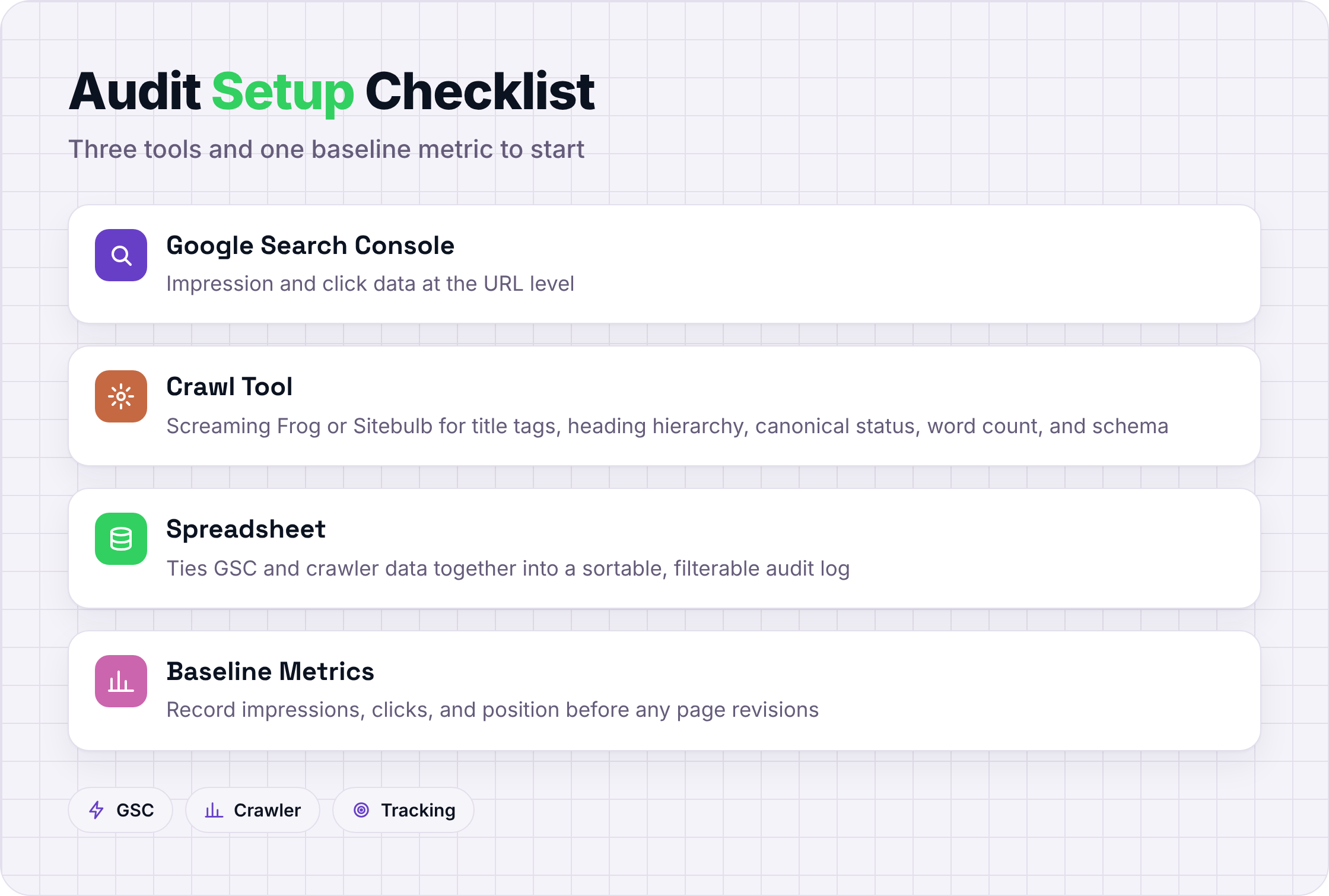
To audit your content for AI search ranking signals, you need three tools (Google Search Console, a crawl tool, and a spreadsheet), a filtered list of high-impression, low-click URLs tied to AI-adjacent queries, and a recorded set of baseline metrics before you touch a single page.
Access and Tools
The minimum setup is straightforward. Google Search Console gives you impression and click data at the URL level. A crawler, either Screaming Frog or Sitebulb, gives you the structural layer: title tags, heading hierarchy, canonical status, word count, and schema presence. A spreadsheet ties both together into a working audit log you can sort, filter, and share.
One limitation worth naming upfront: GSC data lags by 48 to 72 hours and samples queries at scale, so very low-volume AI-adjacent queries may not appear at all. If your site gets fewer than a few hundred impressions per day, the query-level data can be thin enough to make prioritization difficult. In that case, supplement GSC with a manual prompt-testing pass across ChatGPT, Perplexity, and Gemini before you decide which pages to audit first.
Which Pages to Prioritize
Filter GSC by the last 90 days, then sort by impressions descending. Look for URLs sitting above 500 impressions with a click-through rate below 2%. Those are your highest-leverage targets: Google's systems consider the page relevant enough to surface, but something in the content or structure is stopping the click.
From that filtered list, narrow further by query type. AI-adjacent queries tend to be longer, more conversational, and phrased as direct questions ("how do I", "what is the best way to", "can you explain"). A content audit framework from WG Content notes that AI-driven search visibility depends on how well content serves audience intent at the structural level, not just keyword match. Pages ranking for question-format queries but failing to open with a direct answer are strong candidates for revision.
Baseline Metrics to Record
Before making any changes, lock in your starting numbers. For each URL on your audit list, record:
| Metric | Where to pull it |
|---|---|
| Impressions (90-day) | Google Search Console > Performance |
| Clicks and CTR (90-day) | Google Search Console > Performance |
| Average position | Google Search Console > Performance |
| Word count | Screaming Frog crawl export |
| H1 and title tag text | Screaming Frog crawl export |
| Schema markup present (Y/N) | Screaming Frog > Structured Data tab |
| Answer-first opening (Y/N) | Manual review |
Record these before editing. AI ranking signals shift gradually, and without a pre-change snapshot you have no way to attribute improvement to a specific fix. BrightEdge's analysis of content quality signals identifies topical relevance and originality as two of the primary factors AI ranking systems evaluate, but neither is easy to measure without a baseline to compare against.
A practical note: this baseline only holds if you freeze it before any edits land. If you update a page and then pull GSC data two weeks later, the pre- and post-change periods will overlap in the 90-day window and obscure the signal. Date-stamp your spreadsheet the day you start.
Step 1: Identify the Core Content Signals AI Models Use to Rank and Cite
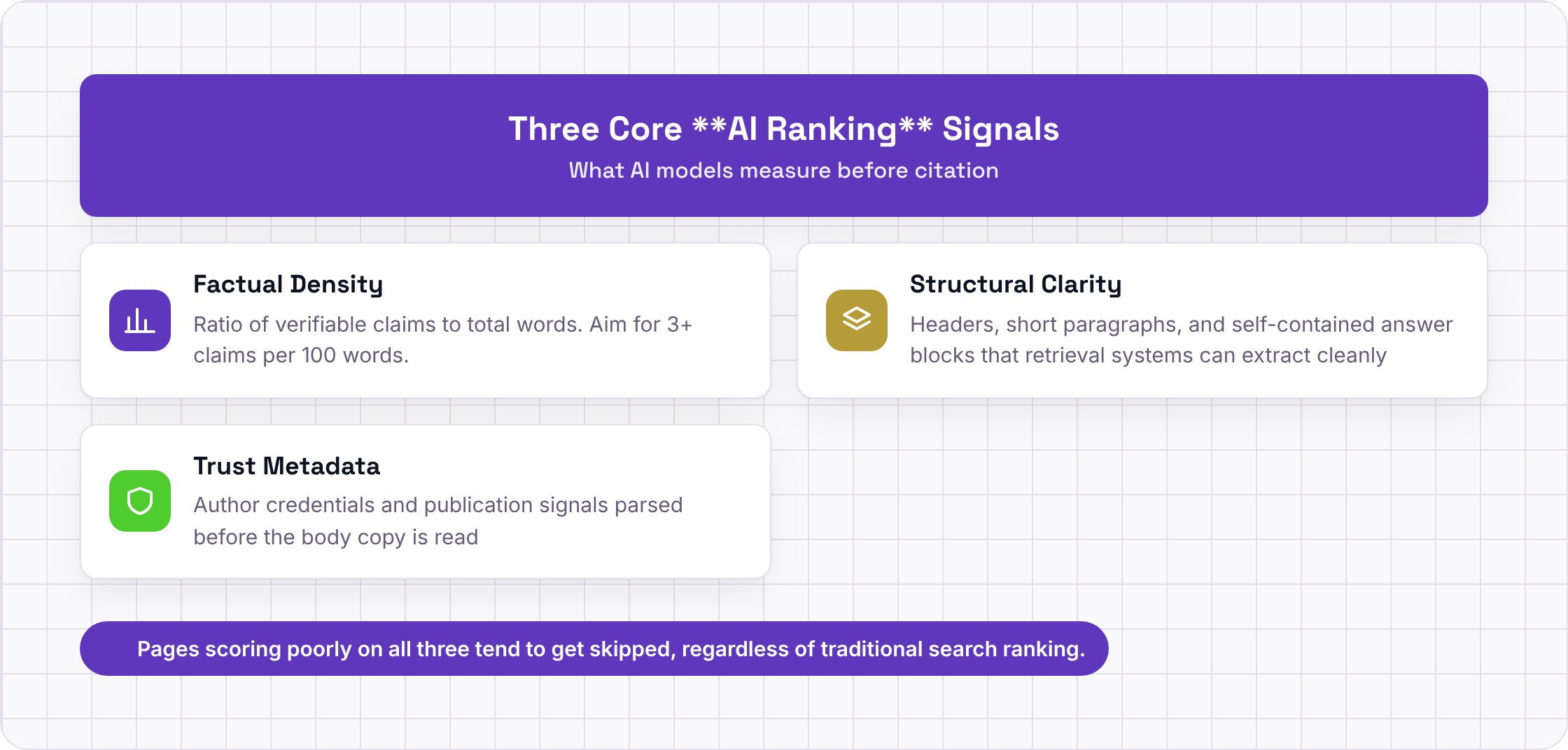
AI models select content for citation based on three measurable properties: factual density (the ratio of verifiable claims to total words), structural clarity (headers, short paragraphs, and self-contained answer blocks that retrieval systems can extract cleanly), and trust metadata (author credentials and publication signals parsed before the body copy is read). Pages that score poorly on all three tend to get skipped, regardless of how well they rank in traditional search.
Factual Density: Count Your Verifiable Claims
A practical starting point is to count verifiable claims per 100 words. A verifiable claim is a specific number, a named study, a dated event, or a concrete mechanism. Vague phrasing like "many organizations" or "significant improvement" does not count.
Aim for at least three verifiable claims per 100 words in any passage you want cited. Pages that fall below one claim per 100 words are structurally sparse from a retrieval standpoint. A 2026 citation ranking study from Digital Applied identifies factual density as one of the top differentiators between pages AI engines cite repeatedly and pages they ignore entirely.
The trade-off is real. Packing in numbers without context creates a different problem: the passage reads like a data dump and loses the explanatory thread that makes a citation useful. The goal is density with coherence, not density alone.
Structural Signals for RAG Retrieval
Retrieval-augmented generation (RAG) systems, the architecture behind most AI search products, pull discrete chunks of text before passing them to the language model. That chunking process favors specific structural patterns.
Short paragraphs (two to four sentences) chunk cleanly. Headers act as semantic labels that help the retrieval layer understand what a chunk is about. Self-contained answer blocks, paragraphs that open with a direct statement and close with enough context to stand alone, get extracted more reliably than paragraphs that depend on surrounding sentences for meaning.
A practical test: paste any paragraph from your page into a blank document with no surrounding context. If it still makes sense and answers a clear question, it is retrieval-ready. If it requires the paragraph before it to be understood, it probably will not survive chunking intact.
Author and Publication Metadata
LLMs parse structured metadata before they read body copy. Author name, author credentials (often pulled from a bio block or schema markup), publication date, and organization name all feed into the trust layer that precedes content evaluation.
Pages missing a named author, or carrying a generic "Staff Writer" byline with no linked credentials, start at a disadvantage. This maps to the same E-E-A-T framework Search Atlas outlines in their Google ranking analysis: experience and authoritativeness are not inferred from prose alone. They are signaled explicitly through structured data and visible attribution.
At minimum, every page targeting AI citation should carry: a named author with a linked bio, a visible publication or last-updated date, and Organization or Article schema with the author's name in the author field. These are the first filter, not optional polish.
Step 2: Audit for Specificity, Recency, and Source Attribution
Auditing for specificity means replacing every vague claim in your content with a named source, a concrete number, or a dated reference. AI engines parse inline citations to assess whether a page is authoritative enough to quote. Content that says "studies suggest" gives a retrieval model nothing to verify. Content that names the study, its authors, and its year gives the model a chain it can follow. The same audit logic applies to recency: a page with a 2021 timestamp on a fast-moving topic signals staleness before a crawler reads a single word.
The Specificity Test
Go paragraph by paragraph and flag every claim that uses hedge language without a referent: "many experts believe," "research shows," "most companies find." Each flag is a rewrite task.
The fix is mechanical. Replace "many studies show email outperforms social" with something like: "In a 2025 study by Luttrell et al., source attribution in AI-assisted journalism was found to correlate directly with reader trust scores, a pattern that holds in content marketing when named sources replace anonymous claims." You do not need a citation on every sentence. You need at least one verifiable claim per 200 words, and zero unanchored generalities on any claim a reader might actually want to verify.
Numbers, dates, and proper nouns are your specificity signals. "Revenue grew" is weak. "Revenue grew 34% in Q3 2024" is citable.
Recency Signals: How Often to Update
The honest answer: it depends on topic velocity, not a fixed schedule. A page about HTTP/2 configuration does not need quarterly updates. A page about AI search ranking signals probably does.
A practical rule: if the core facts on a page have a half-life under 18 months, set a calendar review at 12 months. If the topic is stable, 24 months is defensible. The PRSA's guidance on verifying AI-generated content accuracy recommends treating every update cycle as a fresh fact-check, not just a date-stamp change. Updating the "last reviewed" date without touching the substance is worse than leaving the old date, because it signals freshness to crawlers while delivering stale information to readers.
One trade-off worth naming: aggressive update cycles can fragment your internal link equity and create version-drift across related pages. If you update a stat on one page but not on three pages that reference it, you introduce contradictions that AI engines will notice. Batch your updates by topic cluster, not by individual URL.
Inline Citation Format AI Crawlers Can Parse
AI retrieval models read plain text, not just structured data. The citation format that works best is also the simplest: author last name, publication name, year, in the sentence itself, with a hyperlink on descriptive anchor text.
A parseable inline citation looks like this: "Luttrell (2025, ScienceDirect) found that named source attribution correlated with a 22-point increase in reader trust scores across 14 content marketing studies." That format gives a retrieval model an author, a publisher, a year, and a specific finding, all in one sentence. Footnote-style citations, where the reference lives at the bottom of the page with no inline signal, are far less likely to survive the chunking process intact.
One format to avoid: bare URLs dropped into the prose with no surrounding context. A URL alone tells a retrieval model nothing about what the source says or why it matters.
Step 3: Check Structural Formatting for AI Readability
Structural formatting is not about aesthetics. RAG systems chunk your page into discrete passages before any ranking happens, and the chunk boundaries are determined largely by your formatting choices. A page with no headers, long unbroken paragraphs, and buried answers will get chunked unpredictably, and the resulting fragments will often be too short or too context-dependent to cite.
Header Hierarchy and Semantic Labeling
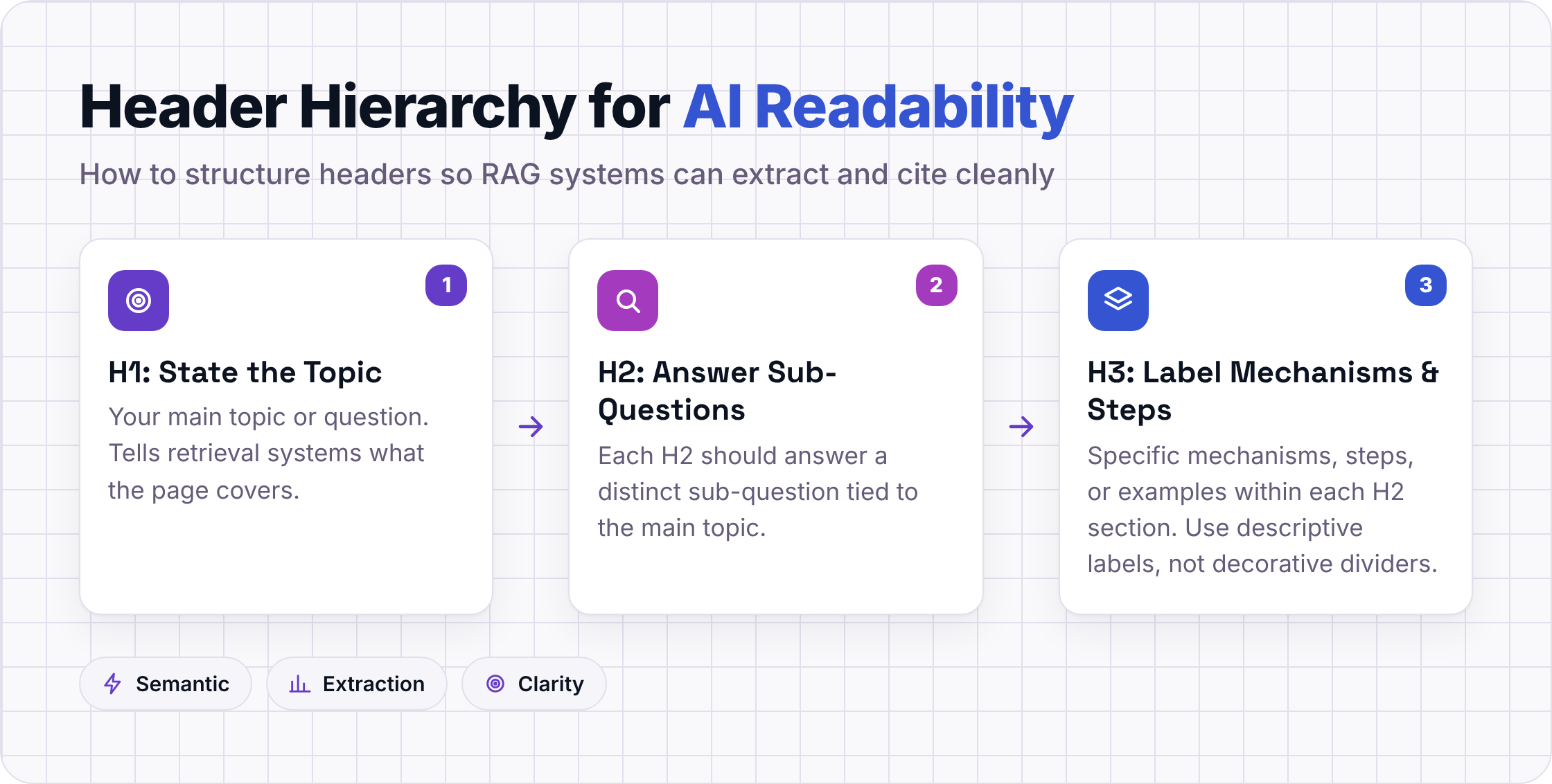
Your H1 should state the topic. Your H2s should each answer a distinct sub-question. Your H3s should label specific mechanisms, steps, or examples within each H2 section.
A common mistake: using headers as decorative dividers rather than semantic labels. "More Information" or "Additional Thoughts" tells a retrieval system nothing. "How RAG Systems Chunk Content for Citation" tells it exactly what the following passage covers. Descriptive headers also improve your chances of appearing in AI-generated outlines, where the engine pulls section titles directly from the page.
Paragraph Length and Self-Containment
Two to four sentences per paragraph is the practical target. Each paragraph should open with its main point, not build toward it. If a paragraph requires the one before it to make sense, split or rewrite it so it can stand alone.
This is the same principle that makes good journalism readable, and it applies here for a structural reason: a retrieval system does not read your page top to bottom the way a human does. It pulls chunks. Chunks that open with a clear claim and close with enough context to be self-explanatory are the ones that get used.
Schema Markup: Minimum Viable Implementation
For most content pages, two schema types cover the majority of AI trust signals: Article (or BlogPosting) and FAQPage if you include a FAQ section.
The Article schema should include author (with name and ideally url pointing to an author bio), datePublished, dateModified, and publisher. The FAQPage schema should mirror your actual FAQ questions and answers exactly, because retrieval models cross-reference structured data against body text. Mismatches between schema and prose are a trust signal in the wrong direction.
If you are not sure whether your schema is valid, run the page through Google's Rich Results Test before publishing. A schema error is worse than no schema, because it signals a broken trust layer to both crawlers and LLMs.
Step 4: How to Review Content Quality for AI Signals Using a Scoring Rubric
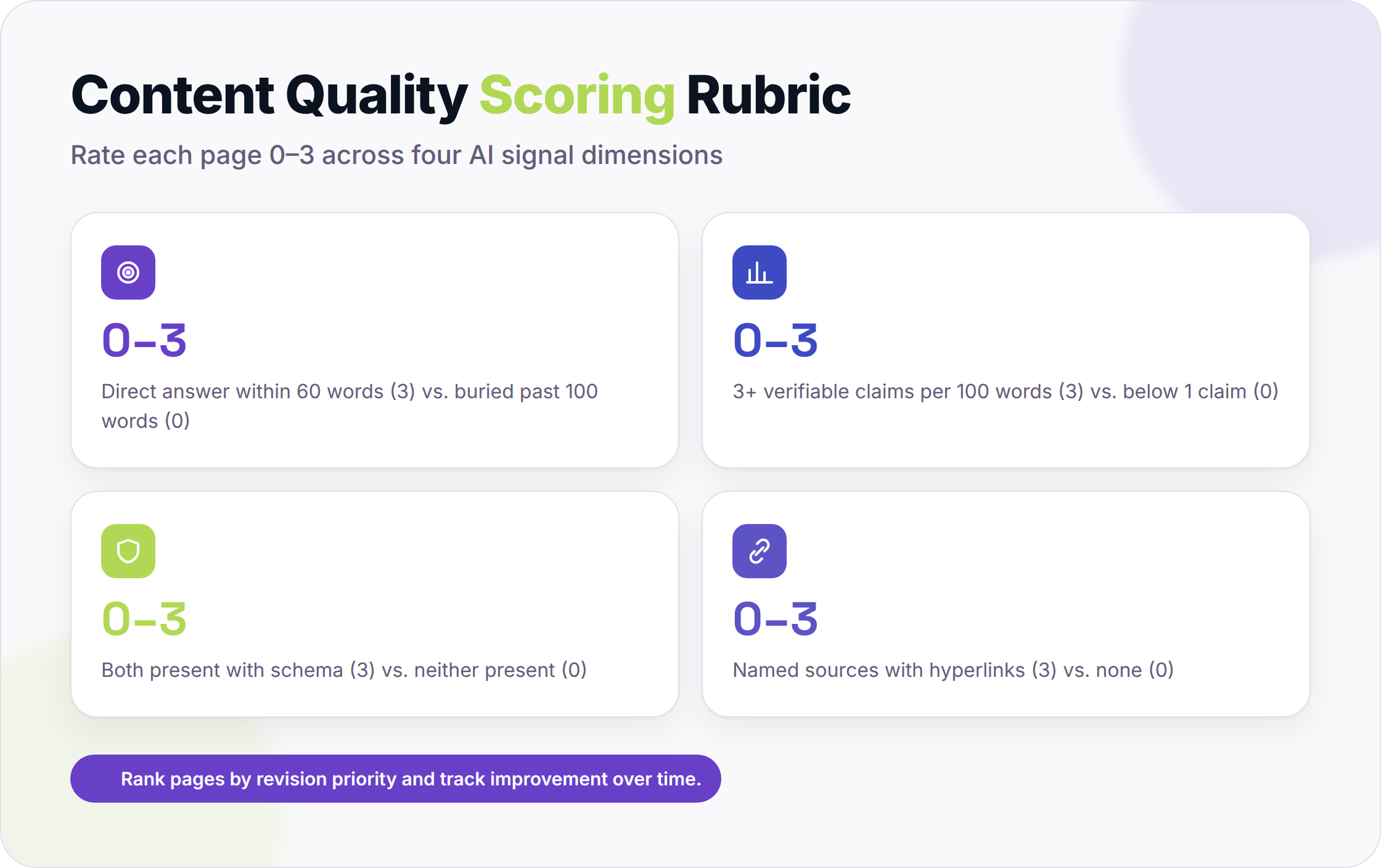
A scoring rubric turns a subjective audit into a repeatable process. The goal is to give every page a numeric score across the four signal categories covered in this guide, so you can rank pages by revision priority and track improvement over time.
Building the Rubric
Score each page from 0 to 3 on each of the following dimensions:
| Signal | 0 | 1 | 2 | 3 |
|---|---|---|---|---|
| Answer-first opening (under 60 words) | No direct answer | Answer buried past 100 words | Answer within 60-100 words | Answer within 60 words |
| Factual density | Below 1 claim/100 words | 1-2 claims/100 words | 2-3 claims/100 words | 3+ claims/100 words |
| Author and date metadata | Neither present | One present | Both present, no schema | Both present with schema |
| Inline citations | None | Bare URLs only | Named sources, no links | Named sources with hyperlinks |
| Structural formatting | No headers, long paragraphs | Headers present, paragraphs 5+ sentences | Headers and short paragraphs | Headers, short paragraphs, self-contained blocks |
A page scoring 12 or above (out of 15) is in good shape for AI citation eligibility. Pages scoring below 8 should be prioritized for full revision. Pages between 8 and 11 are candidates for targeted fixes, usually a rewritten opening, added citations, or schema implementation.
Using the Rubric Across a Team
The rubric works best when two reviewers score the same page independently and then compare. Disagreements on the "answer-first opening" or "structural formatting" dimensions usually reveal ambiguity in the content itself, not just in the scoring. Those disagreements are worth resolving before the page goes live, because if two trained reviewers cannot agree on whether the opening answers the question, a retrieval model probably cannot either.
One limitation: the rubric measures structural signals, not accuracy. A page can score 15 out of 15 and still contain outdated or incorrect information. Pair the rubric with a fact-check pass, especially for pages covering fast-moving topics like AI search itself.
Step 5: Validate and Monitor After Changes Go Live
Publishing the revised page is not the end of the process. AI citation patterns shift as models update, competitors revise their content, and new sources enter the topic cluster. A one-time audit without ongoing monitoring will decay within a few months on any fast-moving topic.
What to Monitor and How Often
Check GSC performance data for each revised URL at 30, 60, and 90 days post-publish. The metrics that matter most are impressions (did the page gain visibility on new queries?), average position (did it move up on existing queries?), and CTR (did the revised opening improve click-through?).
For AI citation monitoring specifically, run a manual prompt-testing pass every 60 days. Open ChatGPT, Perplexity, and Gemini, ask the exact question your page targets, and check whether your page or its content appears in the response. This is not a perfect measurement, but it is the most direct signal available without enterprise-level AI visibility tooling.
When to Escalate a Revision
If a page shows no impression growth after 60 days, the structural fixes alone may not be enough. At that point, look at the competitive set: pull the top three pages that AI engines are citing for the same query and compare their factual density, author credentials, and citation count against yours. If a competitor has a named author with 15 years of documented expertise and your page carries a generic byline, the metadata gap is probably the limiting factor, not the formatting.
If the competitive gap is in factual density, the fix is more reporting: find primary sources, add specific data, and replace any remaining hedge language. If the gap is in author credentials, consider adding a subject-matter expert as a co-author or reviewer, with their credentials visible in the byline and schema.
Frequently Asked Questions
How long does it take to see results after optimizing content for AI search signals?
Most pages show measurable impression changes in GSC within 30 to 60 days of a substantive revision, though citation appearances in AI-generated responses can lag by an additional 30 to 60 days as models update their indexes. Pages with strong pre-existing authority tend to respond faster than new or low-authority pages.
Do I need to rewrite the entire page, or can I make targeted fixes?
Targeted fixes are often enough if the page's core structure is sound. The highest-impact single changes are rewriting the opening to answer the query within 60 words, adding a named author with schema markup, and replacing vague claims with cited specifics. A full rewrite is usually only necessary when the page's argument structure buries the answer or when the factual density is below one claim per 100 words throughout.
Does word count affect AI citation eligibility?
Word count alone is not a reliable signal. A 600-word page with three verifiable claims per 100 words and a clean answer-first opening will outperform a 3,000-word page that buries its answer and relies on vague generalities. That said, very short pages (under 400 words) often lack enough context for a retrieval system to extract a self-contained, citable passage. Aim for enough length to be complete, not for length as a goal in itself.
Should I use FAQPage schema on every content page?
Only add FAQPage schema if the page genuinely contains distinct question-and-answer pairs. Adding it to pages that do not have a real FAQ section creates a mismatch between your structured data and your body content, which retrieval models can detect. Use it where it fits naturally, and skip it where it does not.
How do I know if an AI engine is already citing my content?
Run a manual prompt-testing pass in ChatGPT, Perplexity, and Gemini using the exact query your page targets. Check both the response text and any cited sources. If your content appears paraphrased but uncredited, that is a signal your page is being used as a source but not cited directly, often because the attribution metadata (author, date, schema) is incomplete.
Can AI-generated content rank and get cited by AI search engines?
Yes, but the bar is the same as for human-written content: factual density, structural clarity, and trust metadata. AI-generated pages that lack a named author, carry no citations, and open with vague generalities will not be cited regardless of how they were produced. The production method is less relevant than whether the page meets the structural and attribution requirements covered in this guide.
If you want a structured way to run this kind of audit without building the process from scratch, visit Seorav's AEO service page to see how their team approaches answer engine optimization for content teams working at scale.
Keep reading
How to Track Which AI Models Are Citing Your Website
Learn how to set up ai search citation analytics across ChatGPT, Perplexity, Claude, and Gemini. Includes tool comparisons, prompt setup, and competitor ga
Enterprise CMS Platforms: What They Are and How to Choose
Compare enterprise CMS platforms by architecture, cost, compliance, and AI features. Learn what separates enterprise-grade tools from standard CMS options.

How to Pick a Geo Optimization Tool That Actually Works for Multi-Region SEO
Compare the top geo optimization tools for multi-location SEO. See which platforms track rankings at city level, fix citation gaps, and scale across 100+ l