How to rank your SaaS product in AI search engines
Last updated: 23 July 2026
How to rank your SaaS product in AI search engines comes down to one principle: become the most citable, structured, and contextually relevant source in your category. AI search engines — ChatGPT, Perplexity, Google AI Overviews, and Gemini — pull answers from sources they trust, and trust is built through signal density, not volume.
Why AI Search Is a Different Game for SaaS
Traditional SEO rewards pages that rank for high-volume keywords. AI search rewards sources that get quoted. When a user asks Perplexity "What's the best project management tool for remote teams?", the engine synthesises an answer from three to five sources it considers authoritative. Your SaaS product either appears in that synthesis or it doesn't.
For SaaS companies specifically, this shift matters because buying decisions increasingly start with a conversational query, not a keyword search. A 2024 study by SparkToro found that zero-click searches — where users get answers without visiting a site — had risen to over 58% of all Google searches. AI Overviews accelerate that trend. If your product isn't cited in the answer, you're invisible at the most important moment in the funnel.
The opportunity is real: established SaaS brands with legacy SEO strategies often have thin, keyword-stuffed content that AI engines actively deprioritise. Newer, more specific content can outrank them.
Build a Topical Authority Cluster Around Your Category
AI engines don't just evaluate a single page — they evaluate whether your domain owns a topic. If you build a CRM for freelancers, you need to own the full semantic neighbourhood: client invoicing, contract management, follow-up sequences, freelance cash flow. Not just one blog post, but a cluster of deeply specific, interlinked content.
How to structure the cluster
- Pillar page — a 2,000+ word definitive guide to your core category (e.g., "CRM for freelancers: a complete guide").
- Spoke pages — 800–1,200 word articles on each sub-problem your product solves.
- Comparison pages — honest, specific comparisons against named alternatives. AI engines frequently pull from comparison content when answering "what's the best X for Y" queries.
A concrete example: a SaaS tool for legal billing that publishes a comparison page titled "Clio vs. MyCase vs. [Your Product]: Legal Billing in 2024" with a real feature table will appear in AI-synthesised answers far more often than a generic "why choose us" page.
Optimise for AI Overview Appearance
Google's AI Overviews pull from pages that already rank in the top 10, but they favour specific content formats. According to Google's own Search Central documentation, structured answers — short paragraphs that directly answer a question, followed by supporting detail — are more likely to be extracted.
Practical steps:
- Answer the question in the first sentence of each section. Don't build to the answer; lead with it.
- Use FAQ schema markup. Pages with FAQ structured data give AI systems a pre-formatted extraction target. Implement
FAQPageJSON-LD on any page that answers common buyer questions. - Keep paragraphs under 80 words. Long paragraphs get truncated or skipped in AI synthesis.
- Include specific numbers. Claims like "reduces onboarding time by 40%" are more citable than "saves time."
Get Cited in Third-Party Content
AI engines weight external citations heavily. If 15 independent review articles, forum threads, and industry guides mention your product by name in context — not just in a list — your product becomes part of the AI's associative model for your category.
To build this citation footprint:
- Publish original data. A survey of 200 customers, a benchmark report, a dataset — these get linked and cited organically. Perplexity in particular surfaces original research frequently.
- Get listed on G2, Capterra, and Product Hunt with detailed, keyword-rich descriptions. These platforms are in the training data and citation pools of most major AI engines.
- Pursue editorial mentions in newsletters and publications your buyers read. A mention in a Substack with 10,000 subscribers in your niche is worth more than a generic press release.
The Reddit thread on ranking SaaS in AI search makes this point clearly: established competitors often have weak citation diversity because they relied on domain authority alone. That's the gap newer SaaS products can exploit.
Use Structured Data Across Your Entire Site
Structured data is the clearest signal you can send to an AI engine about what your product is and who it's for. Most SaaS sites implement basic Organization schema and stop there. That's not enough.
Implement these schema types:
| Schema Type | Where to Use | What It Signals |
|---|---|---|
SoftwareApplication | Product page | Category, pricing, platform |
FAQPage | Feature and comparison pages | Extractable Q&A pairs |
HowTo | Tutorial and onboarding content | Step-by-step authority |
Review / AggregateRating | Pricing or landing pages | Social proof and trust |
BreadcrumbList | All pages | Site structure and topic hierarchy |
Validate your markup with Google's Rich Results Test after every deployment. Broken schema is worse than no schema — it signals poor technical hygiene.
Optimise Your Product's Presence on AI-Native Platforms
Beyond your own site, AI search engines pull from specific data sources. Perplexity, for instance, heavily indexes Reddit, Quora, and niche forums. ChatGPT's browsing mode and plugins pull from curated sources.
Actionable moves:
- Participate authentically in Reddit communities relevant to your category. Answers that solve real problems — not promotional posts — get upvoted and indexed. A detailed answer to a question about your product's use case in r/SaaS or a niche subreddit can surface in Perplexity results for months.
- Maintain a public changelog or release notes page. AI engines that index fresh content treat changelogs as freshness signals. Update it at least monthly.
- Submit your product to AI-specific directories as they emerge. The landscape is moving fast, but tools like Futurepedia and There's An AI For That are already indexed by major AI engines.
Measure What Actually Matters
Most SaaS teams track organic traffic and keyword rankings. Those metrics don't capture AI search performance. Add these to your measurement stack:
- Brand mention monitoring — use a tool like Mention or Brand24 to track how often your product name appears in online conversations. Rising mention volume correlates with AI citation frequency.
- AI Overview appearance rate — manually query your 20 most important category keywords in Google and record whether your site appears in the AI Overview. Track this weekly.
- Referral traffic from AI-adjacent sources — Perplexity, You.com, and similar engines do send referral traffic. Segment it in Google Analytics 4 under Traffic Acquisition.
- Share of voice in comparison content — count how many third-party comparison articles include your product. Aim to increase this number by 20% each quarter.
Common failure modes
The most frequent mistake is treating AI search optimisation as a content volume play. Publishing 50 thin articles does less than publishing five deeply specific ones. A second failure mode is ignoring technical hygiene: slow page speed, broken structured data, and poor mobile experience all reduce the probability of AI extraction, regardless of content quality. Finally, many SaaS teams optimise for their own product name but neglect the category and problem-level queries where AI search does its heaviest lifting.
Your First 30 Days: A Realistic Action Plan
Week one: audit your top 10 landing pages for structured data gaps and add SoftwareApplication and FAQPage schema. Week two: identify the five most common questions your buyers ask before purchasing and publish a dedicated, answer-first page for each. Week three: reach out to three industry newsletters or blogs for editorial mentions, and update your G2 and Capterra profiles with specific, keyword-rich descriptions. Week four: set up weekly manual tracking of your 20 priority queries in Google to monitor AI Overview appearances, and create a baseline brand mention report.
This is a 90-day compounding strategy, not a one-week fix. The teams that move first on structured citation-building will hold positions that are genuinely hard to displace — because AI engines, once they associate a source with a topic, update that association slowly.
See how seorav.com can help you build a structured AI search strategy tailored to your SaaS category, from citation audits to structured data implementation. The first step is understanding exactly where your product currently stands in AI-generated answers.
Frequently Asked Questions
How is ranking in AI search engines different from traditional SEO for SaaS?
Traditional SEO optimises pages to rank for specific keywords in a list of blue links. AI search engines synthesise answers from multiple sources, so the goal shifts from ranking to being cited. For SaaS products, this means structured content, strong third-party mentions, and schema markup matter more than keyword density or backlink volume alone.
Which AI search engines should SaaS companies prioritise?
Google AI Overviews reach the largest audience because they appear inside standard Google search results. Perplexity is the second priority — it has a fast-growing user base among technical and professional buyers, exactly the demographic most SaaS products target. ChatGPT's browsing mode and Gemini round out the set, but optimising for Google and Perplexity first covers the majority of AI-driven discovery.
Does publishing more content help a SaaS product appear in AI search results?
Volume alone does not help. AI engines favour content that is specific, structured, and citable — not content that is frequent. Five deeply researched articles that each answer a distinct buyer question will generate more AI citations than fifty generic posts. Prioritise depth, direct answers, and structured data markup over publishing frequency.
What structured data types matter most for SaaS AI search optimisation?
The highest-impact schema types for SaaS are SoftwareApplication (signals your product category and platform), FAQPage (gives AI engines pre-formatted question-and-answer pairs to extract), and HowTo (signals step-by-step authority for tutorial content). Implement these on your product, feature, and comparison pages first, and validate them with Google's Rich Results Test.
How long does it take to see results from AI search optimisation?
Most teams see measurable changes in AI Overview appearances within 60 to 90 days of implementing structured data and publishing answer-first content. Third-party citation building takes longer — typically three to six months before it meaningfully affects how AI engines associate your product with a category. Consistent effort compounds; one-off changes rarely produce lasting results.
Keep reading
Ranking in Google's AI Search: The Deterministic Signals That Actually Move the Needle
Learn how do you rank in SGE with the three signals Google's AI uses to cite sources: schema markup, entity salience, and structured factual claims.
Why AI Ignores Your Content (And How to Fix It)
Learn how to avoid AI content that gets ignored by LLMs. Covers RAG retrieval signals, schema, entity salience, and an answer-first structure checklist.
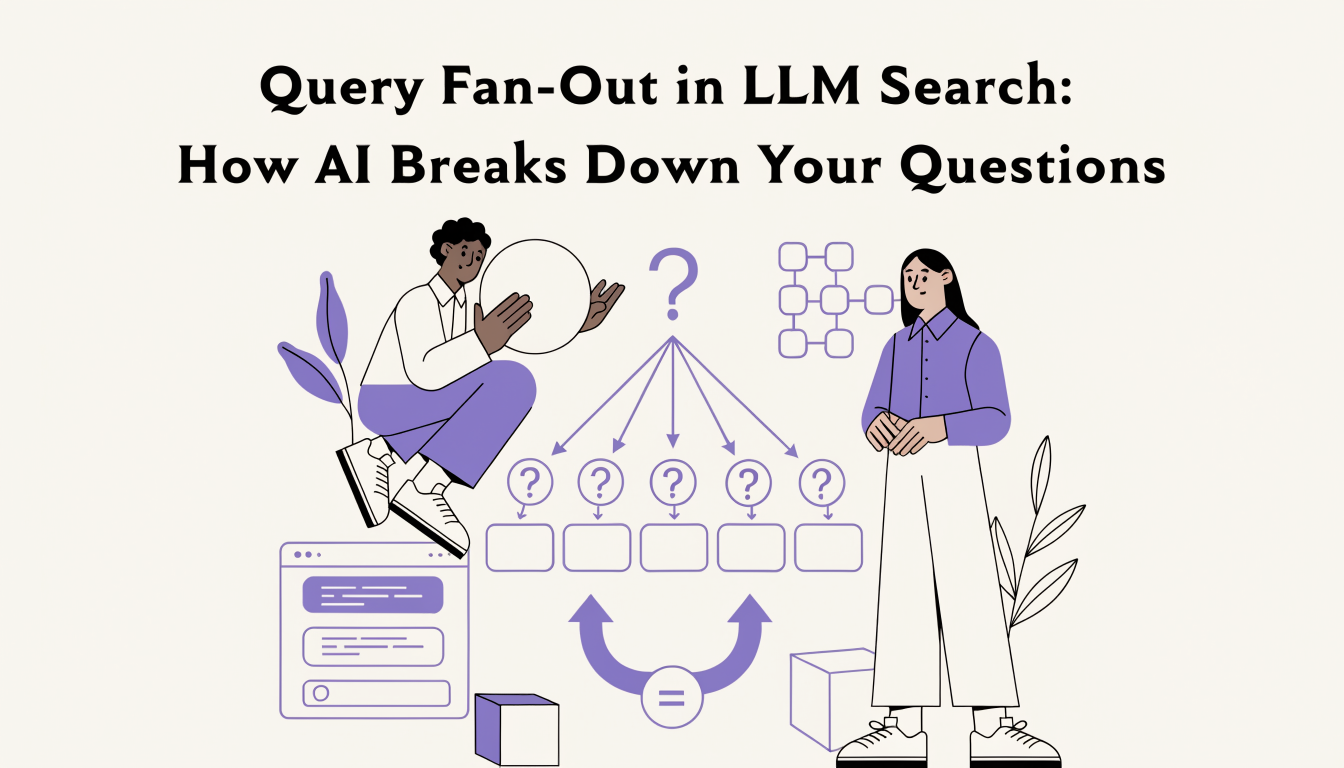
Query Fan-Out in LLM Search: How AI Breaks Down Your Questions
Learn what query fan-out in LLM search is, how AI splits your prompt into 3-8 sub-queries, and how to structure content to win more citation passes.