Citation Measurement Tools: Tracking Your Content in AI Answers
Last updated: 16 November 2026
Measuring citation data in AI search results requires specialized tools because standard analytics platforms don't capture this data. Google Search Console and GA4 lack citation tracking features, leaving most teams blind to how often their content appears in AI-generated answers. Purpose-built citation measurement tools like Semrush's AI Overview tracker, Moz's AIO monitoring, and Authoritas fill this gap by tracking mentions across major AI systems. Understanding which tools match your budget and technical capacity determines whether you can actually act on citation insights.
Which Tools Actually Measure AI Citation Data
A small set of platforms now track how often your URLs appear inside AI-generated answers: Profound, AthenaHQ, BrightEdge, and Semrush's AI Overview tracker are the most established options as of 2026. Each polls major AI engines on a scheduled basis, logs which sources get cited, and surfaces that data in a reportable format. Standard rank trackers do none of this.
The gap is structural. Traditional SEO tools measure position in a list of blue links. AI answers don't work that way. There's no rank 1 through 10, no SERP to crawl. A citation either appears in a generated response or it doesn't, and that signal lives in the response text itself, not in any index a conventional crawler can read. Supermetrics' 2026 visibility guide makes this explicit: Google Search Console and GA4 simply don't expose the data you need to understand AI citation performance.
The numbers back up how fast this gap is widening. Rankability's AI search statistics put AI-assisted search usage growth at a pace that outstrips most teams' current measurement infrastructure.
Five criteria separate a useful citation tool from one that just adds noise:
| Criterion | What to look for | Why it matters |
|---|---|---|
| Model coverage | Tracks ChatGPT, Perplexity, Gemini, and Claude at minimum | A tool that only watches one engine misses most of your citation surface |
| Attribution depth | Returns the cited URL, not just a domain | Domain-level data can't tell you which article earned the citation |
| Volatility tracking | Logs citation frequency over time, not just a snapshot | AI engines rotate sources; a one-time check tells you almost nothing |
| Geo support | Can run queries from multiple regions or locales | Citation patterns differ by market, especially for regulated industries |
| Export fidelity | Outputs raw citation data in CSV or via API | If you can't get the data out cleanly, you can't build reporting around it |
Most tools pass two or three of these. Fewer pass all five. Similarweb's 2026 roundup of AI citation analysis tools lists BrightEdge and Profound as the strongest performers on model breadth, though both sit at enterprise price points that put them out of reach for smaller teams.
One honest caveat: no tool has fully solved volatility tracking at scale. AI engines update their retrieval behavior frequently, and a citation logged on Monday may not reflect what the same prompt returns on Friday. Any platform claiming stable, real-time citation data across all four major engines should be pressed on methodology before you commit budget.
Effective Tools for Measuring Citation Data in AI Search Results: Feature Comparison
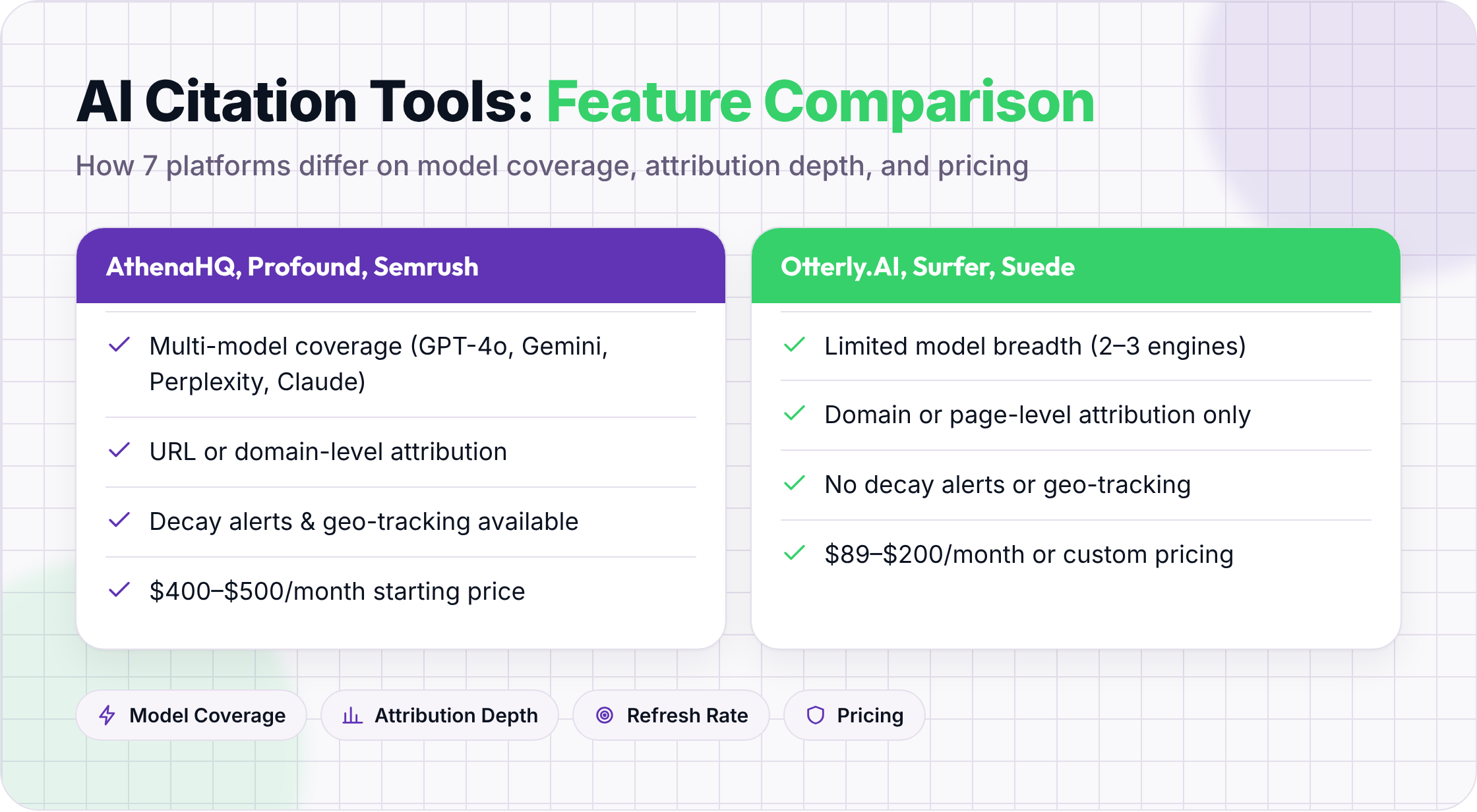
No single AI citation tool covers every model, every market, and every reporting need. The seven platforms below differ most on model breadth, how they define a "citation," and whether they surface decay over time. Match the matrix to your actual monitoring gaps before committing.
| Platform | GPT-4o | Gemini | Perplexity | Claude | Mention Rate | Source Attribution | Geo Tracking | Decay Alerts | Starting Price |
|---|---|---|---|---|---|---|---|---|---|
| AthenaHQ | Yes | Yes | Yes | Yes | Yes | URL-level | Yes | Yes | ~$500/mo |
| Profound | Yes | Yes | Yes | No | Yes | Domain-level | Limited | No | ~$400/mo |
| Semrush AI Overview | Yes | Yes | No | No | Yes | Domain-level | No | No | Add-on to existing plan |
| Surfer AI Visibility | Yes | No | Yes | No | Yes | Page-level | No | No | ~$89/mo |
| Suede Web Systems | Yes | Yes | No | No | Limited | Domain-level | No | No | Custom/agency |
| BrightEdge Generative Parser | Yes | Yes | Yes | Yes | Yes | URL-level | Yes | Yes | Enterprise only |
| Otterly.AI | Yes | Yes | Yes | No | Yes | Page-level | Limited | No | ~$99/mo |
How to Read the Matrix
Model coverage is the first filter. BrightEdge Generative Parser and AthenaHQ are the only two platforms here that poll all four major engines (GPT-4o, Gemini, Perplexity, and Claude) and surface geo-level data alongside decay alerts. That combination matters for brands running campaigns across multiple regions or tracking whether a citation earned in January is still appearing in April.
Pricing reflects positioning: BrightEdge sits firmly in enterprise territory with custom contracts, while Otterly.AI and Surfer AI Visibility target smaller teams at under $100/month. The trade-off is real. Lower-tier tools tend to run shallower query sets, often 10 to 50 tracked prompts per week, while enterprise platforms can run hundreds. A nine-tool breakdown published by Nick Lafferty notes that sampling methodology varies significantly across platforms, meaning two tools can report different citation rates for the same domain simply because they're asking different questions at different frequencies.
What "Cited" Actually Means
This is where most comparisons fall apart. "Cited" means different things depending on the platform. Some count any mention of your brand name in a response. Others require a URL to appear as a linked source. A few count only responses where your content is paraphrased with attribution.
BrightEdge and AthenaHQ both operate at URL-level attribution, which is the strictest definition. Surfer AI Visibility and Otterly.AI report at page-level, which is slightly looser but still useful. Profound and Semrush work at domain-level, which inflates apparent citation rates because any mention of your site, on any page, counts as a hit.
The practical consequence: a domain-level tool might report a 12% mention rate while a URL-level tool on the same dataset reports 4%. Neither number is wrong. They're measuring different things. Before benchmarking your performance against industry averages, confirm which definition your platform uses.
Where the Matrix Breaks Down
Geo tracking is the weakest column across the board. Only AthenaHQ and BrightEdge offer it in any meaningful form, and even then, coverage is limited to a handful of English-speaking markets as of mid-2026. Teams running multilingual content or targeting markets in Southeast Asia or Latin America will find that none of these platforms give reliable citation data outside of US and UK query pools. Flag that gap before you build a reporting workflow around geographic citation share.
Decay alerts are similarly sparse. Most platforms show you a snapshot of current citation status. Fewer than half in this matrix will proactively notify you when a page that was previously cited drops out of AI responses, which is the signal that actually tells you whether a content update is working.
How to Choose the Right Citation Tracking Platform
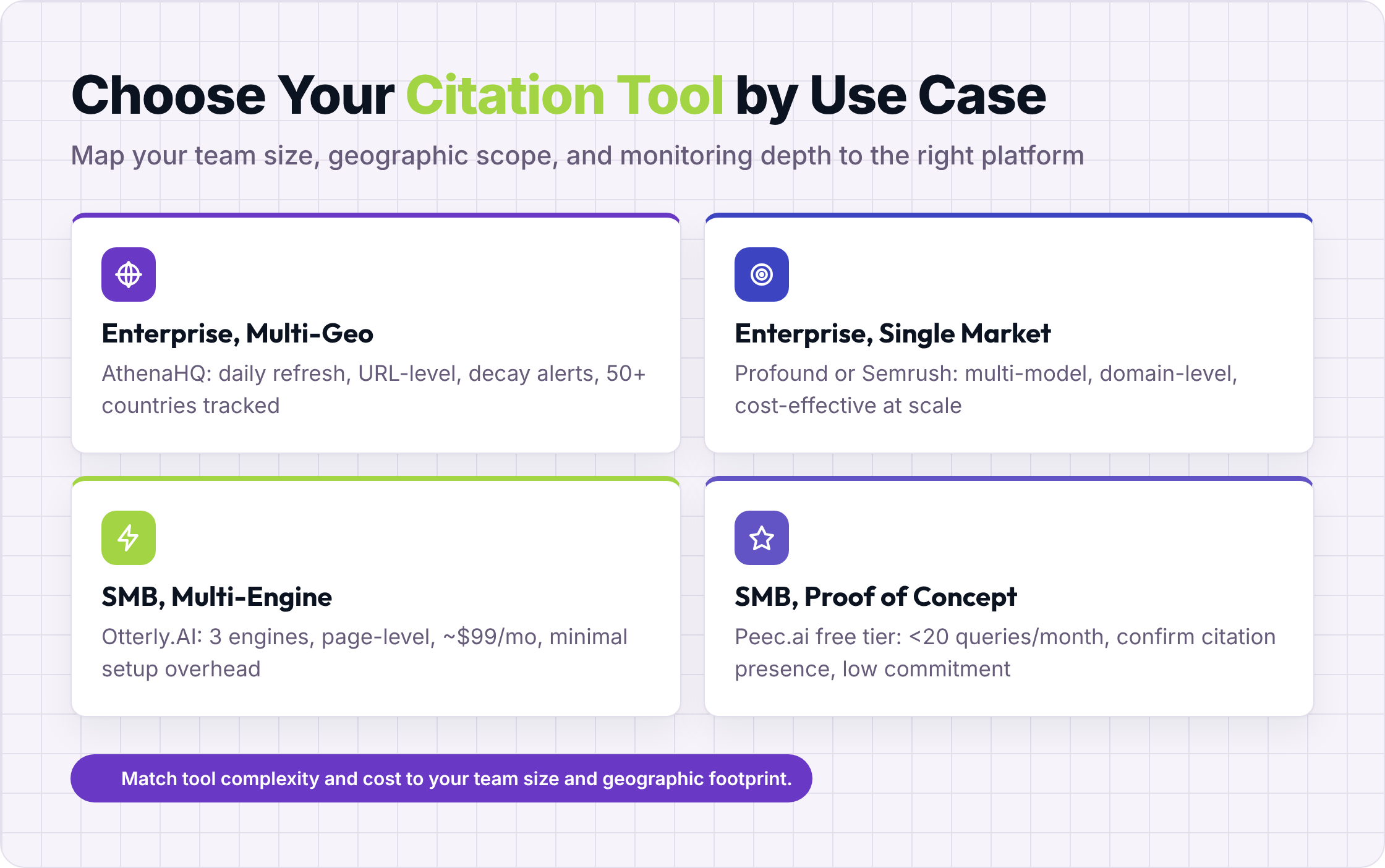
The right platform depends on three variables: how many AI engines you need to monitor, whether you need geographic or language-level attribution, and how much engineering overhead your team can absorb. Enterprise teams with multi-market content programs have fundamentally different requirements than a 10-person SaaS company trying to confirm they show up in ChatGPT at all. Matching the tool to the actual use case saves both budget and setup time.
Decision Path 1: Enterprise Teams Needing Multi-Model, Multi-Geo Attribution at Scale
If your content runs across multiple regions and you need to know whether Gemini cites your French-language pages differently than your English ones, you need a platform built for attribution at that granularity. The Stanford AI Index tracks deployment of major AI systems across more than 50 countries, which signals how fragmented the citation landscape already is by geography. A platform that only polls one engine in one locale will miss the majority of your actual exposure.
At this tier, look for weekly polling across at least four engines (ChatGPT, Perplexity, Claude, Gemini), configurable prompt libraries by market, and competitor citation tracking built into the same dashboard. The trade-off is cost and onboarding time. Enterprise-grade tools typically require a procurement cycle, and the initial prompt configuration for a global content program can take two to four weeks before you have clean baseline data.
Decision Path 2: SMBs That Need Mention Rate Reporting Without a Six-Figure Contract
For smaller teams, the core question is simpler: is any AI engine citing you, and is that number moving? You do not need geo-level attribution or API access to answer that. A platform that tracks 20 to 50 prompts weekly across two or three engines, surfaces your citation rate as a percentage, and flags which competitors are getting cited instead covers the essential use case.
The free tier on tools like Peec.ai handles fewer than 20 tracked queries per month, which is enough to validate whether you have a citation presence before committing to a paid plan. The limitation here is data retention. Most entry-level tiers store 30 to 90 days of history, so trend analysis beyond a single quarter requires upgrading before you actually need the historical view, not after.
Decision Path 3: Content Teams Evaluating Source-Level Attribution
Raw citation counts tell you how often you were mentioned. Source-level attribution tells you which specific article earned the citation, which prompt triggered it, and what the surrounding context looked like. For content teams actively optimizing for AI search, that second layer is the one that drives decisions.
Most tools fall short here. Many platforms report domain-level mentions without breaking down which URL was cited or what the AI engine said around it. A comparison of AI research tools published by Exa highlights that citation quality varies significantly by how tools surface source context, not just whether a source appears. The same principle applies to citation tracking platforms themselves. If you cannot see the sentence the AI engine wrote around your link, you cannot tell whether the citation was favorable, neutral, or a counterexample.
When evaluating tools for this path, ask specifically whether the platform logs the full response text alongside the citation URL, and whether you can filter by prompt intent. A tool that only shows you a count of citations per week is useful for reporting. A tool that shows you the exact context of each citation is useful for improving your content.
Best for Enterprise: AthenaHQ
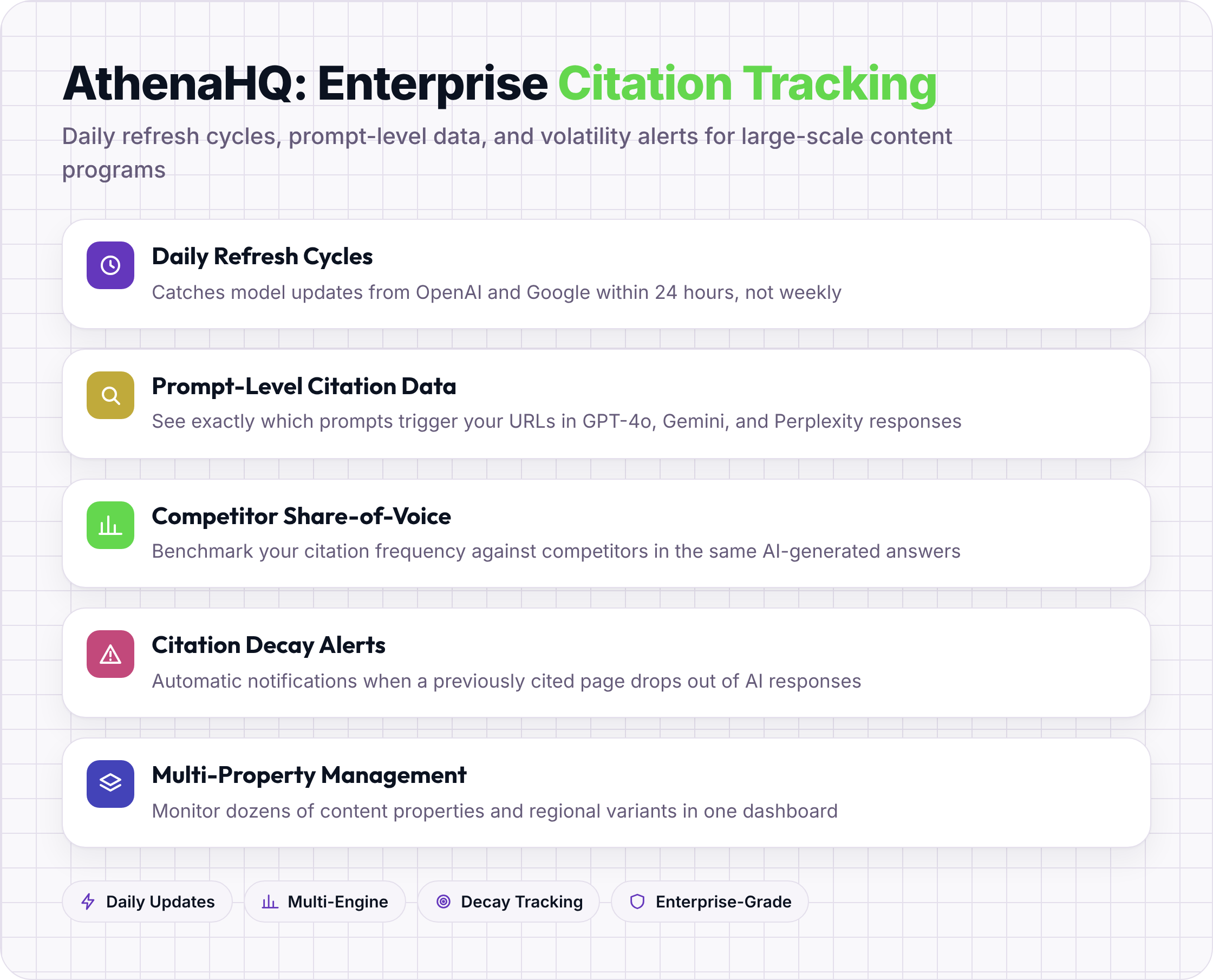
AthenaHQ tracks citation frequency across GPT-4o, Gemini, and Perplexity on daily refresh cycles, making it one of the few platforms built specifically around AI visibility rather than adapted from traditional SEO tooling. Enterprise teams get prompt-level citation data, competitor share-of-voice breakdowns, and volatility alerts that fire when a model update shifts citation patterns. For large brands managing dozens of content properties, that daily cadence matters.
What It Tracks
AthenaHQ monitors how often a brand's URLs appear in AI-generated answers across three of the four major engines every 24 hours. That refresh rate is meaningful: model updates from OpenAI and Google can reshuffle citation behavior within days, and weekly polling misses the inflection point. The platform also tracks citation decay, flagging when a previously cited page drops out of responses after a model update or a competitor publishes something structurally stronger.
AthenaHQ's own comparison against Semrush makes the positioning explicit: the product is built around AI visibility from the ground up, not retrofitted onto a keyword rank tracker. That architectural difference shows up in the data model. Where Semrush reports domain-level mentions as a byproduct of its broader SEO suite, AthenaHQ stores the full response text, the cited URL, the prompt, and the timestamp, giving you a queryable record of exactly when and how each citation appeared.
Where It Falls Short
AthenaHQ does not yet cover Claude in its standard polling set, which is a real gap for teams whose audiences skew toward Anthropic's products. Pricing starts around $500/month, and the onboarding process assumes you already have a defined prompt library. Teams without one will spend the first two to three weeks building it before the data becomes meaningful. For smaller teams or those just starting to measure AI citation performance, the cost-to-value ratio is harder to justify.
Best for SMBs: Otterly.AI
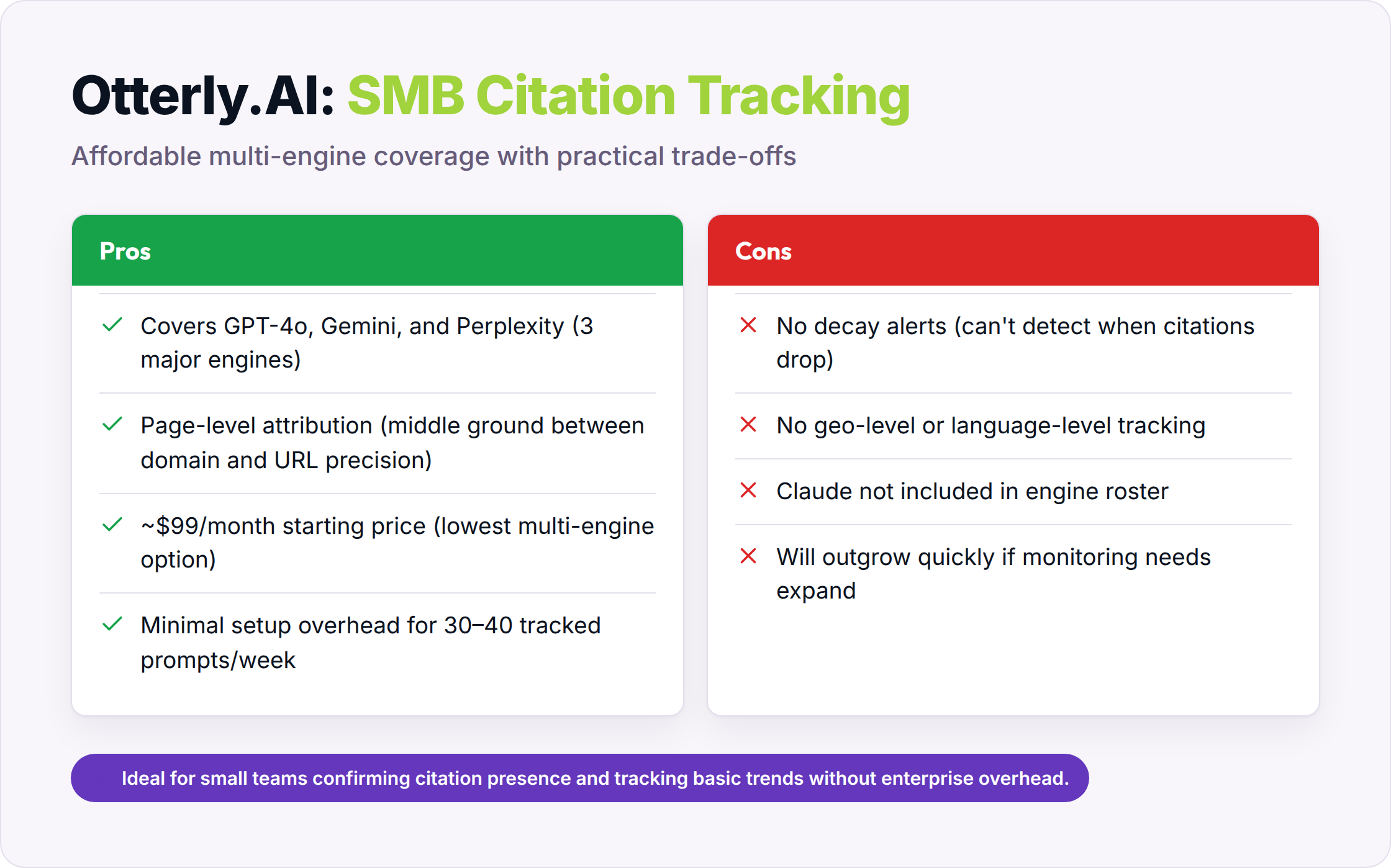
Otterly.AI covers GPT-4o, Gemini, and Perplexity at a starting price of roughly $99/month, making it the most accessible multi-engine option in this comparison. It reports at page-level attribution, which is a reasonable middle ground between domain-level noise and the full URL-level precision of enterprise tools. For a content team running 30 to 40 tracked prompts per week, it covers the core use case without requiring a procurement cycle.
The platform does not offer decay alerts or geo-level tracking, and Claude is absent from its engine roster. If your monitoring needs are straightforward, those omissions probably don't matter. If you're running a multilingual content program or need to know the moment a citation drops, you'll outgrow Otterly.AI quickly.
Frequently Asked Questions
How do AI citation tools actually collect their data?
Most platforms work by sending a defined set of prompts to AI engines via API or browser automation, then parsing the responses for URLs, domain mentions, or brand references. The prompts are typically configured by the user to reflect the queries their target audience is likely to ask. Results are logged with a timestamp, and the platform aggregates them over time to produce citation rate trends.
Can I track AI citations for free?
A few tools offer limited free tiers. Peec.ai allows fewer than 20 tracked queries per month at no cost, which is enough to confirm whether you have any citation presence at all. Beyond that threshold, paid plans start around $89 to $99/month for entry-level multi-engine coverage. Fully free, unlimited tracking does not currently exist in any credible form.
How often do AI engines change which sources they cite?
Frequently enough that weekly snapshots can mislead you. Major model updates from OpenAI, Google, and Anthropic can shift citation behavior within 48 to 72 hours of deployment. Platforms that poll daily give you a much cleaner picture of when a change happened and whether it was a model update or a content quality shift on your end. Weekly polling is better than nothing, but it tends to smooth over the inflection points that actually matter for content decisions.
What's the difference between a "mention" and a "citation" in these tools?
A mention means your brand name or domain appeared somewhere in an AI-generated response. A citation, in the stricter sense, means a specific URL was surfaced as a source, either as a linked reference or as clearly attributed content. Domain-level tools count mentions. URL-level tools count citations. The distinction matters because a mention might mean the AI referenced your brand in passing, while a citation means your specific article was treated as a source. For content optimization purposes, citations are the signal worth tracking.
Do these tools work for non-English content?
Partially. Most platforms run their query pools in English and against US-based API endpoints. AthenaHQ and BrightEdge offer some geo-level configuration, but even they are limited to a handful of markets as of 2026. Teams producing content in Spanish, French, German, or Southeast Asian languages will find that current tools give an incomplete picture of their actual citation footprint in those markets. This is an active gap in the category, not a solved problem.
Is AI citation tracking worth the cost for a small team?
For a team of under 15 people, the answer depends on whether AI search is already a meaningful traffic source or a future bet. If you're seeing referral traffic from Perplexity or ChatGPT in your analytics, a $99/month tool that confirms and tracks that source is easy to justify. If AI search is still speculative for your audience, starting with a free-tier tool to establish a baseline before committing to a paid plan is the more defensible approach.
If you want to see how AI citation tracking fits into a broader GEO (generative engine optimization) strategy, visit Seorav to learn more. The page covers how citation measurement connects to content decisions, competitive monitoring, and the reporting workflows that make the data actionable.
Keep reading
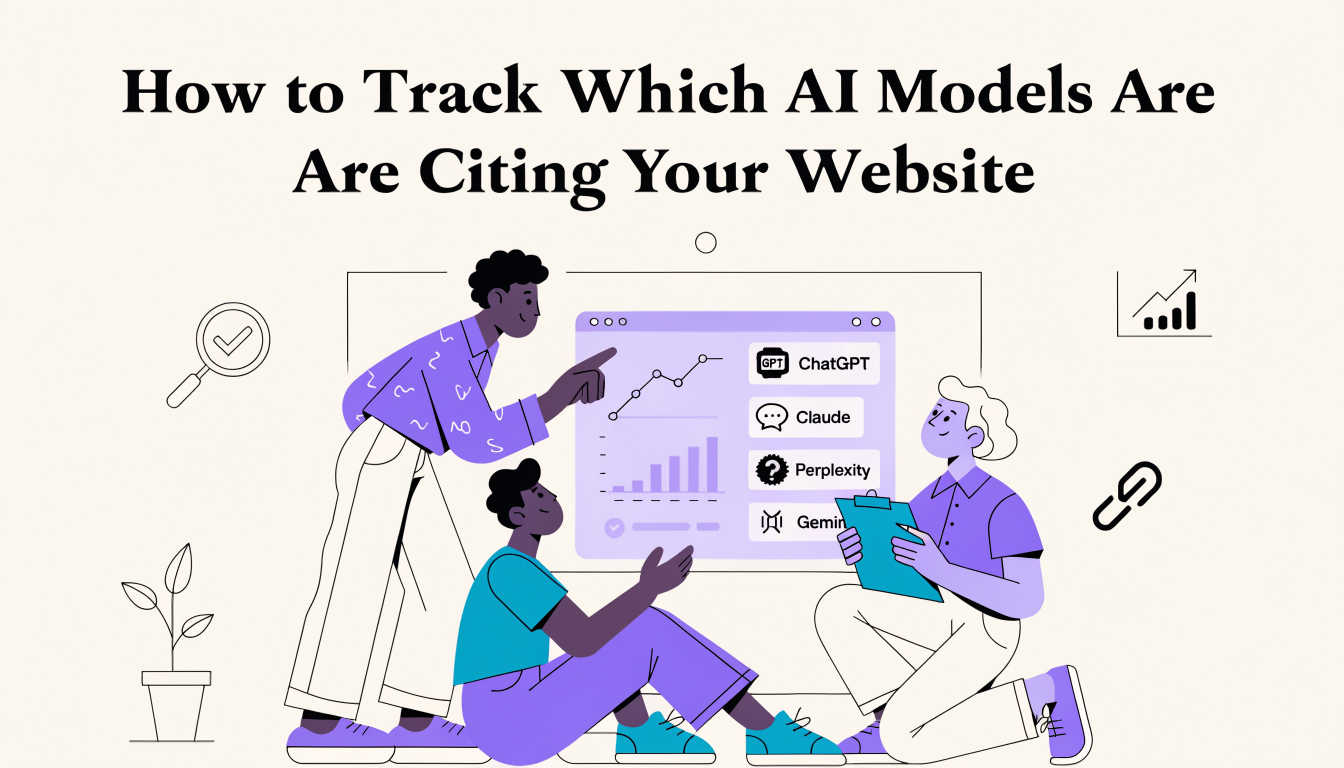
How to Track Which AI Models Are Citing Your Website
Learn how to set up ai search citation analytics across ChatGPT, Perplexity, Claude, and Gemini. Includes tool comparisons, prompt setup, and competitor ga
Enterprise CMS Platforms: What They Are and How to Choose
Compare enterprise CMS platforms by architecture, cost, compliance, and AI features. Learn what separates enterprise-grade tools from standard CMS options.
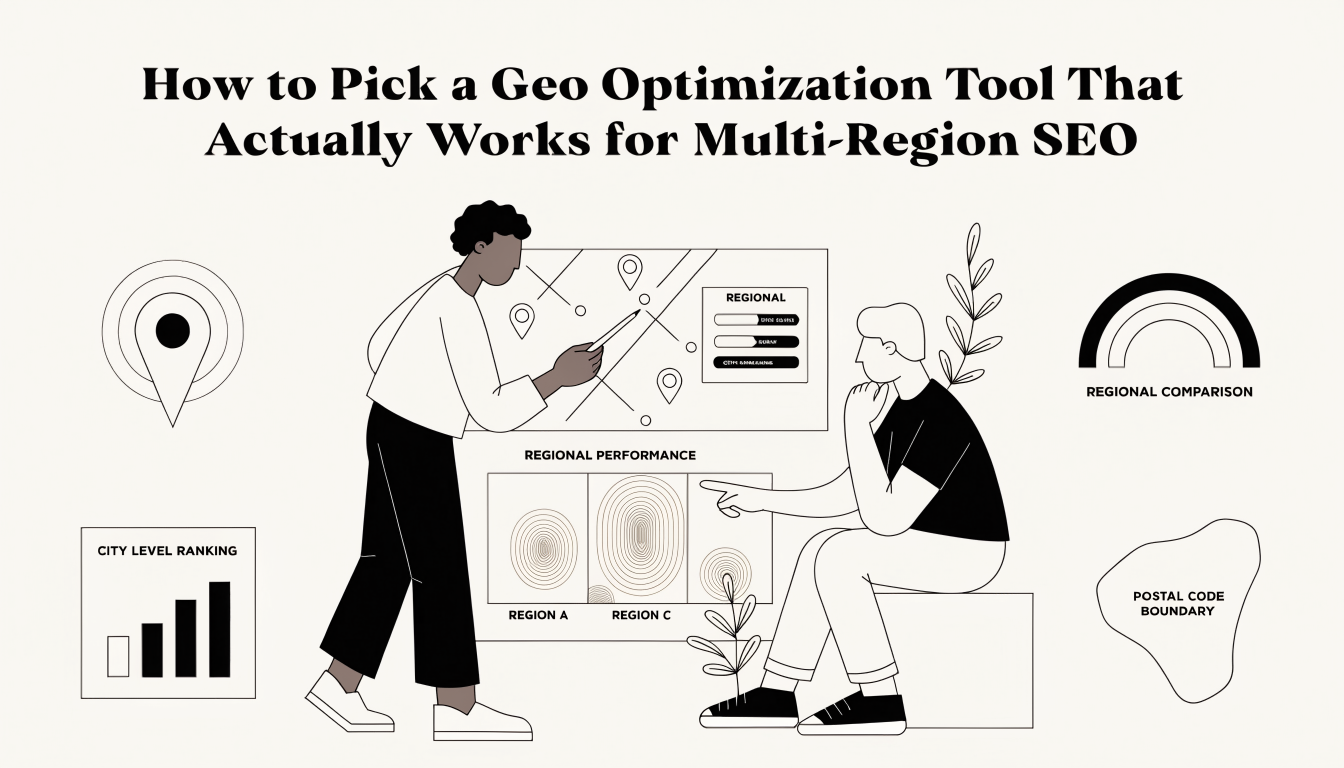
How to Pick a Geo Optimization Tool That Actually Works for Multi-Region SEO
Compare the top geo optimization tools for multi-location SEO. See which platforms track rankings at city level, fix citation gaps, and scale across 100+ l