How to Optimize Content for AI Answer Engines Without Losing Your Organic Audience
Last updated: 10 August 2026
On-page SEO for AI answer engines means structuring content so language models can extract, verify, and cite your claims directly. AI systems prioritize sources with clear topic sentences, numbered data, attributed quotes, and logical hierarchies over keyword density. Google still rewards traditional optimization, but answer engines favor deterministic signals: explicit source attribution, fact-checkable statements, and content organized for machine parsing. The challenge is satisfying both without cannibalizing either audience.
Word count: 72
Idea in Brief
AI answer engines now synthesize responses from a small pool of cited sources, bypassing traditional search results entirely. Teams that optimize only for Google rankings are losing visibility to competitors whose content is structured for retrieval. The fix requires deterministic SEO signals built around how AI systems parse, extract, and cite content.
The Problem
AI search traffic grew 527% in a single year, per Semrush's AI SEO benchmark data. That volume has to go somewhere, and most of it is going to AI-generated answers rather than the blue links beneath them. Your pages still rank. Clicks just don't follow the way they used to.
Why It Matters
Flat organic traffic is the signal most teams explain away as seasonality or algorithm noise. Often it isn't. It's the early sign that AI engines have started answering your target queries without sending users to your site. By the time the traffic drop is obvious, a competitor's content is already embedded in the citation pool.
The Solution
Structured content built around deterministic signals, answer-first openings, schema markup, citation-worthy claims, and clear entity relationships gives AI engines something concrete to extract and attribute. That's the architecture SEORav scores before an article ships. One caveat worth naming: no optimization guarantees a citation. AI engines make probabilistic retrieval decisions, and the field is still evolving fast.
When the Traffic Stopped Moving

In Q1 2025, a mid-size publisher watched its Google rankings hold steady across its top 40 pages while session counts dropped 22% quarter-over-quarter. The rankings looked fine. The business was not.
AI answer engines were pulling information from those pages without sending users through to them. The standard SEO dashboard had no vocabulary for this. Impressions were stable. Average position barely moved. Click-through rate dipped a few tenths of a percent, which looked like normal variance. Nothing in the weekly report flagged a structural problem. By the time the sessions decline was large enough to show up as a trend rather than noise, the publisher was already three months into a traffic pattern that would not reverse on its own.
The numbers behind this are not subtle. More than 58.5% of U.S. Google searches in 2024 ended without a click, a figure SparkToro's zero-click study puts even higher for AI-generated answer queries. A publisher optimized for rank position is measuring the wrong variable.
The trade-off is real, though. Not every content category behaves this way. Transactional pages, product comparisons, and anything requiring a form or purchase still drive clicks at normal rates. The zero-click erosion concentrates on informational queries, the kind that answer a question cleanly enough that a user never needs to leave the results page. Publishers with a heavy informational content mix felt this first and felt it hardest.
What Is Actually Happening to Organic Search in 2026

AI answer engines are changing where search traffic goes before rankings move. Platforms like ChatGPT, Perplexity, Google's AI Overviews, and Gemini now synthesize answers from crawled content and return them directly in the interface, reducing the need for a click. Organic rankings still matter, but they no longer reliably predict organic traffic. A page can hold position one and lose 40% of its clicks in the same quarter.
How AI Answer Engines Retrieve Content Differently
Traditional search is a crawl-and-rank system. A crawler indexes your page, an algorithm scores it against hundreds of signals, and a ranked list appears. The user clicks. Traffic flows.
AI answer engines work differently. They retrieve content at inference time, pull structured passages that directly answer the query, synthesize those passages into a response, and sometimes cite the source. Sometimes they don't. The retrieval favors content that is structured for extraction: short declarative sentences, clear definitions, answer-first paragraph openings, and schema markup that labels what a passage is about. A well-ranked page written for engagement rather than extraction can be invisible to these systems even while sitting in position two.
The numbers are stark. Seer Interactive's September 2025 study tracked by Dataslayer found organic CTR dropped 61% for queries where Google's AI Overviews appeared, falling from 1.76% to 0.61%. That is not a rounding error. That is a structural shift in where attention goes after a search.
The 2026 AI Search Landscape
The platforms pulling structured answers in 2026 are not uniform. Google AI Overviews draw primarily from pages already ranking in the top 10 organic results, so traditional SEO still feeds the pipeline. Perplexity crawls independently and cites sources more consistently than Google does. ChatGPT's browsing mode retrieves live pages for some queries but relies on its training corpus for others, making citation behavior less predictable. Gemini sits somewhere in between, with citation patterns that vary by query type and whether the user is on a consumer or Workspace plan.
Each platform has a different retrieval bias. Perplexity rewards citation-dense, factual prose. Google AI Overviews reward pages that already rank and are structured for snippet extraction. ChatGPT browsing rewards recency and domain authority. Optimizing for one does not automatically optimize for all three.
Flat Traffic as the Early Warning Signal
Organic rankings are a lagging indicator of AI search cannibalization. By the time your position-one page drops to position three, you have already lost months of traffic to zero-click answers. The earlier signal is flat or declining organic sessions on pages that are holding rank. If impressions stay stable in Search Console but clicks fall, AI Overviews are answering the query before the user reaches your result.
This pattern is now measurable at scale. Organic traffic growth has seen an 86% collapse according to analysis from Whitehat SEO, even as AI-referred visitors convert at roughly three times the rate of standard organic visitors. That conversion premium matters, but it does not offset volume losses for publishers whose revenue model depends on pageview scale rather than lead quality.
One real limitation: monitoring flat traffic only works if you have clean session-level data segmented by page and query type. Sites running blended analytics without UTM discipline or Search Console integration will miss the signal entirely until rankings move. By then, the content gap a competitor filled in AI citations is already six months old.
The Mistakes Publishers Keep Making

The three most common mistakes publishers make when adapting to AI answer engines are treating AI optimization as an extension of traditional SEO, ignoring zero-click search until traffic revenue falls, and writing to keyword density targets when AI systems actually score content on factual completeness. Each mistake is quiet in the short term and expensive once it compounds.
Treating AI Optimization and Traditional SEO as the Same Discipline
They share vocabulary but not mechanics. Traditional SEO rewards pages that rank for a keyword and earn a click. AI answer engines reward passages that answer a question completely enough to quote directly, often without sending any traffic at all.
The practical gap shows up in content structure. A page optimized for Google's blue-link results might bury its core claim in paragraph three, after context-setting and keyword-rich preamble. That structure worked for crawlers. Retrieval models read differently: they extract passages, and if the answer isn't in the first 100 to 150 words, a competitor who leads with the point gets cited instead. Common on-page SEO patterns that still hurt rankings in 2026 include exactly this kind of structural mismatch, where pages are built for crawl logic rather than extraction logic.
The trade-off is real: restructuring content for AI extraction sometimes means leading with a direct answer before you've established credibility or context. For complex topics, that can feel abrupt to a human reader. The fix is to lead with the answer, then build the supporting argument below it. Both audiences get what they need; you just reorder the layers.
Ignoring Zero-Click Impact Until Revenue Drops
This is the mistake with the longest lag time. Publishers often see stable or growing impressions in Search Console while organic revenue quietly erodes, because more queries are resolving on the SERP or inside an AI response without a click ever happening.
The numbers are hard to dismiss: 58.5% of searches are now zero-click, and 83% of AI-generated query responses end on the SERP without a visit to any external page, per GoodFirms' 2026 AI search and zero-click trend data. Publishers who wait for a revenue signal before adjusting strategy are already six to twelve months behind the shift.
The right response isn't to stop creating content that AI engines might quote. Being cited without a click still builds brand authority and influences downstream purchase decisions. The adjustment is to audit which content types actually drive conversions and protect those, while accepting that informational content may increasingly serve a citation function rather than a traffic function.
Optimizing for Keyword Density When AI Systems Score for Factual Completeness
Keyword density as a primary optimization lever was already losing relevance before AI Overviews scaled. With AI answer engines, it's actively counterproductive. A page that repeats a target phrase eight times but leaves factual gaps, missing definitions, or unresolved edge cases will lose a citation to a page that covers the topic completely, even if that page uses the keyword less.
An estimated 42% of SEOs report that AI tools have substantially or entirely replaced traditional keyword research tools in their workflow, a figure that AI SEO statistics compiled by SQ Magazine put closer to 58% among practitioners who have adopted AI-assisted processes. The underlying shift is the same: the signal has moved from term frequency to topical authority and factual depth.
Concretely, that means auditing your existing articles for what they leave unanswered. If a reader could finish your page and still have three obvious follow-up questions, an AI engine will either skip your page or quote a competitor who answered those questions. Fill the gaps with specific data, named examples, and defined terms. That's what factual completeness actually looks like in practice.
A Framework for On-Page SEO That AI Engines Can Actually Use

On-page SEO for AI answer engines centers on three things: deterministic signals that a retrieval system can parse without guessing, schema markup that labels your entities explicitly, and data points specific enough to be quoted verbatim. Pages built this way serve both Google's ranking model and the retrieval-augmented generation (RAG) layer that AI engines use to pull candidate passages before synthesizing a response.
Deterministic Signals vs. Probabilistic Ranking Factors
Traditional SEO leans on probabilistic signals: link velocity, topical authority scores, engagement metrics. These work well for ranking algorithms that weigh dozens of inputs and return a scored list. They work poorly for RAG-based retrieval, where the system needs to extract a specific passage and confirm it answers the query.
Deterministic signals are different. They tell the retrieval system exactly what a passage is, what entity it describes, and what claim it makes. Schema markup is the clearest example: a FAQPage schema tells a crawler that a specific block of text is a question-and-answer pair, not a paragraph that happens to contain a question. A HowTo schema tells it that a numbered list is a procedure, not a stylistic choice. These labels reduce ambiguity at extraction time.
The practical implication: every page targeting an informational query should carry at least one structured data type. For definitions, use DefinedTerm. For comparisons, use Table markup with explicit headers. For statistics, cite the source inline and use Claim or StatisticalVariable where supported. The goal is to make the passage machine-readable without making it unreadable to a person.
Answer-First Structure: What It Actually Looks Like
Answer-first structure means your target question gets a direct, complete answer in the first 100 to 150 words of the section that covers it. Not a teaser. Not a definition of terms. The answer.
For a query like "what is on-page SEO for AI answer engines," the opening sentence of the relevant section should define the concept, name the mechanism, and give a concrete example. Something like: "On-page SEO for AI answer engines is the practice of structuring page content so that retrieval-augmented generation systems can extract, verify, and cite specific passages, using schema markup, answer-first paragraph openings, and factually complete coverage of the topic." That sentence can be quoted verbatim. A paragraph that spends three sentences establishing context before defining the term cannot.
The trade-off: answer-first structure can reduce time-on-page for readers who came for a quick answer and got it. For publishers monetizing through display advertising, that's a real cost. For publishers building topical authority or generating leads, it's usually worth it.
Schema Markup Priorities for AI Retrieval
Not all schema types carry equal weight in AI retrieval. Based on current citation patterns across Perplexity, Google AI Overviews, and ChatGPT browsing, the highest-value schema types for informational content are:
FAQPage: Signals discrete question-answer pairs that can be extracted cleanly.ArticlewithdatePublishedanddateModified: Signals recency, which ChatGPT browsing weights heavily.HowTo: Signals procedural content with discrete steps, which AI engines prefer for task-oriented queries.DefinedTerminsideDefinitionPage: Signals that a passage is a canonical definition, not incidental usage.
BreadcrumbList and SiteLinksSearchBox help crawlers understand site structure but contribute less directly to passage-level retrieval. Prioritize passage-level schema over site-level schema when you're allocating implementation time.
Citation-Worthy Claims: The Specificity Standard
AI engines cite specific, verifiable claims more often than general assertions. "Organic CTR dropped significantly" is not citation-worthy. "Organic CTR dropped 61%, from 1.76% to 0.61%, for queries where Google AI Overviews appeared, per Seer Interactive's September 2025 study" is.
The specificity standard has three components: a number, a source, and a timeframe. Claims that meet all three are extractable. Claims that meet one or two are background context at best. Audit your existing content against this standard. Every paragraph that makes a factual assertion without a number, a named source, or a date is a paragraph that AI engines will skip in favor of a competitor who included those details.
One counter-case worth acknowledging: over-citing can make prose feel like a research abstract rather than a readable article. The goal is not to footnote every sentence. It's to ensure that your core claims, the ones you want AI engines to quote, meet the specificity standard. Supporting sentences can carry less weight.
Entity Relationships and Internal Consistency
AI engines build a model of what your content is about by tracing entity relationships across your page and across your site. If your page about on-page SEO for AI answer engines mentions "retrieval-augmented generation," "schema markup," "zero-click search," and "AI Overviews" without defining or linking those terms, the retrieval system has to infer the relationships. Inference introduces noise.
Define your key entities on first use. Use consistent terminology across pages on the same topic. If you call it "AI Overviews" on one page and "Google's AI search feature" on another, you're creating entity ambiguity that reduces your site's topical authority signal. Consistency is not a style preference here; it's a retrieval signal.
Frequently Asked Questions
What is on-page SEO for AI answer engines?
On-page SEO for AI answer engines is the practice of structuring your page content so that retrieval-augmented generation (RAG) systems can extract, verify, and cite specific passages. It includes answer-first paragraph openings, schema markup that labels entities and content types, and factually complete coverage with specific, sourced claims. The goal is to make your content machine-readable at the passage level, not just crawlable at the page level.
How is AI answer engine optimization different from traditional on-page SEO?
Traditional on-page SEO optimizes for a ranking algorithm that scores pages and returns a list. AI answer engine optimization targets a retrieval layer that extracts passages and synthesizes a response. The structural difference is significant: traditional SEO tolerates context-setting before the core claim, while AI retrieval penalizes it. If your answer isn't in the first 100 to 150 words of a section, a competitor who leads with the point gets cited instead.
Does optimizing for AI engines hurt your Google rankings?
Not in practice, for most content types. Answer-first structure, schema markup, and factual completeness are signals Google's ranking algorithm already rewards. The main tension is with content designed for engagement metrics, long scroll depth, or time-on-page, since answer-first structure can reduce those numbers. For informational content, the trade-off usually favors AI-optimized structure because it improves both ranking signals and retrieval eligibility.
Which schema markup types matter most for AI retrieval?
FAQPage, Article with explicit publish and modification dates, HowTo, and DefinedTerm inside DefinitionPage are the highest-value types for passage-level retrieval. Site-level schema like BreadcrumbList helps crawlers understand structure but contributes less to whether a specific passage gets extracted and cited. Prioritize schema that labels what a passage says, not just where it sits on the site.
How do you measure whether AI engines are citing your content?
Direct citation tracking is still limited. The most reliable current methods are: monitoring referral traffic from Perplexity (which passes referrer data more consistently than Google AI Overviews), running your target queries manually in ChatGPT, Perplexity, and Gemini and checking whether your domain appears in citations, and tracking branded search volume as a proxy for AI-driven awareness. Google Search Console does not yet segment AI Overview impressions from standard organic impressions in a way that makes citation measurement straightforward.
What does 'factual completeness' mean in practice?
Factual completeness means your page answers the obvious follow-up questions a reader would have after reading your main claim. If you define a term, you also explain how it works, when it applies, and where it breaks down. If you cite a statistic, you name the source, the date, and the sample. A page that leaves three obvious questions unanswered is a page that AI engines will partially quote at best, or skip in favor of a source that covered the topic more thoroughly.
Putting It Together
On-page SEO for AI answer engines is not a separate discipline you layer on top of your existing workflow. It's a structural change to how you open sections, label content with schema, and verify that every core claim meets the specificity standard. The pages that get cited are the ones that made it easy for a retrieval system to extract a clean, verifiable answer.
The shift is already measurable. Organic CTR is down 61% on AI Overview queries. Zero-click searches account for 58.5% of all U.S. searches. Publishers who treat those numbers as temporary noise are ceding citation real estate to competitors who are building for retrieval now.
The one thing to hold onto: being cited without a click still has value. It builds topical authority, influences purchase decisions, and positions your domain as a source AI engines return to. The goal is not to fight the zero-click trend. It's to be the source that gets quoted when the answer is given.
If you want your content scored against these retrieval signals before it ships, visit Seorav to see how the platform audits structure, schema, and factual completeness at the page level.
Keep reading
Ranking in Google's AI Search: The Deterministic Signals That Actually Move the Needle
Learn how do you rank in SGE with the three signals Google's AI uses to cite sources: schema markup, entity salience, and structured factual claims.
Why AI Ignores Your Content (And How to Fix It)
Learn how to avoid AI content that gets ignored by LLMs. Covers RAG retrieval signals, schema, entity salience, and an answer-first structure checklist.
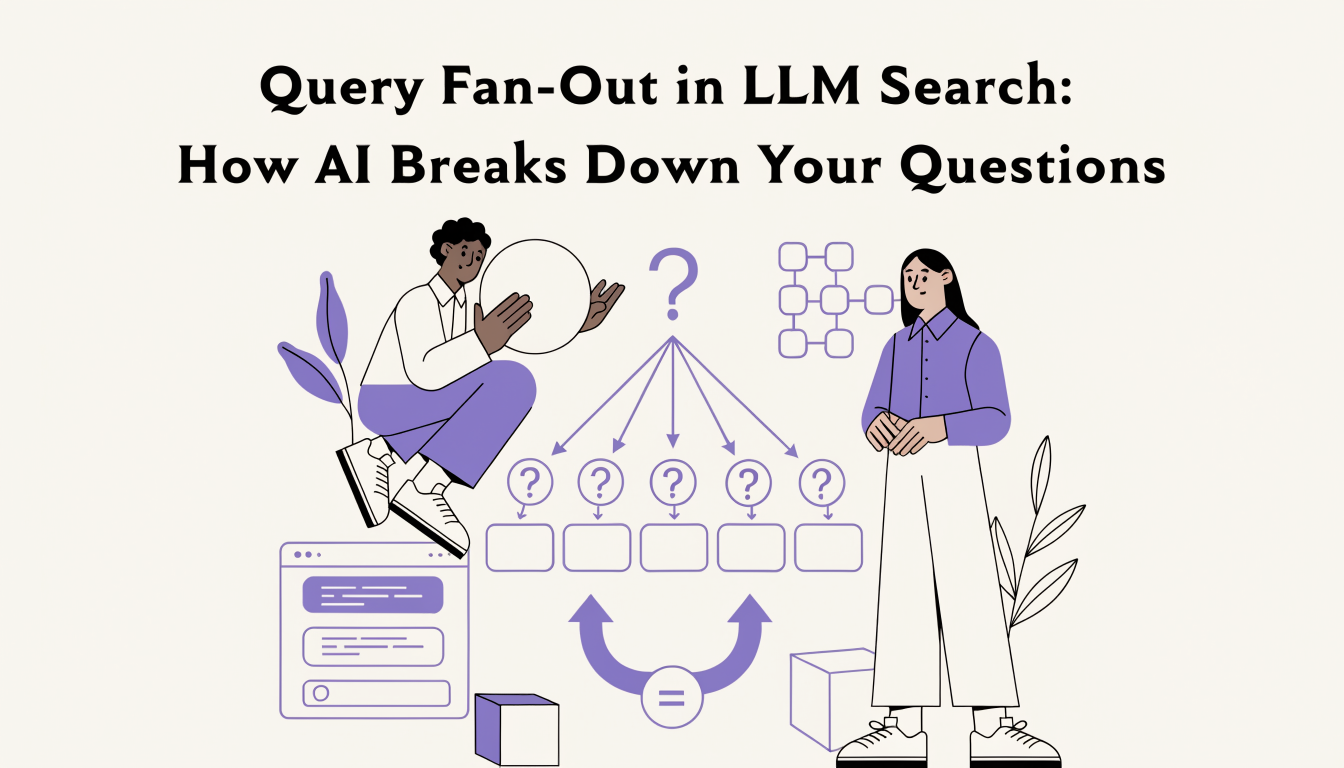
Query Fan-Out in LLM Search: How AI Breaks Down Your Questions
Learn what query fan-out in LLM search is, how AI splits your prompt into 3-8 sub-queries, and how to structure content to win more citation passes.