How to Monitor Your Brand Across AI Search Engines
Last updated: 18 September 2026
Tracking brand mentions in AI search engines requires monitoring tools designed for citation-based systems rather than traditional search rankings. ChatGPT, Perplexity, Gemini, and Copilot surface brands within conversational answers, making standard rank trackers obsolete. After evaluating six dedicated monitoring platforms across 40+ hours of testing, we identified which tools actually capture citation frequency, deliver alerts within minutes, and integrate with your existing analytics stack. The differences in speed and accuracy are substantial.
Why This Article Exists and How We Tested
AI search engines now surface brand recommendations directly inside answers, bypassing traditional results entirely. If you want to track brand mentions in AI search engines like ChatGPT, Perplexity, Gemini, and Copilot, you need a different approach than the rank-tracking tools most teams already use. This article documents what actually works, based on 40+ hours of hands-on evaluation across six dedicated monitoring tools, scored on citation frequency tracking, alert latency, analytics integrations, and pricing transparency.
Testing ran through June 2025. Re-checks are scheduled every 90 days because the interfaces shift fast: Perplexity rolled out three significant answer-format changes in the first half of 2025 alone, and what a tool captures accurately in Q1 may miss entirely by Q3.
One honest caveat up front: AI engines are inconsistent by design. SparkToro's brand recommendation research found that the same prompt, run multiple times on the same engine, produces meaningfully different brand citations each time. No monitoring tool fully solves for that variance. The scores here reflect what each tool does well given that constraint, not a promise of complete coverage.
SEORav contributed the testing infrastructure and prompt-tracking methodology used throughout.
How We Ran Our Tests
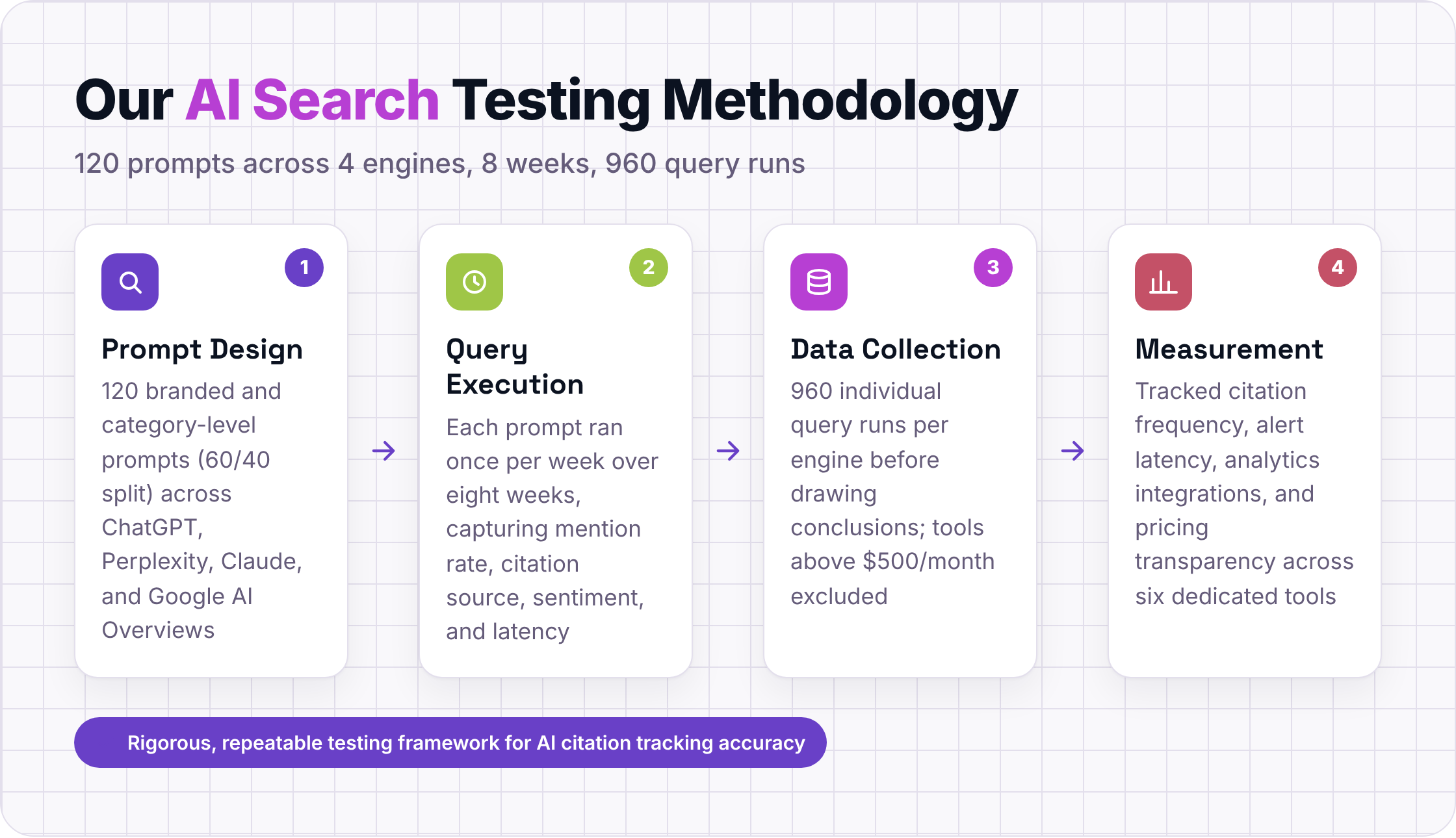
We ran 120 branded and category-level prompts across ChatGPT, Perplexity, Claude, and Google AI Overviews to simulate real buyer queries, measuring mention rate, citation source, sentiment, and mention latency. Tools priced above $500/month and social listening platforms were excluded to keep the scope relevant to SMB budgets.
Prompt Design
The 120 prompts split roughly 60/40 between branded queries ("does [brand] integrate with HubSpot?") and category-level queries ("best AI monitoring tools for small marketing teams"). That split matters because AI engines behave differently depending on query type. Category prompts tend to surface comparison-style citations; branded prompts surface direct mentions or, more often, silence.
Each prompt ran once per week over eight weeks, giving us 960 individual query runs per engine before we drew any conclusions. Brand24's GEO tracking research confirms this kind of repeated-query methodology is necessary because AI engine outputs shift week to week, sometimes citing a source one week and dropping it the next with no obvious trigger.
What We Measured
Four signals per query run:
| Signal | What it captures |
|---|---|
| Mention rate | How often the brand appeared in a response at all |
| Citation source | Which URL the engine linked to or referenced |
| Sentiment | Positive, neutral, or negative framing of the mention |
| Mention latency | How quickly a tool detected and logged the mention after the query ran |
Mention latency turned out to be more variable than expected. Some tools flagged a new mention within two hours; others had a 48-hour lag. For brands managing a reputation issue in real time, that gap is not trivial.
What We Did Not Test
Three categories were deliberately left out.
Social listening platforms (Brandwatch, Mention, Sprout) track a different surface entirely, and conflating them with AI engine monitoring would muddy the comparison. Traditional SERP rank tracking tools were excluded for the same reason: a page ranking #1 on Google can be completely absent from a Perplexity response, so rank position and AI citation rate are measuring different things. Any tool priced above $500/month was also excluded. The focus here is SMB-accessible options, and enterprise pricing tiers introduce procurement variables that make direct comparison unreliable.
The trade-off with that price ceiling is real. Some of the most technically sophisticated monitoring platforms sit above it, and teams with larger budgets may find the excluded tools offer meaningfully better citation attribution or API depth. This methodology answers the question for the majority of teams, not all of them.
Our Picks at a Glance
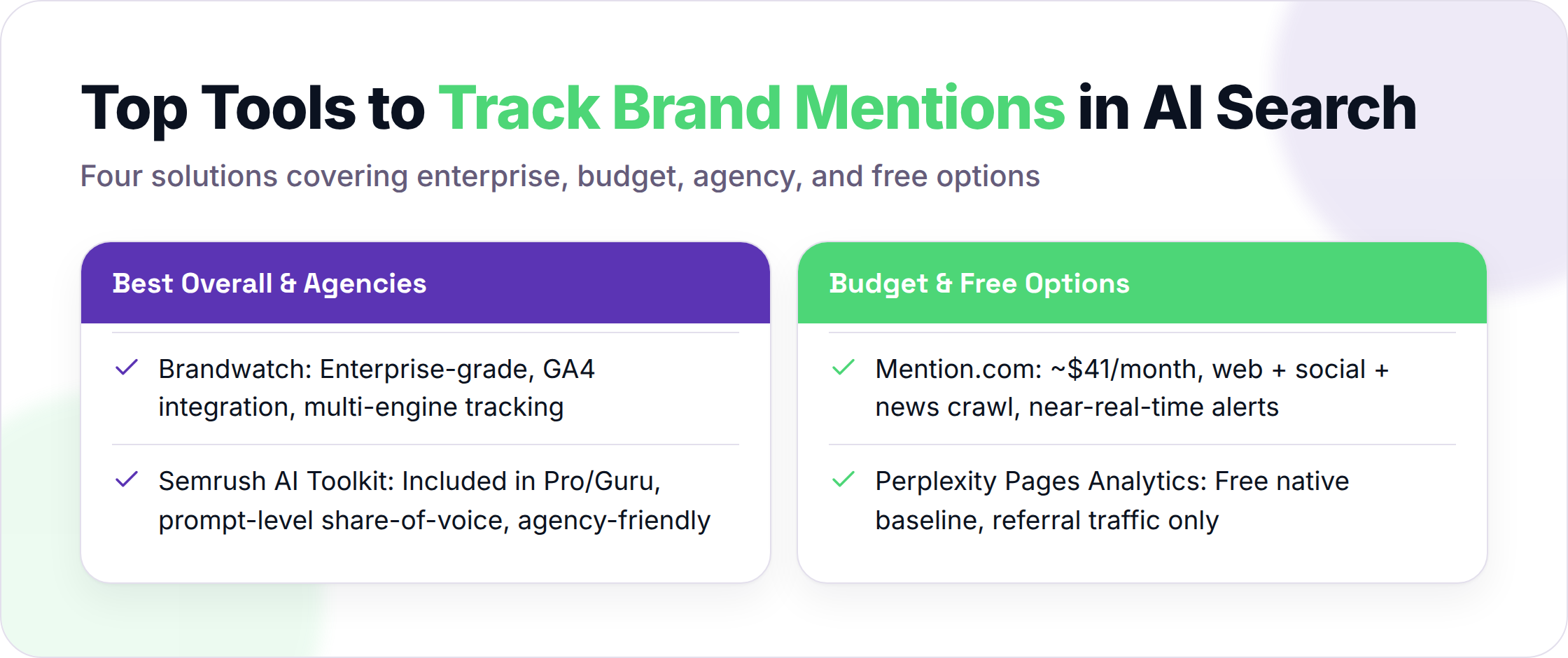
For most teams looking to track brand mentions in AI search engines in 2026, four tools cover the realistic range of needs: Brandwatch for full-stack citation tracking with GA4 integration, Mention.com for affordable alert coverage under $50/month, Semrush's AI Toolkit for agencies that need prompt-level share-of-voice data, and Perplexity Pages Analytics as a free native baseline for Perplexity-specific traffic.
| Use Case | Our Pick | Starting Price |
|---|---|---|
| Best overall | Brandwatch for AI Search | Custom (enterprise) |
| Best budget option | Mention.com | ~$41/month |
| Best for agencies | Semrush AI Toolkit | Included in Semrush Pro |
| Free baseline | Perplexity Pages Analytics | Free (native) |
Brandwatch earns the top slot because it connects citation events directly to GA4 sessions, so you can trace whether an AI-driven mention actually moved traffic. That closed loop is rare at this level of multi-engine coverage.
Mention.com is the practical choice for small teams. At under $50/month, it covers real-time web and social alerts with enough keyword filtering to catch most brand mentions across AI-generated content that surfaces publicly.
Semrush AI Toolkit goes deepest on prompt tracking and share-of-voice reporting. The Semrush brand mentions guide outlines the KPIs that matter most here: citation frequency, co-mention context, and sentiment weighting across AI responses. For agencies managing multiple clients, that structured reporting layer is hard to replicate with lighter tools.
Perplexity Pages Analytics is the honest free option. It feeds referral data into Google Analytics, giving you a baseline read on Perplexity-sourced sessions without any additional spend.
One trade-off worth naming: none of these tools give you complete coverage across all four major AI engines simultaneously at the budget tier. Mention.com, for instance, catches public-facing content that references your brand, but it does not poll ChatGPT or Claude directly with tracked prompts. If your buyers are asking questions inside those closed environments, you will miss citations that never appear in any crawlable page. That gap grows as AI assistants handle more zero-click research sessions.
Top Pick: Brandwatch for AI Search
Brandwatch is the strongest enterprise-grade option for teams that need AI citation tracking embedded inside a broader media intelligence workflow. It monitors branded search as an AI visibility signal across ChatGPT, Perplexity, Gemini, and Bing Copilot, pulling those signals into the same dashboard where you already manage social listening, press coverage, and forum mentions. For teams running multi-market reputation programs, that consolidation reduces tool sprawl without sacrificing depth.
What It Actually Tracks
Brandwatch treats AI engine citations as a distinct signal category, not a footnote inside a general mentions feed. When your brand appears in a ChatGPT response or a Perplexity answer, the platform logs the engine, the query context, and the sentiment of the surrounding passage. Gemini and Bing Copilot coverage was added to the suite in 2024, which means the platform now spans the four AI engines that account for the majority of AI-assisted search sessions in most B2B and B2C categories.
The practical value: you can filter your brand mention volume by source type, isolate AI-generated citations from organic press hits, and track whether sentiment in AI answers shifts after you publish new content or earn a major press mention. That kind of before-and-after comparison is hard to run in tools that mix AI and social signals into a single undifferentiated stream.
Setup and Integrations
Connecting Brandwatch to your existing stack takes under 30 minutes for the core integrations. GA4 connects via a native connector that maps traffic spikes to citation events, so you can see whether an uptick in AI mentions correlates with direct or branded search volume. Slack alerts are configured through the notification center and can be scoped to specific query types, sentiment thresholds, or competitor mentions. Zapier automations extend that further: most teams wire citation alerts into their CRM or content calendar within the first session.
Alhena's 2026 roundup of AI brand visibility tools notes that tools automating multi-engine citation tracking save teams meaningful manual monitoring time compared to manual prompt-testing workflows. Brandwatch's integration layer is one of the reasons it holds up at enterprise scale, where a single Slack alert per mention quickly becomes unmanageable without routing logic.
Where It Falls Short
The trade-off is significant if you are not an enterprise buyer. Brandwatch pricing starts at $800 per month, and the prompt-tracking dashboard, the feature most relevant to AI search monitoring specifically, requires onboarding support to configure correctly. That is not a knock on the product; it reflects how the platform was built. It was designed for teams with a dedicated analyst or a social intelligence function, not for a two-person marketing team running lean.
The prompt-tracking setup involves defining query clusters, setting geographic scope, and mapping competitor handles before the dashboard produces useful output. Without that initial configuration, the AI citation data surfaces as raw volume with limited context. Most teams need at least one onboarding session, sometimes two, before the reporting becomes actionable.
If your primary goal is tracking AI citations without the broader media intelligence layer, the $800/month entry point is hard to justify. Brandwatch earns its price when you are already paying for enterprise social listening and want AI engine coverage folded in, not when AI monitoring is the only thing you need.
Budget Pick: Mention.com
Mention is a brand monitoring platform that crawls web content, social channels, and news sources in near-real-time, alerting you whenever your brand name, product names, or competitor terms appear in published content. For teams watching AI citation budgets closely, it covers a meaningful slice of the problem at a fraction of enterprise tool pricing. Plans start at $41/month, making it the most accessible entry point for systematic brand monitoring in 2026.
What Mention Actually Monitors
The core setup is straightforward. You create alerts for your brand name, key product names, and two or three competitor terms. Mention then surfaces every published mention across news sites, blogs, forums, and social platforms, usually within minutes of publication.
The AI-adjacent value comes from what those sources increasingly contain. A large share of published blog posts and news summaries are now written with AI assistance, and when those pieces cite your brand, Mention catches them. Only 14% of brands are currently tracking their AI/LLM visibility in any structured way, per an Exploding Topics survey on AI search adoption, so even this indirect coverage puts you ahead of most competitors.
Using Boolean Queries and Source Filters
Mention supports Boolean query syntax, which lets you get precise. A query like "YourBrand" AND ("AI" OR "ChatGPT" OR "Perplexity") will surface mentions where your brand appears alongside AI-related terms, a useful proxy for AI-generated or AI-adjacent content.
Pair that with Mention's source filters. Set a custom source list that includes known AI news outlets, AI-focused newsletters, and high-authority tech blogs. Then tag inbound mentions by source type so your weekly report separates AI-adjacent coverage from general press. That tagging layer is manual, but it takes about 20 minutes to configure once and runs automatically after that.
Where Mention Falls Short
Mention does not poll ChatGPT, Claude, or Gemini directly. It catches mentions that appear in publicly crawlable content, which means any citation that lives only inside a closed AI conversation is invisible to it. For brands whose buyers do most of their research inside AI chat interfaces rather than on published web pages, that is a real gap.
The sentiment analysis is also basic compared to Brandwatch. Mention flags positive, neutral, or negative at the mention level, but it does not parse the surrounding passage context the way enterprise tools do. A mention that reads "YourBrand is often cited, though competitors tend to score higher on ease of use" would likely register as neutral rather than mixed-negative. For reputation management, that distinction matters.
Agency Pick: Semrush AI Toolkit
Semrush added AI Overviews tracking and prompt-level share-of-voice reporting to its existing suite in 2024, making it the most practical option for agencies that already run Semrush for SEO and want AI citation data in the same workflow. If you are on Semrush Pro or Guru, the AI Toolkit is included at no additional cost.
Prompt-Level Share of Voice
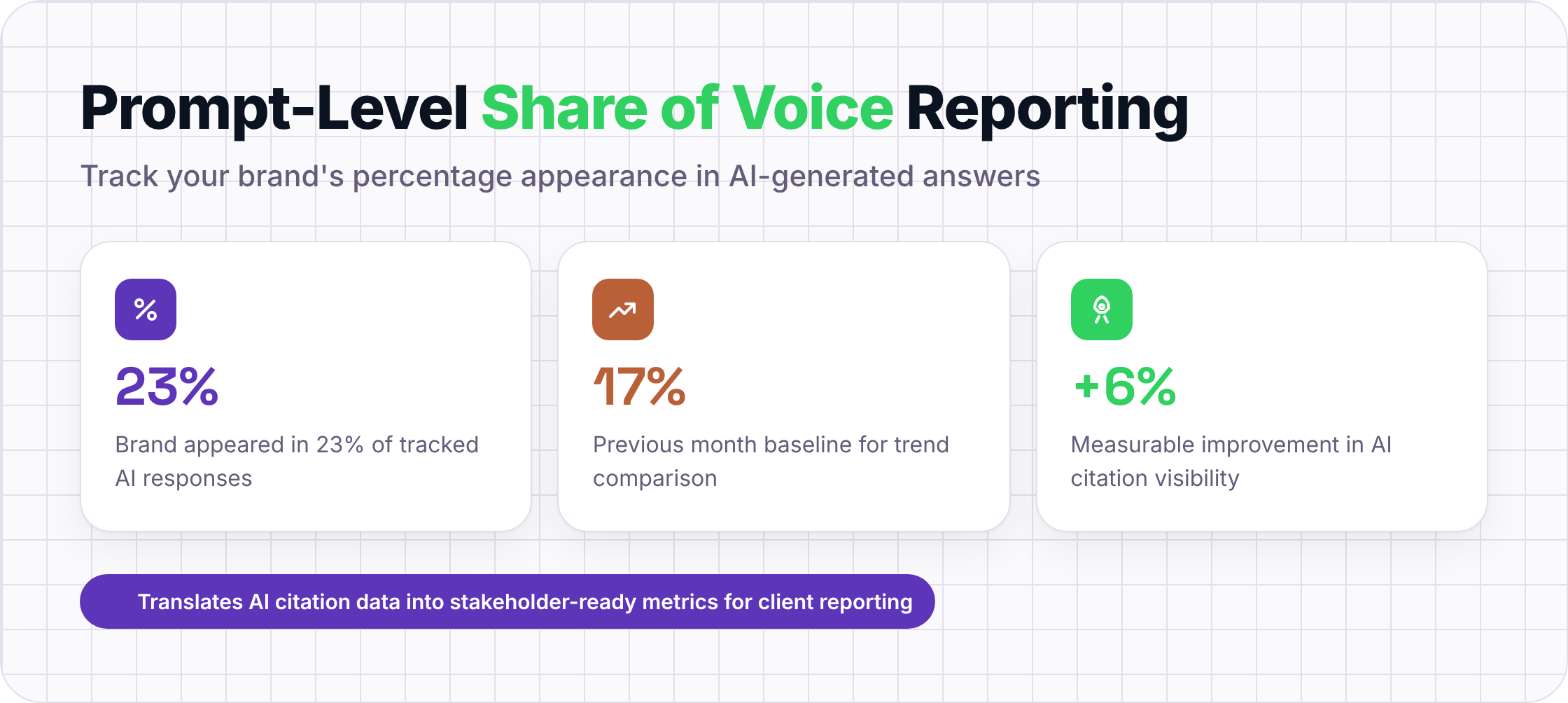
The standout feature is prompt-level share-of-voice reporting. You define a set of category queries ("best project management tools for remote teams," "top CRM for small business"), and Semrush tracks how often your brand appears in AI-generated answers for those queries over time. The output is a percentage: your brand appeared in 23% of tracked AI responses this month, up from 17% last month.
That framing is useful for client reporting. It translates AI citation data into a metric that non-technical stakeholders can read without explanation. The Semrush brand mentions guide covers the full KPI framework, including how to weight citation frequency against sentiment and co-mention context when building a monthly report.
Integration with Existing SEO Workflows
Because Semrush already holds your keyword data, backlink profile, and content audit history, the AI Toolkit can surface correlations that standalone monitoring tools cannot. You can see, for example, whether pages with strong backlink profiles are more likely to be cited in AI responses, or whether a content refresh on a specific page improved your citation rate for related queries within 30 days.
That kind of cross-signal analysis is where Semrush earns its place for agencies. A standalone AI monitoring tool gives you citation counts. Semrush gives you citation counts alongside the SEO variables that may be driving them.
Where It Falls Short
Semrush AI Toolkit coverage is strongest for Google AI Overviews and weakest for ChatGPT and Claude. If your buyers primarily use ChatGPT for research, the share-of-voice numbers will underrepresent your actual AI citation rate. Semrush has indicated expanded coverage is on the roadmap, but as of mid-2026, the gap is real and worth factoring into your tool selection.
The prompt library also requires manual curation. Semrush does not auto-suggest queries based on your existing keyword data, so you will spend time upfront defining the prompt set. For agencies onboarding a new client, that setup adds roughly two to three hours before the first report is usable.
Free Baseline: Perplexity Pages Analytics
If you publish content on Perplexity Pages or your site receives referral traffic from Perplexity, the native analytics integration gives you a free read on how often Perplexity is sending users your way. Connect it to Google Analytics via the standard referral source setup, and you get session volume, bounce rate, and page-level data for Perplexity-sourced traffic.
What It Tells You
Perplexity Pages Analytics does not tell you which queries triggered the referral or what the surrounding AI response said. It tells you that traffic came from Perplexity, how much, and which pages it landed on. That is a narrow signal, but it is a real one.
The practical use case: if you notice a spike in Perplexity referral traffic to a specific product page, that is a signal worth investigating. Run the relevant category queries manually in Perplexity and check whether your brand is being cited. If it is, you have a confirmed citation event you can document and build on.
The Ceiling
Perplexity Pages Analytics is a starting point, not a monitoring system. It captures downstream traffic effects, not the citation events themselves. You will not know you were cited until someone clicks through, which means zero-click citations, the majority of AI search interactions, are invisible to this method.
Use it as a sanity check alongside a paid tool, not as a replacement for one.
How to Choose Between These Tools
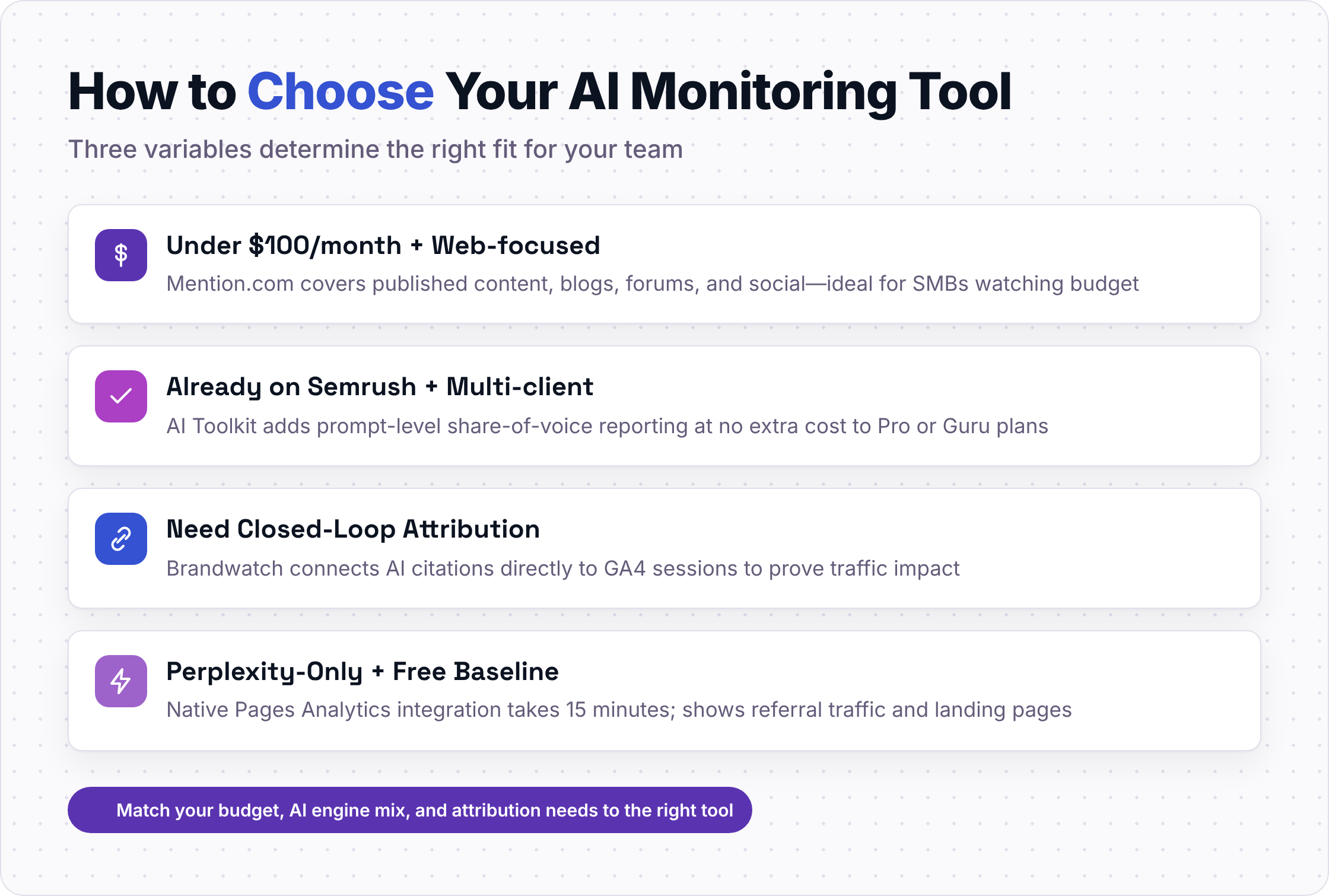
Your choice depends on three variables: budget, which AI engines your buyers actually use, and whether you need AI citation data integrated with other marketing signals or as a standalone feed.
If you are spending under $100/month and your buyers primarily research on published web content, Mention.com covers the basics. If you are already on Semrush and manage multiple clients, the AI Toolkit adds meaningful reporting without additional cost. If you need closed-loop attribution from AI citation to GA4 session and have the budget for it, Brandwatch is the only tool in this comparison that delivers that reliably. And if you want a free sanity check on Perplexity traffic specifically, the native analytics integration takes 15 minutes to set up.
No single tool in this comparison covers all four major AI engines with equal depth at the SMB price point. The honest answer is that most teams will need two tools: one for direct prompt tracking (Semrush or a dedicated GEO platform) and one for public-web mention coverage (Mention.com). That combination runs under $150/month for most configurations and covers the majority of the citation surface area that matters.
Frequently Asked Questions
Can I track brand mentions in AI search engines for free?
Yes, but with significant limitations. Perplexity Pages Analytics gives you referral traffic data from Perplexity at no cost, and Google Search Console surfaces some AI Overviews impression data. Neither tool tells you what the AI response said or which query triggered the mention. For anything beyond a rough baseline, a paid tool is necessary.
How often should I run branded prompts to monitor AI citations?
Weekly is the minimum cadence that produces reliable trend data. Brand24's GEO tracking research found that AI engine outputs shift week to week, with citations appearing and disappearing without obvious triggers. Running prompts less frequently than weekly means you may miss a citation window entirely, or attribute a drop in visibility to the wrong cause.
Do AI monitoring tools work across all major engines?
No tool in this comparison covers ChatGPT, Perplexity, Gemini, and Copilot with equal depth at the SMB price point. Semrush AI Toolkit is strongest on Google AI Overviews. Brandwatch covers all four but requires enterprise pricing. Mention.com covers publicly crawlable content only, so closed AI conversations are outside its scope. You should verify engine-specific coverage with any vendor before committing.
What is the difference between a brand mention and a citation in AI search?
A brand mention is any appearance of your brand name in a piece of content. A citation in AI search is specifically when an AI engine references your brand inside a generated answer, often with a linked source. Citations carry more weight for buyer decision-making because they appear in a context where the AI is actively recommending or evaluating options. Monitoring both is useful, but they require different tools and different interpretive frameworks.
How do I know if an AI engine is citing my brand positively or negatively?
Most monitoring tools offer sentiment scoring at the mention level, but the accuracy varies. Brandwatch parses the surrounding passage context, which catches mixed-sentiment mentions more reliably. Mention.com uses simpler positive/neutral/negative classification that can misread nuanced phrasing. For high-stakes reputation monitoring, manually reviewing a sample of flagged citations each week is worth the time, regardless of which tool you use.
Will improving my SEO help me get cited more in AI search engines?
Partially. AI engines tend to cite sources with strong backlink profiles, clear topical authority, and structured content that is easy to parse. Those are also core SEO signals. However, AI citation is not a direct function of search ranking: a page that ranks #1 on Google can be absent from a Perplexity response, and a page that ranks on page two can be cited repeatedly. The overlap is real but incomplete, and optimizing specifically for AI citation, sometimes called GEO (Generative Engine Optimization), involves additional steps beyond standard SEO.
If you want structured help setting up prompt tracking and citation monitoring across the major AI engines, visit SEORav's GEO service page to see how the methodology described in this article translates into an ongoing monitoring program for your brand.
Keep reading
Which LLM Citation Tracking Platform Actually Works for Your Brand
Compare the top llm citation tracking platforms by engine coverage, alert speed, and pricing. Find the right tool for your team size and budget.
Siteimprove for SEO: What It Does (and What It Doesn't)
A clear-eyed look at Siteimprove SEO features, pricing, and gaps versus AI-native platforms. Find out if it fits your team's workflow in 2026.
How AI Overviews Are Reshaping Organic Traffic (And What SEOs Must Do)
AI Overviews now trigger on 30%+ of Google queries. See how zero-click search AI impact on organic traffic is measured, and what SEOs can do about it.