How to Get Your Content Cited Across Multiple AI Models

Last updated: 1 October 2026
Decentralized footprint expansion means publishing your content across multiple platforms and formats so different AI models can discover and cite it. ChatGPT, Claude, Gemini, and Perplexity train on different datasets and weight sources differently, so a single optimized page rarely reaches all four reliably. You need presence across owned channels, third-party publications, structured data markup, and social signals to ensure consistent citation across the AI landscape. The specific distribution strategy depends on your content type and audience.
The 2026 Stanford AI Index tracks how rapidly these models are diverging in architecture and data sourcing. That divergence has a direct consequence for content strategy: what Perplexity's live-web retrieval layer cites is not the same set of pages that surfaces in Claude's synthesis or Gemini's grounded responses.
One honest caveat up front: earning citations across all four engines simultaneously takes time. Most content gains traction in one or two models first, then spreads as third-party mentions accumulate and the content ages into authority.
TL;DR
Each AI engine pulls from different sources, applies different ranking signals, and surfaces different formats. Publishing one article and hoping it travels is not a reliable plan.
- Decentralized footprint expansion means distributing citable content across multiple formats, domains, and authority sources so no single AI engine's preferences determine whether you get cited.
- Single-model strategies fail because each engine indexes and weights sources differently. Optimizing only for Perplexity does nothing for your Claude citation rate.
- Structure for multi-model citation by leading with a direct answer, attaching schema markup, and citing external authority sources. Those signals travel across engines regardless of their individual ranking logic.
- Track your footprint by polling each engine weekly with the prompts your buyers actually use, then logging which URLs get cited and which competitors keep appearing instead.
The trade-off is real: a broader footprint takes more coordination. Teams with limited publishing capacity will find it harder to maintain citation-ready content across every format and channel at once. Prioritize the two or three prompts closest to your buyers' decisions before expanding scope.
What Decentralized Footprint Expansion Means for AI SEO
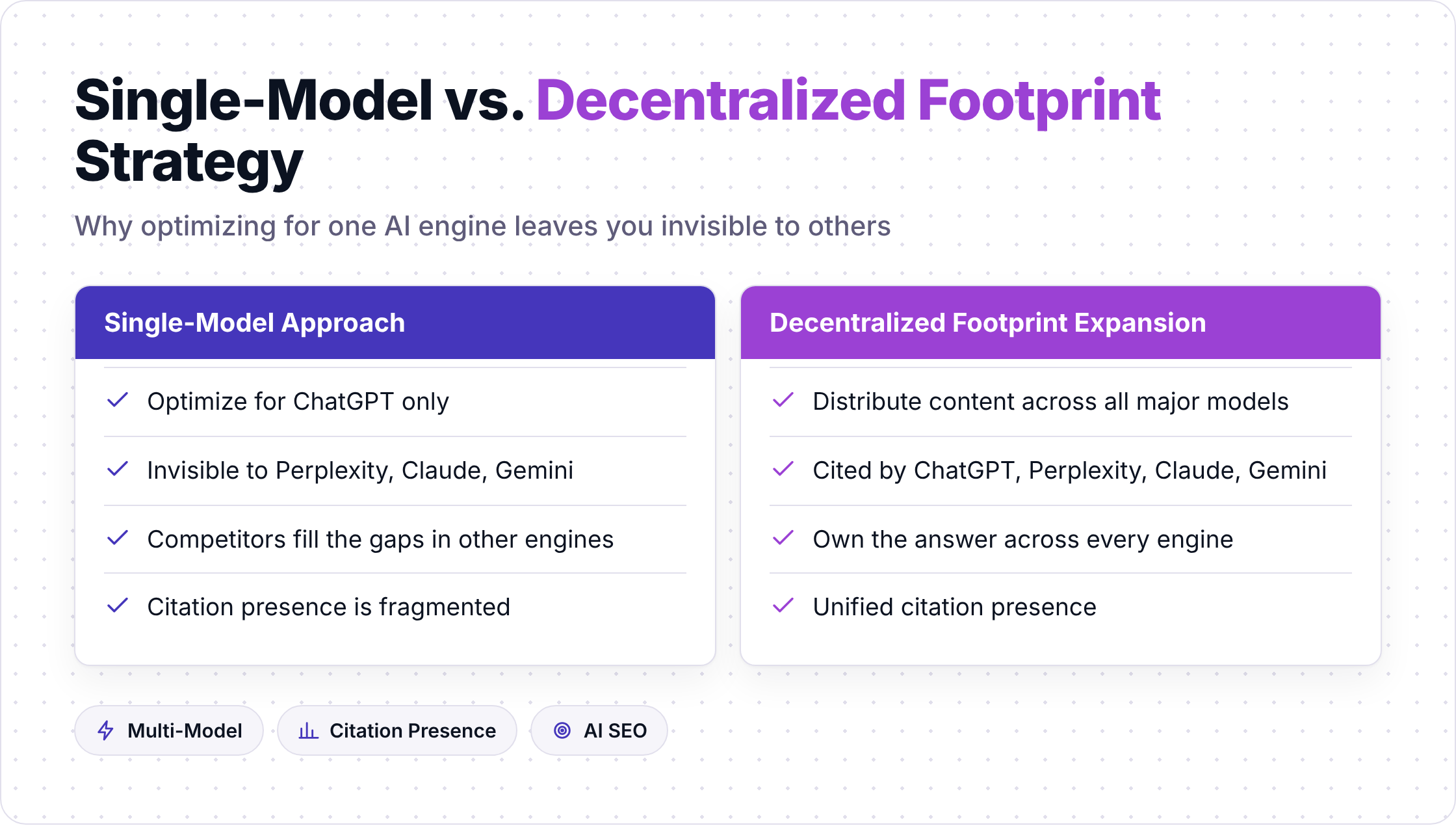
Decentralized footprint expansion means building citation presence across multiple AI models at the same time, rather than optimizing for a single engine. Each model (ChatGPT, Perplexity, Claude, Gemini) draws from distinct training corpora, retrieval indexes, and plugin ecosystems. A brand cited frequently by one model may be nearly invisible to another. Treating AI citation like a single-channel problem is the core mistake most content teams make.
Why Your Google Footprint Only Partially Transfers
Ranking well on Google and getting cited by AI models are related goals, but they share less overlap than most teams expect. Google's ranking signals weight backlinks, page authority, and keyword relevance. AI citation signals weight structural clarity, factual density, and whether a passage answers a specific question cleanly enough to be extracted verbatim.
The numbers reflect this gap. Rankability's analysis of AI search behavior found that a significant share of AI-cited sources do not rank in the top 10 Google results for the same query. A page can be authoritative enough for an AI retrieval index without holding a strong organic position, and vice versa.
Each model compounds this divergence further. ChatGPT's browsing and plugin layer pulls from sources Perplexity's retrieval stack may never surface. Claude's constitutional training shapes which domains it treats as credible. Gemini integrates Google's own index but applies its own citation logic on top of it. The result: cross-model citation overlap for any given brand tends to be lower than 40%, based on Semrush's 2024 AI search data.
The Trade-Off Worth Naming
Pursuing a decentralized citation footprint takes more content surface area than most teams budget for. Structuring articles to satisfy Perplexity's retrieval preferences (short, answer-first passages with clear attribution) can conflict with the longer narrative formats that tend to earn backlinks and Google authority.
Optimizing hard for AI extractability sometimes produces pages that feel thin to a human reader skimming for depth. Teams that ignore this tension often end up with content that performs well in one channel and poorly in the other. The practical fix is to build both layers into a single article: a dense, citable opening passage for AI extraction, followed by substantive supporting sections for human readers and link acquisition.
Why Single-Model Citation Strategies Fail
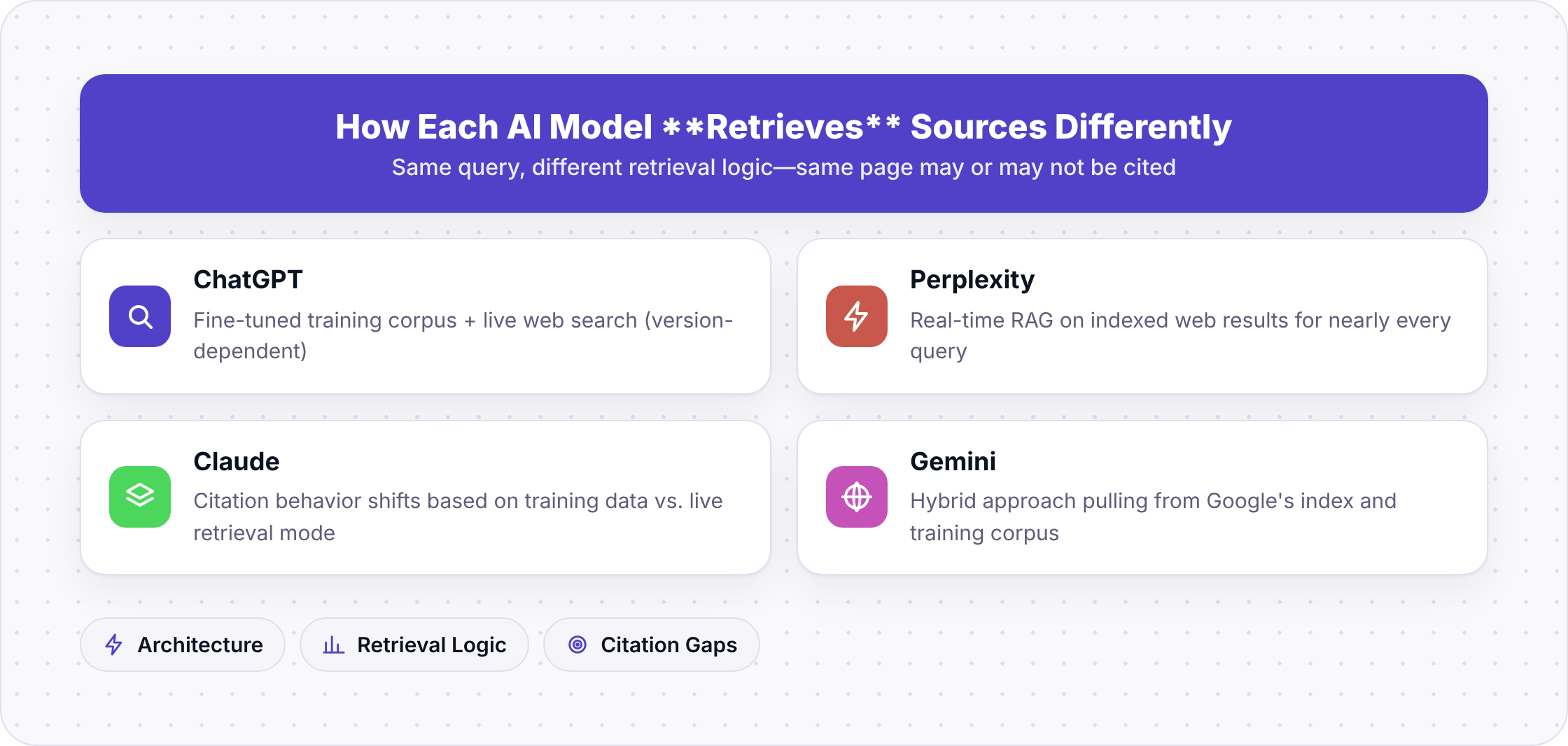
Optimizing your content for one AI model and expecting cross-model visibility is like buying a billboard on one highway and assuming drivers on three others will see it. Each major AI model (ChatGPT, Claude, Gemini, and Perplexity) retrieves and surfaces sources through different underlying architectures. A page that earns citations in ChatGPT responses can be completely absent from Claude or Perplexity answers to the identical query, leaving your competitors to fill that gap.
The Architecture Problem
The divergence starts at the retrieval layer. ChatGPT (depending on the version and whether web browsing is active) may pull from its fine-tuned training corpus, a live web search, or both. Perplexity runs real-time retrieval-augmented generation (RAG) on indexed web results for nearly every query. Claude's citation behavior shifts depending on whether it's operating within its training cutoff or using tool access. Gemini blends Google Search grounding with its own parametric knowledge.
These are not cosmetic differences. A page optimized for dense, structured prose that performs well in fine-tuned recall may score poorly in a RAG pipeline that weights recency and anchor-text clarity. The structural signals that get you cited in one model can actively work against you in another.
A Concrete Scenario
Consider a SaaS brand that holds the number-one organic ranking on Google for "best project management software for remote teams." Their SEO is solid: fast page, clean schema, strong backlink profile. But Perplexity's RAG pipeline is pulling from a fresher set of indexed sources, and Claude is surfacing a competitor whose content is structured as a direct, answer-first response to that exact query. The brand is invisible in both.
This scenario is more common than most marketing teams expect. Research on how digital platforms expand across information environments shows that source authority is context-dependent: a signal that confers credibility in one retrieval system does not automatically transfer to another. Google PageRank and AI citation likelihood are measuring different things.
The Trade-Off Worth Acknowledging
A multi-model citation strategy does add complexity. Structuring content to perform across RAG pipelines, fine-tuned recall, and real-time web retrieval means you are optimizing for several different signals at once, and some of those signals pull in opposite directions. Dense, long-form content tends to perform better in parametric recall; concise, answer-first formatting tends to win in RAG.
Trying to serve both can dilute the clarity of either. The practical resolution is to lead with a tight, self-contained answer block (for RAG and real-time retrieval), then follow with depth (for fine-tuned models), rather than blending the two into a single undifferentiated mass.
Brands that treat AI citation as a single-channel problem will keep optimizing for ChatGPT while Claude and Gemini users see someone else's name.
Mapping and Structuring Content for Multi-Model Citation
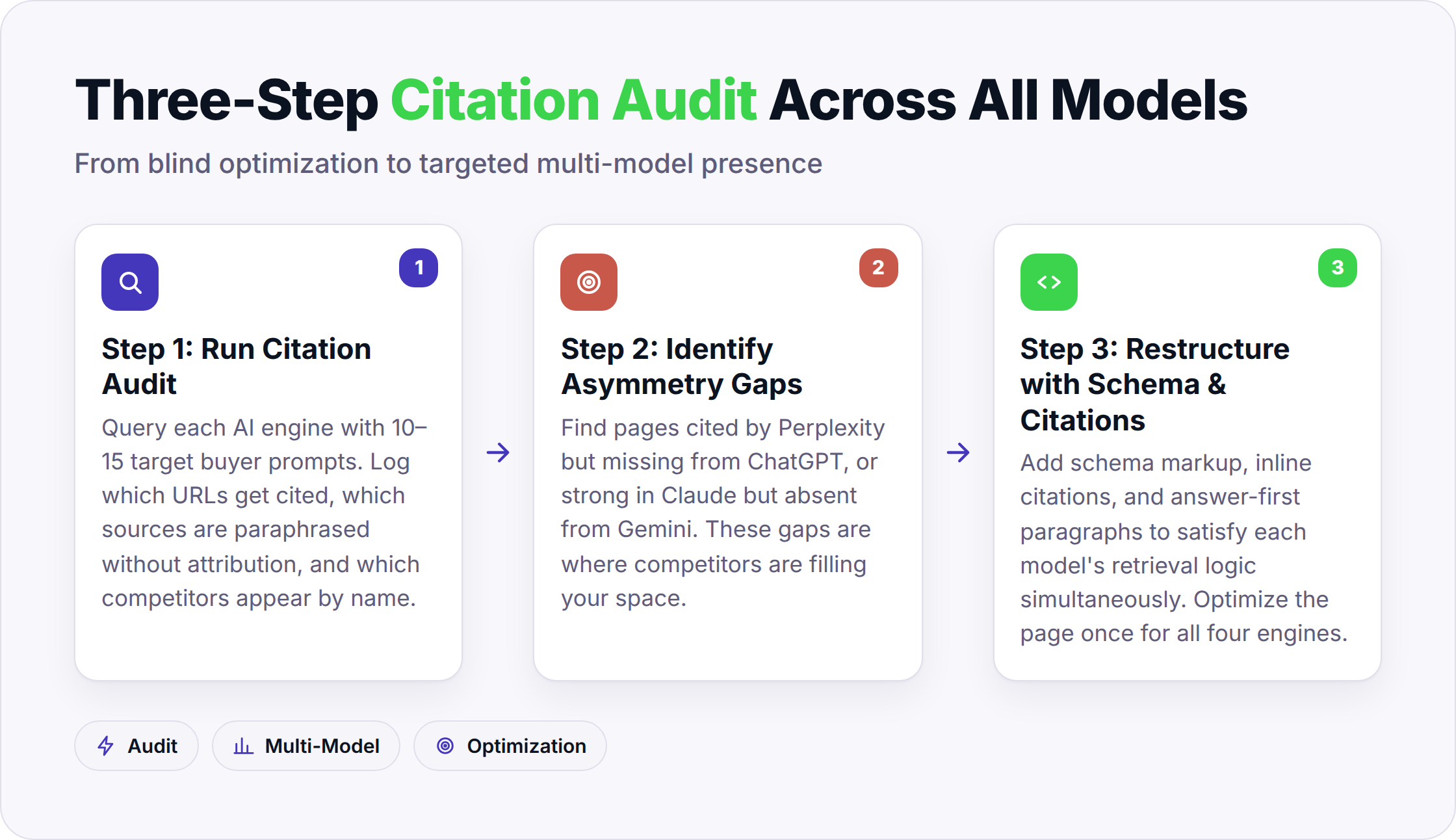
Getting cited across ChatGPT, Claude, Gemini, and Perplexity simultaneously requires three steps: audit which models currently surface your content, identify the gaps where competitors appear instead of you, then restructure existing pages with schema markup, inline citations, and answer-first paragraphs that satisfy each model's retrieval logic at once. The audit is the part most teams skip, and skipping it means optimizing blind.
Step 1: Run a Citation Audit Across All Four Models
Open each AI engine and query it with the exact questions your buyers type. Log every response: which URLs get cited, which sources get paraphrased without attribution, and which competitors appear by name. Do this for at least 10 to 15 target prompts per model, because citation behavior varies by query type, not just by domain authority.
The pattern you are looking for is asymmetry. A page that Perplexity cites consistently may never appear in a Claude response to the same question. That asymmetry tells you something specific about format, not just about authority.
Step 2: Map Citation Gaps to Content Format Preferences
Once you have the audit data, sort your gaps by model. Each engine has observable retrieval tendencies:
- Perplexity favors pages with inline citations and structured definitions near the top.
- ChatGPT pulls from content with clear numbered steps and named sources.
- Gemini responds well to pages with FAQ schema and concise factual claims.
- Claude tends to surface longer-form content with explicit reasoning chains and hedged conclusions.
JMLR's Transactions on Machine Learning Research documents how multi-model systems diverge in their weighting of structured versus unstructured inputs, which maps directly to why the same article gets cited by one engine and ignored by another.
Run competitor prompts next. Take the queries where a competitor gets cited and you do not, then pull their cited page. Note the format: is it a definition block, a step-by-step guide, a stat-heavy summary? That format is what the model rewarded. Your equivalent content needs to match it structurally, not just topically.
Step 3: Restructure Existing Content for Simultaneous Retrieval
Restructuring is faster than rewriting from scratch. For most pages, three targeted changes cover the majority of the gap.
First, move the core answer to the first paragraph. AI engines extract the opening passage most reliably. A page that buries its definition in paragraph four will lose the citation to a page that leads with it.
Second, add JSON-LD schema. At minimum, Article and FAQPage schema give models a structured signal about what the page is and what questions it answers. The Semantic Engine architecture described in Codata's 2024 data science journal demonstrates how schema-documented content structures improve machine-readable retrieval, a principle that applies directly to how AI engines parse and attribute web content.
Third, add inline citations to your own factual claims. A sentence that says "conversion rates drop 12% when page load exceeds three seconds" is more citable than one that says "slow pages hurt conversions." The specificity signals that the claim is grounded, and models treat grounded claims as safer to quote.
The trade-off is real, though. Answer-first structures and heavy schema can reduce the narrative flow that keeps human readers engaged long enough to convert. Build both layers deliberately: a tight, extractable opening for AI retrieval, and enough substantive depth below it to satisfy a reader who keeps scrolling.
Frequently Asked Questions
How long does it take to start appearing in AI citations?
Most content earns its first AI citations within four to eight weeks of publication, assuming it is indexed, structured with schema, and published on a domain with at least some existing authority. Cross-model citation (appearing in three or four engines for the same query) typically takes longer, often three to six months, as third-party mentions accumulate and the content ages into credibility signals that multiple retrieval systems recognize.
Does ranking on Google guarantee AI citations?
No. Semrush's 2024 AI search data shows that cross-model citation overlap for a given brand tends to fall below 40%, and a meaningful share of AI-cited pages do not hold top-10 Google rankings for the same query. Google PageRank and AI citation likelihood measure different things. A page can satisfy an AI retrieval index without ranking organically, and a strong organic ranking does not automatically translate into AI citation.
Which AI model is hardest to get cited in?
Claude is generally the most selective, partly because its constitutional training shapes which domains it treats as credible and partly because it tends to favor longer-form content with explicit reasoning and hedged conclusions rather than short answer-first formats. Perplexity is often the easiest entry point because its real-time RAG pipeline indexes fresh content quickly and rewards inline citations and structured definitions near the top of the page.
Do I need separate pages for each AI model?
You do not need entirely separate pages, but you do need content that serves multiple retrieval preferences within a single page. The practical approach is to lead with a tight, self-contained answer block (which satisfies RAG-based engines like Perplexity) and follow it with substantive depth and explicit reasoning (which satisfies parametric recall in models like Claude). One well-structured page can serve both layers without requiring you to publish four separate versions.
What schema markup matters most for AI citation?
Article and FAQPage schema are the highest-priority starting points. Article schema tells retrieval systems what the page is and who authored it. FAQPage schema surfaces discrete question-and-answer pairs that AI engines can extract cleanly. If your content includes a defined term or concept, adding HowTo or DefinedTerm schema where appropriate gives models additional structured signals to work with.
How do I track whether my content is being cited?
Poll each engine manually on a weekly cadence using the 10 to 15 prompts your buyers actually use. Log which URLs appear, which competitors are named, and which claims get paraphrased without attribution. There is no single automated tool that reliably tracks citations across all four major AI engines simultaneously, so a structured manual audit remains the most accurate method for now. Some SEO platforms are beginning to add AI citation tracking features, but coverage is still inconsistent across models.
If you want a structured approach to building and tracking your decentralized footprint expansion across all four major AI engines, see how Seorav can help. The team works directly on GEO strategy, citation audits, and content restructuring for multi-model visibility.
Keep reading
Keeping Your Content Fresh Enough for AI Search Rankings
Learn how Freshness Decay Deflection keeps your content eligible for AI citations. Audit, update, and measure with a proven quarterly process.

How to Audit Your Content's Stability in AI Search Results
Learn how to run agentic SERP volatility audits that track AI citation stability across ChatGPT, Perplexity, and Google AI Overviews, with scoring and fix
How to Track Your Brand's Mentions Across AI Search Results
Learn how to measure brand mention share across ChatGPT, Perplexity, Gemini, and Copilot, with a step-by-step formula, tool guide, and FAQ.