How to Create Content That Ranks: An SEO-First Approach
Last updated: 13 September 2026
SEO and content creation succeed when you reverse the usual order: start by matching what searchers actually type, then structure your pages so Google's crawlers and readers both understand your argument without friction, and finally build topical depth across related posts until your site becomes the obvious authority. Most creators skip the first step and wonder why their polished content never ranks. The difference between invisible and visible content often comes down to whether you optimized for intent before you optimized for keywords.
That order matters. Most content fails at step one. The numbers back this up: 66.3% of SEO professionals identify original content creation as their highest-impact activity, yet most teams still publish before confirming intent alignment. Effort without intent-fit is just noise.
The connection between SEO and content creation is tighter than most teams treat it. This article covers the full sequence: how to read what a query actually demands, how to structure pages so crawlers and readers both follow them, how to signal expertise through on-page choices, and what to check before anything ships.
One honest caveat: none of this produces overnight results. Topical authority compounds over months, not days. The framework here is built for teams willing to do the work once and do it right.
TL;DR: Key Takeaways
Ranking content starts with keyword research, not writing. Structure your pages around search intent, build in algorithm signals while writing for real readers, and track performance with metrics that reflect actual organic value, not vanity counts.
- Keyword research first. Pick terms before you write a word. Intent shapes everything downstream.
- Structure for intent. Match your format (guide, comparison, answer page) to what the searcher actually wants.
- Write for humans, with signals baked in. Schema, internal links, and answer-first openings belong in the draft, not the revision.
- Measure with real SEO metrics. Organic clicks, ranking position, and citation frequency matter. Impressions alone do not.
One number worth keeping in mind: 68.01% of Google searches in early 2026 ended without a click, Sparktoro's zero-click search analysis shows. Getting ranked is no longer enough on its own. Your content also needs to be the source AI engines and featured snippets pull from directly.
The trade-off is real. An SEO-first approach works well for informational and commercial-investigation queries. It breaks down when you apply the same rigid structure to brand storytelling or thought leadership, where voice and originality carry more weight than keyword density or schema markup. Forcing every piece through the same optimization checklist flattens the writing and often produces content that ranks but does not convert.
The Relationship Between SEO and Content Creation
Google's systems read topical depth, authorship signals, and user engagement to decide which pages deserve visibility. Without content built around those signals from the start, technical SEO is infrastructure with nothing to carry. Content is the primary ranking signal because it is the only thing search engines can actually evaluate.
Incremys' 2026 SEO benchmarks show that organic search drives over 53% of all trackable website traffic, making it the single largest acquisition channel for most businesses. That traffic does not flow to well-structured sites in general. It flows to specific pages that answer specific queries with enough depth to satisfy the intent behind them.
Google's Helpful Content system makes this concrete. Introduced in 2022 and folded into the core algorithm by 2024, it scores pages on topical completeness, first-hand expertise, and whether the content exists primarily to help a reader or primarily to capture a ranking. A page that covers a topic shallowly, or that aggregates information without adding original perspective, scores poorly under that framework regardless of its backlink count.
The feedback loop this creates is worth understanding precisely. High-quality content earns dwell time, return visits, and external links. Those signals lift domain authority. Higher domain authority makes future content easier to rank. Over time, 36.3% of SEO professionals report prioritizing detailed articles and original research as their primary link-earning tactic, because earned links compound in a way paid placements do not.
The trade-off, however, is time. This feedback loop is slow. A new domain publishing genuinely useful content may wait six to twelve months before authority signals accumulate enough to move rankings meaningfully. Teams under pressure to show short-term results often abandon the approach before the compounding kicks in. Any honest SEO strategy should account for that rather than promise faster returns than the mechanism actually delivers.
Keyword Research Before You Write a Single Word
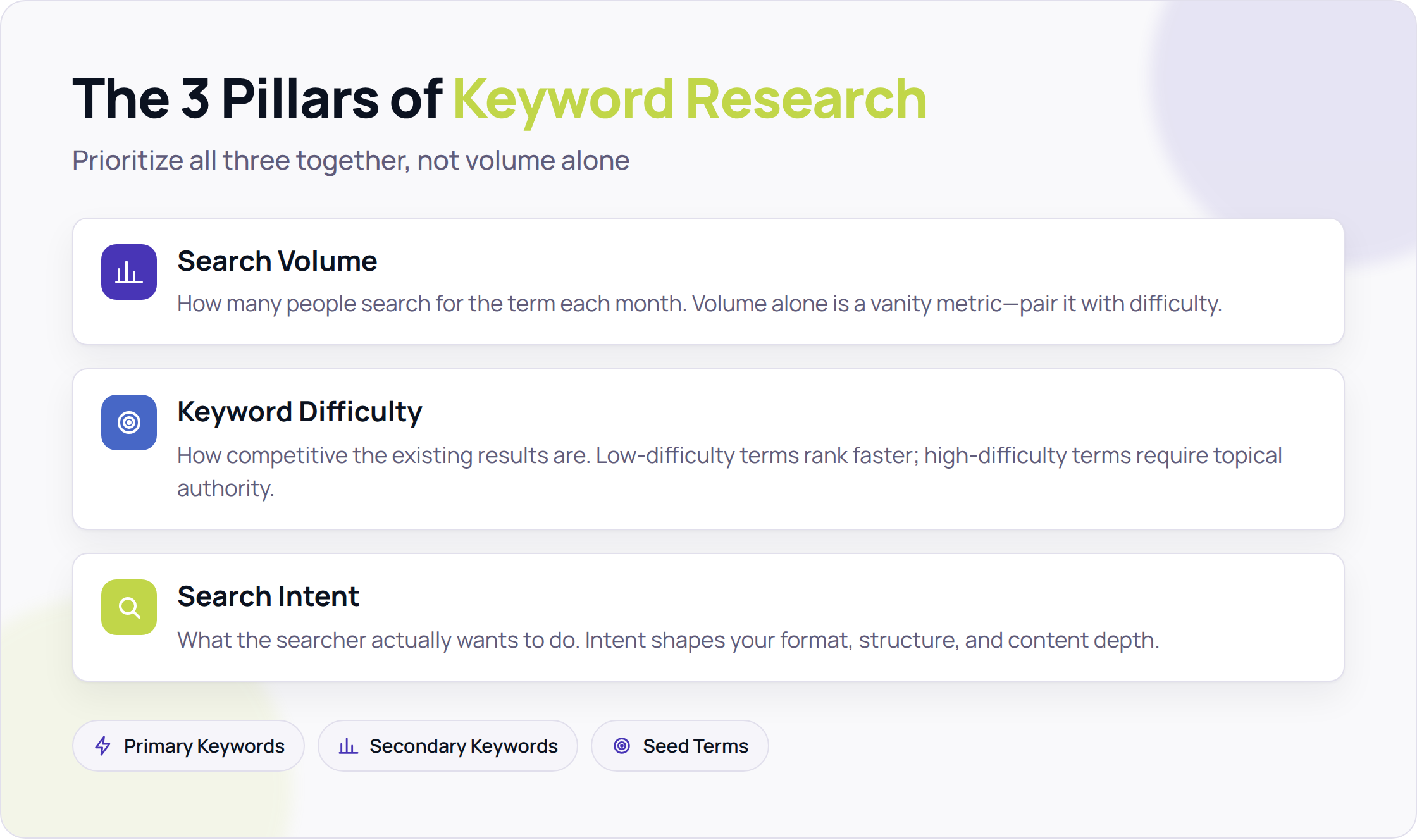
Effective keyword research starts with three data points: search volume (how many people look for a term each month), keyword difficulty (how competitive the existing results are), and search intent (what the searcher actually wants to do). Prioritizing all three together, rather than chasing volume alone, separates content that ranks within months from content that sits on page four indefinitely.
Identifying Primary and Secondary Keywords
Your primary keyword is the one term that defines the page's purpose. Secondary keywords are the related phrases, synonyms, and subtopics that support it.
A useful starting point is to pull a seed term into a keyword tool, then sort the results by a combination of volume and difficulty rather than volume alone. Semrush's keyword research guide recommends filtering by keyword difficulty scores below 50 when you are building a new domain, because competing for lower-difficulty terms first builds the topical authority you need to rank for harder ones later.
Once you have a shortlist, group the terms by meaning, not just by word overlap. "Content marketing strategy" and "how to build a content strategy" share intent even though they share few words. Those belong on the same page. "Content marketing tools" does not. Mixing them dilutes the page's focus and confuses both readers and crawlers.
Mapping Keywords to Funnel Stages
Every piece of content should have one clear job tied to a funnel stage. Informational keywords ("what is X", "how does Y work") belong at the top of the funnel, where the goal is awareness and trust. Commercial keywords ("best X for Y", "X vs Z") sit in the middle, where the reader is evaluating options. Transactional keywords ("buy X", "X pricing", "X free trial") belong at the bottom, where intent is close to a decision.
The mistake most teams make is assigning the same keyword to multiple pages, or writing a bottom-funnel page that reads like a top-funnel explainer. Each piece needs a single intent match. Shortlist.io's 2026 keyword research guide documents this directly: mismatched intent is one of the most common reasons technically sound content fails to rank.
When Long-Tail Variants Beat Head Terms
Head terms ("SEO strategy", "content marketing") carry high volume but also high competition. A new or mid-authority site targeting them is competing against publications with thousands of backlinks and years of topical depth. Long-tail variants ("SEO strategy for B2B SaaS startups", "content marketing for early-stage founders") carry lower volume but also far lower difficulty, and they convert better because the searcher's need is more specific.
The ceiling on long-tail traffic is lower, though. If your business model requires scale, you cannot build entirely on long-tail terms. The practical approach is to use long-tail content to establish topical authority in a cluster, then use that authority as leverage when you eventually target the head term with a pillar page. This breaks down when your niche is too narrow to generate enough long-tail volume to matter. In that case, going after a slightly broader head term from the start may be the better call.
A useful benchmark: keywords with monthly search volumes between 100 and 1,000 and difficulty scores below 40 are generally the fastest path to a first-page ranking for a site under two years old. Start there, build the cluster, then move up the difficulty curve.
Content Structure That Search Engines Reward
Search engines reward content that signals clear topic relationships through heading hierarchy, logical information flow, and canonical URL management. A well-structured 1,500-word article with a clean H1-H3 tree, a descriptive title tag, and properly set canonical URLs consistently outperforms longer, unstructured content. Structure tells crawlers how ideas relate to each other, not just what words appear on the page.
Heading Hierarchy: Topology, Not Typography
Most writers treat H1-H3 tags as font-size controls. Crawlers treat them as a topic map.
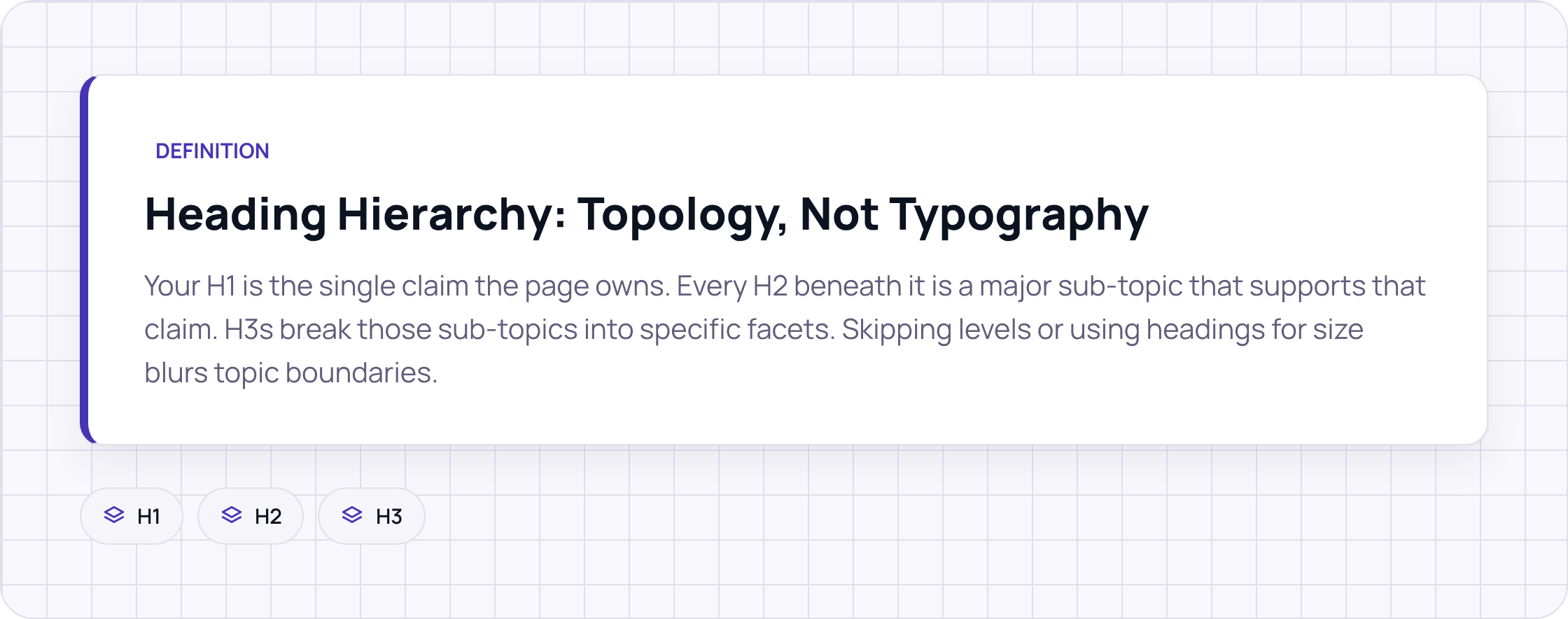
Your H1 is the single claim the page owns. Every H2 beneath it is a major sub-topic that supports that claim. H3s break those sub-topics into specific facets. When you skip levels or use headings to make text look bigger, you blur the boundary between content blocks, and relevant passages get passed over during retrieval.
A properly nested heading tree lets a crawler (or an AI parser) label each passage with its topic before scoring it against a query. A clear site structure combined with metadata and schema markup is the foundation that makes content discoverable and indexable, as Circles Studio's SEO trends analysis makes explicit. Schema attached to a well-structured heading tree compounds the signal.
Structuring a 1,500-Word Article: A Working Blueprint
Follow this sequence for a 1,500-word piece:
| Element | Placement | Purpose |
|---|---|---|
| Title tag | <head> | Primary keyword, under 60 characters |
| H1 | First visible heading | Matches or closely mirrors title tag intent |
| Meta description | <head> | 150-160 characters, answer-first |
| H2 (x3-4) | Every 300-400 words | Major sub-topics, each answering a distinct reader question |
| H3 (x2-3 per H2) | Within each H2 block | Specific facets, steps, or examples |
| Internal links | Throughout body | 2-4 links to related pages, anchor text descriptive |
| Canonical URL | <head> | Points to the preferred version of this page |
Open with a direct answer to the primary question in the first 60-80 words. AI engines extract opening passages verbatim, and 61% of marketers are now increasing SEO spend after a softer 2025, per Typeface's content marketing benchmarks, meaning competition for those extracted passages is rising. Answer first, support second.
Internal links deserve more deliberate placement than most teams give them. Link to pages that cover adjacent sub-topics, use anchor text that names the destination topic specifically, and place links where a reader would genuinely want to go deeper. Two to four internal links per 1,500 words is a reasonable range. More than that and you dilute the signal; fewer and you leave topical relationships unmapped.
E-E-A-T Signals: What Google's Quality Raters Actually Look For
E-E-A-T stands for Experience, Expertise, Authoritativeness, and Trustworthiness. Google's Search Quality Rater Guidelines use these dimensions to evaluate whether a page deserves high visibility. Quality raters do not directly change rankings, but their assessments train the models that do.
Experience and Expertise on the Page
Experience signals come from first-hand detail. A page about keyword research that cites specific tool outputs, names the difficulty thresholds that worked for a particular domain, and describes what happened when a strategy failed reads differently from one that summarizes generic advice. Crawlers cannot verify lived experience, but they can detect the specificity that tends to accompany it.
Expertise signals come from authorship and citation. A named author with a verifiable professional history, bylined on a page that cites primary sources, scores better under E-E-A-T than anonymous content pulling from secondary aggregators. If your team publishes under real names, link each author bio to a page that documents their credentials. If you cite data, link to the original study, not a blog post summarizing it.
Authoritativeness and Trustworthiness
Authoritativeness is largely a function of who links to you and who you link to. A page cited by recognized industry publications carries more authority than one with identical content and no external references. You cannot manufacture this quickly, but you can build toward it by publishing content specific enough to be worth citing.
Trustworthiness covers the mechanical signals: HTTPS, clear authorship, accurate dates, a privacy policy, and contact information. These are table stakes. Missing any of them does not tank a ranking on its own, but they contribute to the overall trust score quality raters assign.
Topical Authority: Building Coverage Depth Before You Need It
Topical authority is Google's assessment of how comprehensively a site covers a subject area. A site that publishes 40 well-structured articles on email marketing, covering everything from list segmentation to deliverability to A/B testing subject lines, will outrank a site with one excellent email marketing guide and nothing else, even if that single guide is technically superior.
The Cluster Model
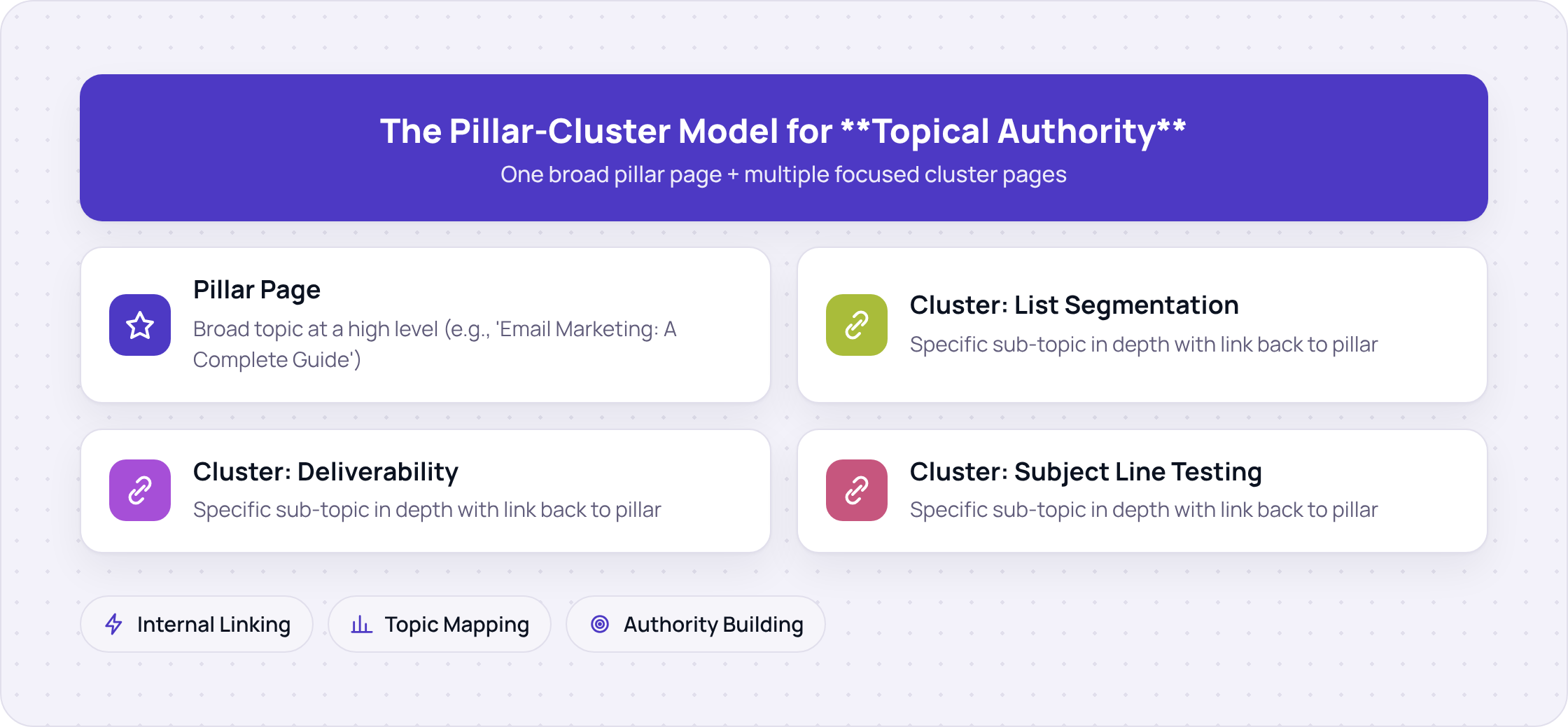
The practical structure for building topical authority is the pillar-cluster model. One pillar page covers a broad topic at a high level ("Email Marketing: A Complete Guide"). Cluster pages cover specific sub-topics in depth ("How to Improve Email Deliverability", "Email List Segmentation Strategies", "Subject Line A/B Testing: What Actually Works"). Each cluster page links back to the pillar, and the pillar links out to each cluster.
This structure does two things. It maps topical relationships for crawlers explicitly, so Google can see that your site covers the subject from multiple angles. It also concentrates authority: when the pillar earns backlinks, that authority flows to the cluster pages through internal links.
How Long Topical Authority Takes to Build
Realistically, a new site publishing two to three cluster articles per week can expect to see meaningful authority signals after four to six months, assuming the content is genuinely useful and not thin. A site publishing once a week may wait nine to twelve months for the same effect.
The compounding nature of this is real but slow. Teams that abandon the cluster model after two months because rankings have not moved are stopping just before the mechanism starts working. Set expectations accordingly before you start, not after you have already published twenty articles and are wondering why nothing has moved.
Writing for Both Humans and Search Algorithms
The tension between writing for readers and writing for crawlers is mostly false. Google's systems have become good enough at evaluating genuine usefulness that optimizing for readers and optimizing for algorithms now point in the same direction most of the time. The exceptions are worth knowing.
Where the Tension Is Real
Schema markup, canonical tags, and title tag formatting are purely technical. A reader never sees them. These need to be correct regardless of how the prose reads. Keyword placement in the first 100 words, in at least one H2, and in the meta description is a mechanical requirement that occasionally forces awkward phrasing. When it does, rewrite the sentence until the keyword fits naturally. If it cannot fit naturally, the keyword may be wrong for the page.
Readability scores matter more than most SEO guides acknowledge. A page written at a grade 12 reading level on a topic where the average searcher is a non-specialist will have higher bounce rates, shorter dwell times, and fewer return visits. All three of those signals feed back into ranking. Writing clearly is not a soft preference; it is a ranking input.
Answer-First Structure
AI engines, featured snippets, and People Also Ask boxes all favor content that states the answer before explaining it. The inverted pyramid structure from journalism applies directly: lead with the conclusion, then provide the evidence and context. A reader who gets the answer in the first paragraph and stays to read the rest is a stronger engagement signal than a reader who scrolls looking for the answer and leaves.
For SEO and content creation specifically, this means your opening paragraph should answer the page's primary question directly, even if the rest of the article goes into much more detail. Do not save the answer for the end.
Pre-Publish Scoring: What to Check Before the Article Ships
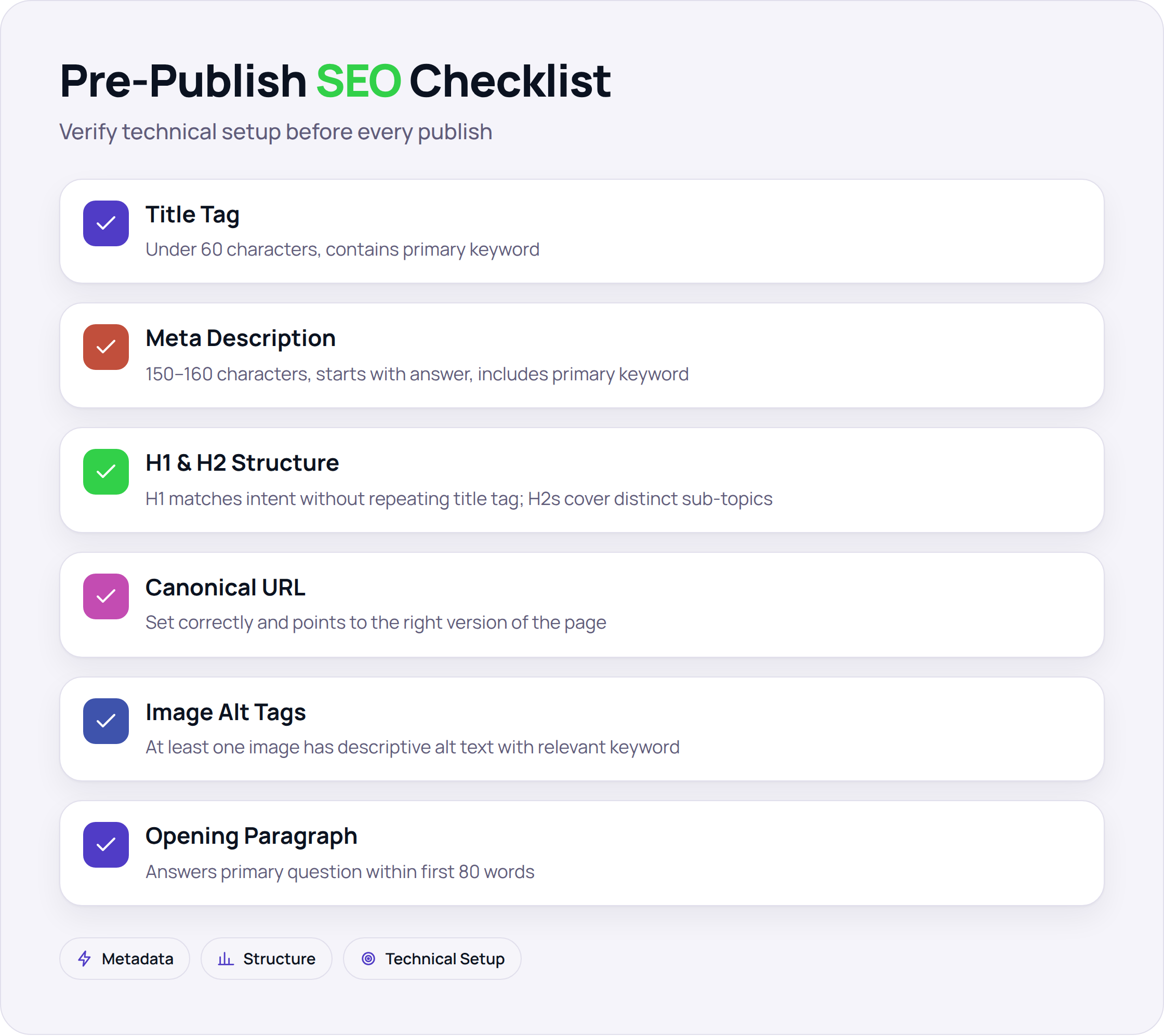
Before publishing, run a final checklist to catch mechanical errors that cost rankings. This is not a substitute for good writing, it is a verification pass to ensure your well-written content has proper technical setup, correct metadata, and clear structure for both crawlers and readers.
Run through these before every publish:
- Title tag is under 60 characters and contains the primary keyword.
- Meta description is 150-160 characters, starts with the answer, and includes the primary keyword.
- H1 matches the intent of the title tag without being identical to it.
- H2s cover distinct sub-topics and none of them repeat the H1.
- Canonical URL is set and points to the correct version of the page.
- At least one image has a descriptive alt tag that includes a relevant keyword.
- The opening paragraph answers the primary question within the first 80 words.
- All external links point to primary sources, not aggregators.
- The page has been checked for duplicate content against your own site using a canonical audit.
- Schema markup (Article, FAQ, or HowTo as appropriate) is validated in Google's Rich Results Test.
One item that often gets skipped: check the page's mobile rendering before publish, not after. Google indexes the mobile version first. A page that looks correct on desktop but breaks on mobile will underperform regardless of how well the content is written.
Frequently Asked Questions
What is the difference between SEO and content creation?
SEO is the set of practices that make content findable through search engines. Content creation is the process of producing the material itself. The two overlap significantly: content that ignores SEO principles rarely ranks, and SEO without substantive content has nothing to optimize. Treating them as separate disciplines is where most teams lose ground.
How long does it take for SEO content to rank?
Most pages on new or low-authority domains take three to six months to appear on the first page for their target keyword, assuming the content is well-structured and the keyword difficulty is appropriate. Pages targeting high-difficulty terms on established domains can take twelve months or longer. These are realistic ranges, not guarantees. Google's crawl frequency, the competitive landscape, and how quickly you build topical authority all affect the timeline.
How many keywords should one page target?
One primary keyword and three to five closely related secondary keywords is a workable range for most pages. The primary keyword defines the page's core topic. Secondary keywords cover the related questions and subtopics a thorough treatment of that topic would naturally address. Targeting more than that on a single page usually means the page is trying to cover too much ground and would perform better split into two focused pieces.
Does word count affect SEO rankings?
Word count is not a direct ranking factor, but it correlates with ranking because longer content tends to cover a topic more completely. A 600-word page that fully answers a simple query will outrank a 2,000-word page that pads its answer with filler. Match the length to what the topic actually requires. For most informational queries, 1,200 to 2,000 words covers the necessary depth. For complex technical topics, 2,500 to 4,000 words may be appropriate.
What is E-E-A-T and why does it matter for content?
E-E-A-T stands for Experience, Expertise, Authoritativeness, and Trustworthiness. Google's quality rater guidelines use these dimensions to assess whether a page deserves high visibility. Pages that demonstrate first-hand experience, cite credible sources, carry named authorship, and maintain accurate information score better under this framework. It matters most for topics where bad information could cause real harm (medical, financial, legal), but it applies across all content categories.
Can you do SEO without creating new content?
You can improve existing content's performance through technical fixes, internal linking, and on-page optimization without publishing new pages. That approach has a ceiling, though. Sites that grow organic traffic consistently over time do so by expanding their topical coverage, not just by polishing what already exists. Technical SEO without content investment is maintenance, not growth.
Ready to Put This Into Practice?
If you want to see how these principles apply to your specific site and content strategy, visit Seorav to learn more. The team there works through exactly this kind of SEO and content creation analysis, from keyword mapping to topical authority building, with results tied to real ranking outcomes rather than activity metrics.
Keep reading
Which LLM Citation Tracking Platform Actually Works for Your Brand
Compare the top llm citation tracking platforms by engine coverage, alert speed, and pricing. Find the right tool for your team size and budget.
Siteimprove for SEO: What It Does (and What It Doesn't)
A clear-eyed look at Siteimprove SEO features, pricing, and gaps versus AI-native platforms. Find out if it fits your team's workflow in 2026.
How AI Overviews Are Reshaping Organic Traffic (And What SEOs Must Do)
AI Overviews now trigger on 30%+ of Google queries. See how zero-click search AI impact on organic traffic is measured, and what SEOs can do about it.