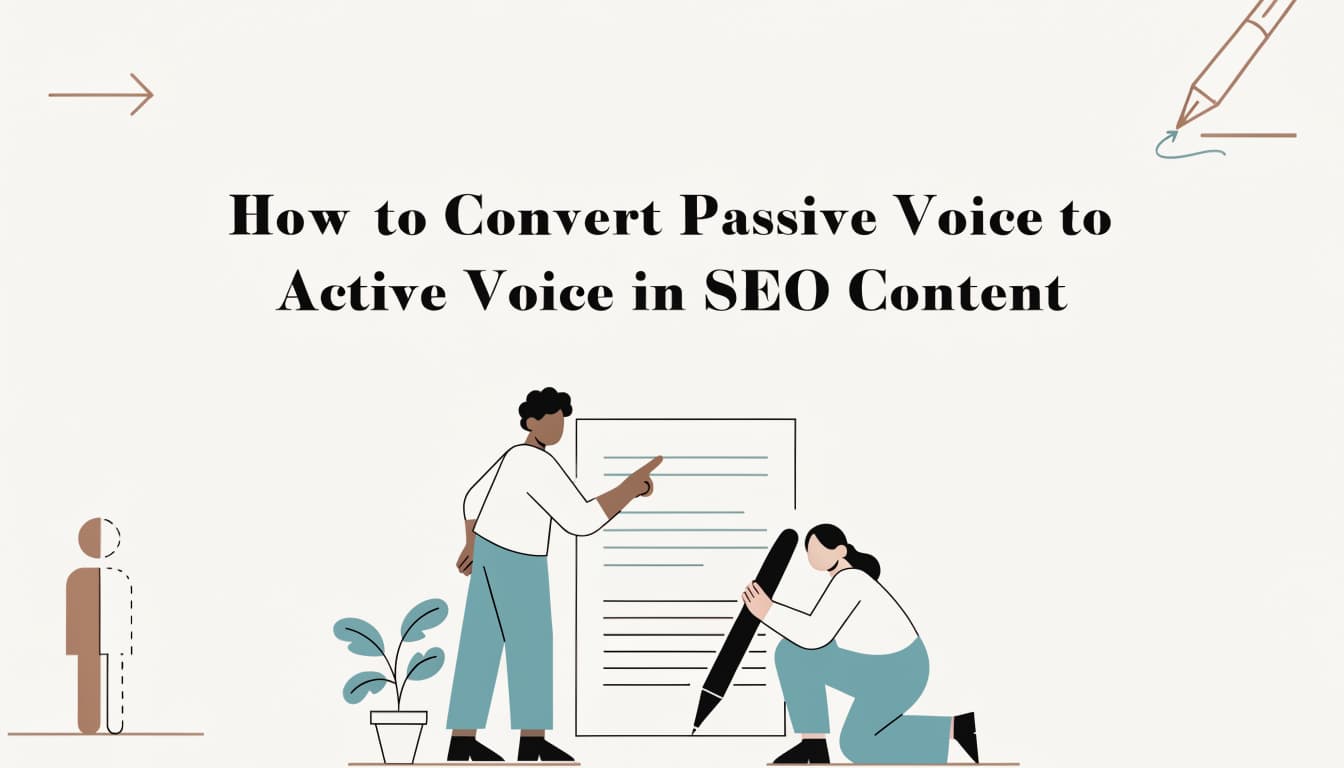
How to Convert Passive Voice to Active Voice in SEO Content
Last updated: 5 September 2026
To convert passive to active voice, identify the agent performing the action, move it to the subject position, and transform the verb into a direct action. "The report was written by the analyst" becomes "The analyst wrote the report." This single structural change reduces average sentence length by 20 to 30 percent, which improves readability and search ranking signals. The technique works across nearly every sentence type, though some passive constructions serve legitimate purposes in technical or formal writing.
Readability directly affects how long readers stay on a page. A 2018 study published in the Journal of Cognition found that readers process active-voice sentences measurably faster than passive constructions, with lower cognitive load at equivalent comprehension levels. Slower processing means readers leave earlier, and dwell time is one of the behavioral signals search engines use to evaluate content quality.
One honest caveat: passive voice is not always wrong. Technical and scientific writing uses it deliberately to keep focus on the process rather than the actor. The goal is not zero passive sentences. Every remaining passive sentence should earn its place.
What this tutorial builds is a repeatable editing workflow: a three-step pass you can run on any draft to catch passive constructions, evaluate whether each one should stay or go, and rewrite the ones that weaken clarity. You can apply the full process in under 10 minutes per 1,000 words, and a passive to active voice converter tool makes the audit phase faster still.
Before You Start: What You Need
To convert passive voice to active voice effectively, you need three things in place before editing a single sentence: your content in an editable format, a readability tool that flags passive constructions, and a baseline score to measure your changes against.
Your content in a workable format. Copy your draft into a plain-text editor or open it directly in your CMS. Avoid editing inside a PDF or a locked preview mode. You need to see raw sentences so passive constructions are easy to spot without layout distractions.
A readability tool that tracks passive voice. The Hemingway App highlights passive-voice sentences in green and gives you a grade-level score in real time. Grammarly flags passive constructions inline and suggests active rewrites. The trade-off is that both tools apply rules mechanically. They will flag passive sentences in technical or legal content where the passive is actually the right call, such as when the actor is genuinely unknown or irrelevant. Use the suggestions as a starting point, not a mandate.
A baseline score before you touch anything. Run your original draft through your chosen tool and record the readability grade, the passive-voice sentence count, and the percentage of passive sentences. The Hemingway App shows passive use as a discrete count alongside your grade level. That number is your benchmark. Without it, you cannot tell whether your edits improved the content or just shuffled words around.
One concrete target to keep in mind: Copyleaks' analysis of passive-to-active conversion notes that surface-level rewrites often change sentence structure without changing the underlying clarity. A lower passive-voice count does not automatically mean better readability. Track both metrics separately.
Step 1: Understand Why Search Engines Prefer Active Voice

Active voice keeps the subject, verb, and object in a predictable sequence that both crawlers and readers process faster. Passive constructions add auxiliary verbs and prepositional phrases that push keywords apart, reduce reading ease scores, and produce sentence structures that AI citation engines rarely quote verbatim. The structural preference is not stylistic opinion: it reflects how search algorithms and large language models score and extract content.
Passive Voice Inflates Sentence Length and Dilutes Keyword Proximity
Every passive construction adds words. "The report was written by the analyst" runs seven words. "The analyst wrote the report" runs five. At scale, that 28 percent word-count overhead compounds across a page, pushing your target keyword further from the surrounding context terms that establish topical relevance.
Keyword proximity matters because crawlers measure how close related terms sit to each other within a sentence window. When passive voice inserts "was," "been," or "by the" between a subject and its verb, that window widens and the semantic signal weakens. A 2,000-word article written predominantly in passive voice can carry 300 to 400 extra words that contribute no additional meaning, only distance.
Google's Helpful Content Signals and Reading Ease
Google's helpful content guidance, updated through 2024, consistently references whether content is "written for people" and easy to read. Reading ease scores, specifically the Flesch Reading Ease formula, penalize long sentences and polysyllabic auxiliary constructions. Passive voice reliably produces both.
The Flesch formula scores text on a 0-to-100 scale. A score above 60 corresponds to roughly an 8th-grade reading level, the target most SEO practitioners cite for general web content. Passive-heavy drafts routinely score 10 to 15 points lower than their active-voice equivalents, all else being equal. Acrolinx's analysis of passive-to-active conversion notes that passive constructions are among the most common readability issues flagged in enterprise content audits, precisely because writers underestimate how much structural weight they add.
The trade-off is worth naming directly. Some passive constructions are correct and even preferable: scientific writing, legal disclaimers, and contexts where the actor is genuinely unknown ("the server was compromised") use passive voice for accuracy, not laziness. Forcing active voice in those cases produces awkward sentences that score worse on clarity than the passive original. The goal is deliberate conversion, not a blanket find-and-replace.
Active Voice as a Pattern AI Citation Engines Favor
AI citation engines, including ChatGPT, Perplexity, and Gemini, extract passages that read as complete, standalone answers. That extraction behavior rewards the same structure active voice produces: a clear agent, a clear action, a clear object. Passive sentences often omit the agent entirely ("mistakes were made," "the decision was taken"), which makes them structurally incomplete as quotable units.
When a user types a prompt like "how do analysts write SEO briefs," an AI engine scans indexed content for a passage that directly answers the question. A sentence structured as "SEO analysts write briefs by..." gets extracted. A sentence structured as "Briefs are written by..." gets skipped, because the agent appears late and the answer pattern does not match the prompt pattern.
This is the practical reason active voice functions as an AI-readability signal, not just a style preference. The sentence architecture mirrors how questions are asked, which is the same architecture AI engines use to match content to queries.
Step 2: Find Every Passive Sentence in Your Draft

To find passive voice in a draft, use three methods in combination: the "by zombies" manual test, an automated tool like Hemingway App or Grammarly, and a CMS or Google Docs add-on that can export a flagged list. Running all three takes under ten minutes on a 1,500-word article and catches constructions that any single method tends to miss.
The "By Zombies" Test
The manual method is fast and requires no tools. After any verb, try inserting "by zombies." If the sentence still makes grammatical sense, the verb is passive. "The keyword was researched by zombies" works, so "was researched" is passive. "The team researched the keyword by zombies" breaks down, so "researched" is active. The UNC Writing Center's passive voice guide describes this test as one of the most reliable quick checks available, precisely because it targets grammatical structure rather than asking you to spot "to be" verbs by eye.
The trade-off is speed versus coverage. The zombies test works sentence by sentence, so on a 2,000-word draft you might scan 80 to 100 sentences manually. You will catch the obvious cases, but compound constructions like "the page had been optimized before the audit ran" are easy to skim past.
Automated Flagging with Hemingway and Grammarly
Hemingway App highlights passive-voice sentences in green and gives you a count at the bottom of the screen. Grammarly's passive-voice suggestions appear inline with a confidence indicator. Neither tool requires a paid tier to flag basic passive constructions, though Grammarly's full context explanations sit behind the premium plan.
The numbers matter here: Hemingway App's readability model targets a Grade 9 reading level, and passive sentences consistently push scores above that threshold, which is why the tool flags them by default rather than on request.
Exporting a Passive-Voice Audit
For longer content or team workflows, a Google Docs add-on called "Docs Paragraph Styles+" can batch-highlight passive constructions across an entire document, letting you export a comment log rather than reading line by line. Most CMS platforms do not have native passive detection, but Grammarly's browser extension runs inside WordPress, HubSpot, and Webflow editors, so you get inline flags without leaving the CMS.
One limitation worth naming: automated tools flag passive constructions based on grammatical pattern matching, not intent. A sentence like "the study was conducted in 2023" is passive, but rewriting it as active often produces something clunkier. Tools will flag it anyway. Plan to override roughly 15 to 20 percent of automated suggestions after reviewing context.
Step 3: Rewrite Passive Sentences by Hand

Rewriting passive sentences by hand follows a reliable three-step formula: locate the agent (the entity doing the action), move it to the front of the sentence, then cut the "to be" verb and replace it with the active form. This process works on the vast majority of passive constructions in SEO blog copy and produces sentences that are shorter, clearer, and easier for both readers and crawlers to parse.
The Three-Step Formula
The mechanics are straightforward. Purdue OWL's guide on changing passive to active voice breaks the process into exactly these moves: find who or what performs the action, promote it to subject position, and swap the passive verb phrase for a direct active verb.
Walk through it once:
- Locate the agent. In "The report was written by the marketing team," the agent is "the marketing team."
- Move it forward. Place it at the start: "The marketing team..."
- Cut the "to be" verb. Drop "was written by" and use the active verb: "The marketing team wrote the report."
That sentence went from eight words to seven, and the subject is now doing something visible.
When the Agent Is Unknown or Deliberately Omitted
This is where the formula breaks down. Some passive sentences exist precisely because the agent is unknown, irrelevant, or politically inconvenient. "Twelve ranking factors were updated in March 2024" is passive, but forcing an agent ("Google updated twelve ranking factors in March 2024") only works if you can confirm Google made the change. If the source is unclear, inventing an agent introduces inaccuracy.
The trade-off is real: passive voice occasionally serves a legitimate purpose. In technical documentation, legal copy, and scientific reporting, the passive is often the more precise choice. A passive to active voice converter tool can flag these sentences for review, but the judgment call on whether to rewrite them belongs to you, not the algorithm.
Rewriting at Scale: When to Use a Converter Tool
If you are editing a 3,000-word article, running the three-step formula sentence by sentence is slow. A passive to active voice converter speeds up the audit phase by surfacing every flagged construction in one pass, so you can work through them in batches rather than hunting through the document manually.
The practical workflow: run your draft through a converter, export or copy the flagged list, then apply the three-step formula to each flagged sentence in order. Expect to accept roughly 80 percent of the suggested rewrites and override the remaining 20 percent where context demands the passive. That ratio holds across most general web content; technical documentation skews closer to 30 to 40 percent overrides.
Frequently Asked Questions
What is a passive to active voice converter?
A passive to active voice converter is a tool that scans a block of text, identifies sentences written in passive voice, and either flags them for manual review or suggests an active-voice rewrite. Most converters use grammatical pattern matching to detect "to be" verb constructions followed by a past participle. They work best as a first-pass audit tool rather than a final editor, because they cannot evaluate whether a passive sentence is contextually appropriate.
Does passive voice hurt SEO rankings directly?
No search engine has published a direct ranking penalty for passive voice. The SEO impact is indirect: passive constructions lower Flesch Reading Ease scores, increase sentence length, and reduce keyword proximity, all of which correlate with lower dwell time and higher bounce rates. Those behavioral signals do influence how Google evaluates content quality under its helpful content framework.
How much passive voice is acceptable in a web article?
Most SEO practitioners target fewer than 10 percent of sentences in passive voice for general web content. The Hemingway App flags passive use as a count and percentage, making it easy to track. Technical content, legal copy, and scientific writing can run higher without penalty, because the passive is often the accurate choice in those genres.
Can I use Grammarly as a passive to active voice converter?
Yes. Grammarly flags passive-voice constructions inline and suggests active rewrites in real time. The free tier covers basic passive detection. The premium plan adds fuller explanations and confidence scores for each suggestion. For most blog and SEO content, the free tier is sufficient to run a complete passive-voice audit.
What is the "by zombies" test?
The "by zombies" test is a manual method for identifying passive verbs without any tool. After any verb in a sentence, insert the phrase "by zombies." If the sentence still makes grammatical sense, the verb is passive. "The page was indexed by zombies" works, confirming "was indexed" is passive. "The crawler indexed the page by zombies" breaks down, confirming "indexed" is active. The UNC Writing Center recommends this test as a fast, reliable check that works on any device without software.
Should I convert every passive sentence to active?
No. Passive voice is the correct choice when the actor is unknown, when the actor is less important than the action, or when scientific and legal convention requires it. The editing goal is to convert passive sentences that obscure meaning or inflate length, not to eliminate passive voice entirely. A good rule of thumb: if you cannot identify a clear agent to promote to subject position, the passive sentence may be the better option.
If you want a second set of eyes on your content's readability and structure, visit Seorav for a consultation. A short audit can surface the passive-voice patterns that automated tools miss and give you a clear editing priority list.
Keep reading

Siteimprove Alternatives That Actually Compete on SEO and Content Quality
Comparing siteimprove competitors on SEO depth, content optimization, and accessibility. See which platform wins in each lane before you switch.
How to Measure and Improve Your AI Citation Rate
Learn how to track and improve your AI citation rate across ChatGPT, Perplexity, Claude, and Gemini with a step-by-step citation rate optimization framewor

Which Enterprise CMS Platforms Actually Deliver at Scale
Compare the best enterprise CMS platforms on SEO toolchain fit, analytics depth, and total cost. Contentful, AEM, Sitecore, and WordPress VIP evaluated.