How to Audit Your Content's Stability in AI Search Results
Last updated: 29 September 2026
Agentic SERP volatility audits track how often AI Overviews change which sources they cite from your content. Standard rank trackers miss this entirely: your page stays at position 4 while the AI Overview stops mentioning it, triggering no alert. BrightEdge's 2024 analysis found 62% of AI-generated answers swap their cited sources within 30 days. Most content teams hemorrhage visibility they never detect because traditional tools only watch keyword rankings, not citation stability.
What Agentic SERP Volatility Actually Is
Your content is stable in AI search if the same source URL appears consistently across repeated queries over a 30-day window. If it disappears and reappears, or gets replaced by a competitor mid-cycle, you have a volatility problem.
How This Differs from a Traditional Ranking Drop
Classic SERP volatility is a positional problem. A page moves from rank 3 to rank 7, traffic dips, you investigate. SERP volatility tracking tools measure exactly this: how frequently domains enter and exit visible positions across a keyword set.
Agentic volatility works differently. There is no rank 3 or rank 7. An AI overview either cites your page or it does not. The engine selects sources dynamically, often re-evaluating them each time a query runs, based on freshness signals, structural fit, and how well your content answers the specific phrasing of the question. A page cited on Monday may be absent by Thursday with no ranking change visible in any standard tool.
That invisibility is the core problem. Traditional volatility leaves a footprint in rank-tracking dashboards. Agentic citation loss leaves none.
Why a Missed Citation Costs More Than a Dropped Blue Link
Losing a blue-link position at rank 4 still leaves you at rank 5. The user sees your result. Losing an AI citation removes you from the answer entirely. The user gets a response, reads it, and moves on. Your page was never part of the consideration.
The cost compounds because AI overviews increasingly absorb queries with the highest purchase intent. A buyer asking "which project management tool handles cross-functional dependencies best" is closer to a decision than someone browsing a category page. If your content is not cited in that answer, you are absent at the moment that matters most, with no fallback position below the fold.
One honest caveat: citation frequency alone is not a complete signal. An AI engine may cite a page for a narrow query variant and ignore it for a broader one. Stability audits need to track both the URL being cited and the specific prompt that triggered the citation. Otherwise you are measuring the wrong thing.
This is the gap that tools like SEORav are built to close: polling AI engines weekly against the exact prompts your buyers use, not a generic keyword proxy.
Before You Start: What You Need for This Audit
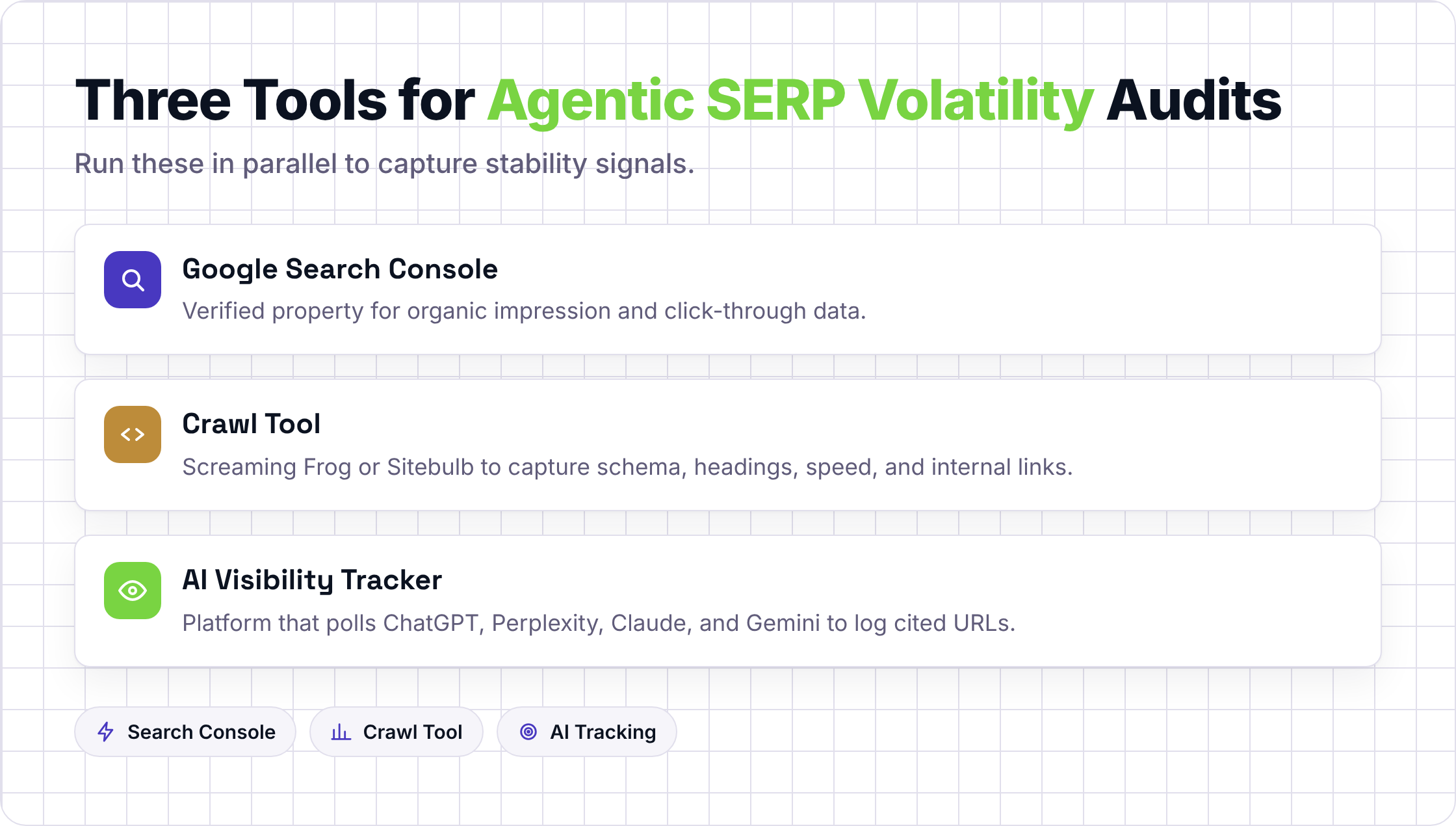
To run agentic SERP volatility audits properly, you need three tools running in parallel: Google Search Console for organic performance data, a crawl tool for on-page signals, and at least one AI visibility tracking platform that logs which URLs get cited by engines like ChatGPT, Perplexity, Claude, and Gemini.
Access Requirements
Start with a verified Search Console property. Without it, you have no reliable impression or click-through data, and everything downstream becomes guesswork. Pair that with a crawl tool (Screaming Frog, Sitebulb, or equivalent) to capture the structural signals that affect citability: schema markup, heading hierarchy, page speed, and internal link density.
The third requirement is the one most teams skip. AI visibility tracking platforms poll major AI engines on a scheduled basis and record which URLs appear in responses. The SERP volatility index framework from Keyword.com illustrates why snapshot data alone misleads you: a single reading tells you where you stand today, not whether that position is stable or eroding week over week.
Baseline Data You Must Collect First
Pull 90 days of impressions and click-through rates from Search Console before you touch anything else. Ninety days smooths out weekly seasonality without going so far back that algorithm updates distort the picture. Export by page, not by query, so you can match organic performance to individual URLs.
Alongside that, collect AI citation snapshots for the same 90-day window. This means logging which of your pages appeared in AI engine responses, for which prompts, and on which dates. Without a dated citation history, you cannot distinguish a content problem from a model update.
The trade-off is real: 90 days of AI citation data is only available if you started tracking before you decided to run this audit. Most teams have not. If your citation log is shorter (30 days is common), you can still proceed, but treat your stability conclusions as directional rather than definitive. A 30-day window is enough to spot obvious volatility. It is not enough to confirm a trend.
One practical note on tooling: the crawl tool and the AI visibility platform do not need to be the same product, and they rarely are. Keep the data in separate exports and join them on URL. That join is where the most useful signals live.
Step 1: Map Which Pages Are Exposed to Agentic Ranking Shifts
Start by identifying which pages already sit inside the agentic ranking surface. That means isolating pages where Google's AI Overviews are generating impressions, tagging each by query intent, and scoring the resulting list by how much a ranking shift would actually hurt. The output is a prioritized page inventory, not a full content review.
Filter GSC Data for AI Overview Impression Share
Open Search Console and pull your last 90 days of performance data. Filter by "Search type: Web," then export the full query-and-page report. Sort by impressions descending, then cross-reference against your click-through rate column. Pages with high impressions but CTR below 2% are strong candidates for AI Overview suppression, where the overview answers the query before the user reaches your result.
The numbers tell a clear story. The March 2026 Google Core Update displaced over 24% of top-10 pages from search results, with informational content taking the sharpest hits. Pages in that category showing CTR compression are your highest-priority targets.
Flag any page where impressions grew quarter-over-quarter but clicks stayed flat or declined. That divergence is the clearest signal that an AI Overview is intercepting traffic before the click happens.
Tag Pages by Query Intent Type
Not all pages face the same exposure. Informational queries (how-to guides, definitions, comparisons) are the primary source material for AI Overviews and carry the highest volatility risk. Navigational queries are largely stable because the user is looking for a specific brand or URL. Transactional queries sit in the middle: AI Overviews appear on some commercial searches, but product and pricing pages are less frequently cited than explanatory content.
Apply a simple three-tier tag to every page in your export:
| Intent Type | AI Overview Exposure | Volatility Risk |
|---|---|---|
| Informational | High | High |
| Transactional | Medium | Medium |
| Navigational | Low | Low |
This tagging step matters because the remediation work differs by tier. An informational page that loses AI Overview placement needs structural changes. A transactional page with the same problem usually needs schema and trust signals instead.
Build a Volatility Risk Score
With your intent tags applied, score each page on three inputs: current impression volume (proxy for how much traffic is at stake), CTR compression ratio (impressions divided by clicks, inverted), and intent tier weight (informational = 3, transactional = 2, navigational = 1). Multiply the three together and rank the list descending.
One limitation worth naming: this scoring model treats all informational pages as equally exposed, and that is not always accurate. A highly authoritative evergreen guide with strong E-E-A-T signals may be more stable than a thin how-to page even if both carry the same intent tag. The score surfaces where to look first, not a definitive verdict on which pages will drop. Treat pages in the top quartile as confirmed priorities, and pages in the second quartile as worth a secondary review before you commit remediation resources.
The output of this step is a single spreadsheet: pages ranked by volatility risk score, tagged by intent, with their impression and CTR data attached. That list becomes the working document for every subsequent audit step.
Step 2: Capture AI Citation Snapshots Across Multiple Agents
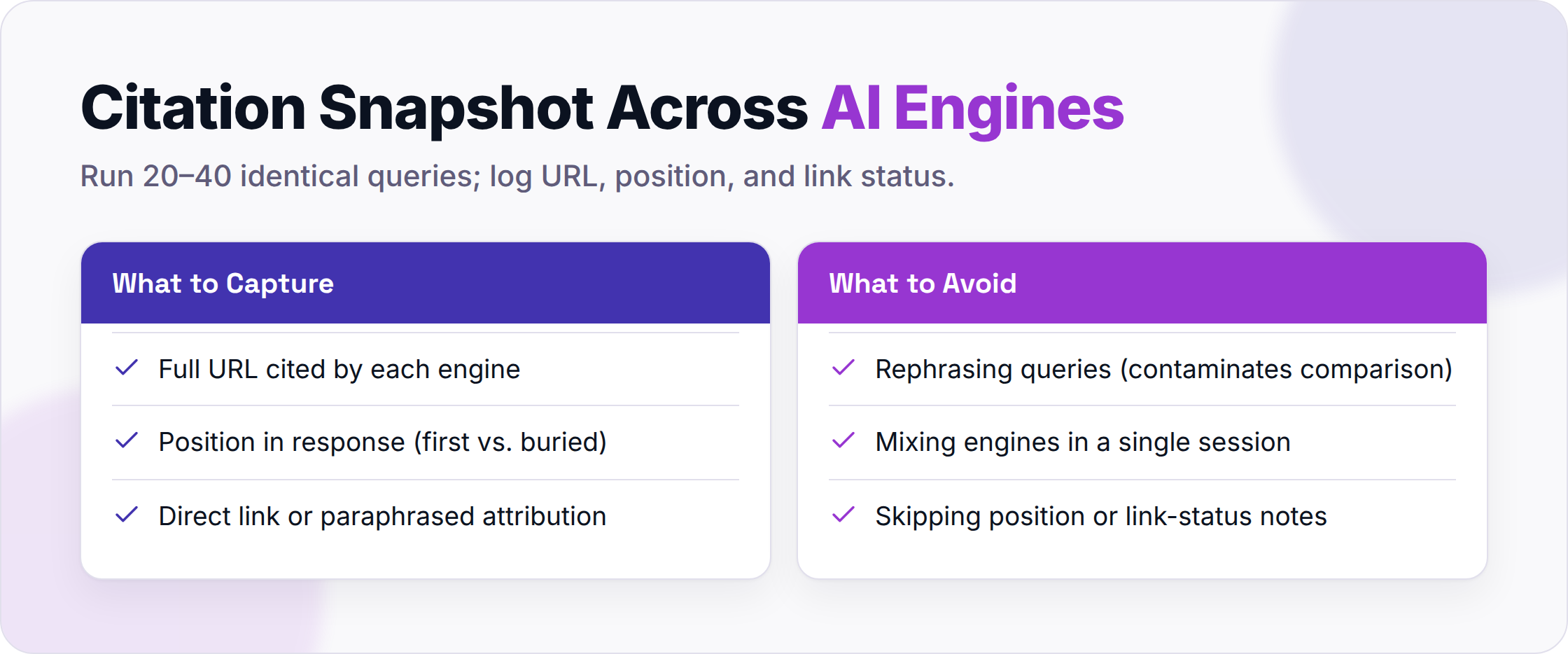
Run your tracked query set through ChatGPT, Perplexity, and Google AI Overviews in a single session, log every URL each engine surfaces, and repeat that process on a fixed schedule. The output is a citation presence matrix: rows are your pages, columns are engines and run dates, and each cell records whether that page was cited. That matrix is the raw material for every stability judgment that follows.
Running the Same Queries Across Three Engines
Use the same 20 to 40 queries in each engine, back to back, without rephrasing. Paraphrasing the query even slightly changes what gets cited, which contaminates your comparison. For each engine, note the full URL cited, the position in the response (first mention vs. buried reference), and whether the citation was a direct link or a paraphrased attribution with no link.
Firstpagesage's 2026 agentic AI adoption report shows that AI-assisted research workflows are now embedded in over 60% of enterprise content teams. The engines your buyers use are diversifying faster than most audit processes account for.
Automating Snapshot Collection at Scale
Manual runs work for a query set under 30, but they break down quickly past that threshold. Response times vary, engines occasionally return different results within the same hour, and a single person logging outputs by hand introduces transcription errors that corrupt your matrix. An AI visibility tool solves this by polling each engine on a set cadence, parsing responses programmatically, and storing the full citation history rather than a single snapshot.
One real trade-off: automated tools normalize responses before logging them, and that normalization can strip context, like whether a citation appeared in a bulleted list versus a narrative paragraph. For stability audits, position context matters, so verify your tool logs response structure, not just URLs.
Reading the Citation Presence Matrix
Once you have three or more runs logged, the matrix tells you three things about your pages:
- Which appear consistently across all engines (stable citations)
- Which appear in one engine but not others (platform-specific authority)
- Which appeared early but have since dropped out (volatility candidates)
A page cited in all three engines across four consecutive weekly runs is structurally stable. A page cited once in Perplexity and never again is a signal to investigate the content, not celebrate the mention. That distinction drives where you spend revision effort next.
Step 3: Measure Volatility Scores and Identify Citation Gaps
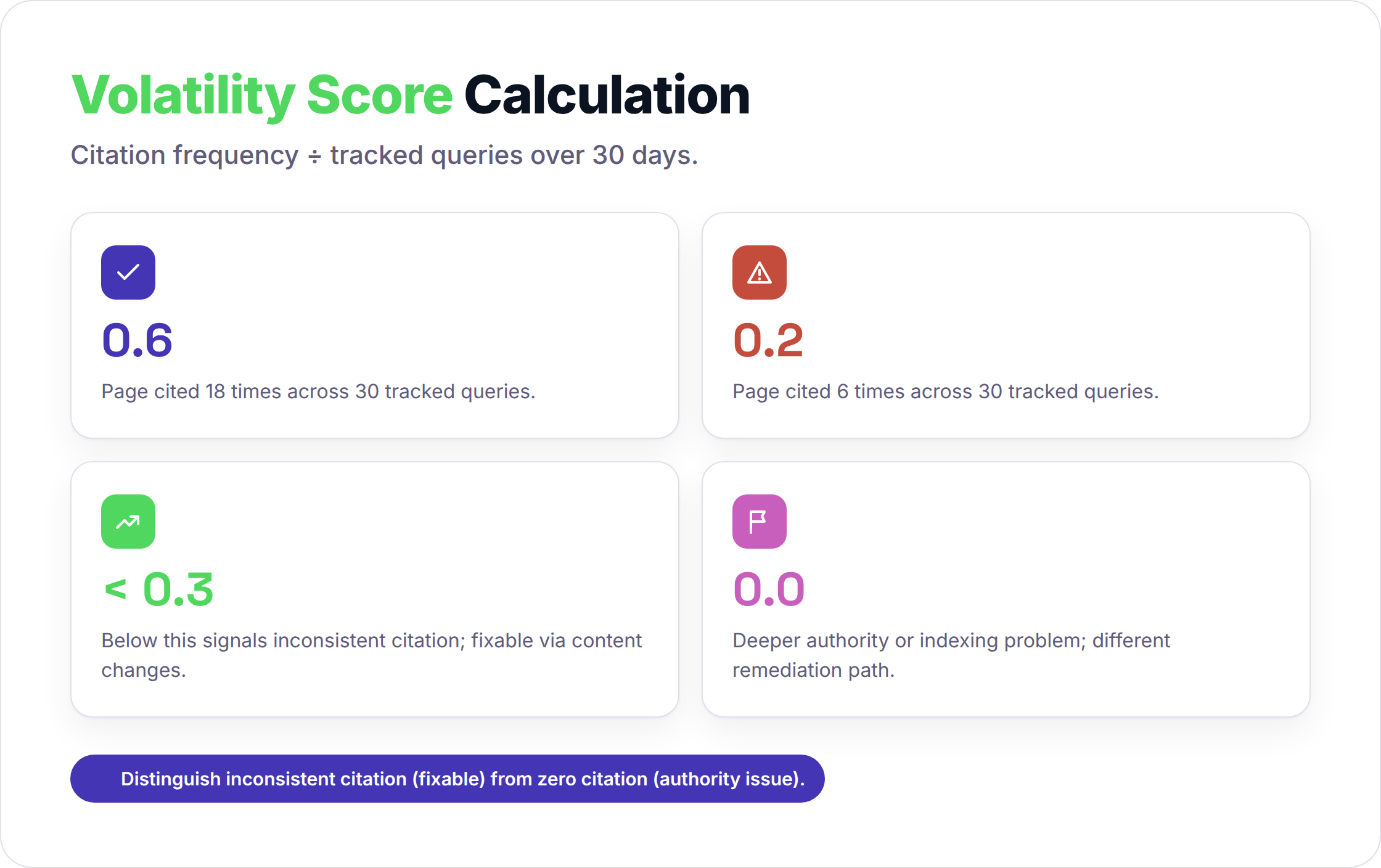
A volatility score for AI citations is calculated by dividing your citation frequency (how many times an AI engine cited your URL across tracked queries) by the total query volume you monitored, measured over a rolling 30-day window. A score below 0.3 signals instability: the engine is citing you inconsistently, not ignoring you entirely.
That distinction matters because inconsistent citation is fixable through structural content changes, while zero citation usually points to a deeper authority or indexing problem. Treating both the same way wastes remediation effort.
How to Calculate Your Citation Frequency Ratio
For each page in your priority list, pull the raw citation count from your AI visibility platform across the 30-day window. Divide by the number of unique queries you tracked. A page cited 18 times across 30 tracked queries scores 0.6, which is stable. A page cited 6 times across 30 queries scores 0.2, which is volatile.
Run this calculation separately for each engine. A page scoring 0.7 in Perplexity and 0.1 in Google AI Overviews has a platform-specific problem, not a content problem. The fix for a platform-specific gap (usually structured data or freshness signals) differs from the fix for a content-wide gap (usually depth, specificity, or source credibility).
Identifying Citation Gaps by Query Cluster
Group your tracked queries into clusters by topic or intent. Then check whether your citation drops cluster around specific topics or spread evenly across your query set. Clustered drops point to a content gap: you are missing coverage on a subtopic the engine considers relevant. Spread drops point to a structural problem: something about how your pages are built is reducing citability across the board.
Common structural causes of spread drops include missing or malformed schema markup, slow page load times (above 3 seconds on mobile), thin word counts on pages competing against longer, more detailed sources, and inconsistent author attribution that weakens E-E-A-T signals.
Setting a Volatility Threshold for Action
Not every page below 0.3 needs immediate remediation. Prioritize pages that meet two conditions: a volatility score below 0.3 and a position in the top quartile of your risk-scored inventory from Step 1. Pages that meet both conditions represent the highest concentration of traffic risk and the clearest case for content investment.
Pages with scores between 0.3 and 0.6 are worth monitoring but not necessarily rewriting. A score in that range often reflects normal model variation rather than a structural content problem. Revisit them after 60 days to see whether the score is trending up or down before committing resources.
Step 4: Diagnose Why Citations Are Dropping
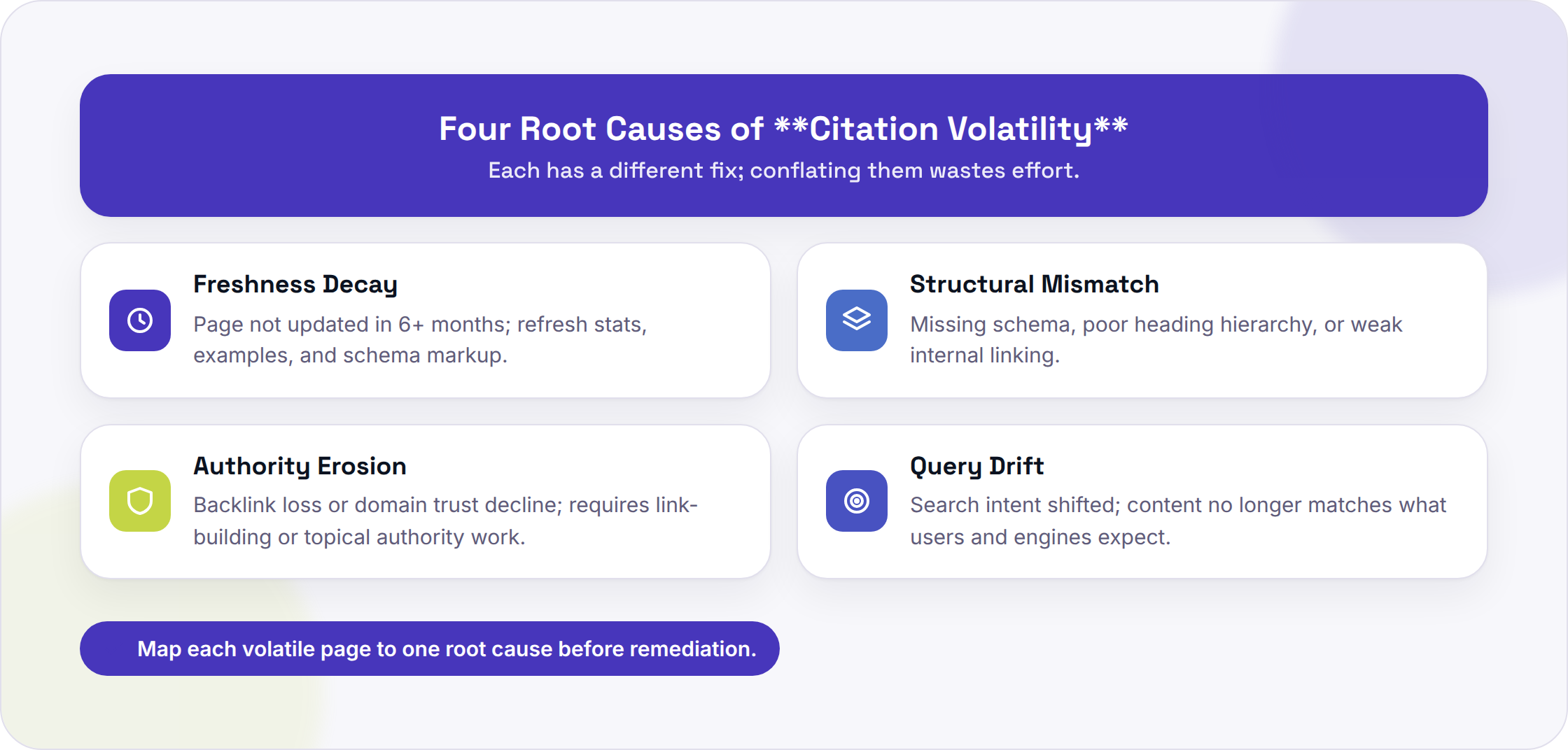
A volatility score tells you a citation is unstable. It does not tell you why. The diagnostic step maps each volatile page to one of four root causes: freshness decay, structural mismatch, authority erosion, or query drift. Each has a different fix, and conflating them produces remediation work that does not move the score.
Freshness Decay
AI engines weight recency more heavily than most content teams expect. A guide published in 2023 and never updated competes against pages that were refreshed in the last 90 days. If your volatile pages have not been touched in six months or more, freshness decay is the most likely cause.
The fix is targeted, not a full rewrite. Update statistics, replace outdated examples, add a "last reviewed" date in your schema markup, and republish. A meaningful content update (not just a timestamp change) signals freshness to crawlers and to the models that ingest crawl data.
Structural Mismatch
AI engines extract answers from content that is structured for extraction: clear headings, direct answers in the first sentence of each section, and explicit attribution of claims to sources. Pages written for human reading flow (narrative paragraphs, buried conclusions, implicit answers) score lower on structural fit even when the underlying information is accurate.
Audit your volatile pages for answer density. For each H2 or H3 heading, check whether the first sentence directly answers the question implied by that heading. If it does not, the engine may be skipping your page in favor of one that does.
Authority Erosion
Citation stability correlates with domain authority signals, but the relevant signals for AI engines differ from those for traditional PageRank. Backlink volume matters less than the credibility of the sources that cite you and the consistency of your author attribution. A page with strong backlinks but no named author, no publication date, and no organizational affiliation is a weaker citation candidate than a page with fewer backlinks and clear E-E-A-T signals.
Check your volatile pages for author bylines, author bio pages with verifiable credentials, organizational schema markup, and outbound citations to primary sources. Missing any of these is a fixable authority gap.
Query Drift
Sometimes the problem is not your content but the query. AI engines update their understanding of what a query means as new content enters the index. A page optimized for "best CRM for small business" in 2024 may now be competing against a different interpretation of that query in 2026, one that emphasizes AI-native features your page does not cover.
Check your citation gaps against the current top-cited pages for each volatile query. If those pages cover topics your page does not, you are facing query drift. The fix is a content expansion, not a structural adjustment.
Step 5: Remediate and Re-Audit on a Fixed Cadence
Remediation without a re-audit schedule is just editing. The point of an agentic SERP volatility audit is to close the loop: make a change, measure whether the citation score improves, and adjust your approach based on what the data shows.
Setting Your Re-Audit Cadence
For pages in the high-priority tier (volatility score below 0.3, top-quartile risk), re-audit every 30 days for the first quarter after remediation. That cadence gives you enough data points to distinguish a genuine improvement from a one-week fluctuation.
For pages in the medium tier (scores between 0.3 and 0.6), a 60-day re-audit cadence is sufficient. Model updates and content changes both take time to propagate through AI engine training cycles, and checking too frequently produces noise rather than signal.
What a Successful Remediation Looks Like
A successful remediation shows a citation frequency ratio that moves from below 0.3 to above 0.5 within two audit cycles, with the improvement holding across at least three consecutive weekly snapshots. A single-week spike followed by a return to baseline is not a success. It is a sign that the change addressed a surface symptom rather than the root cause.
Document every change you make and the date you made it. Without that log, you cannot attribute score changes to specific interventions, and you lose the ability to replicate what worked on other pages.
When to Stop Remediating a Page
Some pages will not recover their citation stability regardless of how much you revise them. If a page has been through two full remediation cycles (roughly 60 days of targeted changes) and its volatility score has not moved above 0.3, the problem is likely structural to the topic rather than the content. The engine may have shifted its preferred source type for that query cluster, favoring video, data tables, or a different content format entirely.
At that point, the more productive investment is a new page built around the current citation patterns for that query, rather than continued revision of an existing asset.
Frequently Asked Questions
What is an agentic SERP volatility audit?
An agentic SERP volatility audit is a structured process for measuring how consistently your pages appear as cited sources in AI-generated search responses over time. Unlike traditional rank audits, it tracks citation presence across engines like ChatGPT, Perplexity, and Google AI Overviews rather than blue-link positions. The goal is to identify which pages are being cited reliably, which are dropping in and out, and why.
How often should I run an agentic SERP volatility audit?
For high-priority pages (those with high impression volume and informational intent), run a full audit every 30 days. For the rest of your content inventory, a quarterly audit is sufficient to catch meaningful shifts without creating more reporting overhead than your team can act on.
Which AI engines should I track in my citation snapshots?
At minimum, track Google AI Overviews, ChatGPT (with Browse enabled), and Perplexity. These three account for the majority of AI-assisted research queries in enterprise buying cycles as of 2026. Claude and Gemini are worth adding if your audience skews toward technical or developer personas, where those engines see higher adoption.
What is a good citation frequency ratio?
A ratio above 0.6 indicates stable citation across your tracked query set. Between 0.3 and 0.6 is a watch zone: the page is being cited but inconsistently, and a model update or a competitor content refresh could push it below the threshold. Below 0.3 means the engine is treating your page as an unreliable source for that query cluster, and structural remediation is warranted.
Can I run this audit without a dedicated AI visibility tool?
Yes, but only for query sets under 30. Above that threshold, manual logging introduces enough transcription error and timing inconsistency to make your citation matrix unreliable. For a full content inventory, an automated AI visibility platform is the only practical option. The manual approach works well as a proof-of-concept before you commit to a tool subscription.
Does improving my AI citation stability affect my traditional organic rankings?
The two signals are related but not identical. Many of the structural improvements that increase citation stability (clearer answer formatting, stronger E-E-A-T signals, fresher content) also correlate with improved organic rankings. However, you can gain citation stability without a ranking change, and you can rank well without being cited in AI Overviews. Treat them as parallel metrics rather than proxies for each other.
If you want to run agentic SERP volatility audits without building the tracking infrastructure from scratch, visit SEORav to see how it works. The platform polls AI engines on a weekly cadence against the exact prompts your buyers use and surfaces citation gaps before they become traffic losses.
Keep reading
How to Track Your Brand's Mentions Across AI Search Results
Learn how to measure brand mention share across ChatGPT, Perplexity, Gemini, and Copilot, with a step-by-step formula, tool guide, and FAQ.
Measuring the Real Value of Zero-Click Visibility in AI Search
Learn how to calculate Zero-Click Visibility Yield, track AI citations across ChatGPT and Perplexity, and convert brand impressions into defensible ROI num
Making Your Website RAG-Compatible: A Technical Playbook
Learn how to make your website RAG-compatible with semantic HTML, schema markup, metadata, and robots.txt settings that AI retrieval systems actually use.