How Query Fan-Out Shapes AI Search Visibility

Last updated: 17 September 2026
Query fan-out optimization for AI search means structuring content to appear across multiple sub-queries that an AI engine generates from a single user prompt. When you search an AI system, it breaks your question into parallel retrieval paths, pulling sources for each decomposed intent separately before synthesizing answers. A page optimized around one keyword often misses most of these retrieval passes entirely. Understanding how to map your content to these hidden sub-queries determines whether your pages surface in AI responses or remain invisible.
Similarweb's breakdown of fan-out mechanics puts the practical implication plainly: fan-out determines which content gets pulled into an AI-generated answer, and the selection happens at the sub-query level, not the keyword level. If your page answers the broad topic but not the specific sub-intents the model is resolving, it gets skipped. Research from Ekamoira puts the scale of this at 8 to 12 retrieval opportunities per query, which means a single well-optimized page is realistically competing for one slot out of a possible eight or more. Missing 70 to 80 percent of retrieval events is not a worst-case scenario. It is the default for content built around a single keyword target.
The mechanism sits in how retrieval-augmented generation (RAG) pipelines work. Google's SGE documentation describes a system where the model decomposes complex prompts before retrieval, not after. Each decomposed sub-query runs independently against the index. That architecture is the reason traditional on-page SEO signals (title tags, meta descriptions, keyword density) do not translate cleanly into AI citation rates. A page can satisfy Google's ranking criteria and still be structurally invisible to the retrieval step that precedes synthesis.
One honest caveat: the exact number of sub-queries a given prompt generates varies by engine, query complexity, and model version. The 8 to 12 figure is an observed range, not a fixed constant. The strategic implication holds regardless of the precise count.
How LLMs Break a Single Query Into Multiple Sub-Queries
When a user submits a prompt to an AI search engine, the system decomposes the intent into several parallel sub-queries, each targeting a distinct facet of the original question, then synthesizes the results into one response. This decomposition typically produces between 3 and 8 sub-queries per prompt and happens inside the RAG pipeline before a single word of the answer is drafted.
Where Fan-Out Happens in the RAG Pipeline
RAG systems work in two stages: retrieval, then generation. Fan-out lives entirely in the retrieval stage. Before the language model writes anything, an orchestration layer takes the raw user prompt and runs semantic decomposition on it, breaking the intent into constituent parts. A question like "what CRM should a 50-person SaaS company use" might split into sub-queries covering pricing tiers, integration ecosystems, onboarding complexity, and churn-reduction features, each sent to the retrieval index in parallel. Conductor's AI search optimization guide describes this as the mechanism that lets AI engines build "comprehensive responses" rather than surface a single best-match document.
Semantic Decomposition in Practice
The decomposition step is not keyword splitting. The model identifies the underlying informational needs implied by the prompt, not just the words present in it. A prompt about "reducing SaaS churn" might never contain the word "onboarding," but the model infers that onboarding friction is a relevant sub-topic and generates a sub-query for it anyway. Optimizing for the literal root query is often insufficient for exactly this reason.
Semrush's query fan-out experiment found that AI systems like Google AI Mode and ChatGPT Search routinely decompose single queries into multiple distinct lookups to assemble their final answers. A page that answers only the surface question may get retrieved on one sub-query and ignored on four others, reducing its chance of appearing in the synthesized response.
Vector Similarity and the Competition Problem
Each sub-query is scored independently against the retrieval index using vector similarity, which measures how closely a chunk of content aligns with the semantic meaning of the sub-query, not just keyword overlap. Your content competes separately on every sub-query the model generates. A page that ranks well on the root intent but poorly on a supporting sub-query (say, a comparison angle or a specific use-case variant) loses ground to a competitor whose content covers that facet more directly.
This maps to a pattern the amicited.com analysis of LLM query decomposition makes explicit: AI visibility is determined not by how well a single page matches a single query, but by how broadly a content set covers the sub-query space a prompt generates.
The Trade-Off Worth Knowing
Broader coverage is not always the right answer. A page that tries to address every possible sub-query can lose topical depth on any one of them, which hurts its vector similarity score on the sub-queries that matter most. Specificity wins individual sub-query retrievals; breadth wins more sub-queries overall. For most content strategies, the better approach is a cluster model where a pillar page handles the root intent and tightly scoped supporting pages handle the sub-query variants, each optimized for depth on its own facet rather than trying to cover everything in one document.
Fan-out also shifts over time. The sub-queries an AI engine generates for the same prompt in January may differ from the ones it generates in March, as model weights update and retrieval indexes change. Treating fan-out as a fixed target is a mistake.
Ranking Signals That Win Across Fan-Out Variations
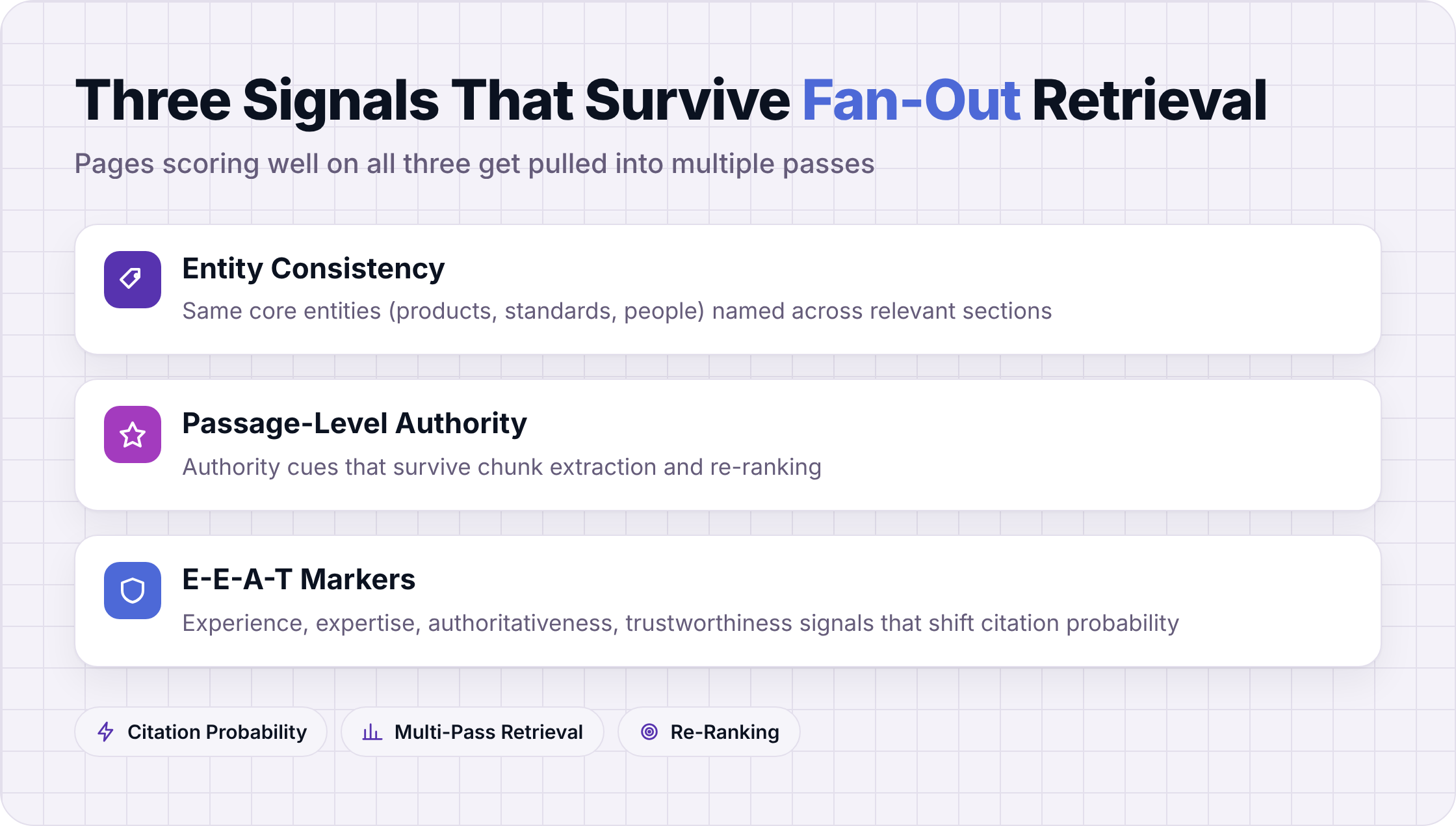
Three signals consistently determine whether a page survives across all the sub-queries an AI engine generates from a single prompt: entity consistency across sections, passage-level authority cues that survive chunk extraction, and E-E-A-T markers that shift citation probability during re-ranking. Pages that score well on all three get pulled into multiple retrieval passes. Pages that score well on only one tend to appear in a single sub-query result and get dropped from the final synthesis.
Entity Consistency Across Sub-Topic Sections
When an AI engine decomposes a query into 8 to 12 sub-queries, each sub-query runs its own retrieval pass independently. A page that names the same core entities (product names, standards, people, organizations) in each relevant section gives the model a consistent anchor to match against multiple passes. A page that buries its key entities in one section and uses pronouns or generic synonyms everywhere else will match one sub-query cleanly and fail the rest.
The practical fix is straightforward: audit each H2 or H3 section as if it were a standalone document. If a reader landed on that section with no context, would they know what product, process, or concept is being discussed? If not, the entity signal is too weak for fan-out retrieval.
Ekamoira's original research on AI query fan-out found that most brands are invisible across fan-out variations precisely because their content is structured for linear reading, not parallel retrieval. The entity problem is structural, not a keyword density issue.
Passage-Level Authority Signals
LLMs do not re-rank full pages. They re-rank passages, typically 100 to 300 word chunks extracted during retrieval. A passage earns authority weight when it contains a specific claim (a number, a date, a named mechanism), a clear subject-predicate structure, and at least one external reference that the model can verify against its training data.
Vague paragraphs ("many organizations are adopting this approach") get deprioritized during re-ranking because they carry no verifiable signal. Specific paragraphs ("Google's AI Overviews, launched in May 2024, now appear on an estimated 47% of informational queries in the U.S.") give the model something to anchor a citation to.
There is a real trade-off here. Writing every passage for chunk extraction can make a long article feel choppy or repetitive to a human reader scrolling top to bottom. Sections start to feel like they are restating context that was already established. The answer is not to make every paragraph self-contained, but to make the opening paragraph of each section self-contained. The rest of the section can build on it normally.
How E-E-A-T Translates Into Citation Probability
Google's E-E-A-T framework (Experience, Expertise, Authoritativeness, Trustworthiness) was designed for human quality raters, but its signals map closely to what LLMs weight during re-ranking. First-person experience markers, named authors with verifiable credentials, citations to primary sources, and publication dates all increase the probability that a passage gets selected over a competitor passage covering the same ground.
Wellows' analysis of AI query fan-out optimization notes that semantic intent and content structure now outweigh exact-match keyword signals in AI retrieval, which aligns with how E-E-A-T signals function. A passage written by a named practitioner with a specific data point beats an anonymous passage with better keyword density.
One limitation worth naming: E-E-A-T signals help most on informational and commercial-investigation queries. For navigational queries or highly commoditized topics where the AI engine already has strong training data, passage-level E-E-A-T has less leverage. The model may cite a well-known brand's generic page over a more authoritative but less recognized source simply because brand familiarity functions as a proxy trust signal in the model's weights. Newer or niche publishers need to compensate with more specific claims and more external citations per passage, not just better author bios.
Building Content That Covers Query Families, Not Single Queries
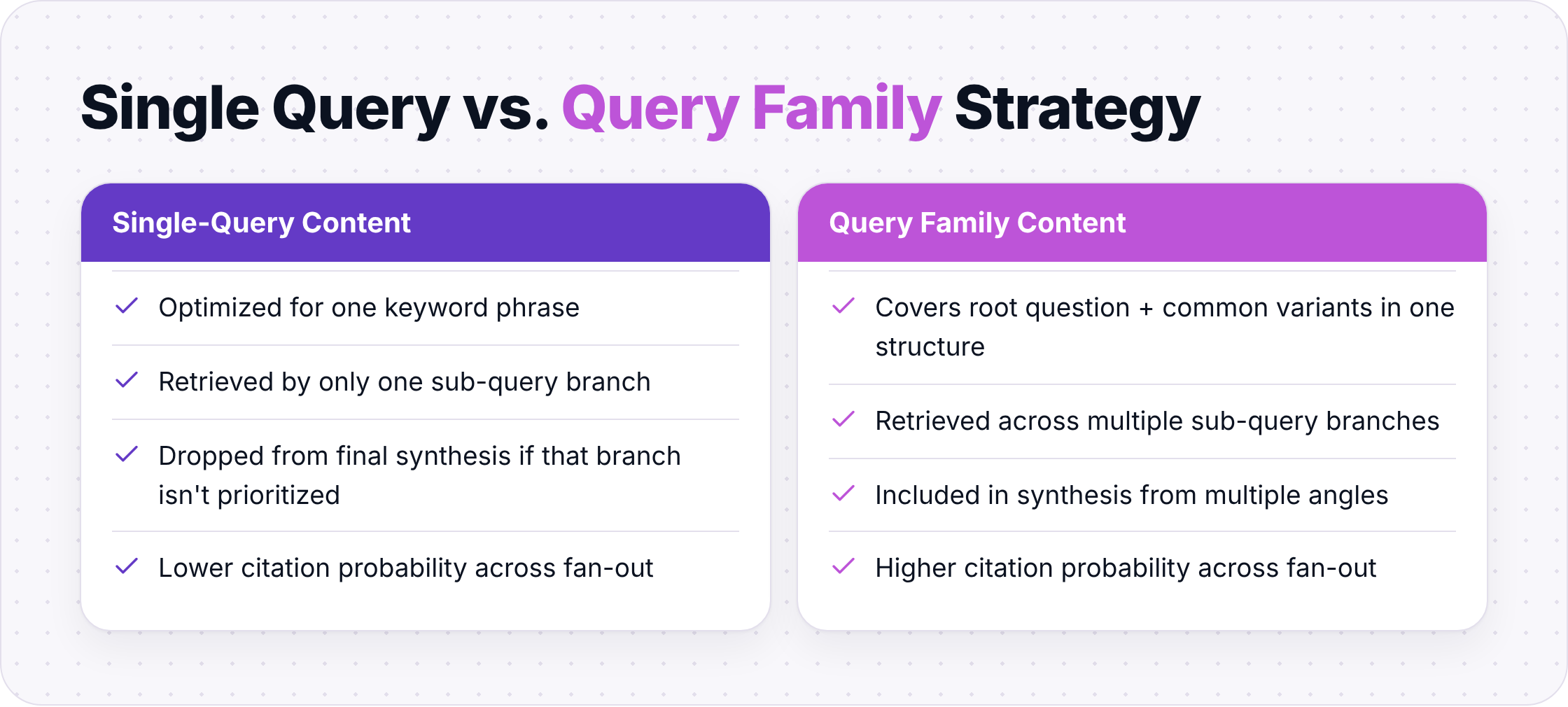
Ranking for a single keyword phrase is no longer enough to earn an AI citation. When an AI search engine receives a query, it fans out into multiple sub-queries and pulls answers from whichever pages address each branch most cleanly. Content built around a query family (covering the root question and its most common variants in a single coherent structure) is far more likely to be retrieved across multiple branches of that fan-out than content optimized for one phrase alone.
Mapping a Query Family
Start by treating your target topic as a parent query and enumerating every sub-question a reader might plausibly ask next. A query like "how to reduce SaaS churn" branches into sub-queries about early warning signals, pricing strategy, customer success workflows, benchmarks by company size, and tool comparisons. A useful exercise: type the parent query into Perplexity or ChatGPT and read the follow-up questions the engine generates. Those are the sub-queries the system is already running internally.
A 2025 SSRN study classifying 1,323 fan-out queries generated from 540 parent queries across ChatGPT, Gemini, and Perplexity found that most parent queries produce between 2 and 6 distinct sub-queries, with informational and comparative intents generating the highest fan-out counts. That range is your practical target: map 4 to 6 sub-queries per topic before you write a single word.
Structuring Content for Parallel Retrieval
Once you have your sub-query map, structure the content so each major section can be retrieved independently. That means:
- Each H2 section opens with a sentence that names the core entity and the specific angle being addressed.
- Key claims appear in the first 50 words of each section, not buried in the third paragraph.
- Supporting data (percentages, named tools, dates) appears at least once per section, not just in the introduction.
This structure does not require you to repeat yourself. It requires you to front-load context at the section level rather than assuming the reader (or the retrieval model) has read everything above it.
Pillar Pages vs. Supporting Pages: When to Split
A single long-form page covering every sub-query in a family can work if the sub-queries are closely related and the depth on each is sufficient. When sub-queries diverge significantly in intent (say, a "what is" sub-query alongside a "how to implement" sub-query alongside a "pricing comparison" sub-query), a cluster model performs better. The pillar page handles the root intent and links to supporting pages that go deep on each variant.
The practical signal for when to split: if answering a sub-query thoroughly requires more than 400 words, it probably warrants its own page. If it can be handled in 150 to 200 words, keep it in the pillar.
Updating for Fan-Out Drift
Sub-query patterns shift as model weights update. A topic that generated 4 sub-queries in early 2026 may generate 7 by late 2026 as the model's understanding of the topic deepens. Build a review cadence into your content calendar: run the parent query through two or three AI engines every quarter and compare the sub-queries generated against your current content map. Gaps that appear are retrieval opportunities your competitors may already be filling.
Frequently Asked Questions
What is query fan-out in AI search?
Query fan-out is the process by which an AI search engine splits a single user prompt into multiple sub-queries, retrieves sources for each one independently, then combines the results into a single synthesized answer. The decomposition happens inside the RAG pipeline before any answer text is generated. Your content is evaluated separately against each sub-query, not against the original prompt as a whole.
How many sub-queries does a typical AI search prompt generate?
The count varies by engine, query complexity, and model version. Observed ranges run from 2 to 6 sub-queries for most informational prompts, with some complex or comparative queries reaching 8 to 12. The 2025 SSRN study of 540 parent queries across ChatGPT, Gemini, and Perplexity found that informational and comparative intents consistently produced the highest fan-out counts. Treat 4 to 6 as a practical planning baseline for most topics.
Why does traditional SEO not fully translate to AI search visibility?
Traditional SEO optimizes for ranking signals (title tags, backlinks, keyword density) that influence how a page is ranked in a list of results. AI search retrieval evaluates passages against semantic sub-queries using vector similarity, which measures meaning alignment rather than keyword overlap. A page can rank on page one of Google and still be structurally invisible to the retrieval step that precedes AI answer synthesis, because the signals that matter are different at the passage level.
What is the best content structure for query fan-out optimization for AI search?
The most reliable structure is a cluster model: a pillar page that addresses the root intent, supported by tightly scoped pages that each go deep on a specific sub-query variant. Within each page, open every major section with a sentence that names the core entity and the specific angle, place key claims in the first 50 words of each section, and include at least one specific data point per section. This gives the retrieval model a clean anchor for each sub-query without requiring you to repeat yourself throughout the document.
How often should I update content to account for fan-out drift?
A quarterly review is a reasonable starting cadence for most topics. Run the parent query through two or three AI engines, compare the sub-queries generated against your existing content map, and identify gaps. Topics in fast-moving categories (AI tools, regulatory areas, software pricing) may need more frequent checks, since model weights and retrieval indexes update continuously and the sub-query landscape can shift meaningfully within a few months.
Does E-E-A-T matter for AI citation rates?
Yes, but with limits. E-E-A-T signals (named authors, primary source citations, specific data points, publication dates) increase the probability that a passage gets selected during re-ranking. The effect is strongest on informational and commercial-investigation queries. On navigational queries or highly commoditized topics, brand familiarity can outweigh passage-level authority signals, meaning a well-known brand's generic page may get cited over a more authoritative but less recognized source. Newer publishers should compensate with more specific claims and more external citations per passage.
If you want a structured audit of how your current content maps against the sub-query space your target topics generate, visit Seorav's AEO service page to see how the team approaches fan-out analysis and content gap identification.
Keep reading
Which LLM Citation Tracking Platform Actually Works for Your Brand
Compare the top llm citation tracking platforms by engine coverage, alert speed, and pricing. Find the right tool for your team size and budget.
Siteimprove for SEO: What It Does (and What It Doesn't)
A clear-eyed look at Siteimprove SEO features, pricing, and gaps versus AI-native platforms. Find out if it fits your team's workflow in 2026.
How AI Overviews Are Reshaping Organic Traffic (And What SEOs Must Do)
AI Overviews now trigger on 30%+ of Google queries. See how zero-click search AI impact on organic traffic is measured, and what SEOs can do about it.