How Often Is Your Content Actually Cited in AI Overviews?
Last updated: 24 September 2026
AI Overview citation frequency tracks how often your content appears as a named source inside AI-generated responses across ChatGPT, Perplexity, Claude, and Gemini. Unlike a backlink, these citations shape what readers see as the answer before they click anywhere. Measuring it requires running your target queries through each platform and logging whether your pages surface in the response. Most sites see citations in fewer than 20 percent of relevant queries, making visibility here a competitive advantage worth monitoring.
The measurement gap is real. Most analytics stacks were built for Google clicks, not AI mentions. Search Console shows impressions and CTR; it has no visibility into whether Perplexity cited your article 400 times last week or zero times. That blind spot has teeth: 2026 data shows only 17-54% of AI Overview citations come from top-10 organic results, meaning a page can rank first and still be invisible inside AI responses.
This article covers what citation frequency looks like in practice, what structural and freshness signals influence it, and how to close the measurement gap. One honest caveat upfront: citation behavior varies by engine, query type, and week. There is no single number that defines "good" frequency. What you can do is establish a baseline and track direction.
Citation Frequency at a Glance
Most content never gets cited in AI Overviews. Studies tracking millions of AI-generated responses show citation rates are highly concentrated: a small share of pages captures the majority of references, and organic search rank no longer predicts which pages those will be.
Four things to take away if you are short on time:
- Rank overlap has collapsed. In mid-2024, roughly 76% of AI Overview citations came from pages already in the organic top 10. By February 2026 that figure had fallen to 17%, meaning a top-ranking page is no longer a reliable proxy for citation visibility.
- Citation is concentrated, not distributed. A small number of domains captures a disproportionate share of references across queries. A 2025-2026 study by Otterly AI analyzed over one million citations across major AI search platforms and found citation share skews heavily toward a narrow set of sources per vertical.
- Standard analytics won't show you this. Google Search Console tracks clicks from traditional results. It does not log whether an AI engine pulled your page into a generated answer. Without a dedicated tracking system, most teams are flying blind.
- The trade-off is real. Optimizing for AI citation and optimizing for traditional organic rank are not always the same task. A page structured to answer a specific question concisely may rank lower in blue-link results than a longer, more comprehensive piece. Chasing citation visibility can mean accepting some organic rank trade-offs, and that calculus will differ by industry and query type.
Understanding AI Overview Citation Frequency
AI systems cite your content based on a combination of structural fit, topical authority, and query-level relevance, not simply because a page ranks well in traditional search. Citation frequency measures how often your URL appears in generated answers across a set of tracked prompts. That number is distinct from impressions, ranking position, or click-through rate, and it moves independently of all three.
A page can rank in position two and never get cited. Another can sit on page three and appear in 40% of AI-generated answers for a related query cluster.
How AI Systems Select Source URLs
When an AI engine generates an answer, it pulls from a retrieval layer that scores candidate passages against the specific query. The selection criteria weight things like answer-first structure, factual density, and how cleanly a passage can be extracted and attributed. Discoveredlabs' citation tracking guide describes this as a fundamentally different measurement problem from organic rank tracking: you need to poll the engine with your target prompts and parse the actual response, not infer visibility from a SERP position.
Impression Share vs. Ranking Position vs. Citation Rate
These three metrics measure different things and should never be treated as proxies for each other.
| Metric | What it measures | What it misses |
|---|---|---|
| Impression share | How often your page appears in a SERP | Whether AI used your content in its answer |
| Ranking position | Where your page sits in organic results | Citation selection, which ignores rank order |
| Citation rate | How often your URL is sourced in AI answers | Traditional click and ranking signals entirely |
The gap between ranking and citation is not trivial. Seer Interactive's September 2025 study found organic CTR dropped 61% for queries that triggered AI Overviews, from 1.76% to 0.61%. That collapse happens regardless of whether your page was cited. If you were cited, you may recover some of that lost traffic through attribution. If you weren't, you lose the click and the brand exposure.
Why the Same Page Gets Cited on Some Variants but Not Others
Query phrasing shifts the retrieval context enough to change which passages score highest. A page optimized around "how to reduce SaaS churn" might get cited consistently on that exact prompt but not on "SaaS churn reduction strategies" because the second phrasing pulls toward list-structured content and the first pulls toward explanatory prose. The engine isn't making a judgment about your page's overall quality; it's matching passage structure to query intent at a granular level.
This is where citation tracking breaks down if you're only monitoring one canonical version of a prompt. A single weekly check on your primary keyword gives you a point-in-time snapshot, not a frequency distribution. You need to track multiple query variants, log every response, and look at citation rate as a percentage across the full prompt set, not a binary yes/no.
Building that kind of prompt coverage takes time and ongoing maintenance. Query intent shifts, new variants emerge, and engines update their retrieval behavior without announcement. Teams that track 10 prompt variants get a cleaner signal than teams tracking one, but even 10 variants won't capture every phrasing a buyer actually uses. Treat citation rate as a directional metric with known blind spots, not a definitive audit of your AI visibility.
Why Citation Frequency Is a Leading Indicator of AI Search Visibility
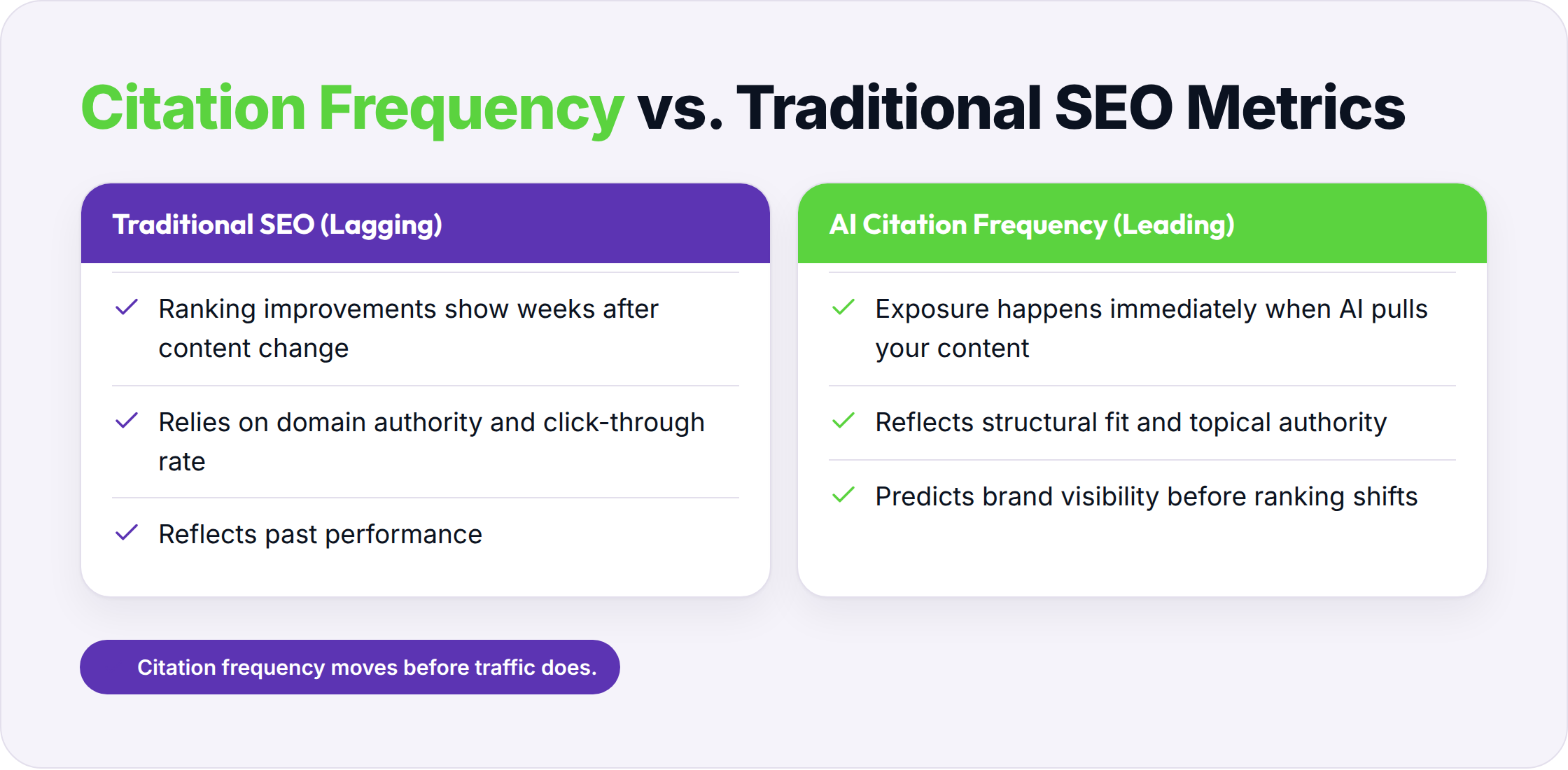
Citation frequency tells you how often AI engines select your content as a trusted source when generating answers. It predicts brand exposure before traditional ranking signals, like domain authority or click-through rate, have time to register the shift. When an AI engine consistently pulls from your pages across multiple prompts, that pattern reflects something structural: the engine has associated your content with a topic cluster, not just a single query.
Citation Rate Moves Before Traffic Does
Traditional SEO metrics are lagging indicators. A ranking improvement shows up in Search Console weeks after the content change that caused it. Citation frequency in AI engines works differently. If your article gets pulled into Perplexity responses for a high-intent prompt today, that exposure is happening now, regardless of whether your Google position has moved.
The numbers support this. Pages with high topic coverage earned a top-10 AI citation at a 27.6% rate, nearly twice the rate of thinner pages. That gap shows up in citation data before it shows up in organic traffic reports, giving your team an earlier signal to act on.
Entity Authority Drives Consistency Across Platforms
Citation frequency is not random. AI engines build internal associations between entities (brands, authors, organizations) and the topics they consistently address. A brand that publishes authoritative content on a narrow subject over time becomes a default reference for that subject, across ChatGPT, Claude, and Perplexity simultaneously.
A 5W analysis of 680 million citations across those three platforms found that brand citation patterns cluster tightly around topic authority rather than domain size. Smaller, focused publishers with deep coverage on specific subjects outperformed larger generalist sites in citation frequency for their core topics. Entity recognition, not raw traffic, is the underlying mechanism.
The Trade-Off: Citations Do Not Always Produce Clicks
High citation frequency can be misleading as a success metric on its own. When an AI engine cites your content to answer a question completely, the user often has no reason to click through. The answer is already in front of them. This is especially common for definitional or factual queries, where a single sentence from your article satisfies the prompt.
A page cited frequently in AI Overviews may show flat or declining referral traffic at the same time its citation count rises. That is not a failure of the content. It reflects how AI engines consume information differently than search engines do. Teams that optimize purely for citation volume without tracking downstream outcomes (brand recall, direct traffic, assisted conversions) will misread what the data is telling them.
Citation frequency is a leading indicator, but it is one signal in a set, not a standalone measure of success.
How to Measure Citation Frequency Across Different AI Platforms
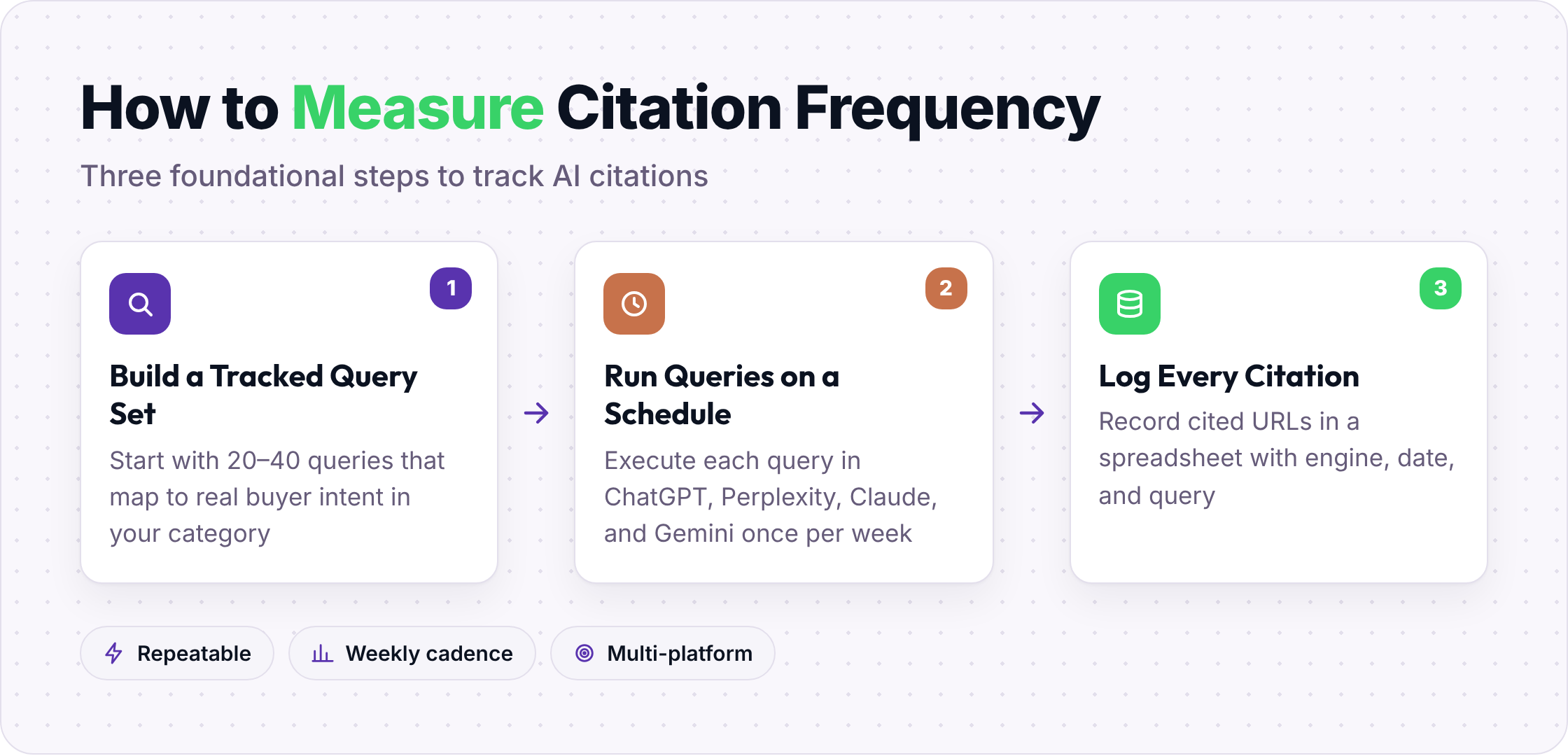
To measure citation frequency, you need three things: a fixed set of queries that represent how your buyers actually search, a consistent schedule for running those queries across each AI platform, and a log that records which URLs each engine cites per run. With that baseline in place, you can calculate a citation rate, spot trends over time, and identify which content is pulling its weight and which is invisible.
Building a Tracked Query Set and Logging Manually
Start with 20 to 40 queries that map to real buyer intent in your category. These should be the phrases someone types into ChatGPT or Perplexity when they are evaluating options, not the keywords you optimized for in 2021. Run each query in ChatGPT, Perplexity, Claude, and Gemini once per week, and log every cited URL in a spreadsheet alongside the engine, the date, and the query.
The trade-off here is time. Running 40 queries across four engines weekly takes roughly two to three hours if done manually, and the process is error-prone: AI engines vary their responses between sessions, so a single run can miss citations that appear 60% of the time but not 100%. Manual logging also breaks down when you need to track competitor citations alongside your own, since the volume of data becomes unmanageable fast.
Using Third-Party Tools to Automate Tracking
Dedicated platforms handle the polling, parsing, and storage automatically. SE Ranking's AI Overview tracker, Semrush's AI Toolkit, and Profound all send your configured prompts to AI engines on a set cadence, extract cited URLs from each response, and store the history so you can see trends rather than one-off snapshots.
The 5W analysis of 680 million AI citations across ChatGPT, Claude, and Perplexity shows just how much citation behavior varies by engine and content type, which makes multi-engine tracking a practical necessity rather than a nice-to-have. Most platforms also flag when a competitor's citation rate rises on a prompt you care about, which gives you a competitive signal that no traditional rank tracker can surface.
What a Usable Citation Rate Looks Like
Once you have two to four weeks of logged data, calculate citation rate as: (number of runs where your URL appeared) divided by (total runs for that query), expressed as a percentage. A page cited in 8 of 20 weekly runs on a given prompt has a 40% citation rate for that prompt.
Aggregate across your full query set to get a portfolio-level view. If your overall citation rate is 12% across 30 tracked prompts and four engines, and it rises to 18% after a content update, that is a meaningful directional signal. If it stays flat or drops, the update did not improve your retrieval fit, regardless of what happened to your organic rank.
No benchmark exists for what a "good" citation rate looks like across industries. Your baseline is your benchmark. Track direction, not absolute numbers.
Structural Signals That Influence AI Overview Citation Frequency
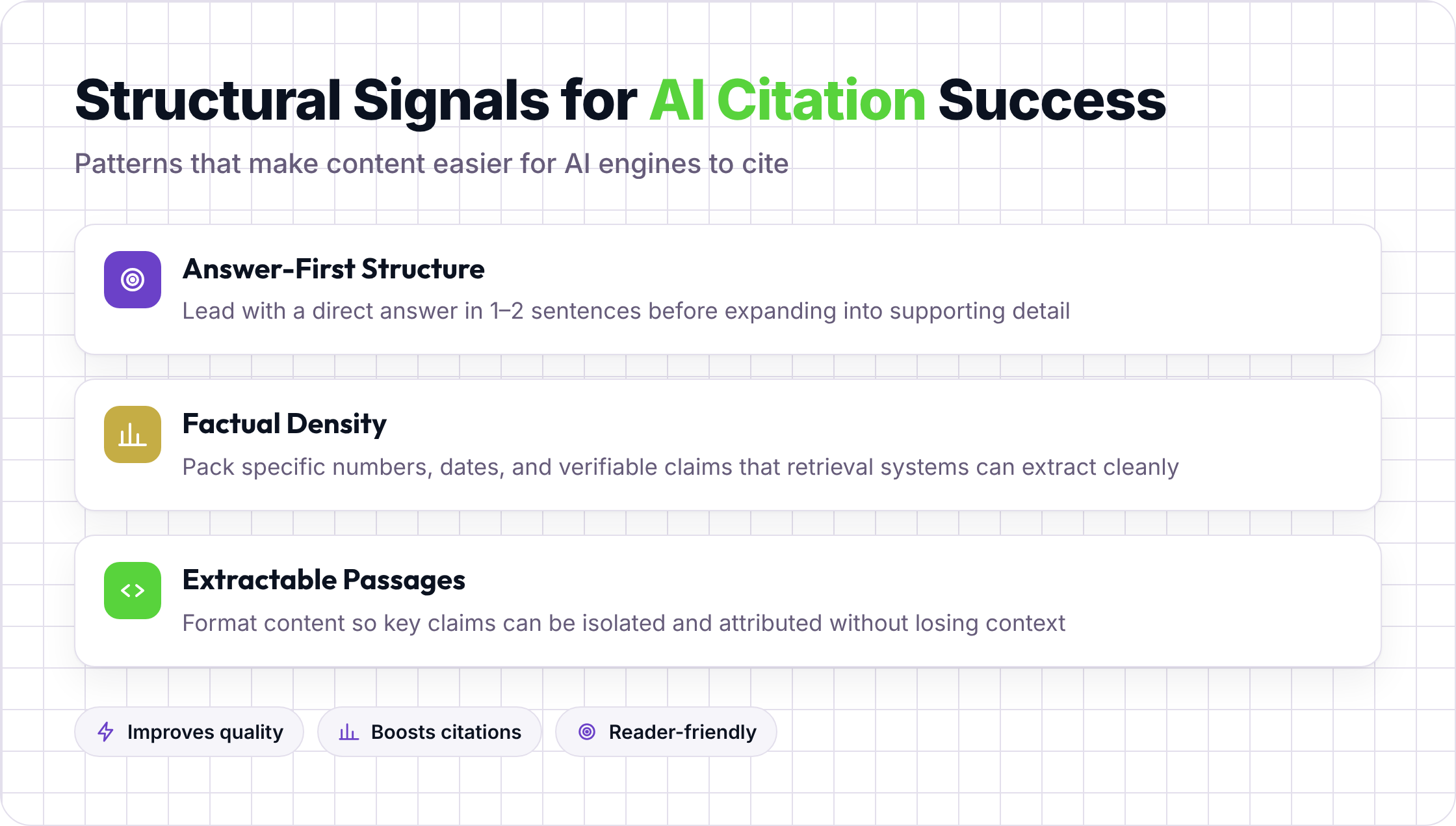
AI engines do not cite pages at random. Certain structural patterns make a page easier to extract, attribute, and surface in a generated answer. Understanding those patterns lets you audit existing content and prioritize updates that are likely to move your citation rate.
Answer-First Structure
Pages that lead with a direct answer to the query before expanding into supporting detail are easier for retrieval systems to parse. If your article buries the core answer in paragraph four after three paragraphs of context-setting, the retrieval layer may score a competitor's more direct version higher, even if your overall content is more thorough.
The fix is straightforward: rewrite your opening paragraph to answer the query in one to two sentences, then support it. This does not mean sacrificing depth. It means front-loading the conclusion and letting the body carry the evidence.
Factual Density and Specificity
Passages with specific numbers, named entities, and dated claims score better in retrieval than vague generalizations. "Revenue grew significantly" is harder to attribute and verify than "Revenue grew 34% in Q3 2025." AI engines prefer passages they can cite with confidence, and specificity is a proxy for confidence.
Audit your highest-priority pages for vague language. Replace "many studies show" with the actual study, the year, and the finding. Replace "experts recommend" with a named expert and a specific recommendation. Each substitution makes the passage more citable.
Passage Extractability
A passage is extractable when it can stand alone as a coherent answer without requiring the surrounding context. Long, nested sentences that reference earlier paragraphs ("as mentioned above," "building on that point") are harder to extract cleanly. Short, self-contained paragraphs that include the subject, the claim, and the evidence in one block are easier.
This is a structural edit, not a content edit. You are not changing what you say; you are changing how each unit of information is packaged so the retrieval layer can lift it cleanly.
Schema Markup and Structured Data
FAQ schema, HowTo schema, and Article schema give AI engines explicit signals about the type of content on a page and the structure of the information. While schema alone does not guarantee citation, it reduces ambiguity about what a page is and what questions it answers.
Pages with FAQ schema that matches the actual questions users ask in AI prompts have a structural advantage: the engine can match the schema question to the user query and extract the schema answer directly. Keep your FAQ schema questions phrased the way a person would actually type them into ChatGPT, not the way you would write a keyword target.
Frequently Asked Questions
What is a good AI Overview citation frequency for my industry?
No cross-industry benchmark exists yet. Your starting point is your own baseline: measure citation rate across your tracked query set for four weeks, then treat that number as your floor. Direction matters more than the absolute figure. A rate rising from 8% to 15% over two months signals that your content changes are working, regardless of what competitors are doing.
Does ranking higher in Google improve my AI citation rate?
Less than it used to. In mid-2024, roughly 76% of AI Overview citations came from top-10 organic results. By February 2026, that figure had dropped to 17%, according to Omnibound's tracking data. Ranking well still provides some lift, but structural fit, factual density, and topic authority now carry more weight in citation selection than position alone.
Can I track AI citation frequency without paid tools?
Yes, but with real limitations. You can manually run a fixed set of prompts across ChatGPT, Perplexity, Claude, and Gemini each week and log cited URLs in a spreadsheet. The problem is consistency: AI engines vary responses between sessions, so a single weekly run per prompt will miss citations that appear intermittently. Manual tracking also becomes unworkable once you need to monitor more than 20 to 30 prompts or want to track competitor citations alongside your own.
Why does my page get cited on some query phrasings but not others?
The retrieval layer matches passage structure to query intent at a granular level. A query phrased as "how to reduce SaaS churn" pulls toward explanatory prose; "SaaS churn reduction strategies" pulls toward list-structured content. Your page may be a strong match for one intent pattern and a weak match for another, even if the underlying topic is identical. Tracking multiple phrasings of the same query is the only way to see this pattern clearly.
Does being cited in AI Overviews actually drive traffic?
Sometimes, but not reliably. When an AI engine cites your content to answer a question completely, many users have no reason to click through. Definitional and factual queries are especially prone to this. Pages with high citation rates can show flat or declining referral traffic at the same time. The value of citation in those cases is brand exposure and entity association, not direct clicks. Track assisted conversions and direct traffic alongside citation rate to get a fuller picture.
How often should I update content to maintain citation frequency?
There is no universal cadence. Pages covering fast-moving topics (pricing, regulations, product specs) need more frequent updates because AI engines deprioritize stale factual claims. Pages covering stable concepts can hold citation rates for months without updates. A practical approach: set a review trigger based on citation rate drop rather than a fixed calendar. If a page's citation rate falls 20% or more over four consecutive weeks, treat that as a signal to audit and refresh the content.
Closing the Gap
AI Overview citation frequency is a metric most teams are not measuring yet, and that gap is an opportunity. You do not need a perfect tracking setup on day one. Start with 20 to 30 queries, run them weekly across two or three engines, and log what you find. Within a month you will have a baseline. Within a quarter you will have enough directional data to make content decisions with confidence.
The structural changes that improve citation rates (answer-first openings, specific numbers, extractable passages) also tend to improve content quality in ways readers notice. The two goals are more aligned than they appear.
If you want a clearer picture of where your content stands in AI-generated answers right now, visit Seorav to learn more about tracking and improving your AI Overview citation frequency.
Keep reading
Backlink Freshness and LLM Citation Frequency: What Actually Matters
Does backlink freshness matter for LLM citation frequency? It helps, but topical authority and content structure are stronger drivers. Here's what the data
Which LLM Citation Tracking Platform Actually Works for Your Brand
Compare the top llm citation tracking platforms by engine coverage, alert speed, and pricing. Find the right tool for your team size and budget.
Siteimprove for SEO: What It Does (and What It Doesn't)
A clear-eyed look at Siteimprove SEO features, pricing, and gaps versus AI-native platforms. Find out if it fits your team's workflow in 2026.