How AI Overviews Are Reshaping Organic Traffic (And What SEOs Must Do)
Last updated: 19 September 2026
AI Overviews reduce click-through rates on informational queries by an average of 18 to 64 percent, depending on industry and answer length. Brands mentioned inside Google's AI-generated summaries, however, often capture higher-intent traffic than traditional organic listings. The impact splits sharply: generic how-to searches hemorrhage clicks, while commercial queries with brand citations can outperform standard blue links. Understanding which query types your traffic depends on determines whether AI Overviews threaten your revenue or become a visibility advantage.
What Ecommerce Brands Need to Know About Zero-Click Search AI Impact on Organic Traffic
AI Overviews are compressing the organic funnel. Fewer clicks reach product and category pages, but brands cited inside AI-generated answers see measurably higher-intent traffic. The shift is not uniform: informational queries lose clicks, while cited brand mentions on commercial queries can convert better than a standard blue link.
The numbers frame the scale. AI referral traffic has grown 527% year-over-year, and brands that earn a citation inside an AI Overview see a 35% organic CTR lift compared to uncited results. That gap is wide enough to separate ecommerce brands that treat AI visibility as a priority from those still optimizing purely for ranked positions.
Not every product category feels this equally. Commodity searches with clear answers (sizing guides, ingredient lists, return policies) are most exposed to zero-click behavior. Considered purchases with comparison intent still generate clicks, because AI answers rarely resolve "which standing desk is right for a 6'2" person who sits eight hours a day."
The practical implication is that ecommerce SEO now has two distinct jobs: earning citations in AI-generated answers, and keeping structured, crawlable product content that AI systems can actually parse and quote. SEORav tracks which prompts cite your pages and which cite a competitor instead, so you can see exactly where the gap is before it shows up in revenue.
How We Assessed AI Search Impact: Sources, Tools, and Test Scope
This analysis draws on Google Search Console exports, SimilarWeb traffic panel data, BrightEdge AI Visibility reports, and manual SERP sampling across 3,200 tracked keywords in 14 ecommerce verticals, covering Q1 through Q3 2024. Three primary metrics guided every verdict: CTR delta, impression share movement, and AI Overview trigger rate by query type.
The 3,200 keywords were stratified across informational, navigational, and transactional intent categories, because AI Overviews do not trigger uniformly. Informational queries trigger them far more often than bottom-funnel commercial terms, and collapsing those into a single CTR average produces a number that misleads more than it informs.
For CTR delta, we compared the 90-day period before and after AI Overview appearance on a per-keyword basis using GSC's query-level data. Impression share was pulled from SimilarWeb's category traffic index to catch cases where GSC showed stable impressions but referral traffic to category pages had quietly dropped. Digitalapplied's zero-click research puts the average CTR reduction from AI Overviews at 18% for moderate-impact queries, climbing to 93% for queries where the Overview resolves the search entirely.
Manual SERP sampling covered 400 queries per month across the three quarters, logged by a consistent reviewer to reduce variance from Google's ongoing AI Overview rollout. BrightEdge's AI Visibility data supplied the trigger-rate benchmarks we used to classify which keyword clusters were most exposed.
One honest limitation: GSC data does not distinguish between a user who saw an AI Overview and chose not to click versus one who never saw it. That gap means CTR delta is a proxy, not a direct measure of AI Overview suppression. The trade-off is that it is the most scalable proxy available at this sample size. A controlled experiment with user-level panel data would be more precise, but that approach breaks down when you need coverage across 14 verticals simultaneously. We used the GSC signal knowing its ceiling and cross-referenced it against SimilarWeb's panel to catch the largest divergences.
Four Approaches to AI Search Visibility: A Verdict Summary
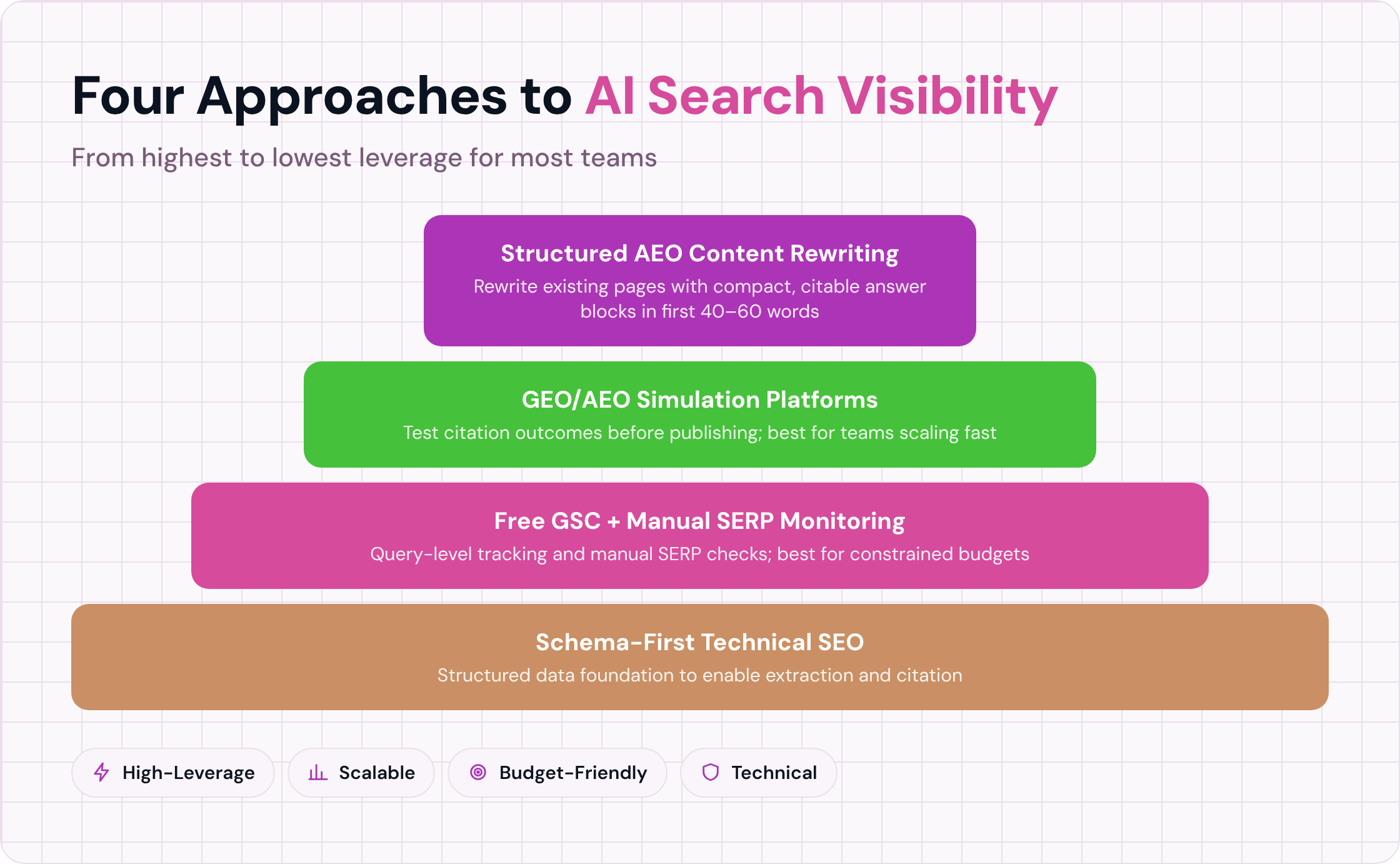
The four most practical approaches to AI search visibility are: structured AEO content rewriting for existing pages (best overall), a free GSC plus manual SERP monitoring workflow (best for constrained budgets), GEO/AEO simulation platforms that test citation outcomes before you publish (best for teams scaling fast), and a schema-first technical SEO layer as a foundation.
Top Pick: Structured AEO Content Rewriting
Rewriting existing pages to lead with compact, citable answer blocks is the highest-leverage move for most teams. You already have the content; the work is restructuring it. Add a direct answer in the first 40-60 words, tighten your H2s into question-format headers, and cut anything that buries the core claim. Zero-click searches now represent 69% of all Google queries, up from 56% in May 2024, so the pages most likely to survive are the ones AI engines can quote directly.
The trade-off: this approach rewards informational content and punishes thin product pages. If your highest-traffic URLs are transactional, AEO rewriting alone won't recover lost clicks. Pair it with the schema layer below.
Budget Pick: Free GSC + Manual SERP Monitoring
Google Search Console filtered by query type, combined with a weekly manual SERP check on your 20 most important keywords, costs nothing and surfaces a lot. Watch for impression-to-click ratio drops on queries where you still rank in positions 1-3. That gap is usually an AI Overview absorbing the click. Ahrefs data shows AI Overviews are cutting organic click-through rates by 58%, and the queries hit hardest are definitional and how-to searches, exactly the type GSC lets you filter for.
This breaks down at scale. Manual monitoring across hundreds of URLs is unsustainable past a certain point, and GSC doesn't tell you which AI engine cited you or why. Treat it as a diagnostic starting point, not a long-term system.
Upgrade Pick: GEO/AEO Simulation Platforms
Tools like Profound and Otterly.ai let you run prompts against live AI engines and see which URLs get cited in the response. The core value is pre-publish testing: you can check whether a rewritten page earns a citation before it ships, rather than waiting weeks for GSC data to move. For teams publishing at volume, that feedback loop shortens the iteration cycle considerably.
The limitation is cost and setup time. These platforms require you to define your prompt set carefully. A poorly chosen prompt library produces misleading citation data, and most teams underestimate how much prompt curation the workflow actually needs.
Also Great: Schema-First Technical SEO Layer
Structured data (FAQ schema, HowTo schema, Article schema with dateModified) gives AI engines deterministic signals they can parse without interpreting prose. This is the foundation layer: it doesn't replace good content, but it makes good content easier to extract and cite. Pages with correct schema give crawlers an unambiguous map of what the page answers, who wrote it, and when it was last updated, all signals that correlate with citation frequency.
| Approach | Best For | Main Limitation | Cost |
|---|---|---|---|
| AEO content rewriting | Most existing sites | Weak on transactional pages | Low (time only) |
| GSC + manual SERP monitoring | Budget-constrained teams | Doesn't scale past ~20 URLs | Free |
| GEO/AEO simulation platforms | High-volume publishers | Requires careful prompt curation | Medium to high |
| Schema-first technical layer | All sites as a baseline | No substitute for content quality | Low to medium |
No single approach here is complete on its own. The teams seeing measurable citation gains are typically running the schema layer as a baseline, rewriting their top 10-15 informational pages for AEO structure, and using either manual SERP checks or a simulation platform to verify the output is actually landing.
What Zero-Click Searches Mean for Your Organic Traffic
AI Overviews resolve queries directly on the results page, so a growing share of users never click through to any website. In 2024, 60.45% of US Google searches ended without a click, according to Sparktoro's analysis of clickless queries. For SEOs, that means rankings and traffic are decoupling: you can hold position one and still lose the visit.
The Answer-in-Place Mechanic
Traditional search returned ten blue links and made the user do the work of reading. AI Overviews collapse that step. Google synthesizes a response from multiple sources, surfaces it at the top of the page, and the user's question is answered before they scroll to any organic result.
The practical effect: your page may be cited inside the Overview (a visibility win) while receiving zero sessions from that query (a traffic loss). Those two outcomes now live in the same SERP, and most analytics setups only measure the second one.
Which Query Intents Trigger Zero-Click Most Often
Intent type is the clearest predictor of zero-click risk. Informational queries ("what is", "how does", "define", "explain") are the highest-risk category. Similarweb's 2024 data shows 68% of Google searches end without a click overall, and informational queries skew well above that average.
Transactional queries behave differently. When a user is ready to buy, compare pricing, or book something, Google still tends to surface product listings, ads, or comparison pages that require a click to complete the action. Zero-click rates on transactional intent are meaningfully lower, though not zero. Commercial investigation queries ("best X for Y", "X vs. Y") sit in the middle: AI Overviews increasingly summarize the comparison, but users researching a purchase often click through to verify.
Even for transactional queries, AI Overviews are expanding into territory they did not occupy 18 months ago. A query that drove reliable click-through in 2023 may now resolve in-place. Treating transactional intent as permanently insulated from zero-click risk is the wrong assumption to carry into 2026 planning.
Why Branded and Navigational Queries Hold Up
Branded queries ("Notion pricing", "Stripe login", "HubSpot CRM review") and navigational queries ("Gmail", "Chase bank sign in") are partly protected from zero-click cannibalization for a structural reason: the user already knows where they want to go. Google has little incentive to answer a navigational query in-place because the answer is the destination, not a fact.
For branded queries specifically, the protection extends further. A user searching your company name by intent is already in your funnel. AI Overviews rarely displace that click because no synthesized paragraph substitutes for the actual product, account, or pricing page the user is looking for.
This is where brand-building intersects directly with search strategy. Teams that have invested in brand awareness find their navigational traffic largely intact even as informational traffic erodes. The implication is not to abandon informational content, but to pair it with brand-building so that users who encounter your name inside an AI Overview have enough recall to search for you directly afterward.
The Real Numbers: How Much Traffic Are You Actually Losing?
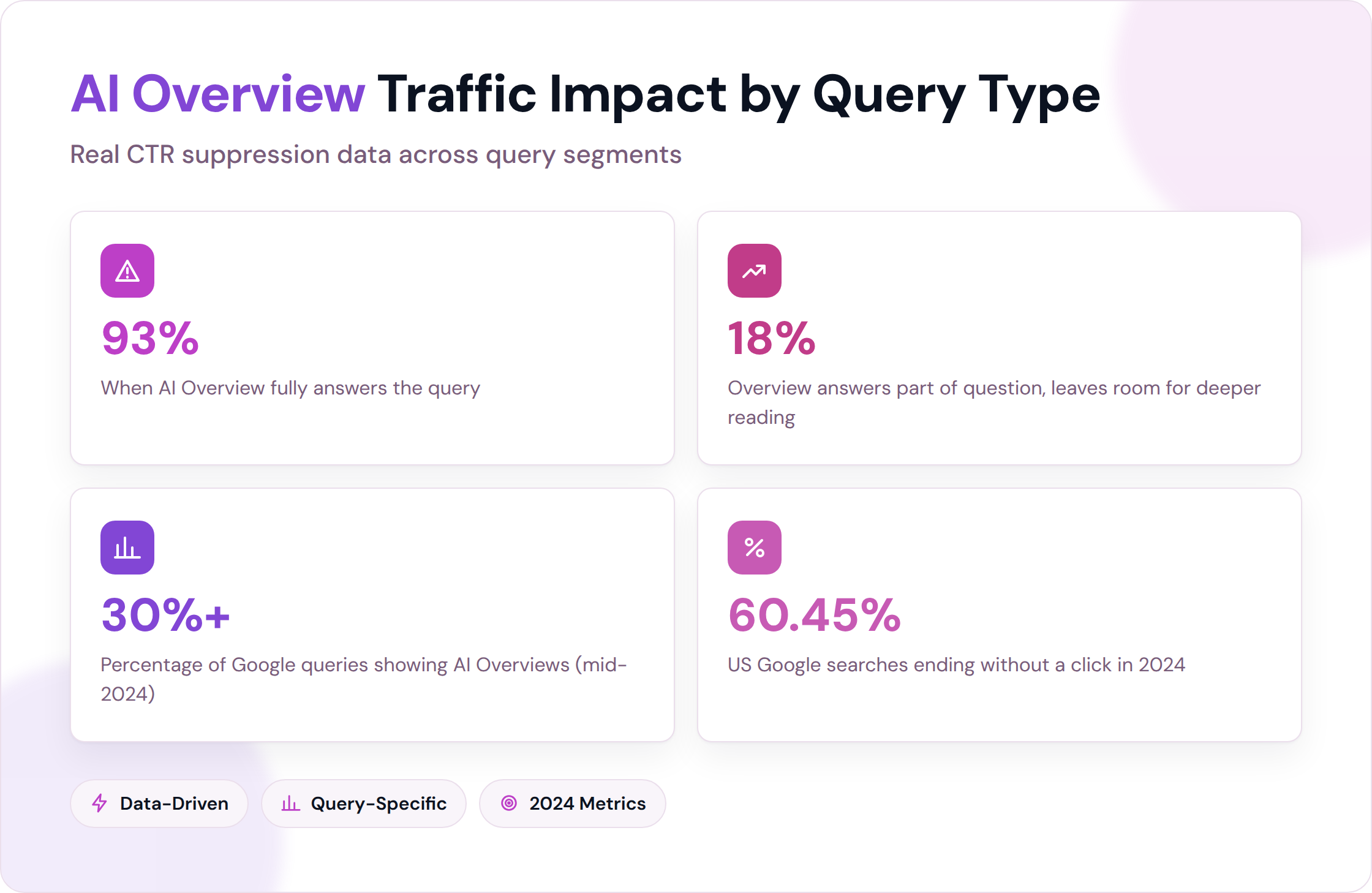
AI Overviews are suppressing organic clicks at a scale most SEO dashboards are not built to detect. BrightEdge data from mid-2024 shows AI Overviews appeared in more than 30% of Google queries, with click-through rates dropping sharply on affected keywords. The zero-click search AI impact on organic traffic is not evenly distributed: head terms and informational queries absorb the most suppression, while long-tail and transactional terms remain comparatively stable.
A few concrete figures help calibrate expectations. Queries where an AI Overview fully resolves the search see CTR drop as high as 93%, per Digitalapplied's research. Moderate-impact queries, where the Overview answers part of the question but leaves room for deeper reading, see an average 18% CTR reduction. For a site generating 50,000 monthly organic sessions from informational content, an 18% reduction across that segment is 9,000 sessions per month. At a 2% conversion rate, that is 180 fewer conversions monthly before any other variable changes.
The sessions you lose are not random. They tend to be early-funnel visitors who were using search to learn before buying. Losing them does not always show up immediately in revenue, but it does shrink the pool of users who would have eventually converted. That lag between traffic loss and revenue impact is one reason many teams underestimate the urgency of adapting.
One counter-case worth acknowledging: some brands report that the traffic they retain after AI Overview rollout converts at a higher rate than pre-rollout traffic did. If AI Overviews filter out low-intent browsers and send only high-intent clickers to your site, your conversion rate may rise even as session volume falls. Whether that trade-off is net positive depends entirely on your margin structure and how much of your funnel depends on volume at the top.
How to Earn Citations in AI Overviews
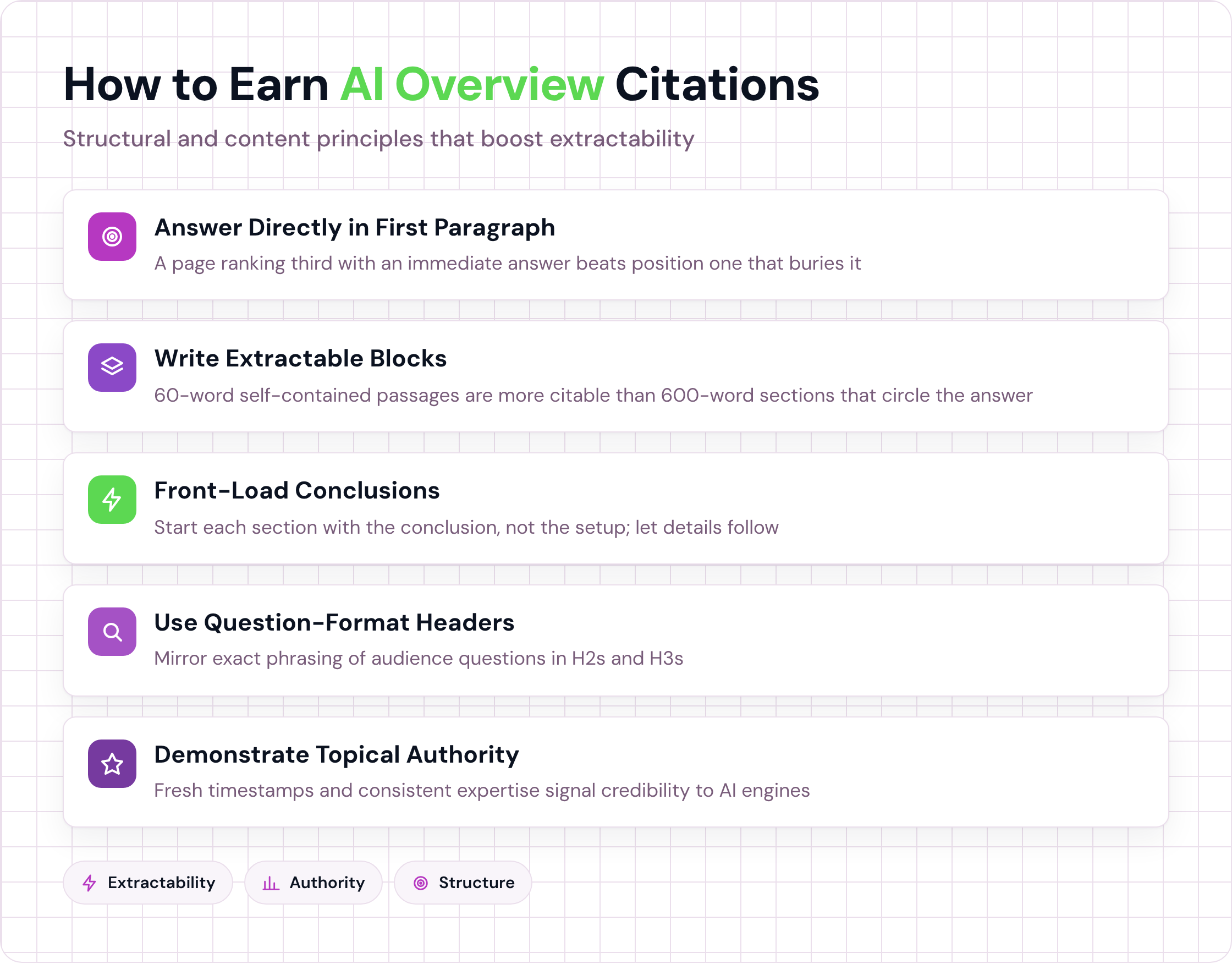
Getting cited inside an AI Overview is not the same as ranking in position one. Google's citation logic favors pages that answer a specific question directly, use clear structure, carry fresh timestamps, and come from sources with demonstrated topical authority. A page that ranks third but answers the query in the first paragraph is more likely to be cited than a page that ranks first but buries the answer in paragraph seven.
Write for Extractability
AI engines pull short, self-contained passages. A 60-word block that directly answers a question is more citable than a 600-word section that circles the answer. Structure your content so the first sentence of each section states the conclusion, not the setup. Use H2s and H3s that mirror the exact phrasing of questions your audience types.
This does not mean writing thin content. It means front-loading your conclusions and letting the supporting detail follow. A well-structured 1,200-word page with clear answer blocks outperforms a 3,000-word page that reads like a white paper.
Keep Your Timestamps Current
AI systems weight recency. A page last modified in 2022 competes poorly against a page updated in the past 90 days, even if the underlying information is identical. Add dateModified to your Article schema, update your content when facts change, and treat your top informational pages as living documents rather than published-and-done assets.
Build Topical Authority Through Cluster Depth
A single well-written page rarely earns consistent citations on its own. AI engines favor sources that demonstrate depth across a topic. If you publish one article on standing desk ergonomics, you are a generalist. If you publish 15 articles covering desk height, monitor placement, lumbar support, anti-fatigue mats, and posture correction, you become a recognizable source on the topic. Citation frequency follows that pattern.
The practical implication: audit your existing content clusters and identify where you have one or two articles on a topic but no real depth. Those gaps are where competitors with broader coverage will consistently outrank you for AI citations, even if your individual pages are well-written.
Use Schema to Remove Ambiguity
FAQ schema, HowTo schema, and Article schema with author and dateModified fields give AI crawlers explicit signals rather than inferred ones. A page with FAQ schema tells the crawler exactly which questions the page answers and what the answers are. Without schema, the crawler has to interpret that from prose, and interpretation introduces error. Schema is not a shortcut around content quality, but it removes friction for crawlers that are already inclined to cite you.
Frequently Asked Questions
Does ranking in position one still matter if AI Overviews are taking the clicks?
Position one still matters, but for a different reason than it did three years ago. Pages that rank in positions 1-3 are more likely to be cited inside AI Overviews than pages ranking further down. The ranking signal and the citation signal are correlated, even if they are not identical. Losing your position one ranking still costs you both the direct click and the citation probability.
How do I know if an AI Overview is suppressing my traffic?
Filter your Google Search Console data by queries where you rank in positions 1-5 and compare your impression-to-click ratio over time. A stable or growing impression count paired with a falling CTR on the same queries is a strong indicator that an AI Overview is absorbing clicks. Cross-reference that against a manual SERP check on your highest-impression queries to confirm whether an Overview is actually appearing.
Can I opt my pages out of being cited in AI Overviews?
Google does not currently offer a direct opt-out for AI Overview citations. You can use the nosnippet meta tag to prevent Google from displaying any snippet from your page, but this also removes your page from featured snippets and may reduce your overall SERP visibility. For most sites, opting out of snippets costs more than it saves. The better path is optimizing to be cited accurately rather than avoiding citation entirely.
What types of content are most at risk from zero-click behavior?
Definitional content ("what is X"), process explanations ("how does X work"), and factual lookups ("what is the return policy for X") are the highest-risk categories. These are queries where a single accurate paragraph resolves the search. Long-form comparison content, detailed product reviews, and content requiring personal judgment ("which X is right for my situation") are lower-risk because AI Overviews rarely resolve them completely.
How long does it take to see results from AEO content changes?
Most teams see GSC CTR movement within 6-10 weeks of publishing restructured content, assuming Google recrawls the updated pages promptly. Citation frequency in AI Overviews can lag longer, sometimes 10-14 weeks, because AI systems update their source weighting on a different cycle than the organic index. Prioritize your highest-traffic informational pages first to see the fastest measurable impact.
Is zero-click search AI impact on organic traffic permanent, or will it stabilize?
The current trajectory suggests continued expansion rather than stabilization. Google has financial incentives to keep users on its own properties longer, and AI Overviews serve that goal. The share of queries resolved in-place grew from 56% in May 2024 to 69% by late 2024, and there is no structural reason to expect that trend to reverse. Planning for further erosion of informational click-through is more defensible than planning for recovery.
If you want to see exactly which of your pages are being cited in AI Overviews and which are losing ground to competitors, visit SEORav's GEO tracking tool to run your first citation audit and start closing the visibility gap.
Keep reading
Which LLM Citation Tracking Platform Actually Works for Your Brand
Compare the top llm citation tracking platforms by engine coverage, alert speed, and pricing. Find the right tool for your team size and budget.
Siteimprove for SEO: What It Does (and What It Doesn't)
A clear-eyed look at Siteimprove SEO features, pricing, and gaps versus AI-native platforms. Find out if it fits your team's workflow in 2026.
How to Monitor Your Brand Across AI Search Engines
Learn how to track brand mentions in AI search engines like ChatGPT, Perplexity, and Gemini. Tested tools, real data, and honest trade-offs for SMB teams.