Healthcare SEO: Ranking When Trust and Compliance Matter Most
Last updated: 27 August 2026
Healthcare SEO requires a different approach than standard search optimization because trust and compliance carry legal weight. Organic search drives 54% of healthcare website traffic, yet a practice that publishes strong clinical content but runs non-compliant analytics faces real exposure. E-E-A-T signals matter more in healthcare than almost any other industry. Local citations alone won't move the needle if your expertise credentials and author authority aren't clearly documented. The stakes are higher because your audience is making health decisions based on what ranks.
Word count: 82
This article covers all three together: trust signals, clinical authority, and technical compliance. Separating them creates gaps that are hard to diagnose and expensive to fix.
Four Things That Separate Healthcare SEO From Generic SEO
Healthcare SEO operates under stricter rules than standard search optimization. Google's YMYL classification, HIPAA-constrained analytics, E-E-A-T requirements tied to named clinicians, and local pack dominance over organic rankings all create a compliance and credibility layer that generic strategies simply don't account for.
- YMYL classification raises the bar for every page. Health content falls into Google's "Your Money or Your Life" category, so pages are evaluated at a higher quality threshold than a recipe blog or a product review. Seoprofy's healthcare SEO breakdown makes this explicit: inaccurate or thin health content faces harsher ranking penalties than equivalent content in lower-stakes verticals.
- HIPAA limits which tracking tools you can deploy. Standard analytics setups, including certain Google Analytics 4 configurations with ad features enabled, can expose protected health information. Tighter tracking means less behavioral data to inform content decisions, and many practices end up with incomplete conversion attribution as a result.
- E-E-A-T requires named clinicians, credentials, and citations. A page signed by "Staff Writer" won't cut it. Author bios need licensure details, institutional affiliations, and links to peer-reviewed sources. Wheelhouse DMG's guide to healthcare SEO covers how practices structure author markup to satisfy these signals without turning every article into a CV.
- Local pack visibility often drives more appointments than organic rankings. For most single-location practices, a position in the Google Maps 3-pack converts at a higher rate than a page-one organic result. This breaks down for telehealth providers or multi-state networks, where geographic relevance is diluted and organic content targeting condition-specific queries tends to outperform local signals.
Why SEO for the Healthcare Industry Operates Under a Different Rulebook

Healthcare SEO sits under a stricter set of quality standards than almost any other content category online. Google classifies medical content as YMYL (Your Money or Your Life), meaning a ranking error carries real-world consequences: a patient who reads inaccurate dosage information or misunderstands a symptom description can be harmed. That classification triggers elevated scrutiny of every E-E-A-T signal on the page, from author credentials to the recency of clinical claims.
YMYL Classification and What It Actually Changes
YMYL is not a penalty flag. It is a scoring threshold. When Google's quality raters assess a healthcare page, they apply a higher bar for demonstrated expertise than they would for a travel blog or a product review. A page recommending a treatment protocol needs visible author credentials, institutional affiliation, and citations to peer-reviewed sources. A page about the best hiking boots does not. The practical result: thin content that ranks fine in low-stakes verticals gets suppressed in healthcare.
The August 2023 broad core update made this concrete. Medical and health sites saw some of the sharpest visibility swings of any sector that cycle, with several large symptom-checker and patient-education domains losing 30 to 50 percent of their organic traffic within weeks of the rollout. Healthcare Success documents the pattern in their 2026 guide, noting that sites without clear authorship signals and medically reviewed content were disproportionately affected.
The Trust Gap Between Healthcare and Other Regulated Industries
Financial services and real estate also carry YMYL classification, but the trust gap between those sectors and healthcare is wider than most SEO practitioners expect.
A mortgage lender can satisfy Google's quality signals largely through regulatory disclosures, licensed author bios, and links from recognized financial institutions. The compliance infrastructure already exists. Healthcare content has to do more: clinical accuracy must be verified by a credentialed practitioner, content often needs to reference evolving clinical guidelines, and the risk of a patient acting on outdated information is immediate and physical, not financial.
Real estate SEO, by comparison, operates in a category where the "harm" of bad information is a wasted viewing appointment. The stakes are asymmetric.
Smaller practices and independent clinics often cannot afford a full-time medical reviewer or a compliance editor. For those teams, the rigorous authorship and review standards that Google rewards are genuinely difficult to meet. Competing on broad clinical terms against hospital systems with dedicated content teams is rarely viable. The more realistic path is tight geographic and condition-specific targeting, where the authority bar is lower and the competition thinner.
Percepture's analysis of healthcare SEO requirements frames this directly: compliance-sensitive content must be accurate, medically reviewed, and carefully worded to avoid regulatory exposure, which adds production overhead that simply does not exist in most other verticals. Ignoring that overhead does not make the rules go away. It just means the algorithm enforces them without warning.
E-E-A-T Requirements for Medical Content: What Google Actually Checks

Google's quality raters apply stricter scrutiny to health content than almost any other category. For medical pages, E-E-A-T means a named, credentialed author, institutional affiliation visible on the page, citations to peer-reviewed or clinical sources, and a visible review date. Pages that omit any of these signals are routinely rated "Fails to Meet" in quality rater review, regardless of how well the prose reads.
Experience and Expertise: Why Anonymous Authors Fail
An anonymous byline is a structural problem, not a stylistic one. Google's quality rater guidelines classify health content as YMYL material, and Google's own documentation on helpful content makes clear that raters are instructed to ask whether the content demonstrates first-hand experience and subject-matter expertise. A page attributed to "Staff Writer" or "Editorial Team" gives raters nothing to evaluate.
The fix is specific. The author bio needs a name, a credential (MD, RN, PharmD, or equivalent), a license state if applicable, and a link to a verifiable professional profile such as a state medical board listing or a hospital directory page. A bio that says "Dr. Sarah Chen, board-certified internist, licensed in Ohio" is stronger than one that stops at "Dr. Sarah Chen."
Authoritativeness Signals: Credentials, Research, and Affiliations
Authoritativeness for medical content is built off-page as much as on it. The signals that carry the most weight are institutional affiliations (a university hospital, a recognized health system, a professional medical association), published peer-reviewed research indexed in PubMed or a comparable database, and citations from other authoritative health domains.
Workshop Digital's analysis of Google's quality guidelines describes this as an ongoing maintenance requirement, not a one-time setup. A clinician who published research in 2018 but has no recent activity, no updated profile, and no current institutional affiliation presents a weaker authority signal than one with a 2024 conference presentation and an active hospital page.
One trade-off worth naming: smaller independent practices often cannot match the institutional authority of a major academic medical center. A solo cardiologist in private practice will not outrank Cleveland Clinic on broad cardiology terms purely through E-E-A-T signals. The realistic strategy is to narrow the topical focus, build depth on a specific condition or procedure, and earn citations from local or regional health organizations rather than competing head-on for national terms.
Trustworthiness Mechanics: Sources, Review Dates, and Clinical Links
Trustworthiness is the most operationally concrete of the four dimensions. Three mechanics move the needle.
Primary source citations. Link to the clinical trial, the CDC guidance, or the FDA label, not to a secondary summary of it. A page about metformin dosing that cites the prescribing information directly is more trustworthy than one that cites a wellness blog summarizing the same document.
Visible review dates. A "medically reviewed on [date]" line near the top of the page tells both raters and readers that the information is current. For fast-moving topics (drug approvals, treatment guidelines, vaccine schedules), content older than 12 months without a review note is a liability.
Clinical evidence links. Healthcare SEO strategy in 2026 increasingly treats outbound links to clinical evidence as a trust signal rather than a traffic leak. Practice Builders' 2026 healthcare SEO and GEO guide documents this shift in the context of generative engine optimization: AI engines parsing your page for citation worthiness look at what you cite, not just what you say.
The limitation here is maintenance overhead. A 200-page health content library with accurate review dates and live clinical citations requires a real editorial process: someone with clinical knowledge checking whether guidelines have changed, updating links when studies are retracted or superseded. Teams that publish and forget will accumulate trust debt faster than teams in less regulated verticals.
HIPAA, Privacy Rules, and Technical SEO: Where They Collide

Standard web analytics and healthcare SEO have a compliance problem. The HHS 2022 bulletin classified IP addresses, appointment-request URLs, and condition-specific page paths as protected health information (PHI) when collected alongside identifiable user data. That ruling made default Google Analytics 4 setups on patient-facing pages a HIPAA liability, not just a technical oversight. Healthcare marketers now have to build search visibility without the tracking infrastructure most SEO workflows take for granted.
What the 2022 HHS Bulletin Actually Changed
The bulletin did not ban analytics outright. It drew a line between aggregate, non-identifiable traffic data and data that could be linked to a specific patient's health condition or care-seeking behavior. The practical effect: any analytics tag that captures the full URL of a page like /book-appointment?condition=depression or /patient-portal/login alongside a cookie or IP address is collecting PHI under the bulletin's framework.
Several large health systems, including Advocate Aurora Health and WakeMed, faced federal investigations in 2022 and 2023 after using Meta Pixel on patient-facing pages. The Pixel transmitted appointment-booking data, including condition categories, to Meta's ad platform. Those cases established that "we didn't know the pixel was doing that" is not a viable compliance defense.
For SEO purposes, the constraint is real. You lose the ability to track which organic landing pages convert to appointment bookings through standard GA4 event flows. You lose remarketing audiences built from health-condition page visits. You lose the behavioral data that informs content gap analysis at the conversion stage.
Compliant Analytics Configurations That Still Support SEO
You have workable options, though each involves trade-offs.
Server-side tagging with PHI filtering. Route analytics through a server-side container (Google Tag Manager server-side or a comparable solution) that strips identifiable parameters before data reaches GA4. This preserves aggregate traffic and engagement data while removing the PHI that triggers HIPAA exposure. The downside: implementation requires developer resources and ongoing maintenance as URL structures change.
HIPAA-compliant analytics platforms. Tools like Freshpaint and Piwik PRO Healthcare Edition are built with PHI filtering at the architecture level. They cost more than GA4 (which is free) and require staff training, but they give you a defensible compliance posture and enough behavioral data to run content strategy decisions.
Consent-based tracking with explicit patient authorization. Some practices implement a consent layer that allows full analytics tracking only after a patient explicitly opts in. This is compliant but produces a heavily skewed dataset: patients who opt in are not representative of all visitors, and conversion data from the opted-in cohort may not reflect actual appointment-booking behavior across your full audience.
The honest assessment: no compliant configuration gives you the same data richness as an unconstrained GA4 setup. You are making a trade between legal exposure and analytical precision. Most practices should accept the data loss and build content strategy on keyword research, rank tracking, and aggregate traffic trends rather than on individual-level behavioral data.
Technical SEO Priorities That Don't Require Tracking Data
Several high-impact technical SEO tasks require no analytics data at all and carry no HIPAA risk.
Core Web Vitals optimization is one. Google's page experience signals (Largest Contentful Paint, Interaction to Next Paint, Cumulative Layout Shift) are measured against your live pages by Google's own crawlers. You can audit and fix them using PageSpeed Insights or the Chrome User Experience Report without touching your analytics setup.
Schema markup is another. Structured data for medical conditions (MedicalCondition), physicians (Physician), and local businesses (LocalBusiness) helps Google understand your content and can improve rich result eligibility. None of this requires user tracking.
Crawl efficiency matters more on large healthcare sites than most teams realize. A hospital system with 10,000 pages, many of them thin location or provider directory pages, wastes crawl budget on low-value URLs. Auditing your robots.txt, XML sitemaps, and internal link structure to prioritize clinically substantive pages is a purely technical task with no compliance dimension.
Local SEO for Healthcare Practices: The 3-Pack and Beyond
For most brick-and-mortar healthcare practices, local search visibility drives more appointment volume than any other organic channel. A primary care clinic ranking in the Google Maps 3-pack for "primary care doctor near me" in a mid-size city will typically see more new patient inquiries from that placement than from a page-one organic ranking for a condition-specific term.
Google Business Profile Optimization for Medical Practices
Your Google Business Profile (GBP) is the single highest-leverage local SEO asset for a healthcare practice. The fields that matter most are not always the ones that get attention.
Primary category selection. Google offers granular medical categories: "Internist," "Cardiologist," "Pediatrician," and dozens of others. Selecting the most specific applicable category rather than the generic "Medical Clinic" improves relevance matching for specialty-specific queries. A practice that lists itself as "Family Medicine Physician" rather than "Doctor" will rank for more targeted searches.
Services and attributes. GBP allows you to list specific services (annual physicals, telehealth visits, sports medicine consultations) and attributes (wheelchair accessible, accepts new patients, languages spoken). These fields feed into Google's local ranking algorithm and appear directly in the knowledge panel, reducing friction for patients evaluating whether your practice fits their needs.
Review velocity and response rate. Google's local ranking algorithm weights both the volume and recency of reviews. A practice with 200 reviews but none in the past six months will typically rank below one with 80 reviews and a steady stream of recent feedback. Responding to reviews, including negative ones, signals active management and improves the profile's engagement signals.
One compliance note: asking patients to leave reviews is generally permissible, but the request cannot be conditioned on a positive review, and you cannot offer incentives. Responding to reviews requires care: confirming or denying that someone is a patient, even implicitly, can constitute a HIPAA disclosure.
NAP Consistency and Citation Building
NAP (Name, Address, Phone) consistency across directories is a foundational local SEO requirement. For healthcare practices, the relevant citation sources extend beyond the standard Yelp/Yellow Pages tier.
Health-specific directories carry disproportionate authority: Healthgrades, Zocdoc, Vitals, WebMD's physician directory, and the US News Health provider listings all pass meaningful local signals. A practice listed consistently across these sources with matching NAP data, correct specialty categories, and complete profiles will outperform one with inconsistent or incomplete listings.
The practical challenge is maintenance. Practices that move locations, change phone numbers, or add providers often find that old NAP data persists in directories for months or years. A citation audit using a tool like BrightLocal or Whitespark, run annually, catches the drift before it compounds into a ranking problem.
Localized Content Strategy for Multi-Location Practices
Multi-location healthcare organizations face a specific challenge: how to create location pages that are genuinely useful rather than thin, templated duplicates that Google treats as low-quality content.
The standard approach of swapping city names into a template ("Welcome to [City] Family Medicine") produces pages that rank poorly and convert worse. The pages that perform are ones that address location-specific context: the patient population served, the specific providers at that location, the insurance plans accepted at that site, and any services unique to that location.
A regional health system with 15 clinic locations should treat each location page as a standalone content asset, not a template fill. That requires more production effort, but the alternative is 15 thin pages competing against each other and against stronger local competitors.
Content Strategy for Healthcare: Depth Over Volume

Healthcare content strategy in 2026 has shifted away from publishing volume toward topical depth and clinical specificity. The practices and health systems that gained organic visibility after the 2023 and 2024 core updates were not the ones publishing the most articles. They were the ones building comprehensive, clinically accurate coverage of specific condition areas with clear authorship and maintained review cycles.
Condition-Specific Content Clusters
A content cluster for a specific condition (say, Type 2 diabetes management) should cover the full patient journey: initial symptoms and diagnosis, treatment options and their trade-offs, lifestyle modifications, medication management, complication monitoring, and when to seek specialist care. Each subtopic becomes a page. The cluster's hub page links to each subtopic, and each subtopic links back to the hub.
This structure does two things. It signals topical authority to Google by demonstrating comprehensive coverage of a subject area. It also serves patients at different stages of their care journey, which improves engagement signals (time on page, pages per session) that correlate with ranking performance.
The trade-off: building a genuine condition cluster requires clinical input at every stage. A diabetes content cluster written without endocrinologist review will contain errors, and those errors are both a patient safety issue and an E-E-A-T liability. The production cost is real.
Targeting Informational vs. Transactional Queries
Healthcare search queries split roughly into two categories: informational (what are the symptoms of atrial fibrillation?) and transactional (cardiologist accepting new patients near me). Your content strategy needs to address both, but with different page types.
Informational queries are best served by clinically detailed, well-cited educational content. These pages build topical authority and capture patients early in their care journey. They rarely convert directly to appointments, but they establish your practice as a credible source before a patient is ready to book.
Transactional queries are best served by service pages and location pages optimized for local intent. These pages should be lean, specific, and conversion-focused: clear information about the service, the providers who deliver it, the location, accepted insurance, and a direct path to booking.
Mixing these two intents on a single page typically serves neither well. A page that tries to be both a comprehensive guide to atrial fibrillation and a service page for your cardiology practice will rank below a dedicated educational page on the informational query and below a dedicated service page on the transactional query.
Generative Engine Optimization (GEO) for Healthcare
AI-generated search summaries (Google's AI Overviews, Bing Copilot responses, and similar features) are increasingly the first result a patient sees for health queries. Being cited in those summaries requires a different optimization approach than traditional blue-link ranking.
AI engines pull from pages that are structured for machine parsing: clear headings, concise factual statements, primary source citations, and schema markup that identifies the content type. A page that buries its key clinical claim in the fourth paragraph of dense prose is less likely to be cited than one that states the claim clearly in the first sentence under a descriptive heading.
Practice Builders' 2026 healthcare SEO and GEO guide documents this shift in detail. The practices seeing citation in AI Overviews for health queries are those with strong E-E-A-T signals, primary source citations, and content structured around specific patient questions rather than broad topic coverage.
The limitation: AI Overview citations do not always drive click-through traffic. A patient who gets a complete answer from an AI summary may not visit your page at all. GEO optimization builds brand visibility and authority signals, but its direct contribution to appointment volume is harder to measure than traditional organic traffic.
Frequently Asked Questions
How long does healthcare SEO take to show results?
Most healthcare practices see measurable ranking improvements within four to six months of implementing technical fixes, local citation cleanup, and on-page E-E-A-T improvements. Competitive clinical content targeting broad condition terms can take 12 to 18 months to reach page one, particularly when competing against established health systems or major patient-education domains. Local pack visibility typically moves faster than organic content rankings.
Does HIPAA apply to SEO activities specifically?
HIPAA applies to any technology that collects, transmits, or stores protected health information, including analytics tools, tracking pixels, and form submissions on patient-facing pages. SEO activities that involve only keyword research, content creation, and link building carry no HIPAA risk. The compliance exposure comes from the analytics and tracking infrastructure used to measure SEO performance, not from the optimization work itself.
Can a small practice compete with hospital systems in search?
Yes, but not on the same terms. A two-physician family medicine practice will not outrank a regional health system on broad terms like "primary care doctor" in a major metro. The viable path is geographic specificity (targeting a specific neighborhood or suburb), condition specificity (building depth on a narrow set of conditions the practice treats), and local pack optimization, where the playing field is more level than organic rankings. Hospital systems often have weak GBP optimization and inconsistent local citations, which creates openings for smaller practices.
What schema markup matters most for healthcare sites?
The highest-priority schema types for healthcare are Physician (for individual provider pages), MedicalClinic or LocalBusiness (for location pages), MedicalCondition (for condition-specific content), and FAQPage (for pages structured around patient questions). BreadcrumbList and SiteLinksSearchBox are useful for large sites with complex navigation. Schema does not directly improve rankings but improves rich result eligibility and helps AI engines parse your content accurately.
How should healthcare practices handle negative reviews for SEO purposes?
Respond to every negative review promptly and professionally, without confirming or denying the reviewer's patient status. A response that says "We take all feedback seriously and encourage you to contact our patient relations team at [phone number]" is compliant and demonstrates active management to both Google's algorithm and prospective patients reading the profile. Do not ask the reviewer to remove the review, and do not offer compensation in exchange for a revision. Review response rate is a GBP engagement signal, and practices that respond consistently tend to outperform those that don't in local pack rankings.
Is telehealth SEO different from in-person practice SEO?
Telehealth SEO differs in one significant way: geographic targeting. An in-person practice targets a radius around its physical location. A telehealth provider licensed in multiple states can target condition-specific queries across those states without a local intent modifier. This means telehealth SEO leans more heavily on organic content strategy and less on local pack optimization. The E-E-A-T and HIPAA requirements are identical regardless of care delivery model.
If you are working through the compliance, content, and technical layers of SEO for the healthcare industry and need a team that understands all three, Talk to Seorav about building a strategy that fits your practice's size, specialty, and regulatory environment.
Keep reading
Ranking in Google's AI Search: The Deterministic Signals That Actually Move the Needle
Learn how do you rank in SGE with the three signals Google's AI uses to cite sources: schema markup, entity salience, and structured factual claims.

Why AI Ignores Your Content (And How to Fix It)
Learn how to avoid AI content that gets ignored by LLMs. Covers RAG retrieval signals, schema, entity salience, and an answer-first structure checklist.
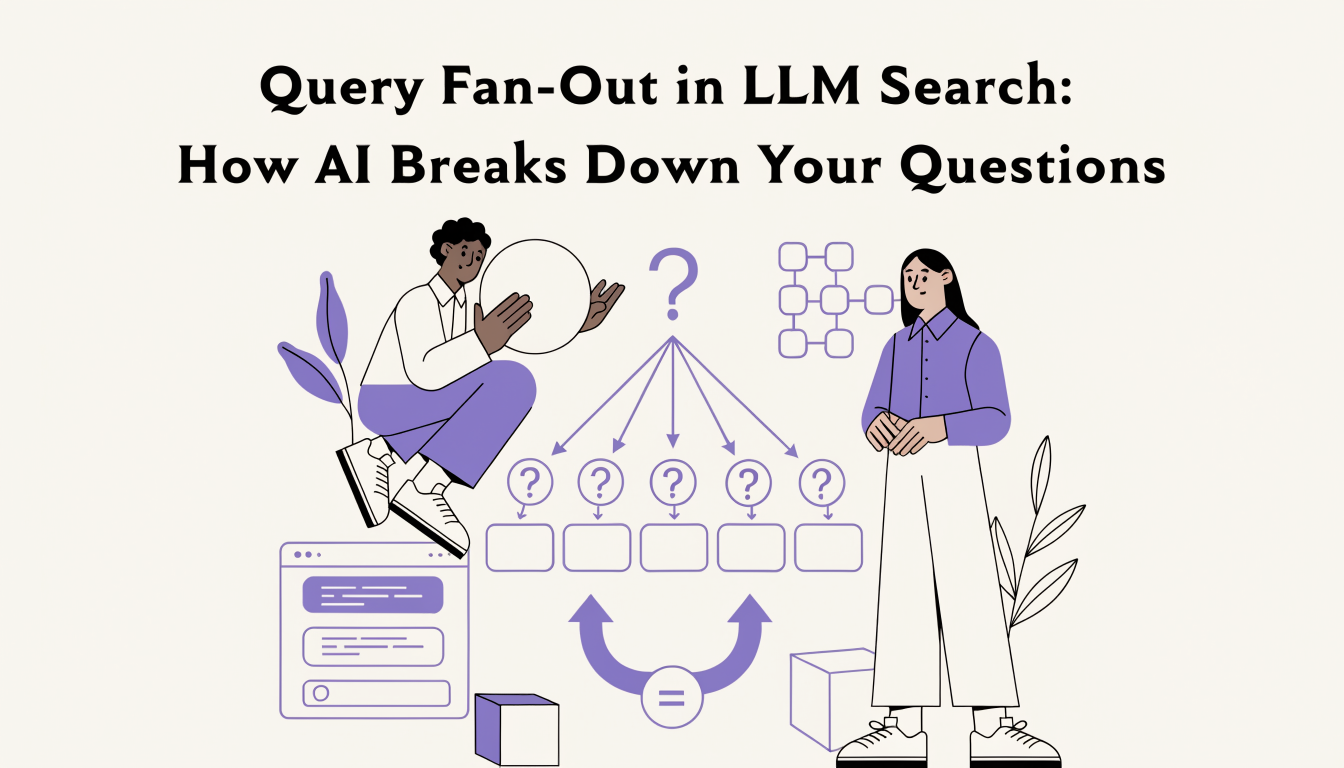
Query Fan-Out in LLM Search: How AI Breaks Down Your Questions
Learn what query fan-out in LLM search is, how AI splits your prompt into 3-8 sub-queries, and how to structure content to win more citation passes.