Google SEO in 2025: Still Worth It, or Finally Fading Out?
Last updated: 12 November 2026
Google SEO is not dead in 2025, but the tactics that drove traffic in 2022 no longer work. Google processes 8.5 billion searches daily, and organic search remains the largest traffic source for most websites. The shift is real: keyword stuffing, thin content, and link schemes now trigger penalties instead of rankings. Brands adapting to Google's focus on experience signals and topical authority continue capturing significant traffic. The question is not whether SEO survives, but whether your strategy does.
The "is Google SEO dead" question has a reliable two-year cycle. A new feature ships (featured snippets, voice search, AI Overviews), traffic dips for a subset of queries, and a wave of posts declares the discipline finished. A decade of digital marketers have watched this pattern repeat without the funeral ever arriving. The reason the prediction keeps failing: it conflates a specific tactic becoming obsolete with the entire channel dying. Those are different problems.
What makes 2025 genuinely different is the zero-click shift reaching statistical significance. Sparktoro's 2026 analysis found that 68% of Google searches now end without a click, driven largely by AI-generated answer boxes. Prior algorithm cycles (Panda, Penguin, Helpful Content) changed how pages ranked. This one changes whether a search produces a visit at all.
One honest caveat worth keeping in mind: traffic volume and SEO value are no longer the same metric. A brand cited inside an AI Overview gets visibility without a click. Measuring only sessions will make the channel look worse than it actually is.
Why "Is Google SEO Dead in 2025" Feels So Urgent Right Now
Google SEO's value shifted measurably in 2024, not gradually over years. AI Overviews began absorbing answers that previously sent clicks to publisher pages, and zero-click search rates climbed sharply enough that SEO teams started questioning budget allocations they had not reconsidered in a decade.
Click-through rates dropped roughly 30% in the months following Google's AI Overviews rollout in May 2024, even as impression counts held steady or grew. That divergence, rankings staying flat while traffic quietly bled out, is what made the shift so disorienting. Teams were watching their positions and seeing green. Their analytics told a different story.
A concrete example: a mid-size informational publisher covering personal finance and health topics reported losing between 30% and 40% of organic traffic over roughly six months in late 2024. The pages that collapsed were almost entirely informational queries: definitions, how-to explanations, comparison articles. AIOSEO's SEO statistics research identifies this content type as most exposed to zero-click displacement, where Google's own interface answers the question before a user reaches a result.
The pattern is instructive. Transactional and navigational queries held up. Someone searching "buy running shoes size 11" or "Notion pricing page" still clicks through. The damage concentrated almost entirely in informational intent, the segment that many content-heavy publishers had built their entire traffic model around.
To be fair, this does not mean Google SEO is broken across the board. For local search, product pages, and brand-navigational queries, organic rankings still convert. The limitation is that the old assumption, that ranking for informational keywords reliably produces traffic, no longer holds the way it did in 2022. Teams that built content strategies around high-volume, low-commercial-intent keywords are the ones feeling the most pressure right now.
The Reality of Google SEO's Current State
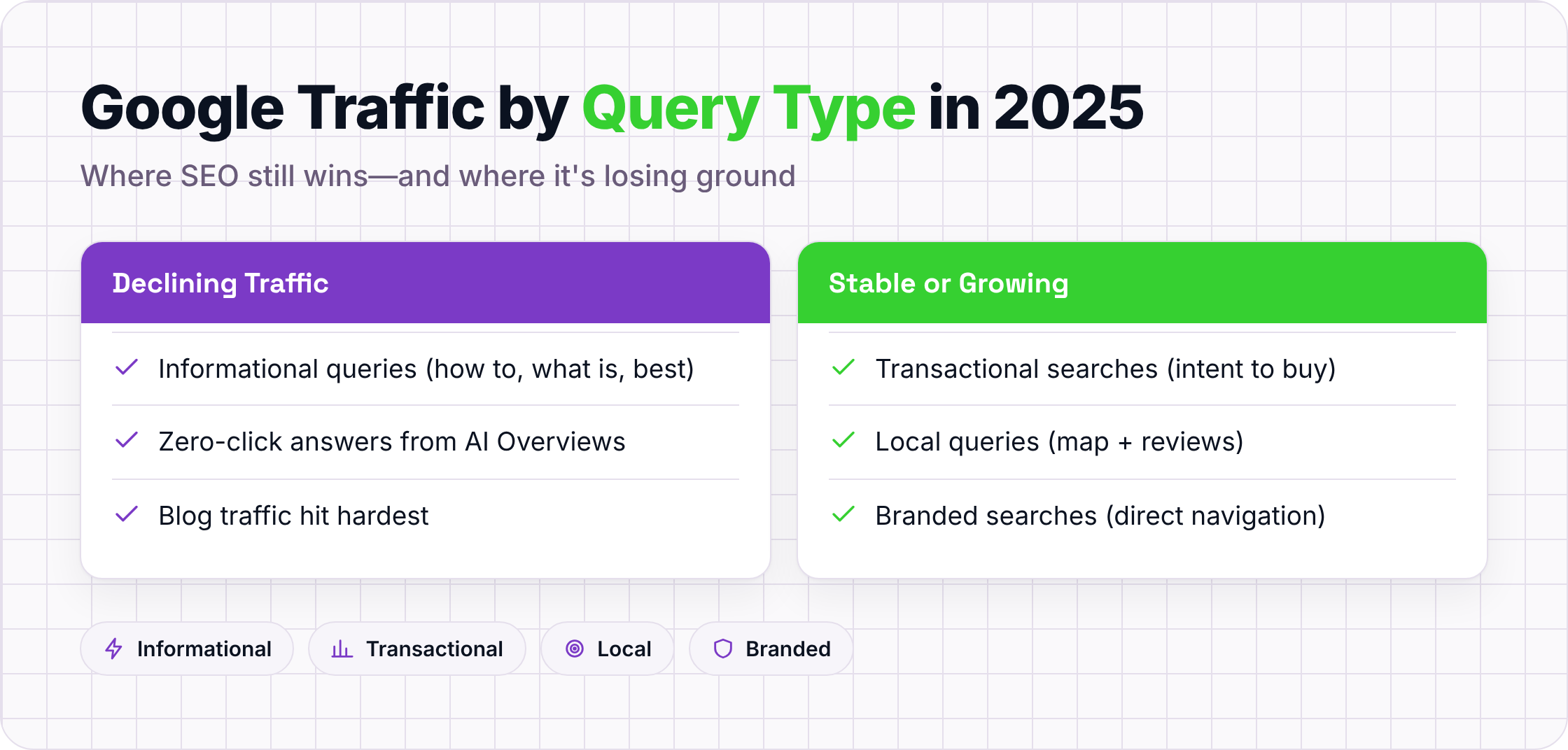
Google SEO in 2025 is not uniformly declining. Traffic losses are concentrated in specific query types, while other categories remain stable or are growing. Informational queries, the kind that once drove massive blog traffic, have taken the hardest hit as AI Overviews absorb answers before a click happens. Transactional, local, and branded searches still deliver measurable click-through volume. The filter separating sites that survive algorithm updates from those that do not is increasingly E-E-A-T.
Where Google Traffic Is Actually Falling
The damage is real but narrow. Informational queries ("how to," "what is," "best way to") are the category most exposed to zero-click behavior. When Google surfaces a direct answer at the top of the results page, a large share of users never scroll further. Navigational queries face a similar risk: if someone types a brand name to find a login page, Google's own Knowledge Panel often resolves the intent without a click.
Graphite's research into SEO traffic trends puts the overall decline at roughly -2.5%, not the dramatic collapse that circulates in marketing forums. The aggregate figure masks a sharper drop in informational verticals, where some publishers report 20-40% year-over-year losses on their top how-to content since AI Overviews expanded in late 2023.
Where Google Traffic Is Holding or Growing
Transactional queries, searches with purchase intent, are largely intact. A user searching "buy standing desk under $400" or "book a plumber in Austin" is not satisfied by a paragraph summary. They need a page, a price, a phone number. Local searches follow the same logic: Google Maps and the local pack still drive foot traffic and calls in ways that AI-generated answers cannot replicate.
Branded searches are also stable. When someone types your company name, they are looking for you specifically, and Google still routes that intent to your site reliably. This maps to a consistent pattern webyes.com documents in their 2025 SEO analysis: fewer searches end in a click overall, but Google still handles the majority of search volume, and click-through rates on high-intent queries have not collapsed the way informational rates have.
E-E-A-T as the Primary Survival Filter
Google's 2025 algorithm behavior has made one thing structurally clear: Experience, Expertise, Authoritativeness, and Trustworthiness signals are no longer a ranking bonus. They are the baseline for staying indexed at a competitive level.
Sites that have survived the Helpful Content updates and the March 2024 core update share a common profile: named authors with verifiable credentials, first-person experience embedded in the content, citations to primary sources, and a clear editorial identity. Generic content, even technically optimized generic content, has been systematically demoted.
E-E-A-T is genuinely hard to retrofit. A site built on anonymous, templated content cannot simply add author bios and recover. Google's quality raters evaluate the full page context, the site's reputation off-page, and the consistency of expertise signals across the domain. For publishers who built large content libraries between 2018 and 2022 using scaled, low-differentiation production, the path back is slow and expensive. Health, finance, and legal categories face a higher bar than others, and smaller independent sites often cannot match the institutional authority signals that large publishers carry by default.
If your site's traffic is concentrated in informational queries and your content lacks strong E-E-A-T signals, incremental optimization will not close the gap in 2025. The structural work comes first.
How Google's Algorithm Has Shifted in 2025
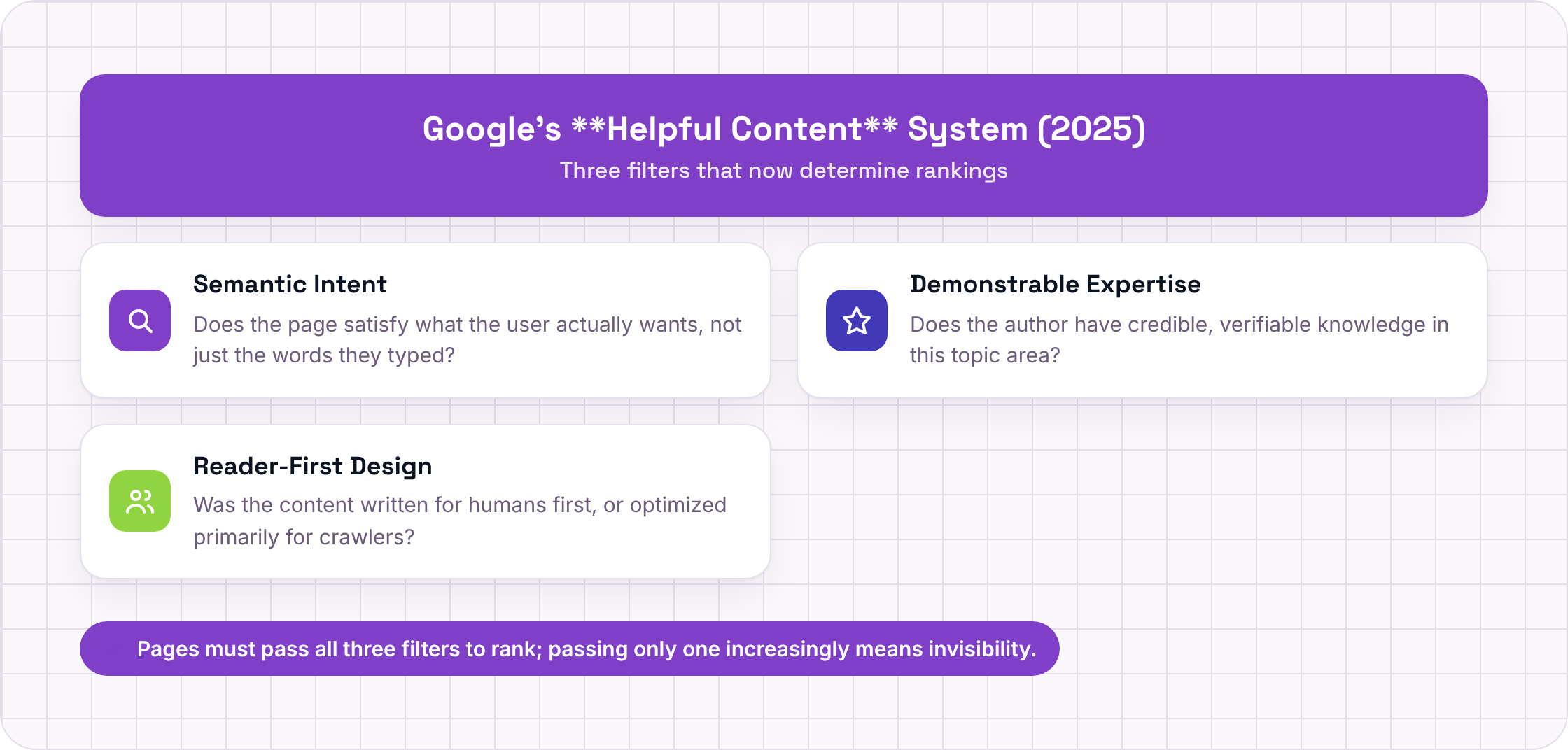
Google's 2025 algorithm no longer rewards pages that match a query word-for-word. The Helpful Content System now evaluates whether a page satisfies the underlying intent behind a search, whether the author has demonstrable expertise in the topic area, and whether the content was built for a reader or for a crawler. Pages that pass all three filters rank. Pages that pass only one are increasingly invisible.
From Keyword Matching to Semantic Intent
The shift away from exact-match signals has been building for years, but 2025 is where it became unmistakable in the data. Google's December 2025 Core Algorithm Update, tracked by Found across its 18-day rollout, produced ranking volatility that disproportionately hit thin, keyword-stuffed pages while lifting longer, topic-coherent content. The Helpful Content System measures topical coverage, reading context, and user satisfaction signals, not keyword density.
In practice, a page about "project management software for remote teams" no longer competes purely on how many times that phrase appears. It competes on whether it covers adjacent concepts like async workflows, time-zone coordination, and integration with tools teams actually use. Semantic completeness is now a ranking input.
Entity Authority and Author Credibility
Google's systems have become more precise about who is writing, not just what is written. Author entities, organizational entities, and topical authority signals are now weighted more explicitly in post-HCU rankings. A byline attached to a verifiable professional profile, a publication with a clear subject focus, and internal linking that reinforces topical depth all contribute to how Google scores a page's credibility.
The trade-off is real. Smaller publishers with genuine expertise but thin digital footprints often struggle to establish entity authority quickly. A solo practitioner who knows a subject deeply may still rank below a larger site with weaker content simply because the larger site has more established entity signals. Building entity authority takes months of consistent, attributed publishing, and there is no shortcut that holds up past the next core update.
Content Built for Rankings Gets Filtered First
Pages engineered around ranking signals rather than reader value are now the first casualties of each core update cycle. The Helpful Content System's classifier runs continuously, not just at update intervals, which means a page can lose ranking equity between major updates if its engagement signals deteriorate.
Stackademic's 2025 analysis documents this structural transformation driven by Google's AI Overviews, entity-based ranking, and intent classification. Content farms that produced 50 variations of the same article targeting slight keyword permutations have seen the most severe losses. Pages with high impressions but low click-through rates and short dwell times are being deprioritized regardless of their backlink profiles.
If a page's primary design decision was "what keyword do I target" rather than "what does someone actually need to know," it is now structurally vulnerable. The algorithm has gotten good enough at detecting the difference.
The Rise of AI Search and What It Means for Google
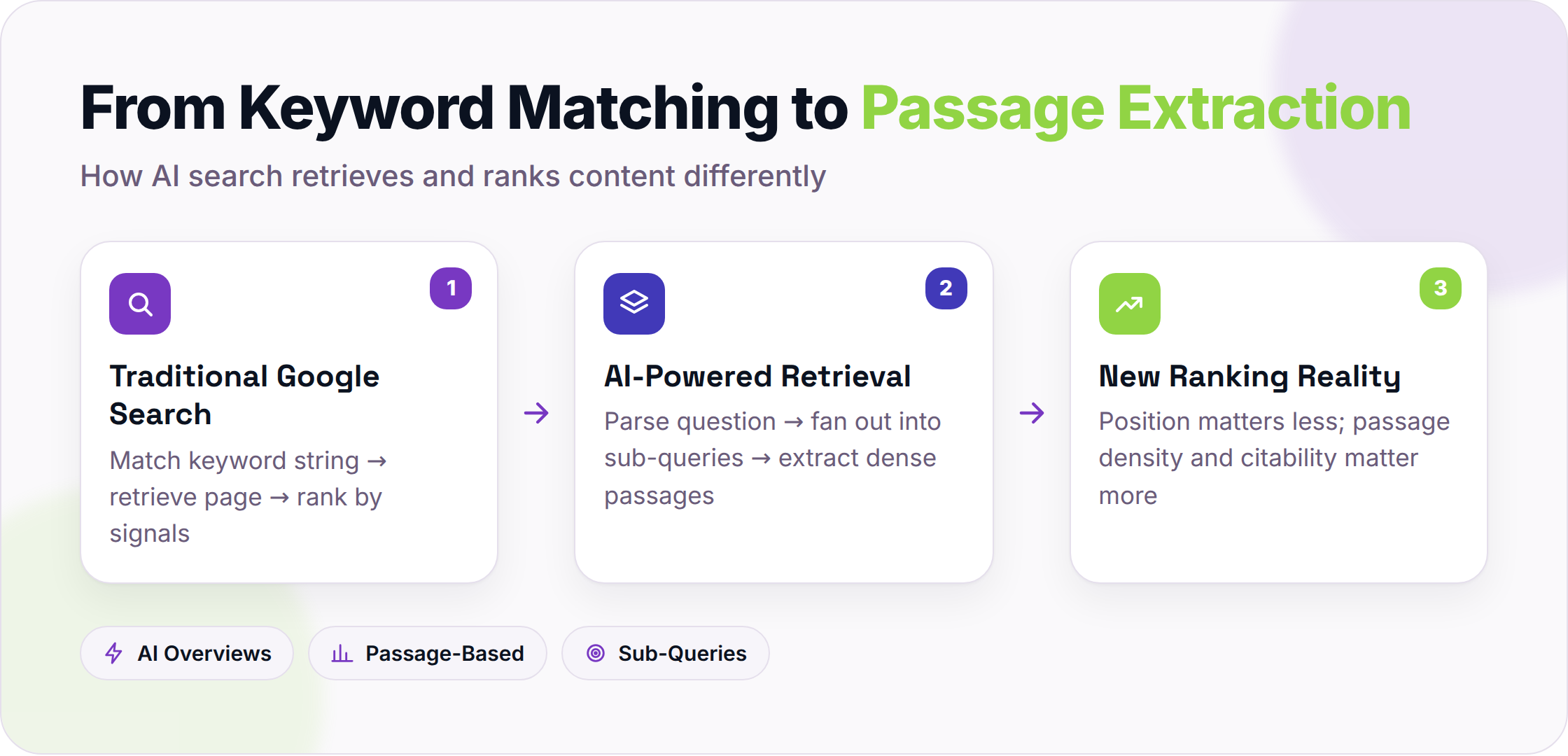
AI search engines are changing how queries get answered, not just where. When a user asks ChatGPT or Perplexity a question, the system fans out that query into multiple sub-queries, retrieves candidate passages from across the web, and synthesizes a single response. Google now does something similar with AI Overviews. The practical result: ranking position matters less than whether your content contains a passage dense enough to be extracted and cited directly.
Query Fan-Out Changes the Retrieval Model
Traditional Google search matched a keyword string to a page. AI-powered retrieval matches a question to a passage. That distinction changes what "optimizing for search" actually means. A page that ranks #3 for a head term but contains one highly specific, well-sourced paragraph on a sub-topic may get cited in AI Overviews more often than the #1 result, which covers the topic broadly but shallowly.
The implication for your content strategy: depth on specific sub-topics now competes with breadth across a keyword cluster. You do not need to cover everything. You need to cover something better than anyone else has.
What Gets Cited in AI Overviews
Google's AI Overviews pull from pages that demonstrate three things: factual specificity (numbers, dates, named sources), clear attribution (who wrote this and why should Google trust them), and structural clarity (the answer is findable in a discrete passage, not buried in 2,000 words of preamble).
Pages optimized purely for traditional ranking signals, long introductions, keyword-rich headers, thin body paragraphs, tend to perform poorly in AI Overview citations even when they rank well in the blue-link results below. The two systems reward different things, and right now most SEO teams are only measuring one of them.
The Perplexity and ChatGPT Factor
Google's share of the search market is still dominant, but it is no longer the only place people go to get answers. Perplexity reported 100 million monthly active users in early 2025. ChatGPT's search feature, launched in late 2024, is processing a volume of queries that Bing could not achieve in a decade. These platforms do not use Google's index exclusively, and they surface sources differently.
For your site, this means the question "is Google SEO dead" is partly the wrong frame. The more useful question is whether your content is structured to be retrieved and cited by any AI-powered retrieval system, Google's included. The answer to that question is the same regardless of which platform is doing the retrieving: specific, attributed, structurally clear content wins.
What Actually Works in Google SEO Right Now
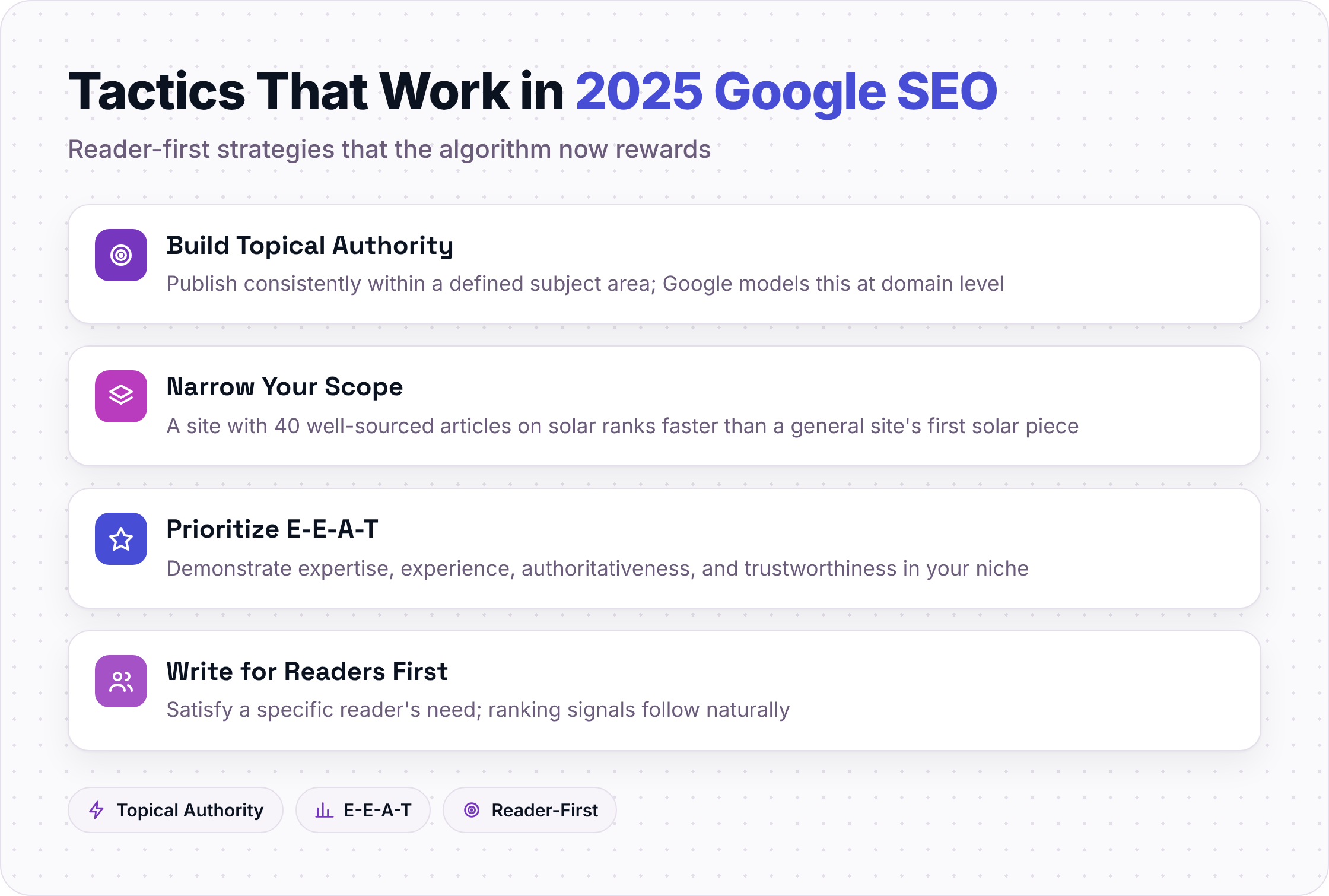
The tactics that are producing measurable results in 2025 share a common thread: they are built around satisfying a specific reader with a specific need, not around gaming a ranking signal. That is not a philosophical statement. It is a description of what the algorithm currently rewards.
Topical Authority Over Keyword Volume
Sites that publish consistently within a defined subject area are outperforming sites that chase high-volume keywords across unrelated topics. Google's systems now model topical authority at the domain level, not just the page level. A site that has published 40 well-sourced articles on residential solar installation will rank for new solar-related queries faster than a general home improvement site publishing its first solar article, even if the general site has more total backlinks.
The practical implication: narrowing your content scope often produces better results than expanding it. Counterintuitive, but consistent with how entity-based ranking works.
First-Hand Experience as a Differentiator
Content that includes specific, verifiable first-hand experience is harder for AI to replicate and harder for competitors to copy. A review that includes actual purchase receipts, real product photos, and specific performance data from your own testing ranks differently than a review assembled from other reviews. Google's quality raters are trained to look for this distinction, and the algorithm reflects their assessments over time.
This is one area where smaller, independent publishers have a genuine structural advantage over large content operations. A solo expert who has spent 15 years in a field can produce content that a scaled content team cannot match on experience signals, even if the scaled team wins on production volume.
Technical SEO Still Matters, Just Differently
Core Web Vitals, crawl efficiency, structured data, and mobile performance are not optional. They are table stakes. A technically broken site will not rank regardless of content quality. But technical SEO alone no longer moves the needle the way it did in 2019. Fixing your page speed from 4.2 seconds to 1.8 seconds matters. Shaving it from 1.8 to 1.6 seconds probably does not.
Structured data is worth specific attention in 2025. Schema markup for articles, FAQs, how-tos, and product pages increases the probability that your content gets parsed correctly for AI Overview extraction. It does not guarantee citation, but it removes a barrier.
Link Building Has Not Died, But It Has Narrowed
Backlinks still matter. A page with zero external links pointing to it is at a structural disadvantage against a comparable page with 20 links from relevant, authoritative sources. What has changed is the signal-to-noise ratio. Google's systems have gotten better at identifying link schemes, paid placements, and low-quality directory links. A handful of genuine editorial links from topically relevant sites now outweighs hundreds of links from unrelated or low-authority sources.
The trade-off: earning genuine editorial links is slow and expensive. Digital PR, original research, and tools or resources that other sites want to reference are the most reliable methods. Guest posting on low-authority sites for link volume is largely a waste of time in 2025.
Frequently Asked Questions
Is Google SEO dead in 2025?
No. Google SEO is not dead in 2025, but it has changed enough that strategies built before 2023 often produce worse results than they used to. The channel still drives more website traffic than any other single source, and organic rankings still convert for transactional, local, and branded queries. The shift is that informational content, the kind that once reliably drove blog traffic, now competes directly with AI-generated answers that appear before any result gets a click.
Will AI replace Google search entirely?
Not in the near term. Google still holds roughly 90% of the global search market as of mid-2025, and its AI Overviews are built on top of its existing index rather than replacing it. Platforms like Perplexity and ChatGPT Search are growing, but they are supplementing Google for specific use cases rather than displacing it at scale. The more accurate picture is that the search landscape is fragmenting, and content that performs well across AI retrieval systems tends to perform well on Google too.
What types of content still rank well on Google in 2025?
Content with strong E-E-A-T signals, meaning named authors with verifiable credentials, first-hand experience, and citations to primary sources, consistently outperforms generic content. Transactional pages, local service pages, and original research tend to hold rankings better than informational how-to content. Structured data markup, topical depth within a defined subject area, and genuine editorial backlinks are the factors that separate pages that survive core updates from those that do not.
How do AI Overviews affect my site's traffic?
AI Overviews reduce click-through rates on informational queries by surfacing answers directly in the search results page. If your site is cited inside an AI Overview, you get brand visibility without a click, which has some value but does not show up in your session counts. Sites that have seen the largest traffic drops are those heavily dependent on high-volume informational keywords with low commercial intent. Transactional and local queries are much less affected.
Should I invest in SEO or paid search in 2025?
The answer depends on your query mix and your timeline. Paid search delivers immediate traffic for transactional queries but stops the moment you stop paying. SEO builds compounding visibility over time but requires 6-12 months before most sites see meaningful results from new content. For most businesses, the practical answer is both, with the budget split weighted toward whichever channel your highest-converting queries favor. If your top queries are heavily informational, shifting some SEO budget toward content that targets transactional intent is worth considering before committing to either channel exclusively.
Is it too late to start SEO in 2025?
No, but the starting conditions are harder than they were in 2020. Established sites with topical authority and strong E-E-A-T signals have a compounding advantage that new sites take time to close. A new site entering a competitive vertical today should expect 12-18 months before organic traffic becomes a reliable channel. Starting with a narrow topical focus, building genuine expertise signals from the first article, and targeting lower-competition queries with clear commercial intent gives a new site the best realistic path to traction.
Where to Take This Next
If you are reassessing your SEO strategy in light of how Google's algorithm and AI Overviews have shifted, the specifics of your site's query mix and content structure matter more than general advice. Visit Seorav to see how they can help you audit what is working, identify where your traffic exposure is highest, and build a content approach that holds up through the next round of algorithm changes.
Keep reading
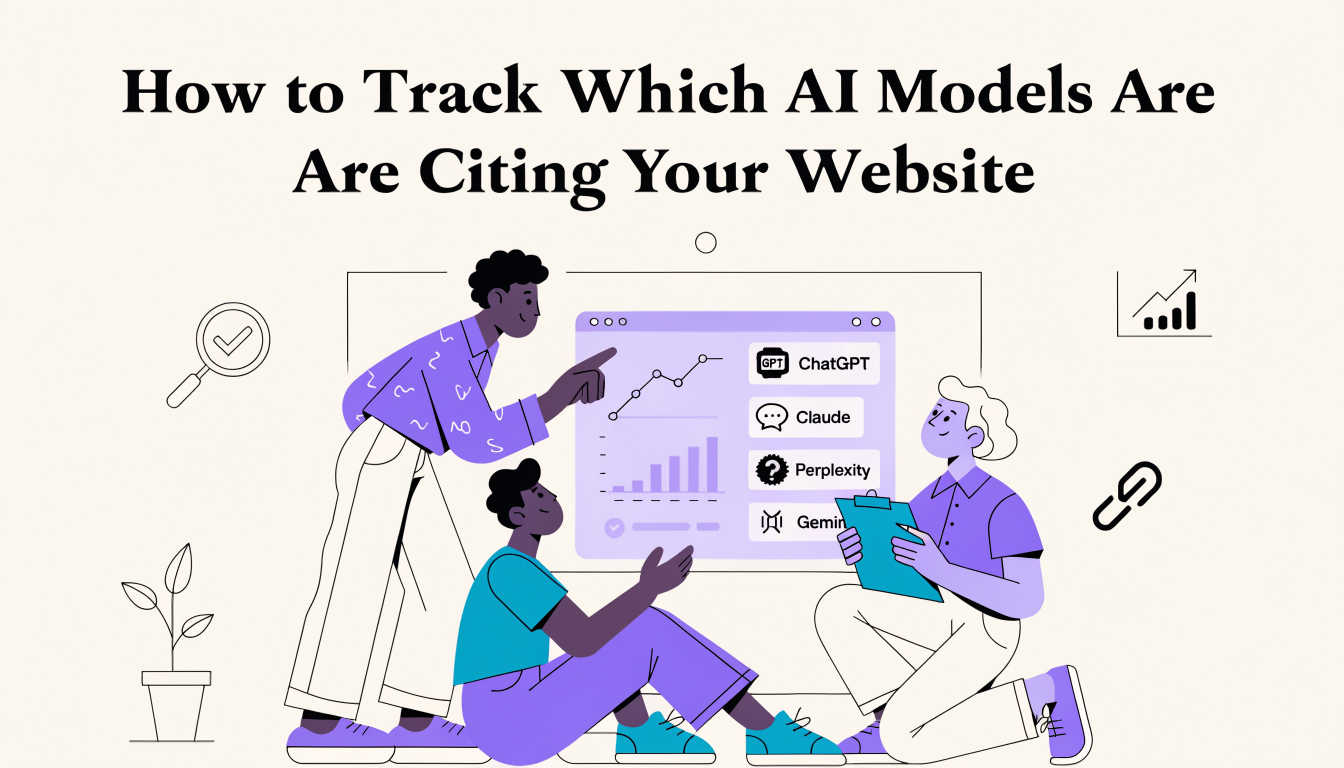
How to Track Which AI Models Are Citing Your Website
Learn how to set up ai search citation analytics across ChatGPT, Perplexity, Claude, and Gemini. Includes tool comparisons, prompt setup, and competitor ga
Enterprise CMS Platforms: What They Are and How to Choose
Compare enterprise CMS platforms by architecture, cost, compliance, and AI features. Learn what separates enterprise-grade tools from standard CMS options.
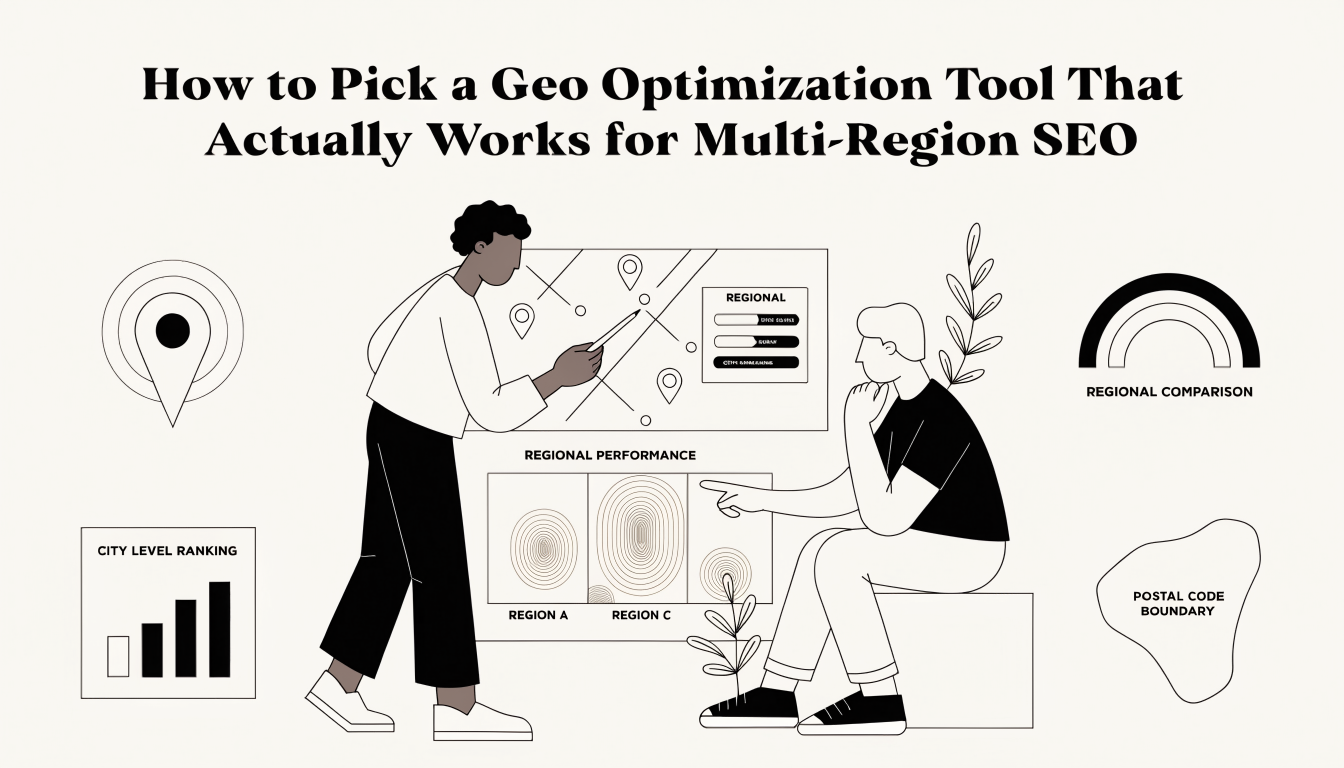
How to Pick a Geo Optimization Tool That Actually Works for Multi-Region SEO
Compare the top geo optimization tools for multi-location SEO. See which platforms track rankings at city level, fix citation gaps, and scale across 100+ l