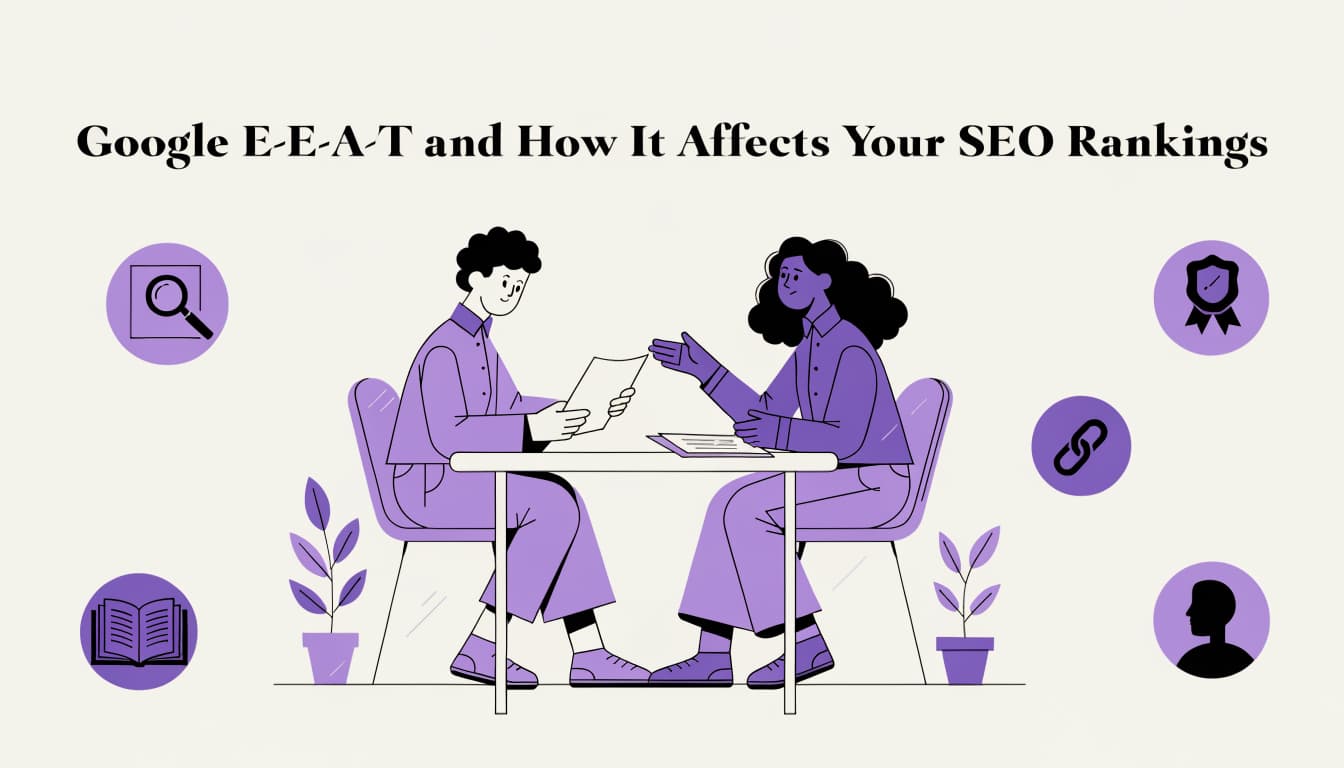
Google E-E-A-T and How It Affects Your SEO Rankings
Last updated: 23 July 2026
Google E-E-A-T and How It Affects Your SEO Rankings is the question every content team asks after a traffic drop. E-E-A-T — Experience, Expertise, Authoritativeness, and Trust — is Google's quality framework for evaluating content. It is not a single ranking signal, but it shapes dozens of signals that do influence rankings directly.
What E-E-A-T Actually Is (and What It Is Not)
Google added the first "E" for Experience to its Search Quality Rater Guidelines in December 2022, expanding the older E-A-T framework. The guidelines now run to over 170 pages and are used by thousands of human quality raters to train and calibrate Google's automated systems.
Here is the critical distinction: Google's own documentation states that "E-E-A-T itself isn't a specific ranking factor." No single E-E-A-T score exists that you can check or optimise directly. What does exist is a constellation of measurable signals — author credentials, backlink profiles, on-page citations, site reputation — that Google's algorithms use as proxies for quality. Treat E-E-A-T as a diagnostic lens, not a metric.
The Four Pillars Defined
Experience asks whether the content creator has first-hand, real-world involvement with the topic. A review of hiking boots written by someone who has worn them on a 50-mile trail carries more weight than one written by a desk researcher.
Expertise covers formal or demonstrated knowledge. For medical content, that means a licensed clinician. For a tutorial on Python debugging, it might mean a developer who can show working code.
Authoritativeness is largely about external recognition — who links to you, who cites you, and whether your brand name appears in credible third-party sources. Ahrefs' Domain Rating and Moz's Domain Authority are imperfect but widely used proxies for this dimension.
Trust is the master signal. Google's guidelines describe it as the most important of the four. Trust covers factual accuracy, transparent authorship, secure site infrastructure (HTTPS), and clear editorial policies.
E-E-A-T vs. Helpful Content: How They Overlap
Since August 2022, Google's Helpful Content system has run as a site-wide classifier. A page that fails the helpful content test can suppress rankings across an entire domain, not just the offending URL. E-E-A-T and helpful content are not the same thing, but they reinforce each other.
| Dimension | E-E-A-T | Helpful Content System |
|---|---|---|
| Primary purpose | Content quality framework | Site-wide classifier |
| Who applies it | Human raters + automated proxies | Automated classifier |
| Scope | Page and author level | Domain level |
| Introduced | 2014 (E-A-T), expanded Dec 2022 | August 2022 |
| YMYL sensitivity | Very high | Moderate to high |
| Actionable fix | Author credentials, citations, links | Remove or improve low-quality pages |
YMYL — Your Money or Your Life — topics (finance, health, legal, safety) face the strictest E-E-A-T scrutiny. A financial advice page from an anonymous author on a domain with no backlinks will struggle regardless of how well-written the prose is.
How E-E-A-T Signals Are Built in Practice
Author-Level Signals
Google's systems can associate bylines with author entities. Maintaining a consistent author bio page, linking to published work elsewhere, and earning mentions in industry publications all strengthen the author entity. A 2023 study by Semrush found that pages with identifiable authors outperformed anonymous pages in competitive YMYL niches by a measurable margin in post-Helpful Content update data.
Site-Level Signals
- Backlinks from topically relevant, authoritative domains remain the strongest external authority signal.
- A clear "About" page, editorial policy, and contact information reduce trust friction.
- Factual accuracy matters: pages that cite primary sources (government data, peer-reviewed research) are harder for Google to classify as low-quality.
Content-Level Signals
- Original research, proprietary data, or documented personal experience differentiate a page from thin rewrites.
- Depth of coverage — answering follow-up questions a reader would naturally have — signals expertise.
- Regular updates on time-sensitive topics signal ongoing editorial care.
Where E-E-A-T Efforts Often Fail
Many teams treat E-E-A-T as a checklist: add an author bio, get a few links, done. That misses the point. Google's quality raters are asked to imagine how a knowledgeable friend would react to a page. A bio that says "John is a health writer" does not establish medical expertise. A link from a low-authority directory does not build authoritativeness.
E-E-A-T improvements also take time to register. Unlike a technical fix — resolving a crawl error can show results in days — building genuine topical authority across a domain typically takes months. If your site is new or covers a broad range of unrelated topics, E-E-A-T signals are harder to accumulate and easier to dilute.
Which Approach Should You Prioritise?
The right emphasis depends on where your site sits today.
If you are in a YMYL niche (health, finance, law), author credentials and external citations are non-negotiable. Anonymous or thin content in these categories faces a structural disadvantage that no amount of keyword optimisation can overcome. Hire credentialed contributors, link to primary sources, and build a transparent editorial process first.
If you are in a non-YMYL niche (travel, hobbies, software tutorials), Experience is the differentiator. First-hand accounts, original photography, and documented personal results will outperform generic summaries. Authoritativeness still matters, but a smaller topical footprint with deep coverage often beats a wide footprint with shallow pages.
If your domain has a Helpful Content classifier penalty, the priority is removing or substantially improving the low-quality pages dragging down your site-wide score before investing in new E-E-A-T signals. Publishing more content on a penalised domain accelerates the problem.
If you are auditing existing content, an E-E-A-T checklist is a useful starting point: verify author credentials are visible, confirm all factual claims have sources, check that HTTPS is enforced sitewide, and audit your backlink profile for toxic links that undermine trust.
There is no shortcut that substitutes for genuine subject-matter depth. Tools that claim to produce an "EEAT score" are measuring proxies — useful for auditing, but not the same as the real thing.
See how seorav.com can help you audit your content against E-E-A-T criteria and build a strategy that addresses the signals that actually move rankings.
Frequently Asked Questions
Is E-E-A-T a direct Google ranking factor?
No. Google's own documentation confirms that E-E-A-T is not a specific ranking factor. It is a quality framework used to train human quality raters, whose assessments help calibrate automated systems. The signals those systems use — backlinks, author credentials, factual accuracy, site reputation — are the actual ranking inputs. Improving E-E-A-T means strengthening those underlying signals, not chasing a score.
What is the difference between E-A-T and E-E-A-T?
Google's original framework, E-A-T, covered Expertise, Authoritativeness, and Trust. In December 2022, Google added a first 'E' for Experience, recognising that first-hand, real-world involvement with a topic is a distinct quality signal. A product reviewer who has personally used the item demonstrates Experience; a certified professional demonstrates Expertise. Both matter, but Experience is the newer and often overlooked dimension.
What are YMYL topics and why do they face stricter E-E-A-T scrutiny?
YMYL stands for Your Money or Your Life. It covers topics where inaccurate information could harm a reader's health, finances, safety, or legal standing — medical advice, investment guidance, legal procedures, and similar subjects. Google applies stricter quality standards to YMYL content because the cost of a wrong answer is high. Anonymous authorship or unverified claims on YMYL pages face a structural ranking disadvantage.
How long does it take for E-E-A-T improvements to affect rankings?
There is no fixed timeline. Technical fixes like HTTPS migration can show results within weeks. Author credential improvements and new editorial policies may take one to three months to be reflected in quality rater assessments. Building genuine topical authority through backlinks and original content typically takes six months or more. E-E-A-T is a long-term investment, not a quick fix.
Can small or new sites compete on E-E-A-T signals?
Yes, but the strategy differs. A new site cannot match an established brand's backlink profile or domain history. The most effective approach is to narrow topical focus, publish content with verifiable first-hand experience, and build author credentials visibly from day one. Depth on a small number of closely related topics accumulates E-E-A-T signals faster than thin coverage across many unrelated subjects.
Keep reading
Ranking in Google's AI Search: The Deterministic Signals That Actually Move the Needle
Learn how do you rank in SGE with the three signals Google's AI uses to cite sources: schema markup, entity salience, and structured factual claims.
Why AI Ignores Your Content (And How to Fix It)
Learn how to avoid AI content that gets ignored by LLMs. Covers RAG retrieval signals, schema, entity salience, and an answer-first structure checklist.
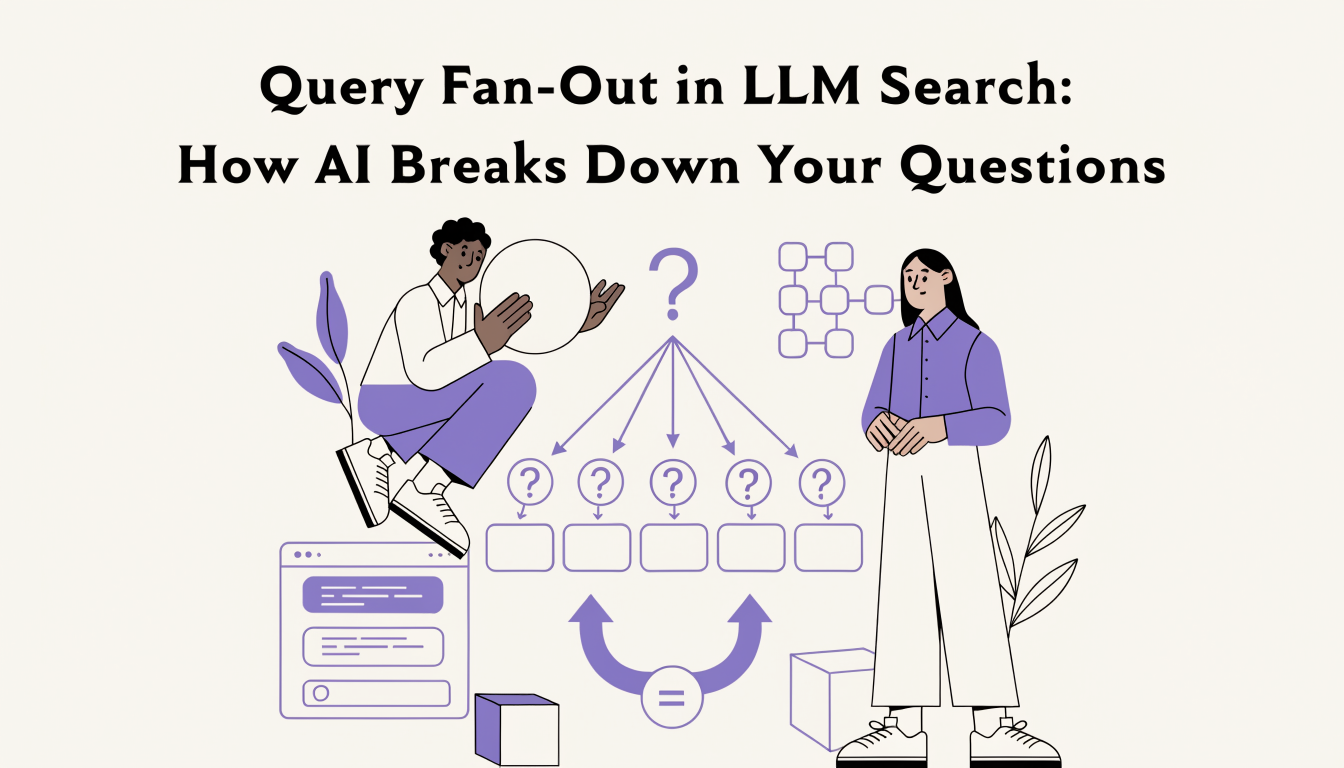
Query Fan-Out in LLM Search: How AI Breaks Down Your Questions
Learn what query fan-out in LLM search is, how AI splits your prompt into 3-8 sub-queries, and how to structure content to win more citation passes.