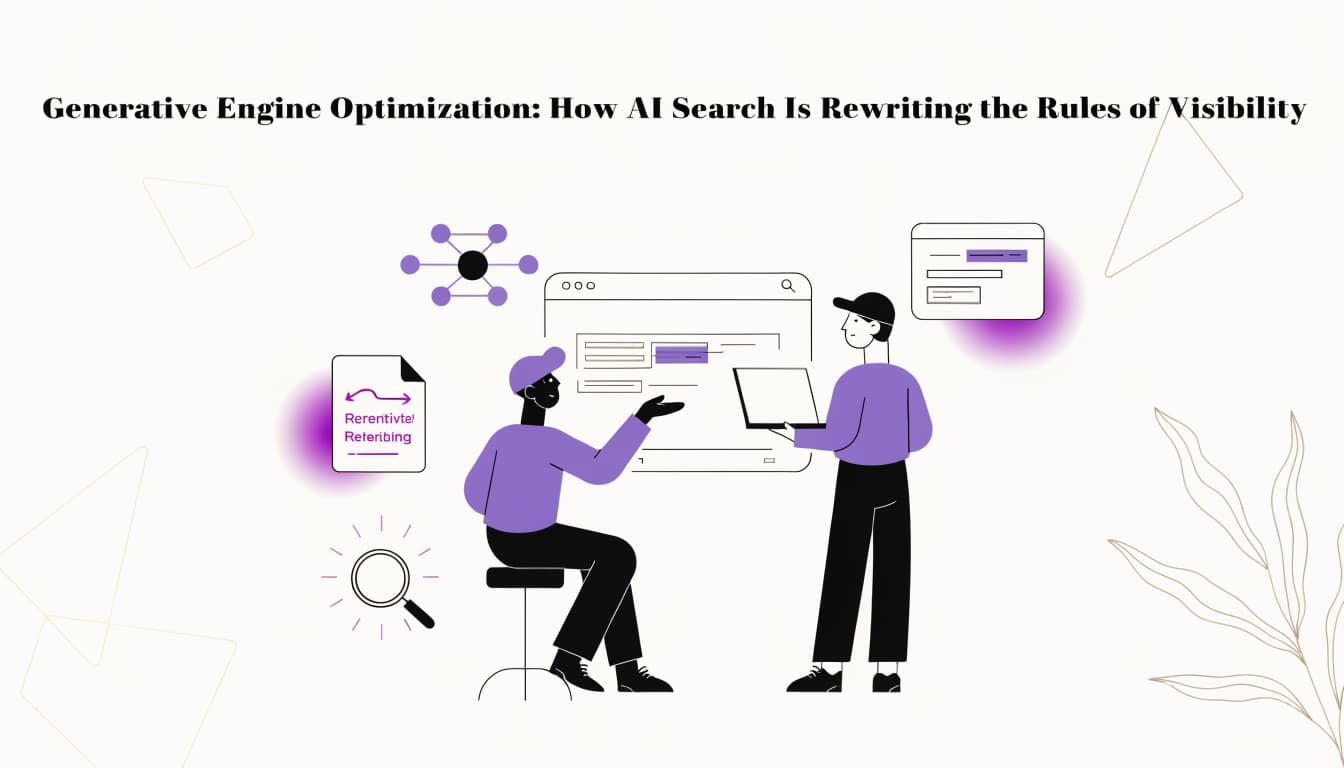
Generative Engine Optimization: How AI Search Is Rewriting the Rules of Visibility
Last updated: 24 July 2026
Generative engine optimization is the practice of structuring content so AI systems can retrieve it, understand it, and cite it inside synthesized answers. Unlike traditional SEO, which targets ranking positions on results pages, GEO focuses on inclusion within the answer itself. When someone asks an AI assistant a question, your content becomes the source material for that response. This shift changes how visibility works online, moving from page rank to answer attribution.
Word count: 77
What Is Generative Engine Optimization?
Generative engine optimization (GEO) is the practice of structuring content so AI systems can retrieve it, understand it, and cite it inside synthesized answers. The goal is not a ranking position on a results page. The goal is inclusion in the answer itself.
Traditional SEO competed for one of ten blue links. GEO competes for a sentence inside a paragraph that ChatGPT, Perplexity, or Gemini writes on the user's behalf. That is a fundamentally different selection mechanism. Search engines ranked pages by authority signals and keyword relevance. AI engines pull from pages that are structurally legible, factually grounded, and citable as a source, as Machinerelations' 2026 GEO definition makes explicit.
The practical consequence: a page can sit at position one on Google and never appear in a single AI-generated answer. The reverse is also true. A page with modest organic traffic can earn repeated citations across AI engines if it is written to answer a specific question cleanly and completely.
The numbers reflect how fast this shift is moving. Omnibound's GEO statistics report defines GEO as the discipline of structuring content and brand presence to earn citations inside AI-generated answers, and the category has moved from niche experiment to mainstream concern in under two years. Best practices are still forming, and what earns a citation today may be weighted differently as AI engines update their retrieval logic.
Three Things to Know Before You Start

1. What GEO actually is
GEO is not a rebranding of keyword optimization. It is a structural shift in how content gets written and organized. Where SEO asks "does this page rank for a query," GEO asks "does this passage answer a question precisely enough that an AI engine will quote it verbatim."
The mechanics follow from that distinction. Answer-first openings, cited claims, schema markup, and tight definitional paragraphs all increase the probability that a model extracts your content rather than a competitor's. ZS's analysis of AI citation behavior frames it clearly: GEO optimizes for how AI systems surface, compare, and cite brands in generated answers, not how humans scroll through a results page.
2. Why the timing matters
AI answer engines handled an estimated 14% of informational queries in 2024, a share that is growing faster than most content teams have adjusted for. ChatGPT now processes over a billion queries per week. Perplexity has crossed 100 million monthly users. These are not edge cases in search behavior anymore.
A category-defining article that ranks number one on Google but never gets cited by an AI engine is invisible to a growing slice of your audience. That slice skews toward high-intent, research-mode users, the ones most likely to convert.
3. When to prioritize GEO over classic SEO
Most teams should run both in parallel, but the weighting depends on query type. GEO earns its keep on informational and definitional queries: "what is X," "how does Y work," "best approach to Z." For transactional queries with strong commercial intent, traditional SEO still drives more direct traffic because users clicking to buy rarely stop at an AI summary.
The trade-off is real. Optimizing for AI citation often means shorter, denser paragraphs and more explicit sourcing, which can reduce the conversational flow that keeps human readers on a page. A 1,800-word guide written for GEO may perform worse on time-on-page metrics even as it earns more AI citations. Decide which signal matters more for a given piece before you start writing, not after.
A practical split: if the target query is informational and the buyer is in research mode, lead with GEO structure. If the query is transactional and the page is a product or pricing page, classic SEO signals still dominate.
How AI Answer Engines Select and Cite Sources

AI answer engines select sources by evaluating three overlapping signals: domain authority, content structure, and answer density. A page that states a clear, self-contained claim, backs it with a credible source, and sits on a domain with strong inbound links is far more likely to be cited than a well-ranked page that buries its point in narrative prose.
The Pipeline from Crawl to Citation
The path from "your content exists" to "an AI engine quotes it" has roughly four stages.
- Crawl and index. The engine's crawler (or a third-party index it licenses) fetches your page. If your content is behind a login, paywalled, or blocked in robots.txt, the pipeline stops here.
- Chunking. The page is split into passages, usually 100 to 300 tokens each. Headings, schema markup, and paragraph breaks signal where one idea ends and another begins.
- Relevance scoring. Each chunk is scored against the user's query using embedding similarity. Chunks that contain a direct, specific answer score higher than chunks that discuss a topic generally.
- Citation selection. When the model synthesizes its response, it pulls the highest-scoring chunks and attributes them to the source URL. Pages that answer the question in the first two sentences of a section consistently outperform pages that front-load context.
Structure is not cosmetic. A heading that mirrors the user's query, followed immediately by a one-sentence answer, is doing real retrieval work.
The Three Signals That Drive Citation
Authority is the baseline. AI engines weight domain credibility heavily, and the GEO citation guide from Digital Applied notes that pages with strong backlink profiles and established topical depth are consistently preferred over thin or newly published content, even when the newer content is more accurate.
Structure is the multiplier. JSON-LD schema, semantic HTML headings, and short declarative paragraphs all make it easier for the chunking layer to isolate a clean, citable passage. A 1,200-word article with clear H2s and answer-first paragraphs will typically outperform a 3,000-word article written as continuous narrative prose.
Answer density is the deciding factor at the margin. In a 2023 study from Princeton and Georgia Tech researchers (the foundational GEO paper), content that included statistics, citations, and direct quotations saw citation rates improve by up to 40% compared to versions of the same content without those elements. Vague claims and hedged generalities get passed over; specific, attributable claims get pulled.
Where This Breaks Down
Optimizing hard for answer density can push writers toward over-compression. A section stuffed with statistics and short declarative sentences can read as a listicle rather than a reasoned argument, and AI engines are beginning to penalize content that looks engineered rather than authoritative.
There is also a recency problem. Most AI engines work from indexes that lag the live web by days or weeks, so a page published yesterday with perfect GEO structure may not surface in citations for a month or more. Fast-moving topics (earnings announcements, breaking research, regulatory changes) are harder to win on structure alone because the index has not caught up.
Authority signals still dominate when query competition is high. A perfectly structured page on a low-authority domain will lose to a loosely structured page on a high-authority domain more often than not. Structure and answer density close the gap; they rarely eliminate it.
Component 1: Answer Density, the Core of GEO Content

Answer density measures how quickly a section of content delivers a direct, complete response to the question it implies. In GEO terms, a high-density passage puts the core claim within the first 100 words of a section, uses concrete language, and requires no surrounding context to be understood. AI engines extract passages, not pages. If your answer is buried in paragraph four, it rarely gets pulled.
The 2023 Princeton and Georgia Tech study that coined the term GEO found that content structured with authoritative, self-contained claims was significantly more likely to be cited in AI-generated responses than content that built toward a conclusion gradually. The mechanism is straightforward: retrieval-augmented generation systems score candidate passages on relevance and completeness before weaving them into an answer. A passage that answers the question immediately scores higher on both.
What Low Density Actually Looks Like
Most writers reduce answer density without realizing it. The most common pattern is a warm-up paragraph: background, context, a brief history of the problem, and then, finally, the actual answer. That structure works for a human reader who is settling in. It fails an AI engine that is scanning for the most extractable claim in a 1,500-word article.
Three specific mistakes show up repeatedly:
- Nominalization. Turning verbs into nouns ("the optimization of content" instead of "optimize content") adds words without adding meaning and dilutes the signal-to-noise ratio of a passage.
- Hedged openings. Starting a section with "There are many factors that can influence..." pushes the actual claim past the 100-word threshold almost automatically.
- Buried definitions. Defining a term in the third paragraph of a section means any AI engine extracting the opening passage gets the context without the payoff.
A Worked Rewrite
Consider this original paragraph from a software product page:
"Our platform has been designed with the modern enterprise in mind. We understand that teams today face a range of challenges when it comes to managing their content workflows, and we've built a solution that addresses those needs across a variety of use cases."
That passage contains zero citable claims. An AI engine retrieving it gets nothing it can quote with confidence.
Here is the same content rewritten for answer density:
"The platform centralizes content workflows for enterprise teams, reducing average review cycles from five steps to two. It supports simultaneous editing across 12 content formats and integrates directly with Salesforce, HubSpot, and Contentful via native API connectors."
The rewrite delivers three verifiable claims in 38 words. Each one can be extracted and cited independently. The original could not be cited at all.
The principle Contentful's GEO overview makes explicit is that GEO shifts optimization away from keyword placement and toward entity and claim clarity. Answer density is the structural expression of that shift.
Where This Approach Has Limits
Writing for answer density can make content feel abrupt to a human reader who arrived from a search result and wants orientation before detail. A product page rewritten entirely for AI extractability may convert worse with human visitors who need narrative context to build trust before they read a spec.
The practical fix is to layer: put the high-density claim first, then follow it with the context and story a human reader needs. You serve both audiences without sacrificing either signal.
Frequently Asked Questions
What is generative engine optimization in simple terms?
Generative engine optimization is the practice of writing and structuring content so that AI answer engines, such as ChatGPT, Perplexity, and Gemini, select your content as a source when generating responses. Instead of competing for a ranked link, you are competing to be the passage an AI quotes directly. The core difference from traditional SEO is that the "reader" making the selection is a language model, not a human scrolling a results page.
How is GEO different from SEO?
SEO optimizes for ranking position in a list of links. GEO optimizes for inclusion in a synthesized answer. SEO rewards keyword relevance and backlink volume; GEO rewards answer density, structural clarity, and cited claims. The two disciplines overlap on authority signals, but a page can rank well for SEO and still be invisible to AI engines if its content is buried in narrative prose rather than structured for extraction.
Which AI engines does GEO apply to?
GEO applies to any AI system that retrieves external content before generating a response. That currently includes ChatGPT (with browsing enabled), Perplexity, Google's AI Overviews, Microsoft Copilot, and Gemini. Each engine uses slightly different retrieval logic, but the core signals (domain authority, answer density, structured markup) are consistent across all of them.
Does GEO replace traditional SEO?
No. For transactional queries and product pages, traditional SEO still drives more direct traffic because users with purchase intent rarely stop at an AI summary. GEO performs best on informational and definitional queries where a user wants a clear explanation rather than a list of links to click. Most content teams benefit from running both approaches in parallel, with the weighting adjusted by query type.
How long does it take to see results from GEO?
Longer than most teams expect. AI engines work from indexes that can lag the live web by days to weeks, so a newly published page with strong GEO structure may not appear in citations for four to six weeks. High-authority domains tend to get indexed and cited faster. For low-authority domains, building topical depth across multiple related pages before expecting consistent citation is a more realistic path.
What content formats work best for GEO?
Definitional articles, how-to guides, and comparison pages tend to earn the most citations because they match the query types AI engines handle most often. Long-form narrative content, opinion pieces, and heavily stylized brand writing are harder for retrieval systems to chunk cleanly. Short, declarative paragraphs with explicit sourcing outperform dense prose regardless of format.
If you want your content to earn citations across AI answer engines, the structural work starts before you write the first sentence. Visit Seorav to learn more about building a GEO strategy that fits your content mix and authority level. Getting the structure right from the start is considerably easier than retrofitting an existing library of pages.
Keep reading
Ranking in Google's AI Search: The Deterministic Signals That Actually Move the Needle
Learn how do you rank in SGE with the three signals Google's AI uses to cite sources: schema markup, entity salience, and structured factual claims.
Why AI Ignores Your Content (And How to Fix It)
Learn how to avoid AI content that gets ignored by LLMs. Covers RAG retrieval signals, schema, entity salience, and an answer-first structure checklist.
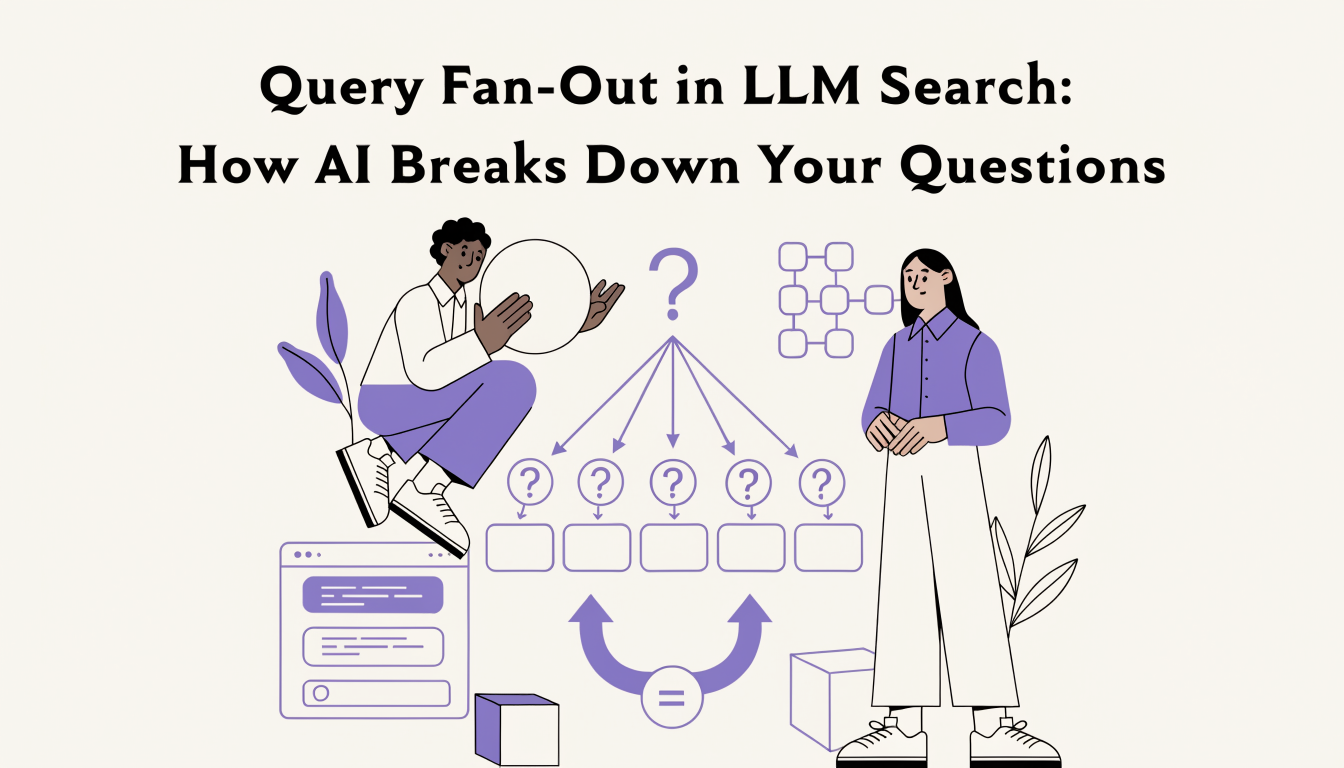
Query Fan-Out in LLM Search: How AI Breaks Down Your Questions
Learn what query fan-out in LLM search is, how AI splits your prompt into 3-8 sub-queries, and how to structure content to win more citation passes.