Finding and Fixing the Semantic Gaps Costing You AI Citations
Last updated: 2 October 2026
A semantic gap deficit occurs when your content targets a topic's primary keywords but omits the conceptual scaffolding, related questions, and contextual details that AI retrieval systems evaluate before selecting sources for citations. You can rank first on Google while remaining invisible to every AI engine answering the same query. The gap isn't about keyword density; it's about whether your page answers the adjacent questions your audience actually asks.
The numbers make the cost concrete. Authoritas's 2024 AI citation study found that 46% of pages cited by AI engines answer the core query within the first 60 words. Pages that bury the answer, or never state it cleanly, get passed over regardless of how much supporting content follows. Depth alone does not compensate for a slow start.
One honest caveat before going further: closing semantic gaps improves citation eligibility, but AI engines still make probabilistic choices. Better structure raises your odds; it does not guarantee a slot.
TL;DR
Semantic gaps are the missing concepts, entity relationships, and question patterns that prevent AI engines from treating your content as a citable source. Fixing them requires auditing what your pages say against what AI engines actually retrieve, then adding the missing structure before a competitor fills the space.
- AI engines select citations based on semantic fit, not keyword density. A page that answers the literal question but misses adjacent concepts gets skipped.
- Gartner reports that neglecting semantics causes AI agents to produce inaccurate outputs and exposes organizations to wasted spending. That finding applies directly to content retrieval, not just internal AI systems.
- Identifying gaps means comparing your existing coverage against the entity clusters and sub-questions AI engines surface for your target prompts, then prioritizing the ones competitors haven't addressed yet.
- The trade-off: closing semantic gaps takes real editorial time. Pages that try to cover every adjacent concept without genuine depth tend to score poorly on specificity, which is itself a citation signal. Breadth without substance can make the problem worse.
What a Semantic Gap Deficit Is and Why It Suppresses AI Citations
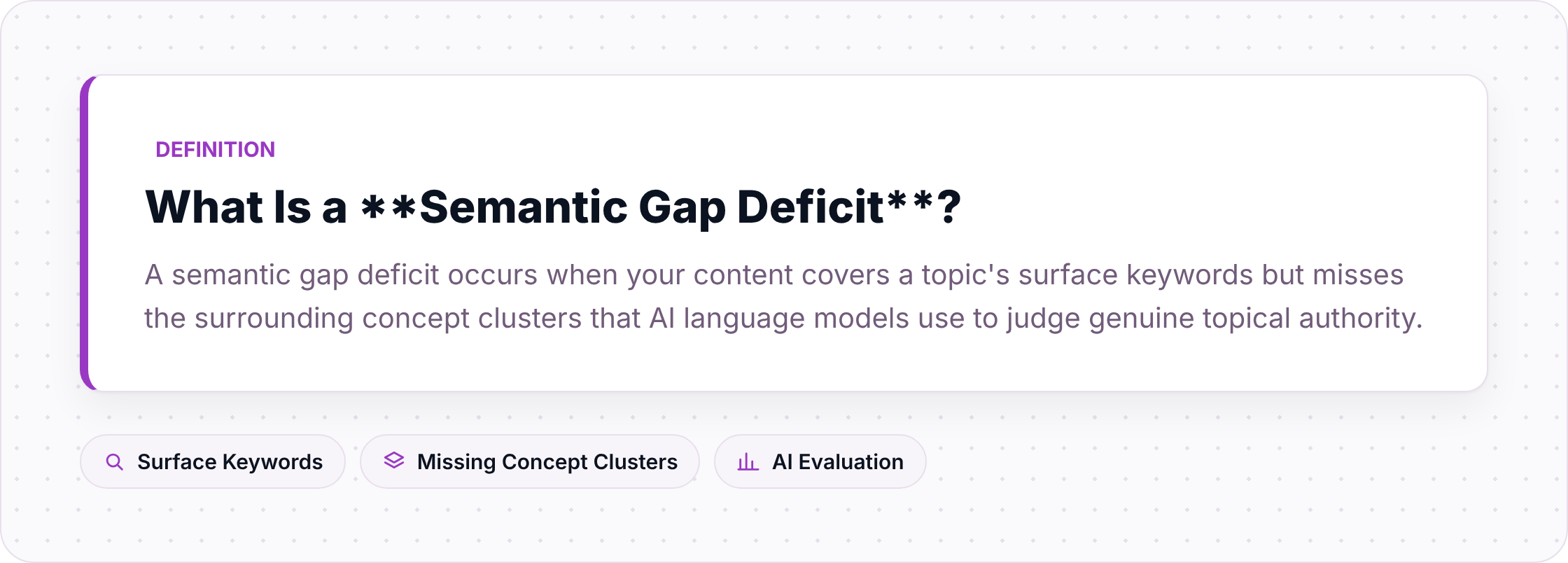
A semantic gap deficit occurs when your content covers a topic's surface keywords but misses the surrounding concept clusters that AI language models use to judge whether a page genuinely understands a subject. LLMs score content by concept coverage, not keyword density. A page that mentions "churn rate" without addressing cohort analysis, retention benchmarks, or revenue impact signals incomplete topical authority, and AI engines treat it accordingly: they cite someone else.
The distinction between a missing keyword and a missing concept cluster matters more than most content teams realize. A missing keyword is a vocabulary problem. A missing concept cluster is a comprehension problem. When a model like GPT-4 or Claude evaluates a page on customer retention, it is not counting how many times "retention" appears. It is checking whether the page connects retention to adjacent concepts: payback period, net revenue retention, expansion revenue, churn segmentation. The semantic gap problem describes exactly this misalignment: the space between machine-level feature matching and genuine human-understandable concept coverage.
The traffic mix is shifting in ways that make this urgent. Similarweb's 2025 State of Digital report recorded a measurable decline in Google-referred clicks to informational content as AI-generated answers absorb queries before a user ever clicks through. AI-driven referrals from engines like Perplexity and ChatGPT are growing as a share of total referral traffic, even if the absolute numbers are still smaller than organic search. Content that earns an AI citation gets surfaced inside the answer itself, not buried in a results list.
One trade-off worth acknowledging: closing semantic gaps takes real editorial judgment, not just a tool pass. Automated topic-gap tools can surface missing terms, but they cannot reliably distinguish between a concept that is genuinely absent and one that is implied by the surrounding argument. A page on SaaS pricing does not need to define "marginal cost" to demonstrate pricing expertise. Over-stuffing adjacent concepts to satisfy a coverage score can make prose harder to read and, paradoxically, less citable, because AI engines also weight clarity and sentence-level coherence. The approach breaks down when teams treat concept coverage as a checklist rather than a structural editorial decision.
How Semantic Gaps Prevent Your Content From Being Selected by LLMs
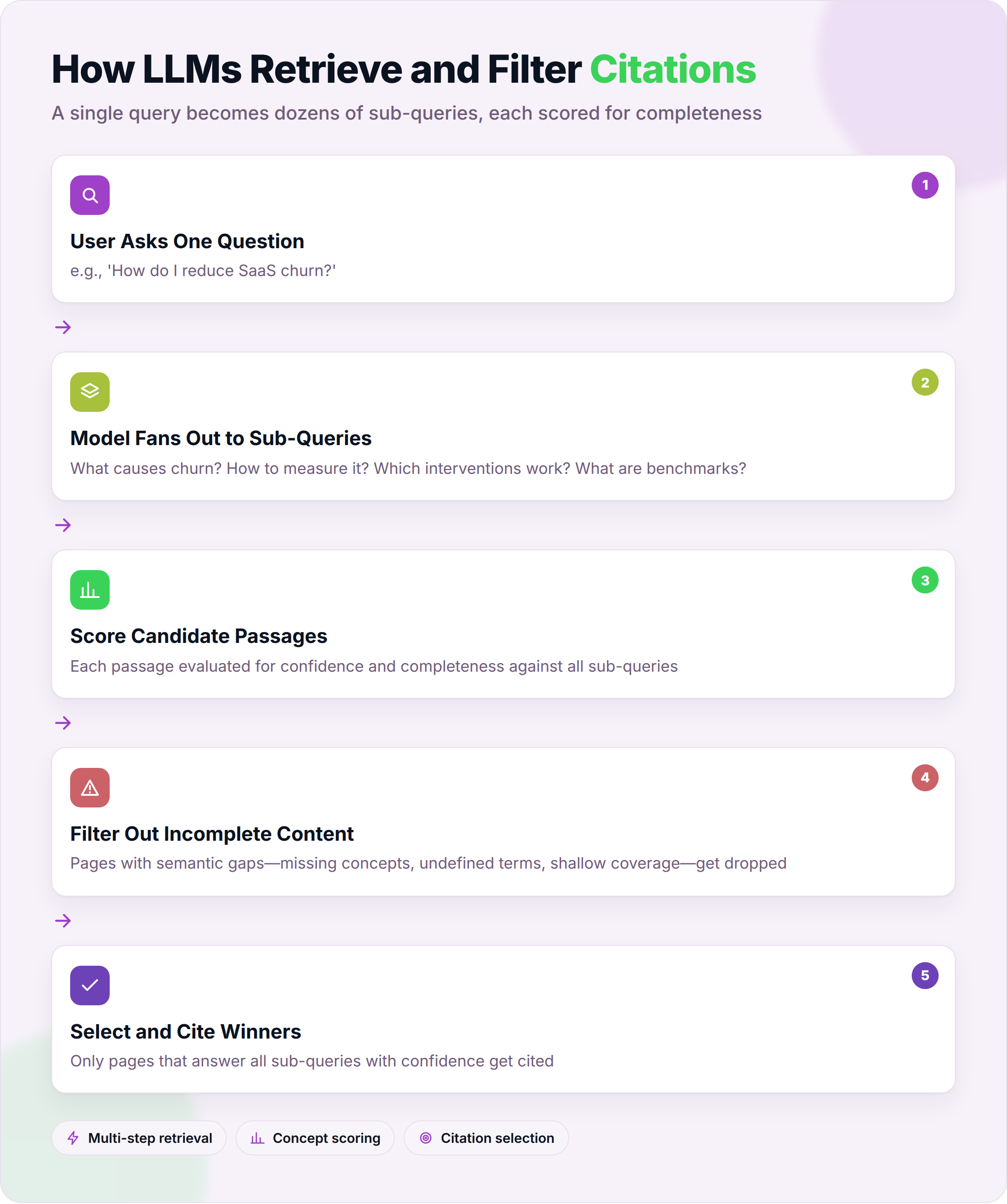
When an LLM fields a user query, it does not retrieve one page and quote it. It decomposes the question into multiple sub-queries, scores candidate passages for confidence, and drops anything that feels incomplete or ambiguous. Content with semantic gaps, meaning missing concepts, undefined terms, or shallow coverage of adjacent topics, gets filtered out at that scoring stage. Not because it is irrelevant, but because the model cannot cite it with enough certainty to stake its answer on it.
Query Fan-Out: One Question, Dozens of Sub-Queries
A user asking "how do I reduce SaaS churn?" is not generating one retrieval request. The model internally fans that out: what causes churn, how to measure it, which interventions work at which company stage, what the benchmarks are, and so on. Each sub-query needs a confident answer from somewhere.
If your page covers the top-level question but skips the sub-topics, it gets passed over for pages that address the full cluster. A 2025 Frontiers in AI study on semantic gaps in ML systems found that models consistently fail to surface content when contextual relationships between concepts are not explicitly represented in the source material. That is precisely what shallow, keyword-focused pages lack.
Context Window Prioritization and Why Shallow Pages Get Dropped First
Once candidate passages are pulled into the context window, the model has to decide what to keep. Space is finite. Passages that carry high information density per token survive; thin passages that restate the question without extending it get dropped.
Longer pages are not automatically safer. A 3,000-word article that repeats the same three points in different phrasing is thinner, in the model's estimation, than a 900-word page that defines terms precisely, gives concrete numbers, and addresses at least one counter-case. Depth of coverage per concept matters more than raw word count.
MIT researchers studying LLM reliability found that models sometimes form spurious associations between grammatical patterns and topic signals, which means a page that looks topically relevant on the surface can still get deprioritized if its internal concept structure does not match what the model expects to see in a trustworthy source. You cannot fix that with better keywords alone.
The Citation Selection Mechanism: Confidence Scoring Over Relevance Scoring
Relevance gets your content into the candidate set. Confidence determines whether it gets cited.
Confidence scoring, in practical terms, means the model is asking: "Can I quote this passage without hedging?" If the passage is vague, contradicts itself, or leaves obvious sub-questions unanswered, the model assigns lower confidence and reaches for something else. Pages that define their terms, cite external data, and address edge cases consistently outperform pages that are technically on-topic but editorially thin.
Meta AI's research on semantic drift in text generation makes this dynamic explicit: models generate correct, well-grounded facts first, then drift toward less reliable content as they move further from high-confidence source material. If your page is not structured to anchor the model's confidence early, in the opening paragraphs, with specific claims and clear definitions, it is more likely to be used as background context than as a cited source.
Even well-structured, high-confidence content can be bypassed if a competitor's page covers the same concept cluster with more recent data or a more specific example. Semantic completeness raises your floor; it does not guarantee the citation. Recency and specificity still matter, and in fast-moving topics, a page that was comprehensive six months ago may now have gaps it did not have at publish.
Identifying and Analyzing Semantic Gaps in Your Existing Content
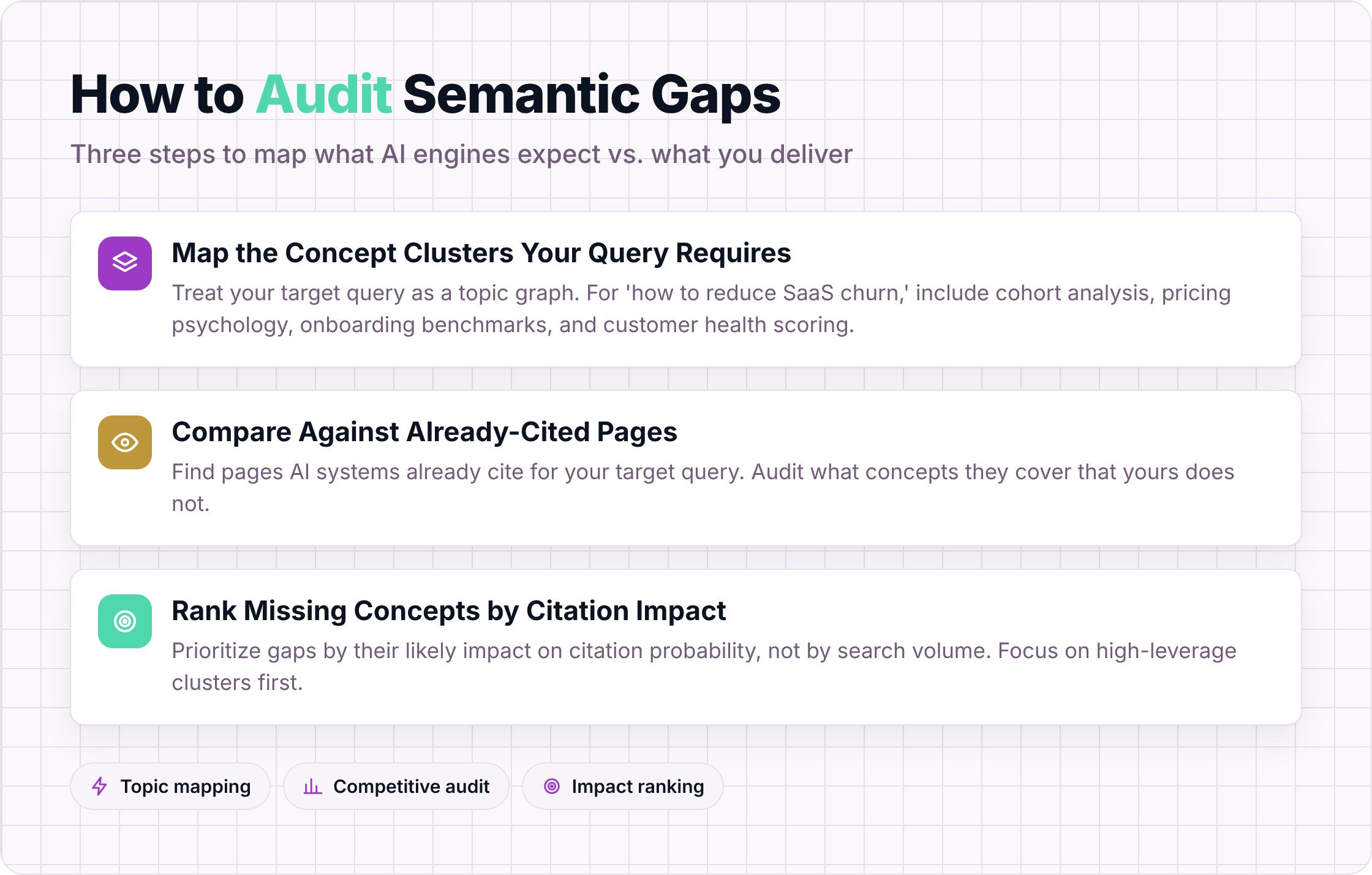
A semantic gap is the distance between the concepts an AI engine expects to find on your page and the concepts you actually cover. To close that gap, you need three things: a map of what the target query requires, a direct comparison against pages AI systems already cite, and a way to rank each missing concept by its likely impact on citation probability rather than its search volume.
Step 1: Map the Concept Clusters Your Target Query Actually Requires
Start by treating your target query as a topic graph, not a keyword. Every query implies a set of sub-concepts that a complete answer must address. For a query like "how to reduce SaaS churn," that graph includes cohort analysis methods, pricing psychology, onboarding benchmarks, and customer health scoring. If your page covers only two of those clusters, an AI engine retrieving a confident, citable answer will pass you over for a page that covers four.
The practical method: pull the top five URLs that ChatGPT or Perplexity cites for your query, extract their H2 and H3 headings, and build a flat list of every concept they address. That list is your required concept inventory. A 2026 guide to semantic clustering and intent mapping describes this process as "concept coverage scoring," where pages are evaluated on the proportion of expected sub-topics they address, not just keyword density.
Step 2: Audit Your Page Against Competitor Content AI Systems Do Cite
Once you have the concept inventory, run a gap audit. Place your page's headings and key claims alongside the cited competitor pages and mark every concept your page omits or addresses too briefly to be quotable.
Brief coverage is its own problem. A single sentence on "cohort analysis" does not give an AI engine enough substance to extract a confident passage. The threshold is roughly 80 to 120 words per concept cluster before a retrieval model treats it as substantive. That pattern is consistent with Yotpo's 2026 analysis of Information Gain and AI Overviews, which found that thin coverage of expected sub-topics was the primary reason pages failed to appear in AI-generated answers even when they ranked on page one of Google.
One real trade-off here: expanding every concept cluster adds word count, and longer pages can dilute the answer-density that AI engines reward. This approach breaks down when a query is genuinely narrow and the cited pages are short. In those cases, depth per concept matters more than breadth across concepts.
Step 3: Score Each Gap by Citation Impact, Not Search Volume
Not every missing concept carries equal weight. A gap in a concept that cited pages address in detail, and that maps directly to the query's primary intent, will cost you more citations than a gap in a peripheral sub-topic.
Score each gap on two axes: how frequently the concept appears across the cited competitor pages (a proxy for how expected it is), and how directly it connects to the query's core intent. Gaps that score high on both axes should be addressed first. Gaps that appear in only one competitor page and sit at the edge of the topic graph can wait, or be skipped entirely if adding them would dilute the page's focus.
A useful shortcut: run your target query through three different AI engines and note which sub-topics each one volunteers in its answer. Concepts that appear in all three responses are effectively required. Concepts that appear in only one are optional. Prioritize accordingly.
Fixing Semantic Gaps: The Structural Edits That Actually Move Citations
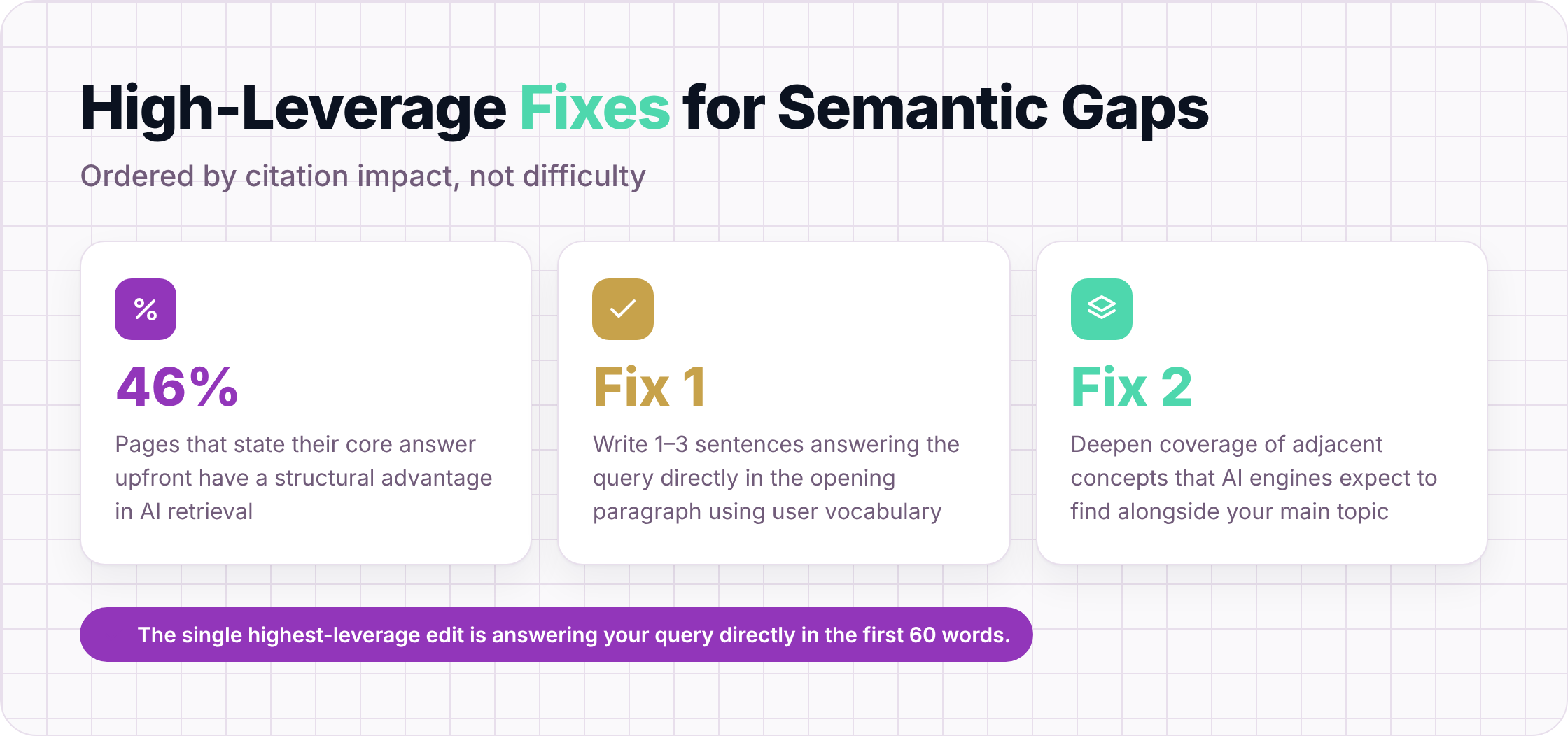
Closing semantic gaps requires moving beyond diagnostic audits to concrete editorial changes. The fixes below target specific gap types and are ordered by their impact on citation probability, not by difficulty.
Fix 1: Add a Direct Answer Block in the First 60 Words
If your page does not state its core answer in the opening paragraph, AI engines have to infer it from context. Many do not bother. Write one to three sentences that answer the query directly, using the same vocabulary a user would use to ask it. Do not save the answer for a conclusion or bury it after background context.
This is the single highest-leverage edit for most pages. Authoritas's citation data shows that 46% of cited pages answer the query within the first 60 words. Pages that do not are competing at a structural disadvantage before the model even evaluates their concept coverage.
Fix 2: Expand Thin Concept Clusters to the 80-120 Word Threshold
For each concept cluster your audit flagged as too brief, write a dedicated subsection of at least 80 words. Include a definition, a concrete example or number, and one edge case or limitation. That structure gives the model three distinct passage types to choose from when constructing its answer.
Avoid padding. If you cannot write 80 substantive words on a concept, the concept may not belong on this page. Forcing coverage of a peripheral topic to hit a word count produces exactly the kind of thin, low-confidence prose that gets filtered out.
Fix 3: Define Terms the Query Implies but Your Page Skips
AI engines expect pages on technical topics to define their terms. A page on "net revenue retention" that never defines the metric, or defines it only in passing, signals incomplete coverage. Add a one-sentence definition for each technical term your page uses but does not explain. Place definitions close to first use, not in a glossary at the bottom.
This fix is especially important for pages targeting queries where the user may not know the terminology. The model is more likely to cite a page that bridges the gap between expert vocabulary and plain-language explanation.
Fix 4: Address at Least One Counter-Case or Limitation
Pages that present only the affirmative case read as promotional to AI engines, and promotional content gets lower confidence scores. Add one paragraph per major claim that acknowledges a condition under which the claim does not hold, a scenario where the recommended approach fails, or a data point that complicates the picture.
This is not about hedging everything. It is about demonstrating that the page has considered the full shape of the topic, which is a signal AI engines associate with authoritative sources.
Fix 5: Add Specific Numbers, Dates, and Named Sources
Vague claims ("studies show," "many companies find") are low-confidence passages. Replace them with named studies, specific percentages, and dated findings wherever possible. A sentence like "Authoritas's 2024 study found that 46% of cited pages answer the query within 60 words" is far more citable than "research suggests that fast answers perform better."
If you do not have a specific source for a claim, either find one or soften the claim to match what you can actually support. Unsourced specificity is worse than acknowledged uncertainty.
Measuring Whether Your Semantic Gap Fixes Are Working
Measure citation impact directly by tracking AI engine behavior before and after edits. Set up a feedback loop that isolates the effect of your semantic gap fixes from other ranking signals, then iterate based on what the data shows.
Track AI Citation Frequency Before and After
Run your target queries through ChatGPT, Perplexity, and Google's AI Overviews once a week for four weeks before making edits. Record which pages get cited and how often. After publishing your fixes, run the same queries for four weeks and compare. Citation frequency is a noisy signal, but directional changes over four-week windows are meaningful.
One limitation: AI engines update their retrieval behavior continuously, and a change in citation frequency may reflect a model update rather than your edits. Run a control query (a topic you did not edit) alongside your test queries to separate the two effects.
Monitor Answer Inclusion Rate, Not Just Ranking Position
A page can rank in position three on Google and never appear in an AI-generated answer. Track both metrics separately. If your ranking holds steady but your AI citation rate improves after edits, the semantic gap fixes are working. If both metrics move together, the improvement may be driven by something else, like a backlink or a freshness signal.
Check Passage-Level Retrieval, Not Just Page-Level Traffic
AI engines cite passages, not pages. Use a tool that shows you which specific passages from your page are being surfaced in AI answers. If the same passage keeps getting cited while others are ignored, that tells you where your concept coverage is strong and where it is still thin. Revise the ignored sections first.
Frequently Asked Questions
What exactly is a semantic gap deficit?
A semantic gap deficit is the measurable shortfall between the concepts an AI engine expects a page to cover and the concepts the page actually addresses. It is not about missing keywords. It is about missing concept clusters, undefined terms, and unanswered sub-questions that cause retrieval models to treat your page as incomplete and cite a competitor instead.
How is a semantic gap different from a content gap?
A content gap is typically defined as a topic your site has not covered at all. A semantic gap exists within a page you have already published: the topic is there, but the surrounding concepts, definitions, and sub-questions that make the page citable are missing. You can have zero content gaps and still have severe semantic gap deficits on every page you publish.
Which AI engines are most affected by semantic gaps?
All major retrieval-augmented generation systems are affected, including ChatGPT, Perplexity, Google's AI Overviews, and Claude. Each uses slightly different retrieval and ranking logic, but all of them score candidate passages for conceptual completeness before selecting a citation. A page with a significant semantic gap deficit will underperform across all of them, not just one.
How long does it take to see results after fixing semantic gaps?
Most teams see directional changes in AI citation frequency within four to eight weeks of publishing substantive edits. The timeline depends on how quickly AI engines re-index the updated content and how competitive the concept cluster is. Pages in low-competition topic areas tend to see faster movement. Pages competing against well-established sources may take longer, and some may not move at all if the competitor's coverage is genuinely more complete.
Can you fix a semantic gap deficit without adding a lot of words?
Yes, in some cases. If the gap is a missing definition or a missing data point, a single well-placed sentence can close it. If the gap is an entire concept cluster that the page never addresses, you will need at least 80 to 120 words of substantive coverage to cross the threshold AI engines use to treat a concept as addressed. The goal is not more words; it is more complete concept coverage per word.
Do semantic gap fixes help with traditional SEO as well?
Generally yes. Concept coverage improvements tend to increase topical authority signals that Google's ranking systems also reward. Pages that address a topic's full concept graph tend to attract more relevant internal and external links, earn longer dwell times, and rank for a broader set of related queries. The fixes are not in conflict with traditional SEO; they reinforce it. The one exception is pages that were intentionally kept short and focused for a narrow query. Adding concept coverage to those pages can dilute their relevance signal for the primary keyword.
If you want a structured audit of your pages' semantic gap deficits and a prioritized fix list, visit Seorav to learn more. The process starts with your highest-traffic pages and works outward from there.
Keep reading
How to Get Your Content Cited Across Multiple AI Models
Learn how decentralized footprint expansion gets your content cited across ChatGPT, Claude, Gemini, and Perplexity with structured, multi-model content str
Keeping Your Content Fresh Enough for AI Search Rankings
Learn how Freshness Decay Deflection keeps your content eligible for AI citations. Audit, update, and measure with a proven quarterly process.
How to Audit Your Content's Stability in AI Search Results
Learn how to run agentic SERP volatility audits that track AI citation stability across ChatGPT, Perplexity, and Google AI Overviews, with scoring and fix