Data Platforms That Power AI Search Visibility
Last updated: 5 November 2026
Structured data platforms power AI search by exposing product catalogs, knowledge bases, and content through machine-readable schema that retrieval engines can parse and cite directly. When your data lacks this foundation, AI systems skip it entirely, regardless of historical Google traffic. The platforms that win AI visibility share one trait: they treat schema not as optional metadata but as the primary interface between human content and machine understanding.
The numbers back this up: AI search referral traffic grew sharply through 2024 and into 2025, with ChatGPT, Perplexity, and Gemini collectively driving a measurable share of high-intent visits that traditional analytics tools never capture. Teams optimizing for those engines need a platform that speaks schema first.
This article covers three things in sequence: which platform categories actually support AI retrieval, how the ranking mechanics inside generative engines differ from classic PageRank logic, and where integration points matter for shipping structured content without rebuilding your stack. That order is deliberate. Picking an integration before you understand the retrieval mechanics is how teams end up with well-connected platforms that still never get cited.
One honest caveat: no platform guarantees citation. Structured data raises your odds; it does not control the model.
Four Things to Know Before Reading Further
Structured product feeds using schema.org and JSON-LD are the baseline requirement for AI search visibility. Vector-search-ready platforms like Google Cloud Vertex AI Search and Algolia NeuralSearch lead adoption. Visibility gaps surface fastest in beauty, apparel, and consumer electronics. Standard GA4 reports cannot track these gaps; a dedicated AI visibility analytics layer is required.
Structured data is the entry ticket. Without schema.org markup delivered via JSON-LD, AI retrieval engines have no reliable signal to parse your product attributes. Every other optimization builds on this one.
Platform choice shapes your ceiling. Google Cloud Vertex AI Search and Algolia NeuralSearch are currently the two most widely adopted vector-search-ready platforms for commerce use cases, with Algolia reporting that NeuralSearch queries grew over 300% year-on-year through 2024. Both platforms require meaningful engineering lift to integrate cleanly with existing PIM or catalog systems, and smaller teams often underestimate that cost by a factor of two or three.
Category exposure is uneven. Visibility gaps show up fastest in beauty, apparel, and consumer electronics, largely because those categories carry dense attribute sets (shade ranges, sizing grids, compatibility specs) that AI engines parse differently from simpler product types. A home goods retailer may see far less disruption than a cosmetics brand running 400 SKU variants.
Your analytics stack probably has a blind spot. GA4 tracks clicks from Google Search. It does not log citations from ChatGPT, Perplexity, Claude, or Google AI Overviews. Measuring AI search visibility requires a separate analytics layer that polls those engines directly on a regular crawl cadence. Teams that skip this step are optimizing without feedback.
What Data Platforms Power AI Search Engines
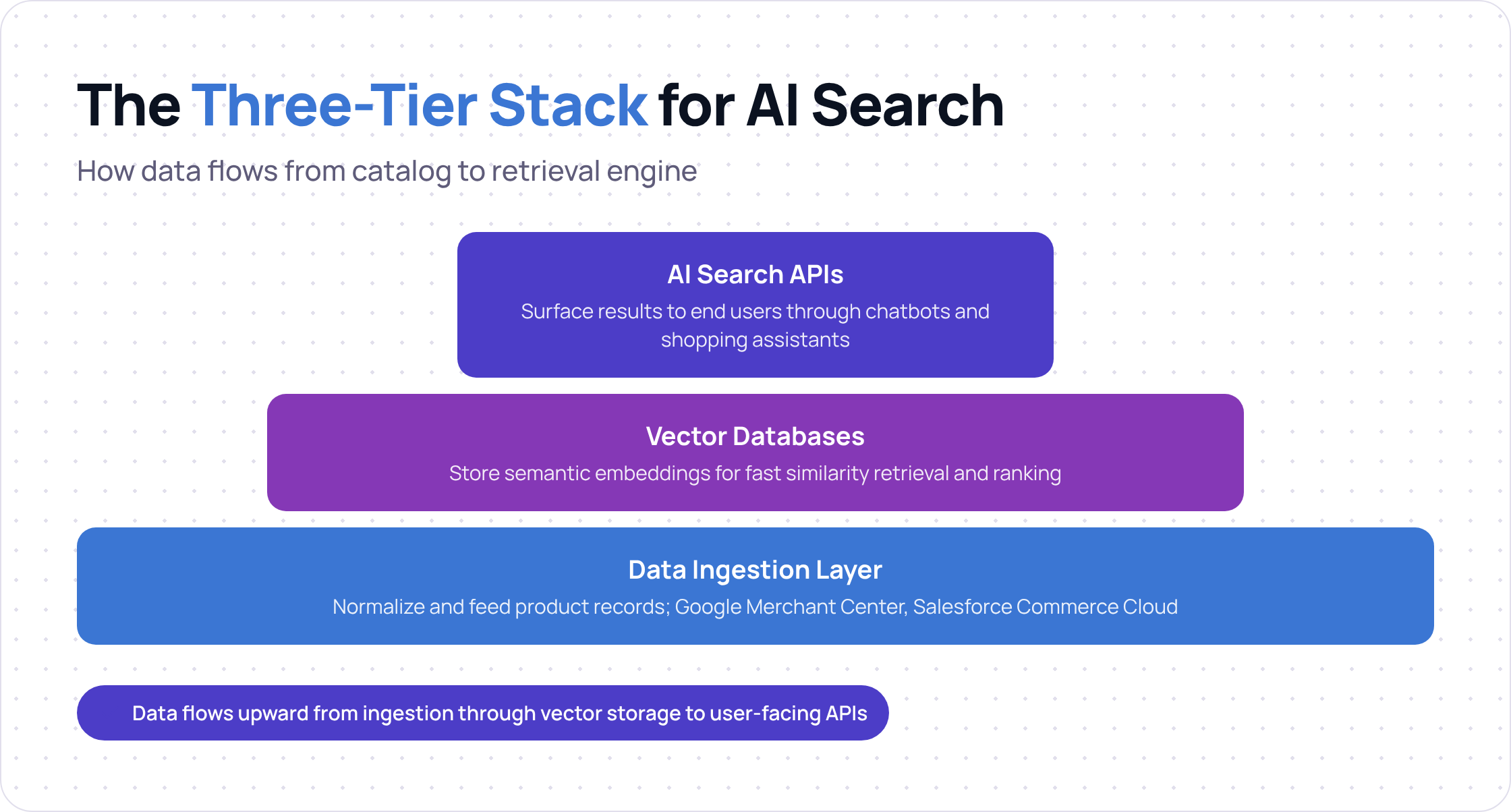
AI search engines pull answers from structured data sources through retrieval-augmented generation (RAG) pipelines, not open web crawls alone. The infrastructure behind those pipelines splits into three tiers: data ingestion layers that normalize and feed product or content records, vector databases that store semantic embeddings for fast similarity retrieval, and AI search APIs that surface results to end users. Google Merchant Center, Salesforce Commerce Cloud, and Algolia each occupy a distinct position in that stack.
The Three-Tier Stack
Ingestion layer. This is where raw catalog data gets cleaned, categorized, and formatted. Google Merchant Center sits here. It accepts structured product feeds (title, price, GTIN, availability) and passes them directly into Google's Shopping Graph, which feeds both traditional Shopping results and Google AI Overviews. A product with incomplete attributes at this layer simply does not appear in AI-generated answers, regardless of how well the brand's editorial content performs.
Vector database layer. Once data is ingested and embedded, it lives in a vector store. Salesforce Commerce Cloud connects to this tier through its Einstein AI layer, which generates semantic embeddings from product descriptions and customer behavior signals. Those embeddings let AI engines match a conversational query like "waterproof hiking boots under $150" to relevant SKUs without requiring an exact keyword match. The trade-off: vector indexes require regular re-embedding as catalog data changes. A product updated in the source catalog but not yet re-embedded will return stale or mismatched results, and most teams underestimate how often that lag occurs in practice.
AI search API layer. Algolia operates primarily here. Its NeuralSearch product combines vector search with keyword ranking, giving developers a single API endpoint that handles both semantic and exact-match queries. This is the layer that e-commerce sites query at runtime, and the layer most directly visible to AI engines that call external APIs to enrich their answers.
Where RAG Pipelines Fit
RAG pipelines do not replace these platforms; they depend on them. When a user asks Perplexity or ChatGPT a product question, the engine queries a retrieval system, pulls the top-ranked structured records, and uses those records as grounding context before generating a response. Getpassionfruit's 2025 AI search statistics tracker puts ChatGPT's share of chatbot referrals at 79.4%, which means the retrieval quality feeding that engine has direct commercial consequences for any brand selling through AI-assisted discovery.
The table below maps each platform to its tier and primary function:
| Platform | Stack Tier | Primary Function in RAG Pipeline |
|---|---|---|
| Google Merchant Center | Ingestion | Structured product feed normalization; feeds Shopping Graph |
| Salesforce Commerce Cloud | Vector / Embedding | Einstein AI embeddings; semantic product matching |
| Algolia NeuralSearch | AI Search API | Runtime query handling; hybrid vector + keyword retrieval |
The Limitation Worth Naming
This three-tier model works cleanly for product catalog use cases. It breaks down when the content being retrieved is unstructured, such as long-form editorial, support documentation, or user-generated reviews. Those content types require additional preprocessing (chunking, metadata tagging, entity extraction) before they can be embedded and retrieved reliably. Brands that assume their blog content will flow through the same RAG pipeline as their product catalog often find that AI engines either ignore it or surface it inconsistently. Structured data has a structural advantage; everything else has to earn its way in.
How AI Search Platforms Use Data to Rank Products
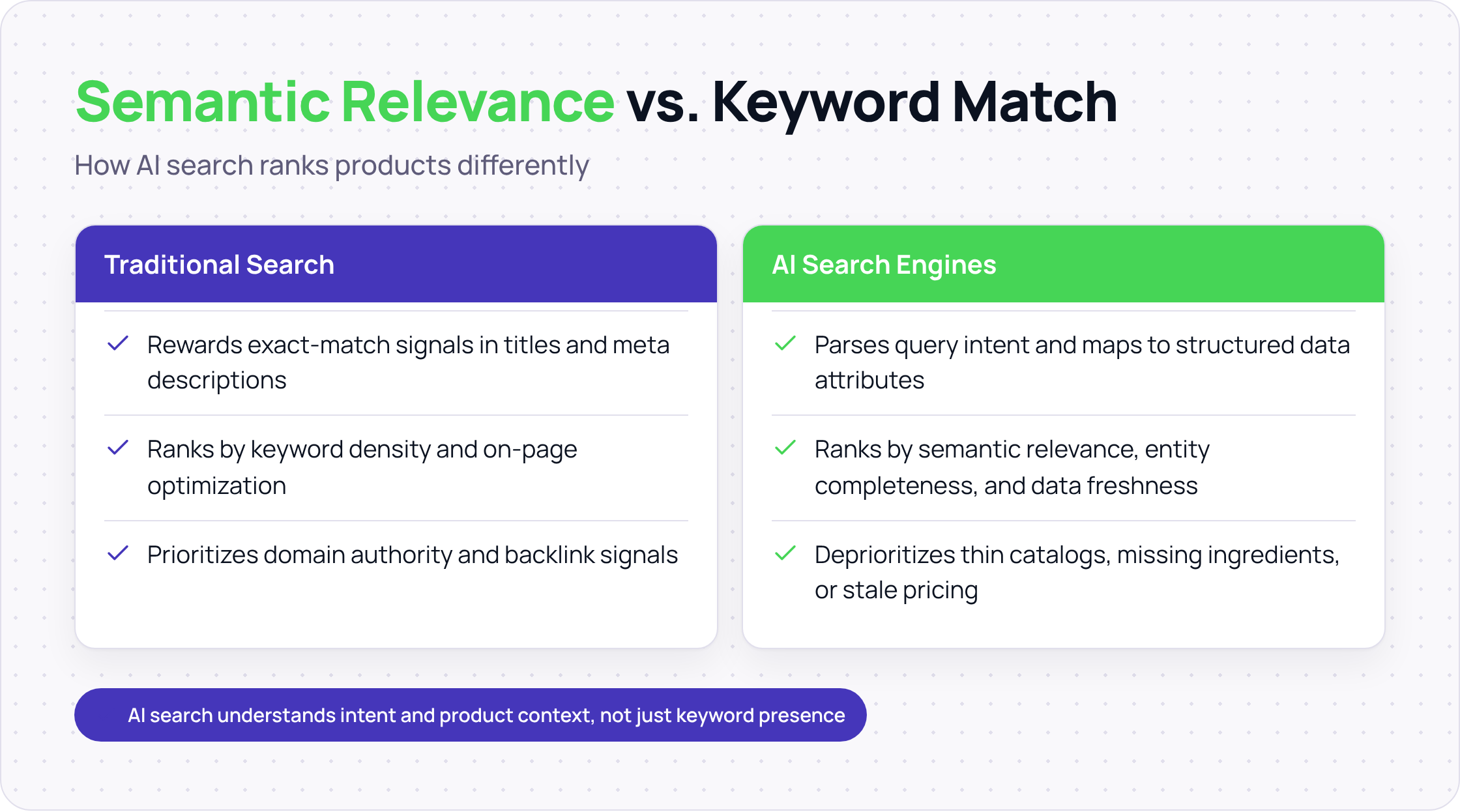
AI search platforms rank products by evaluating semantic relevance, entity completeness, and data freshness rather than keyword density. When a chatbot is the search interface, the system needs to understand what a product is and how it relates to your intent, not just whether a title contains the right words. Catalogs with thin attribute data, missing ingredient lists, or stale pricing get deprioritized because the model cannot confidently cite them as an answer.
Semantic Relevance vs. Keyword Match
Traditional search engines reward exact-match signals: a product page with "vitamin C serum" in the H1 and meta description ranks for that phrase. Conversational AI engines work differently. They parse the full query for intent, then look for structured data that maps cleanly to that intent. A user asking "what serum works for hyperpigmentation on sensitive skin" triggers a lookup across ingredient function, skin type compatibility, and formulation type, not a keyword scan.
Omnibound's AI search intelligence data puts AI-generated search responses at a growing share of zero-click outcomes, with citation selection driven heavily by structured entity data rather than page authority alone.
Signals That Conversational Platforms Weight Most
Three signals consistently separate cited products from skipped ones: completeness, freshness, and entity clarity.
Completeness means every attribute field is populated. Size, material, active ingredients, usage instructions, certifications. A product record with 12 populated fields outperforms one with 4, even if the sparse record has stronger backlinks.
Freshness matters because AI engines are increasingly trained or retrieval-augmented with recent data. A product page last updated 18 months ago, with pricing that no longer matches live inventory, introduces ambiguity the model resolves by citing something else.
Entity clarity is the most technical of the three. It refers to how unambiguously a product can be mapped to a known concept. A moisturizer labeled "nourishing cream" is harder to classify than one labeled "ceramide-rich barrier repair moisturizer, fragrance-free." The second version gives the model enough signal to place it in a specific answer context.
Upland Software's 2026 AI search platform feature analysis identifies robust data infrastructure as the primary driver of AI search success, specifically calling out structured taxonomy and real-time data sync as table-stakes requirements for enterprise catalogs.
Why Beauty and Cosmetics Catalogs Lose Visibility
Beauty is one of the highest-stakes categories for this problem. A shopper asking a chatbot "what's a good retinol for beginners" expects an answer that accounts for concentration percentage, formulation type (cream vs. serum), and potential irritation notes. If your product data only includes a marketing description and a price, the AI engine has no reliable way to match it to that query.
Ingredient data is the specific gap. Many cosmetics brands maintain ingredient lists for regulatory compliance but do not structure them in a way that is machine-readable at query time. The INCI name for an ingredient and its functional role (exfoliant, humectant, emollient) need to be explicitly mapped in the catalog, not buried in a PDF or a flat text block.
Even well-structured catalogs can lose citations when a competitor's editorial content (a review, a how-to guide, a dermatologist Q&A) provides richer contextual framing than a product record alone can. Structured data is necessary but not always sufficient. Brands that combine complete catalog attributes with supporting content, FAQs, and usage guidance consistently outperform those relying on product data alone. Catalog hygiene and content strategy have to work together, not in separate silos.
Top Data Platforms for AI Search Visibility and How to Connect Them
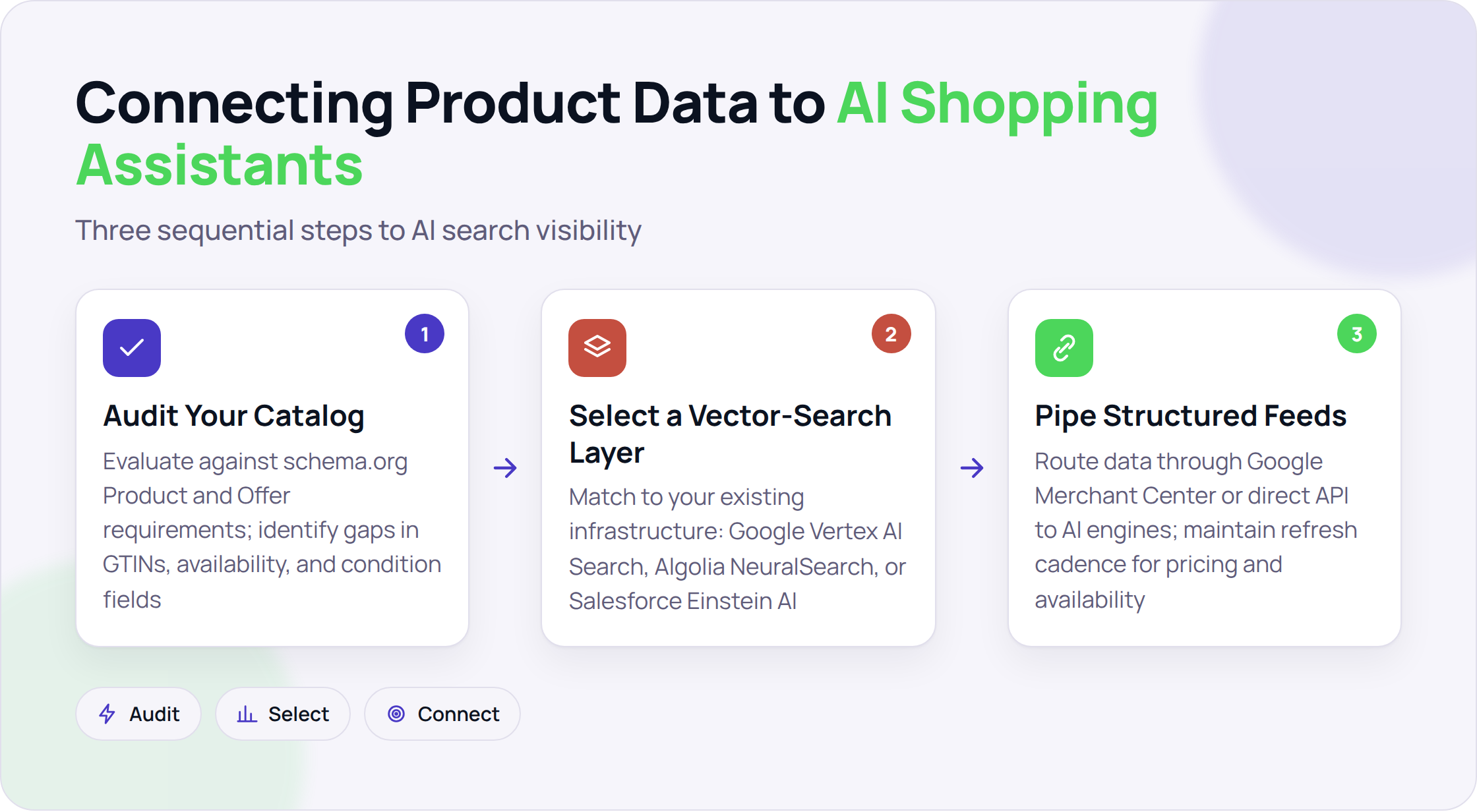
Connecting product data to AI shopping assistants requires three sequential steps: auditing your catalog against schema.org Product and Offer requirements, selecting a vector-search layer matched to your existing infrastructure, and piping structured feeds into AI engines through Google Merchant Center or a direct API. Teams that skip the audit step tend to discover their gaps only after a competitor starts showing up in chatbot answers where they used to dominate.
Google Merchant Center
Google Merchant Center remains the most direct path for product data to reach Google AI Overviews and Google Shopping. Feed quality is the variable that matters most. Products with complete GTINs, accurate availability signals, and populated condition fields consistently outperform those with partial data, even when the underlying product is comparable.
One practical note: Merchant Center's feed diagnostics surface attribute errors, but they do not tell you which missing attributes are costing you AI Overview citations specifically. You need a separate monitoring layer for that signal.
Algolia NeuralSearch
Algolia NeuralSearch is the platform most commonly adopted by mid-market and enterprise e-commerce teams that need to answer the question of what data platform supports AI search at the API layer. Its hybrid retrieval model (vector plus keyword) means you do not have to choose between semantic matching and exact-match precision. The 300%-plus query growth figure Algolia reported through 2024 reflects real adoption, not just marketing.
The integration cost is real, though. Connecting NeuralSearch to a Shopify Plus or Salesforce Commerce Cloud catalog cleanly requires custom indexing logic, and the ongoing maintenance burden of keeping embeddings fresh is often underestimated in initial project scoping.
Salesforce Commerce Cloud with Einstein AI
Salesforce Commerce Cloud suits teams already inside the Salesforce ecosystem. Einstein AI generates embeddings from product descriptions and behavioral data, which means the semantic layer improves over time as transaction data accumulates. For brands with large catalogs and established customer bases, that feedback loop is a genuine advantage.
The limitation: Einstein AI's retrieval quality depends heavily on the richness of your product descriptions at the point of ingestion. Sparse descriptions produce sparse embeddings, and sparse embeddings produce weak retrieval. Cleaning your catalog before enabling Einstein is not optional if you want accurate results.
Google Cloud Vertex AI Search
Vertex AI Search is the enterprise-tier option for teams building custom AI search experiences rather than plugging into a commerce platform. It supports multimodal retrieval (text, image, structured data) and integrates directly with BigQuery for catalog management at scale. The trade-off is complexity: Vertex AI Search requires more engineering investment than Algolia or Merchant Center, and it is better suited to organizations with dedicated ML infrastructure than to teams looking for a fast deployment.
Frequently Asked Questions
What data platform supports AI search for e-commerce specifically?
Google Merchant Center, Algolia NeuralSearch, and Salesforce Commerce Cloud with Einstein AI are the three most widely adopted platforms for e-commerce AI search visibility. Each covers a different layer of the stack: Merchant Center handles feed ingestion, Algolia handles runtime query retrieval, and Einstein AI handles semantic embedding. Most mid-to-large retailers use at least two of the three in combination.
Does schema.org markup actually affect AI search citations?
Yes, and the effect is measurable. AI retrieval engines use schema.org Product and Offer markup to identify and classify product attributes at parse time. Products without that markup require the model to infer attributes from unstructured text, which introduces errors and reduces citation confidence. JSON-LD is the preferred delivery format because it keeps the markup separate from the visible page content and is easier for crawlers to parse reliably.
How is AI search ranking different from Google's traditional PageRank?
PageRank weights inbound links as a proxy for authority. AI search ranking weights entity completeness, semantic relevance to the query, and data freshness. A product with zero backlinks but a fully populated, schema-compliant catalog record can outrank a well-linked competitor in a chatbot answer. The two systems are not mutually exclusive, but the signals they prioritize are genuinely different, and optimizing for one does not automatically optimize for the other.
Can small brands compete with large retailers in AI search?
Yes, within limits. AI retrieval systems do not inherently favor large catalogs over small ones. A small brand with 50 fully attributed, schema-compliant SKUs can outperform a large retailer with 5,000 poorly structured ones in specific query contexts. The disadvantage small brands face is content depth: large retailers often have more supporting editorial content (reviews, guides, FAQs) that provides additional retrieval context. Closing that gap requires deliberate content investment alongside catalog hygiene.
What analytics tools track AI search visibility?
GA4 does not track AI search citations. Tools built specifically for generative engine optimization (GEO) monitoring, such as those that crawl ChatGPT, Perplexity, and Google AI Overviews on a scheduled basis, are required. Some SEO platforms added AI visibility modules in 2025, but coverage and crawl frequency vary significantly across vendors. Evaluating a tool's crawl cadence and the specific engines it monitors is the right starting point before committing to any platform.
How often should product data be refreshed for AI search?
Pricing and availability data should sync at least daily, ideally in near-real-time. Attribute data (descriptions, ingredients, specifications) should be reviewed and updated whenever a product formulation or specification changes, not on a fixed calendar schedule. Stale pricing is one of the most common reasons AI engines skip a product record in favor of a competitor's, because the model cannot confidently cite a price it cannot verify as current.
Putting It Together
Answering the question of what data platform supports AI search requires looking at the full stack, not a single tool. Google Merchant Center handles feed ingestion. Algolia NeuralSearch or Vertex AI Search handles runtime retrieval. Salesforce Einstein AI handles semantic embedding for teams already in that ecosystem. The connective tissue is structured data: schema.org markup, complete attribute fields, and a refresh cadence that keeps pricing and availability current.
The brands gaining ground in AI-assisted discovery right now are not necessarily the ones with the biggest catalogs or the highest domain authority. They are the ones whose product data is clean enough, complete enough, and fresh enough for a retrieval model to cite with confidence.
If you want to see where your catalog stands against those requirements, visit Seorav's GEO analysis tool to get a structured view of your current AI search visibility and the specific gaps costing you citations.
Keep reading
Why E-E-A-T and LLM Optimization Are Reshaping SEO Rankings
Learn why E-E-A-T and LLM optimization are the new ranking factors in 2026, and how to structure content that both Google and AI engines trust and cite.
Schema Markup for AI Search Engines: What to Add and How to Do It
Learn how to use schema markup for AI engines with JSON-LD examples for Article, HowTo, and FAQPage types. Includes validation tools and scaling tips.
Tools to Track When Competitors Get Cited in AI Search Results
What solutions track competitor citations in AI-generated search responses? Compare 7 tools including Profound, Semrush, and Otterly across engine coverage