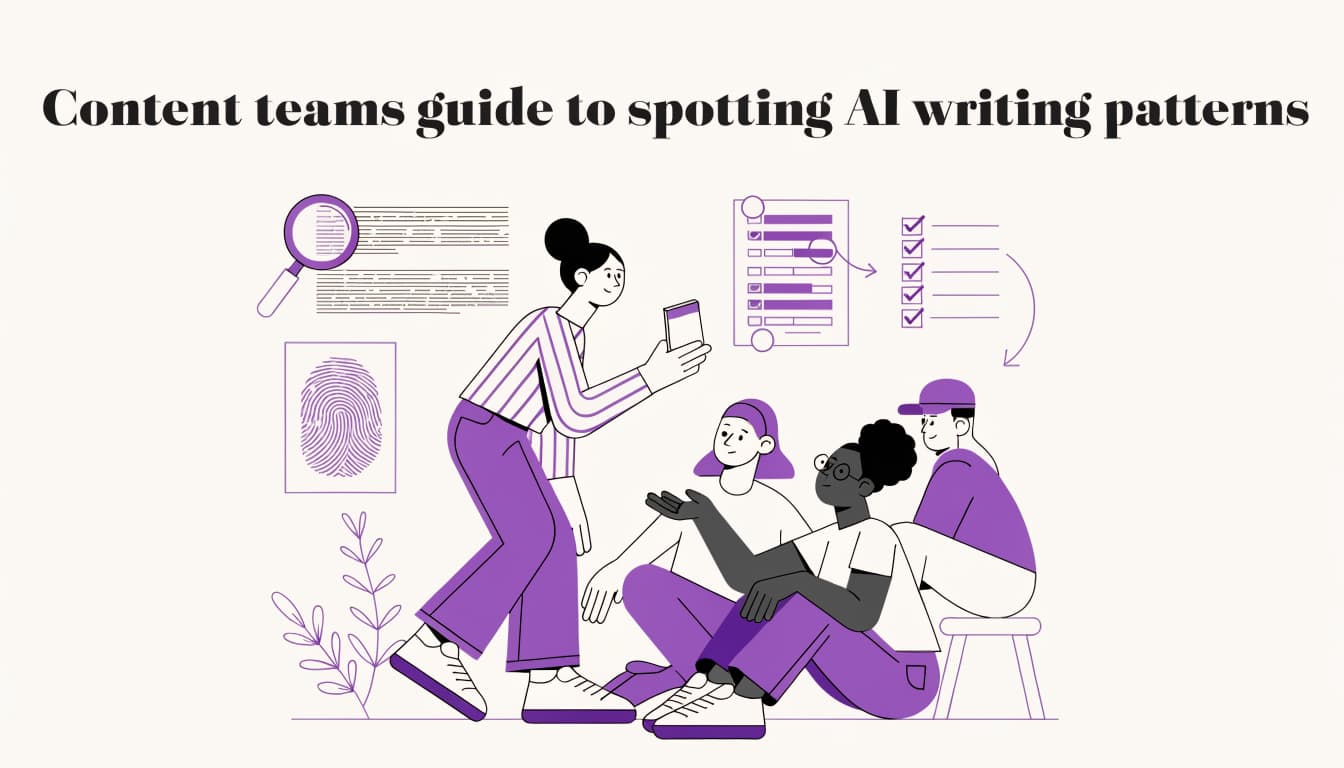
Content teams guide to spotting AI writing patterns
Last updated: 23 July 2026
The Content teams guide to spotting AI writing patterns starts with a simple premise: AI-generated text has structural fingerprints, not just word-level tells. Learn to read those fingerprints at the paragraph and document level, and your editorial team will catch AI-assisted content far faster than any automated detector alone.
Why This Problem Is Harder Than It Looks
Most detection advice focuses on individual words — "utilize," "delve," "tapestry" — and those signals are real. But large language models have been retrained on feedback that discourages obvious buzzwords. The result is that surface-level vocabulary checks now miss a growing share of AI output. A 2023 study by researchers at the University of Pennsylvania found that GPT-4 output fooled human reviewers more than 50% of the time when reviewers relied only on word-choice instincts.
For content teams, the stakes are concrete: brand voice dilution, duplicate-risk penalties from search engines, and eroded reader trust. An editorial workflow that catches patterns at the structural level — not just the lexical level — is the practical answer.
The Structural Fingerprints That Actually Matter
AI language models are trained to produce well-organized, balanced output. That training bias creates predictable document shapes.
The Three-Point List Problem
Count the bullet lists in a draft. AI tools default to grouping items in threes or fives because training data rewards symmetry. A human writer covering, say, five reasons a product failed might list four — because that's how many exist. An AI will find a fifth to complete the set. If every section in a document has exactly three bullets, treat that as a flag.
Paragraph-Level Uniformity
Paste a draft into a word processor and check paragraph lengths. Human writers naturally produce short punchy paragraphs next to longer analytical ones. AI output tends toward uniform paragraph lengths — typically 40–70 words each — because the model optimizes for readability scores rather than rhetorical effect. More than four consecutive paragraphs within 10 words of the same length is a structural tell.
The Hedging Ladder
AI models are trained to avoid false claims, which produces a recognizable hedging pattern: a claim, followed by a qualifier, followed by a second qualifier. "X is often effective, though results may vary, and individual circumstances should always be considered." That triple hedge in a single sentence is rare in human writing but common in AI output. Editors can scan for it quickly.
Sentence-Level Patterns Your Team Should Memorize
Beyond structure, certain sentence constructions appear at above-average rates in AI text.
- Appositive overload: AI frequently stacks noun phrases — "John Smith, a renowned expert and leading voice in the field, noted..." — because it mirrors academic citation style from training data.
- Passive-to-active pivots within a paragraph: A paragraph that opens in passive voice and pivots to active mid-way is a common AI rhythm, not a human one.
- Transition sentence as its own paragraph: Phrases like "This brings us to the next consideration" or "With that context established" sitting alone as one-sentence paragraphs are near-universal in AI drafts.
- Symmetrical contrast: "While X offers Y, Z provides W" constructions appear roughly three times more often in AI text than in comparable human journalism, based on pattern analysis published by Pangram Labs.
Tonal and Voice Patterns That Slip Past Vocabulary Checks
Voice is harder to fake than vocabulary, and AI consistently fails in specific ways.
Forced Expertise Without Evidence
Human subject-matter experts cite specifics because they lived them: "We ran this test on 400 users in Q3 2022 and saw a 17% drop in bounce rate." AI generates plausible-sounding expertise without the lived specificity. Watch for paragraphs that assert authority but contain no dates, no named tools, no concrete numbers. One such paragraph in a 1,000-word piece is normal. Three or more in a row is a pattern.
Emotional Flatness at Inflection Points
Human writers modulate tone when the subject demands it — a case study about a product failure carries a different register than one about a success. AI maintains a consistent motivational-neutral tone regardless of subject matter. If a draft about a brand crisis reads with the same cheerful confidence as a product launch announcement, the emotional flatness is a tell.
The Missing Disagreement
Human writers argue with their own premises. They introduce a counterargument, sit with it, and respond to it. AI tends to acknowledge counterarguments in a single sentence — "Of course, some may argue..." — then immediately dismiss them. Real editorial thinking takes the opposing view seriously for at least a paragraph.
Building a Team Detection Workflow
Solo instinct doesn't scale. A repeatable workflow does.
- First-pass structural scan (5 minutes): Check paragraph-length uniformity, bullet-list symmetry, and lone transition sentences. Flag any draft where two or more structural tells appear.
- Voice audit (10 minutes): Highlight every sentence that makes an expertise claim. Count how many include a specific date, number, named tool, or named person. A ratio below 1 specific claim per 200 words is a flag.
- Hedging count (3 minutes): Search for "may," "might," "often," "typically," and "generally." More than eight of these across 800 words warrants closer review.
- Human specificity test: Ask the writer to name one thing from personal experience that shaped a claim in the piece. If they cannot, escalate.
Detection tools like GPTZero or Originality.ai can assist, but they carry false-positive rates that make them unreliable as standalone gatekeepers — particularly for content that blends human editing with AI drafts. Use them as one signal among several, not as the verdict.
Measuring Success and Recognizing Failure Modes
Track two metrics once your workflow is running: detection rate (percentage of flagged drafts that editorial review confirms as AI-heavy) and false-positive rate (percentage of flagged drafts from human writers). A well-calibrated workflow should hit a detection rate above 70% and a false-positive rate below 15% within 60 days.
The most common failure mode is pattern drift. AI tools update frequently — sometimes monthly — and a pattern that was a reliable signal in January may be less common by June. Assign one editor to review a sample of 20 published pieces every quarter and recalibrate the checklist based on what they find.
A second failure mode is over-reliance on vocabulary blocklists. Teams that only scan for "utilize" or "delve" will miss structurally AI-shaped content written with varied vocabulary. The structural and tonal checks in this guide are harder to game than word-level filters.
Your First 30 Days: A Realistic Action Plan
Week one: Audit 10 recent published pieces using the structural scan above. Document which patterns appear most frequently in your content category — patterns in B2B SaaS copy differ from those in lifestyle journalism.
Week two: Build a one-page editorial checklist from your audit findings. Keep it to eight items maximum. Longer checklists get skipped.
Week three: Run the checklist on all incoming drafts. Track flags in a shared spreadsheet — writer ID, pattern triggered, outcome after review.
Week four: Review the data. Identify which patterns have the highest confirmation rate in your specific content type. Retire the lowest-signal checks. Add one new check based on anything novel you spotted.
This is a living process, not a one-time fix. AI writing capabilities change faster than any static checklist can accommodate, so the team habit of observing and updating is the real deliverable.
See how seorav.com can help your editorial team build detection workflows, brand-voice audits, and content quality systems that keep pace with how AI writing tools actually evolve.
Frequently Asked Questions
What are the most common AI patterns in writing that editors miss?
The most frequently missed patterns are structural, not lexical. Uniform paragraph lengths, symmetrical bullet lists, and lone transition sentences sitting as single-line paragraphs are reliable tells that vocabulary-only checks skip entirely. Editors trained to look at document shape — not just word choice — catch a significantly higher share of AI-assisted drafts than those using blocklists alone.
Can AI writing detectors replace a human editorial workflow?
No. Tools like GPTZero and Originality.ai carry meaningful false-positive rates, particularly for content that mixes human editing with AI drafts. They work best as one signal inside a broader editorial process — structural audits, voice checks, and specificity tests — rather than as standalone verdicts. Relying on a single tool will both miss AI content and incorrectly flag legitimate human writing.
How do AI sentence structures differ from human writing?
AI sentence structures tend toward symmetrical contrast ('While X offers Y, Z provides W'), appositive stacking, and triple hedging within a single sentence. Human writers produce more irregular rhythms: short punchy sentences next to long analytical ones, and arguments that sit with counterpoints rather than dismissing them in a single clause. Sentence-level uniformity across a whole document is the clearest structural flag.
How often should a content team update its AI detection checklist?
At minimum, once per quarter. AI language models are updated frequently — sometimes monthly — and patterns that reliably flagged content in one quarter may be less common in the next. Assign one editor to audit a sample of 20 published pieces each quarter and document any new structural or tonal patterns. A checklist that isn't refreshed becomes less accurate over time, not more.
Does AI writing detection work the same way for fiction as for marketing copy?
No. Fiction AI patterns skew toward emotional flatness, generic sensory description, and plot symmetry — every act resolves too cleanly. Marketing copy AI patterns lean toward hedging, expertise claims without specifics, and bullet-list symmetry. The underlying detection logic (look for structural uniformity and missing lived specificity) applies to both, but the specific tells differ by content category and require separate checklists.
Keep reading
Ranking in Google's AI Search: The Deterministic Signals That Actually Move the Needle
Learn how do you rank in SGE with the three signals Google's AI uses to cite sources: schema markup, entity salience, and structured factual claims.
Why AI Ignores Your Content (And How to Fix It)
Learn how to avoid AI content that gets ignored by LLMs. Covers RAG retrieval signals, schema, entity salience, and an answer-first structure checklist.
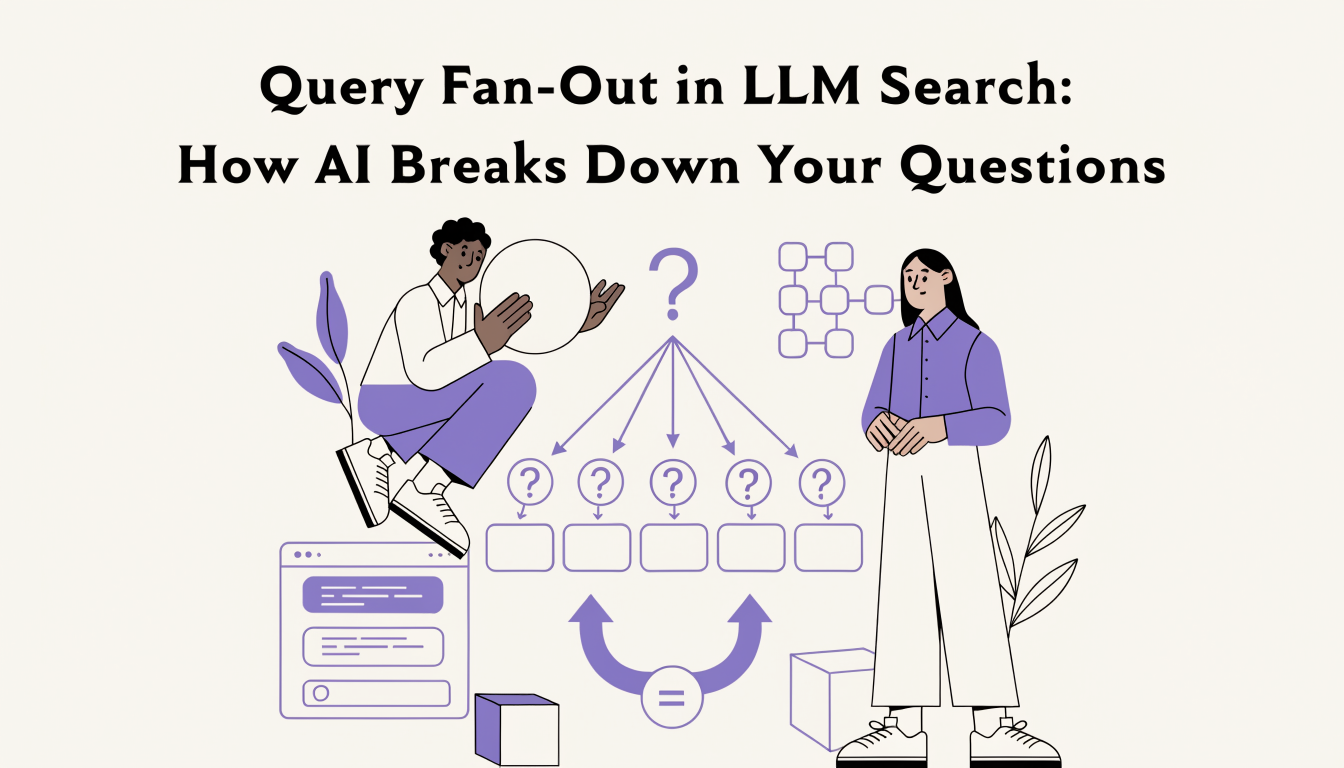
Query Fan-Out in LLM Search: How AI Breaks Down Your Questions
Learn what query fan-out in LLM search is, how AI splits your prompt into 3-8 sub-queries, and how to structure content to win more citation passes.