Building Knowledge Graph Authority That AI Systems Trust
Last updated: 16 September 2026
Build knowledge graph authority by establishing your brand as a verifiable, coherent entity across structured data, third-party sources, and multiple platforms. AI systems prioritize consistency over volume: a schema.org markup on your homepage, mentions in industry databases, and corroborating citations from trusted publishers signal that your brand deserves inclusion in knowledge panels and AI citations. The foundation is not your website alone but whether machines can independently confirm your expertise exists beyond your own claims.
Bing, Google, and the major LLMs all pull from overlapping entity graph signals: structured data on your pages, third-party mentions that confirm your attributes, and cross-platform consistency between your schema markup and what Wikipedia, Wikidata, or authoritative directories say about you. These systems share a common substrate of entity resolution, so a brand that builds a coherent footprint in one place tends to surface across all of them.
The numbers are concrete. BrightEdge's 2024 research found that brands with structured entity profiles are cited 3x more often in AI Overviews than brands without them. That gap is structural: a knowledge graph supplies verified facts that LLMs cannot reliably generate on their own, so models lean on it when deciding what to quote and who to credit.
One honest caveat upfront: entity authority is not a one-time setup. Signals decay when third-party sources go stale or schema markup falls out of sync with your actual content. Maintenance is part of the work.
Why Knowledge Graph Authority Decides Who AI Cites
When an AI system decides whether to cite your brand, it checks whether your brand exists as a verified entity in its knowledge graph: a node with consistent attributes, confirmed relationships, and corroborating signals across multiple sources. Brands that clear that check get cited. Brands that do not get paraphrased or skipped.
The mechanism is less mysterious than it sounds. Entity resolution works by matching a name against known records, checking whether co-citation signals reinforce a consistent identity, and tracing provenance back to authoritative reference points. A brand that appears in three independent, high-trust sources within the same topical context gets treated as a corroborated entity. A brand that appears only on its own domain does not.
Co-citation matters more than most practitioners expect. If three independent, high-trust sources reference your brand in the same topical context, an AI system treats that as corroborating evidence of expertise. A single authoritative mention carries less weight than a cluster of consistent, contextually aligned references across unrelated domains.
Provenance chains matter too. A statistic that appears on your site, sourced to a named study, sourced to a peer-reviewed dataset, carries more trust than an unsourced assertion, even if both appear on pages with identical backlink profiles. AI engines weight citations partly by how traceable the original claim is.
The Brand That Disappeared from AI Search Overnight
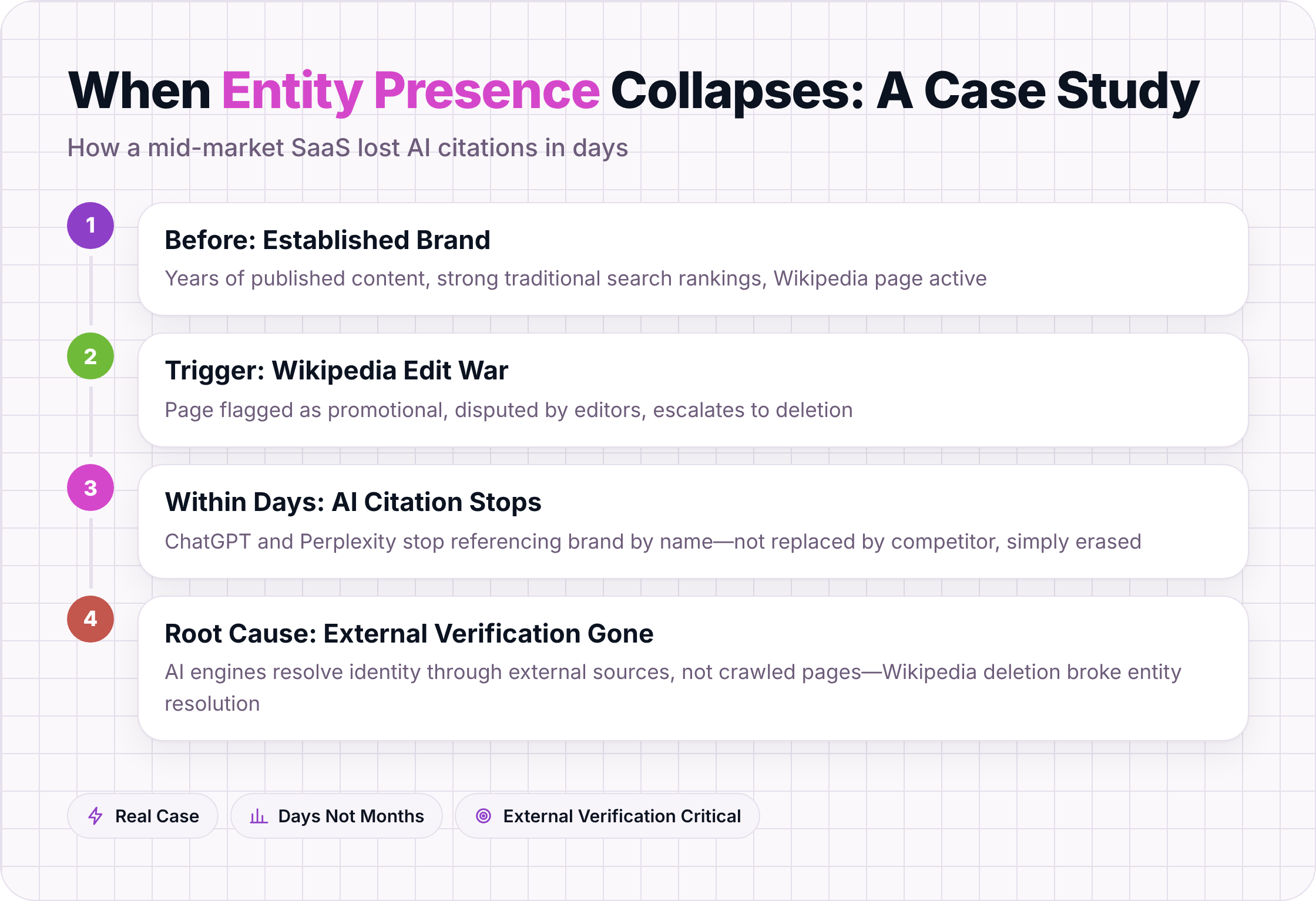
Entity presence is load-bearing infrastructure for AI visibility. When a mid-market SaaS company lost its Wikipedia page to a deletion dispute, AI systems stopped citing it by name within days, despite years of published content and strong traditional search rankings. This happened because AI engines resolve brand identity through external verification sources, not crawled pages.
Here is a documented pattern that knowledge graph practitioners have flagged repeatedly: a mid-market SaaS company, well-established in its niche, watched its AI citation rate fall to zero after an edit war on its Wikipedia page escalated to deletion. The page was flagged as promotional, disputed by editors, and eventually removed. Within days, ChatGPT and Perplexity stopped referencing the brand by name. They did not cite a competitor instead. They simply stopped acknowledging the company existed.
The mechanism is entity disambiguation. AI systems resolve brand names against structured knowledge sources, including Wikidata, Google's Knowledge Graph, and Freebase-derived entity stores. When a brand has no clean entity record, the model either conflates it with a similarly named company or drops it from responses entirely. Discoveredlabs' entity recognition framework makes this explicit: without a machine-readable entity definition, your brand is effectively anonymous to the model's retrieval layer, regardless of how much content you have published.
The trade-off is real and worth naming. Wikipedia is not under your control, and that is precisely the problem. Your brand can do everything right, publish structured data, maintain consistent NAP (name, address, phone) signals, build schema markup, and still lose its entity record because a volunteer editor decided the page lacked sufficient third-party sourcing. Companies with fewer than three or four independent, substantive press mentions are genuinely at risk of deletion, and no amount of on-site schema fixes that.
What the incident reveals is that unmanaged knowledge graph presence is a single point of failure. Fragmented or absent brand data keeps you invisible to AI engines, a pattern Yext's 2026 knowledge graph visibility research documents across mid-market categories. The fix is not reactive. Your brand needs entity records distributed across multiple authoritative nodes, including Wikidata (which you can edit directly), Crunchbase, LinkedIn company pages, and industry-specific directories, so that no single deletion event collapses the whole structure. Redundancy is the architecture.
What Knowledge Graph Authority Actually Means
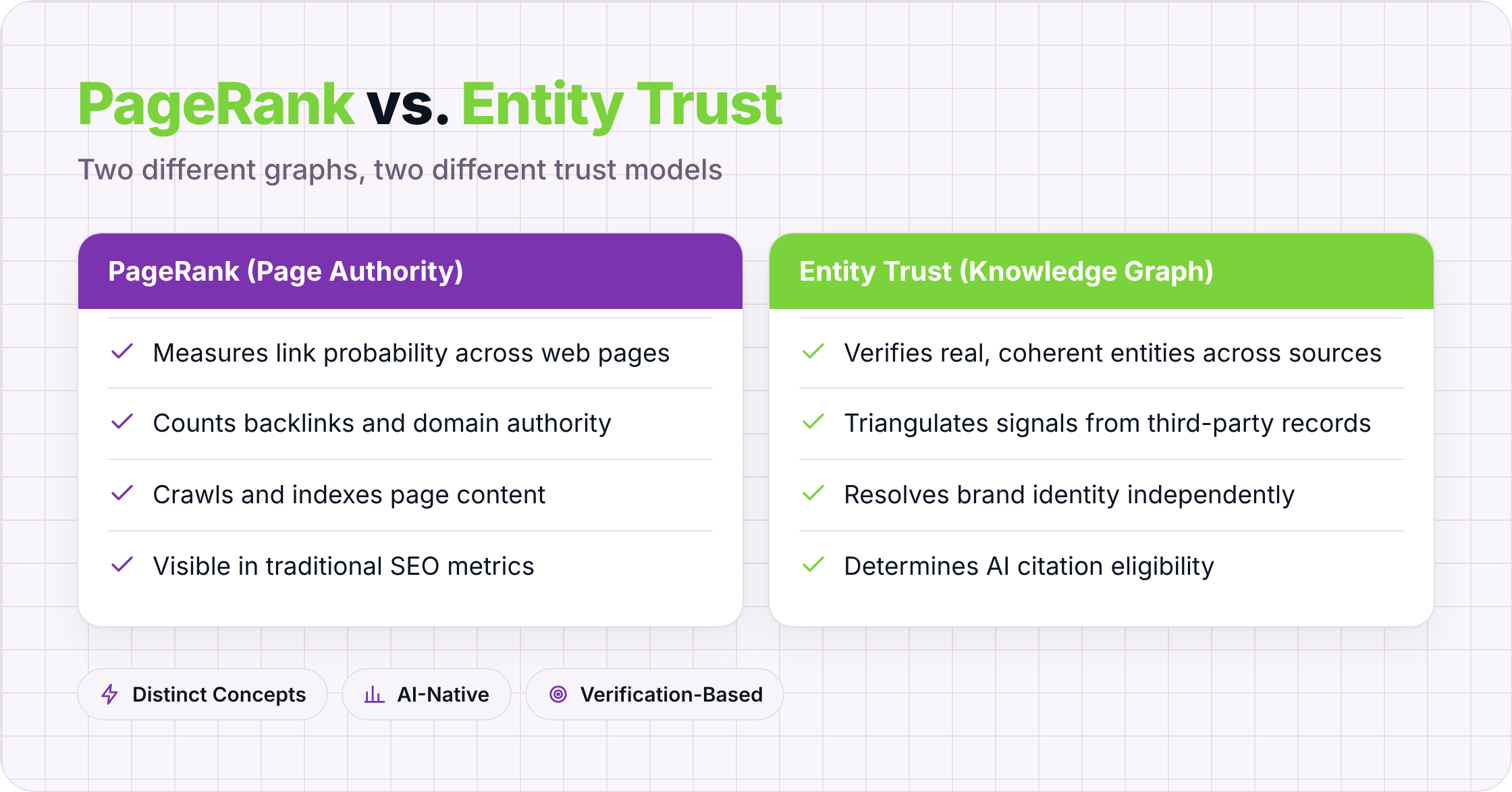
Knowledge graph authority is the degree to which an AI system can independently verify that your brand is a real, coherent entity with a defined scope of expertise. It is distinct from link authority. Your site can accumulate thousands of backlinks and still be invisible to an AI engine's entity resolution layer because no structured, cross-referenced record of your brand exists outside your own domain. AI systems trust entities they can triangulate, not pages they can crawl.
PageRank vs. Entity Trust
PageRank-style authority is a graph of pages. Entity trust is a graph of things. Google's original PageRank algorithm measured the probability that a random web walker would land on a given page. Knowledge graph trust measures something different: whether a named entity (your company, your authors, your core topics) can be resolved to a stable, consistent record with verifiable attributes.
The practical gap between these two models is significant. Adobe's structured content guidance frames this as the difference between organizing pages and organizing entities: the former optimizes for crawlers, the latter optimizes for the inference layer that sits above crawling.
Your brand can rank on page one for a competitive keyword and still fail entity resolution if its structured data is inconsistent, its authorship is anonymous, or its topical scope shifts article to article. AI systems penalize incoherence even when traditional search signals look healthy.
Where Wikidata, Wikipedia, and Knowledge Panels Fit
These three platforms form the top tier of the verification stack, and they operate differently.
Wikipedia provides narrative context: a human-readable record that LLMs were trained on directly. If your brand has a Wikipedia article, that article's categories, inbound links, and cited sources become part of how the model understands what you do and who you are.
Wikidata provides machine-readable facts: structured triples (subject, predicate, object) that AI systems can query programmatically. A Wikidata entry for your organization, linked to your domain via the official website property and connected to your industry category, gives entity resolution a concrete anchor. This is where sameAs schema on your own site pays off: it creates a verifiable bridge between your pages and the Wikidata record.
Google's Knowledge Panel sits at the intersection of both. It is Google's public-facing display of what its Knowledge Graph has resolved about your entity. Earning a panel signals that Google's entity resolution layer has enough cross-referenced data to commit to a stable record for your brand.
The trade-off is real, however. Smaller brands, niche B2B companies, and recently founded organizations often cannot meet Wikipedia's notability threshold, which requires significant independent coverage in reliable sources. For those brands, Wikidata entries (which have a lower notability bar) and consistent schema markup across owned properties become the primary verification path. This works, but it takes longer to propagate through AI training cycles, and there is no guaranteed timeline for when a model will recognize the entity as authoritative.
The numbers reflect how early most organizations are on this curve: Motadata's enterprise knowledge graph research notes that reducing AI hallucinations is one of the primary drivers pushing enterprises toward structured entity data, precisely because unverified entities produce unreliable outputs. If AI systems cannot verify your brand, they will either hallucinate details about you or omit you entirely.
The Structured Data and Citation Mistakes Most Brands Make
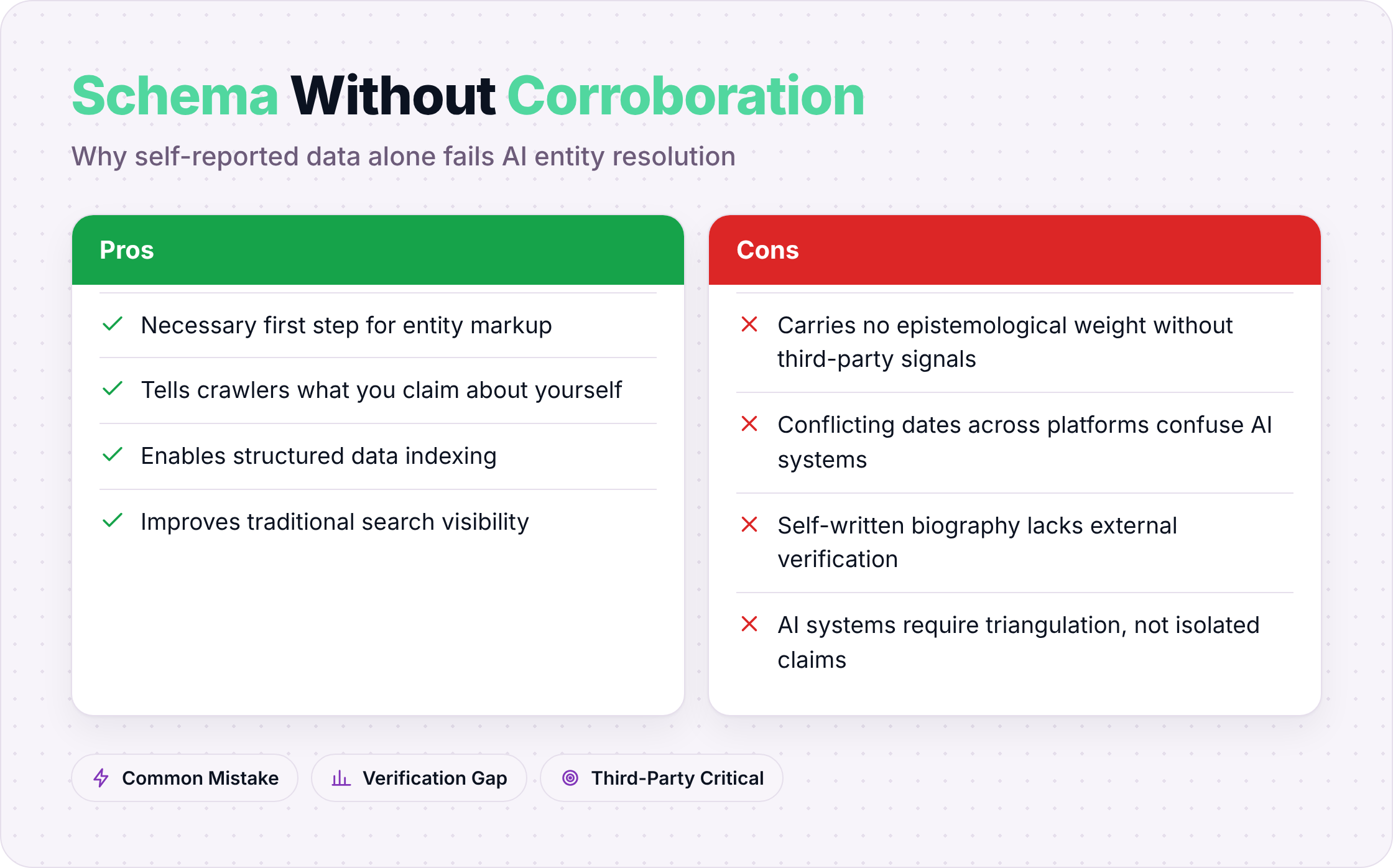
Most brands treat Schema.org markup as a finish line. It is not. Structured data tells search crawlers what you claim about yourself. It does not tell AI systems whether those claims are true. Without corroborating signals from third-party sources, a perfectly formatted Organization schema carries roughly the same weight as a self-written biography: technically present, epistemically thin.
Schema Without Corroboration Is a Claim, Not a Credential
Publishing JSON-LD with your brand name, founding date, and sameAs links is a necessary first step. But AI systems resolve entity identity by triangulating across sources, not by reading your own markup and accepting it. If your schema says your company was founded in 2018, your Crunchbase profile says 2019, and your LinkedIn "About" section omits the date entirely, the model has three conflicting signals and no external arbiter. The result: low-confidence entity resolution, which typically means no citation.
The fix is corroboration before markup. Get the facts consistent on Wikipedia (if you qualify), Wikidata, your Google Business Profile, and at least two industry directories before you finalize the schema. The schema then confirms what the external record already says, and that confirmation actually registers.
Cross-Platform Inconsistency Breaks Entity Resolution
NAP data (name, address, phone) is the oldest local SEO concern, but the same fragmentation problem scales to B2B brands at the entity level. A company called "Acme Corp" on its website, "Acme Corporation" on LinkedIn, and "Acme" in press mentions creates three candidate entities. AI systems have to decide whether those are the same organization or different ones.
This maps to a documented challenge in knowledge graph construction: a comprehensive end-to-end guide on building knowledge graphs identifies entity disambiguation as one of the hardest steps in the pipeline, precisely because small naming variations compound across sources. For your brand, the practical implication is that every platform where your name appears needs to use the exact same legal or registered name. Abbreviations, stylized versions, and informal shorthand all introduce ambiguity that entity resolution systems cannot reliably collapse.
Authorship Anonymity Undermines Topical Authority
Anonymous content is a trust signal problem at the entity level, not just a credibility problem for readers. When your articles carry no named author, AI systems cannot build an authorship graph that connects your brand to a human expert with a verifiable track record. The content exists, but it floats without an entity anchor.
The fix is straightforward but requires consistency. Assign named authors to every substantive piece of content. Give each author a profile page with structured data (Person schema, including sameAs links to their LinkedIn profile and any relevant professional directories). Over time, the authorship graph reinforces your brand's topical scope, because the model can see that the same named experts consistently write about the same subject area.
How to Build Knowledge Graph Authority for Your Brand: A Practical Sequence
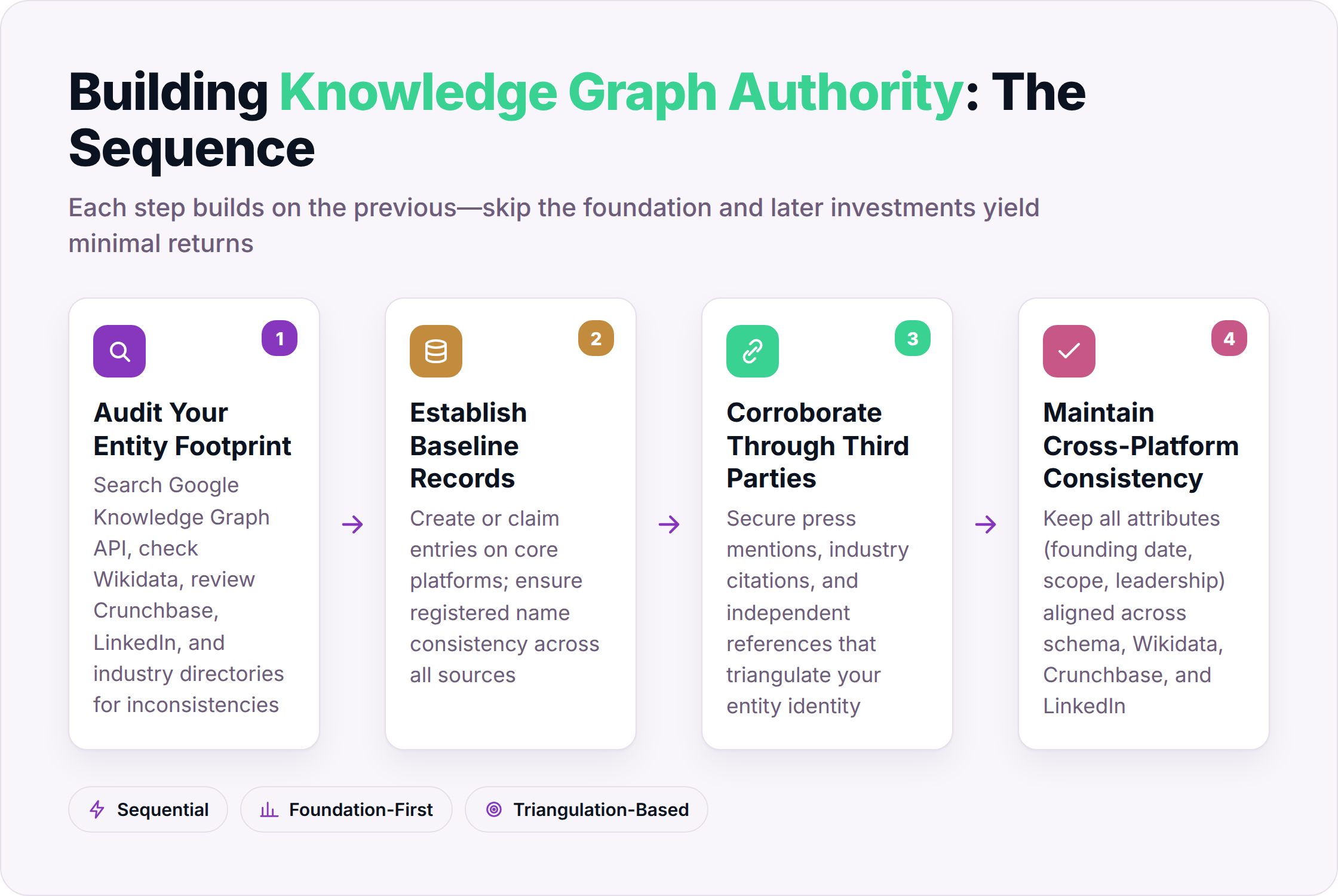
Building knowledge graph authority requires a specific sequence: establish your baseline entity footprint, corroborate it through third-party sources, then maintain consistency across platforms. Each step builds on the previous one because AI systems verify your brand by triangulating signals, not by accepting isolated claims. Skip the foundation and later investments yield minimal returns.
Step 1: Audit Your Current Entity Footprint
Before you add anything, map what already exists. Search your brand name in Google's Knowledge Graph Search API (free, requires a key). Check whether a Wikidata entry exists. Review your Crunchbase, LinkedIn, and any industry directory listings for factual consistency. Note every place your brand name appears in a form that differs from your registered name.
This audit typically surfaces three to five inconsistencies that are actively suppressing entity confidence. Fix those before you build anything new.
Step 2: Establish a Wikidata Entry
If your brand does not have a Wikidata entry, create one. Wikidata has a lower notability bar than Wikipedia and accepts entries for organizations that have a verifiable online presence. At minimum, your entry should include:
- The organization's official name (matching your schema exactly)
- The
instance of: organizationorinstance of: businessproperty - The
official websiteproperty linked to your domain - Your industry category
- Your founding date (matching every other source)
Once the Wikidata entry exists, add a sameAs property in your Organization schema pointing to the Wikidata entity URL. This creates the machine-readable bridge that entity resolution systems use to confirm your identity.
Step 3: Earn Three Independent Press Mentions
Three substantive, independent mentions in sources that AI systems treat as authoritative (trade publications, regional business journals, recognized industry blogs) is the practical minimum for entity corroboration. These mentions need to include your full brand name, your category, and ideally a factual claim (founding date, location, product category) that matches your structured data.
Pitching for coverage is outside the scope of this article, but the targeting logic is specific: prioritize publications that are indexed in Google News, have their own Wikipedia articles, or are cited in academic or government sources. Those signals propagate faster through entity resolution pipelines than coverage from newer or lower-authority outlets.
Step 4: Implement and Maintain Organization Schema
Your Organization schema should include, at minimum: name, url, logo, foundingDate, description, sameAs (pointing to Wikidata, LinkedIn, Crunchbase, and any Wikipedia article), and contactPoint. If you have named founders or executives, add founder and employee properties with nested Person schema.
Set a quarterly review cadence. Schema that was accurate at launch drifts as companies evolve, and a founding date or address that no longer matches your Wikidata entry is an active trust signal problem, not a minor inconsistency.
Step 5: Build Topical Depth Through Named Authors
Assign named, schema-marked authors to every substantive article. Each author's profile page should carry Person schema with sameAs links to their LinkedIn and any professional directory listings. Over 12 to 18 months, a consistent authorship graph signals to AI systems that your brand has genuine human expertise in a defined subject area, not just a content volume strategy.
The limitation here is time. Authorship graphs take longer to propagate through AI training cycles than structured data changes. Brands that start this process in 2026 should expect meaningful entity recognition improvements by late 2027 at the earliest, assuming consistent publishing and no major entity disruptions.
Frequently Asked Questions
How long does it take to build knowledge graph authority?
Expect 6 to 18 months for meaningful results, depending on your starting point. Brands with zero entity presence (no Wikidata entry, no press coverage, no schema markup) typically need 12 months of consistent work before AI systems begin citing them reliably. Brands that already have some third-party coverage and a Google Knowledge Panel can see improvements in 3 to 6 months after fixing schema inconsistencies and corroborating their entity data.
Do I need a Wikipedia page to appear in AI citations?
No, but it helps significantly. Wikipedia articles are part of most LLM training datasets, so a well-sourced Wikipedia page accelerates entity recognition. If your brand does not meet Wikipedia's notability threshold, a Wikidata entry combined with consistent schema markup and three or more independent press mentions can achieve similar results, though the timeline is longer and the propagation is less predictable.
What is the difference between schema markup and knowledge graph authority?
Schema markup is a claim your site makes about itself. Knowledge graph authority is the degree to which external, authoritative sources corroborate that claim. Schema markup is necessary but not sufficient. An AI system that sees your Organization schema and finds no matching record in Wikidata, no press coverage, and no consistent third-party mentions will treat the schema as unverified and weight it accordingly.
Can a small or new brand build entity authority without press coverage?
Yes, but the ceiling is lower and the timeline is longer. A new brand can establish a Wikidata entry, implement consistent schema markup, and build an authorship graph without any press coverage. Those signals establish a baseline entity record. Press coverage from authoritative sources is what elevates that record from "exists" to "trusted," and that distinction determines whether AI systems cite you or simply acknowledge you exist.
What happens if my entity data conflicts across platforms?
Conflicting entity data lowers the confidence score AI systems assign to your brand during entity resolution. Low confidence typically results in no citation, even if your brand is genuinely relevant to the query. The model defaults to sources it can verify cleanly. Auditing and correcting inconsistencies across Wikidata, your schema, your Google Business Profile, and major directories is the highest-leverage fix available to most brands.
How do I know if AI systems recognize my brand as an entity?
Search your brand name in Google and check whether a Knowledge Panel appears on the right side of the results. If it does, Google's entity resolution layer has committed to a stable record for your brand. You can also query the Google Knowledge Graph Search API directly with your brand name to see what structured data Google has resolved. For LLM-specific recognition, test your brand name in ChatGPT, Perplexity, and Claude: if the models describe your brand accurately without hallucinating details, entity recognition is working. If they confuse you with another company or decline to describe you, your entity footprint needs work.
If you want a structured assessment of where your brand stands in AI entity resolution and a prioritized plan for closing the gaps, see how Seorav can help. The team works specifically on answer engine optimization, which means building the entity signals, schema architecture, and corroboration strategy that determine whether AI systems cite your brand or ignore it.
Keep reading
Which LLM Citation Tracking Platform Actually Works for Your Brand
Compare the top llm citation tracking platforms by engine coverage, alert speed, and pricing. Find the right tool for your team size and budget.
Siteimprove for SEO: What It Does (and What It Doesn't)
A clear-eyed look at Siteimprove SEO features, pricing, and gaps versus AI-native platforms. Find out if it fits your team's workflow in 2026.
How AI Overviews Are Reshaping Organic Traffic (And What SEOs Must Do)
AI Overviews now trigger on 30%+ of Google queries. See how zero-click search AI impact on organic traffic is measured, and what SEOs can do about it.