Building a Content Moat That AI Search Engines Can't Ignore
Last updated: 8 November 2026
A content moat for your B2B SaaS company forms when you publish proprietary research, customer data, or internal frameworks that competitors cannot replicate without your resources. This means moving beyond generic advice to original findings: your actual churn patterns, pricing experiments, or product roadmap decisions that only you can document. The shift requires trading broad reach for defensibility. Most SaaS companies publish interchangeable content; yours should be the one source AI search engines cite because the information simply doesn't exist elsewhere.
A content moat is a body of work that retrieval-augmented generation (RAG) systems consistently select over competitors because it contains specific, verifiable information that generic content cannot replicate. It earns citations in LLM-powered results by being the most credible answer available, not just the most recent one.
The numbers reframe the problem fast. Sparktoro's 2024 zero-click search analysis puts the share of Google searches that end without a click at roughly 65%. Most search interactions now resolve inside the results page itself, or inside an AI-generated answer. If your content is not the source being quoted, you are invisible to that user entirely.
The word "moat" matters here. In the context of RAG-powered engines, a moat is not a traffic advantage or a domain authority score. It is the degree to which your content is structurally irreplaceable: proprietary data, a named benchmark, a point of view no one else has published. CXL's content moat framework identifies unique data and distinctive voice as the two attributes that consistently separate cited content from skipped content.
One honest caveat: a moat takes time to build. Content that earns AI citations in six months is rare. The structural work comes first.
Why Most B2B SaaS Content Disappears Into the Noise
Most B2B SaaS content fails to earn citations from AI engines because it was built to rank, not to be referenced. Teams optimize for keyword coverage and publishing cadence, then watch traffic erode when search behavior shifts. The structural gap is simple: volume without verifiable claims gives AI engines nothing worth quoting.
The anecdote that keeps circulating in B2B marketing circles is instructive. A mid-market SaaS company held the number one organic position for its primary category keyword, then lost roughly 40% of its organic traffic within two quarters of Google's Search Generative Experience rollout. The ranking never moved. The clicks did. AI-generated overviews absorbed the query and answered it without a click-through, and the company's article, built around keyword density rather than citable data, was never surfaced as a source.
Query fan-out changes the stakes for B2B buyers specifically. When a buyer types "best project management software for distributed engineering teams," an LLM doesn't retrieve one result. It fans out across dozens of sub-queries: pricing comparisons, integration compatibility, security certifications, peer reviews. A single article optimized for the head term satisfies none of those sub-intents well enough to be cited across the full response. B2B purchase cycles involve multiple stakeholders with different questions, and content built around one keyword serves one of them at best.
The gap between publishing volume and citation frequency is measurable. Directive Consulting's B2B SaaS content marketing guide puts the core failure plainly: most B2B content strategies prioritize easy-to-create content over content that directly influences purchase decisions. The practical consequence in AI search is that an article without original data, a named methodology, or a defensible point of view gives the model no reason to quote it when a competitor's piece contains all three.
The trade-off is real. Producing content with genuine verifiable claims, proprietary benchmarks, or primary research takes significantly longer than publishing a 1,500-word overview. For early-stage teams with limited resources, that investment can delay coverage of topics that still matter for pipeline. The approach also breaks down when a company has no existing data asset to draw from and no customer base large enough to survey meaningfully. In those cases, the faster path is co-authoring research with a partner or analyst firm, not waiting until internal data accumulates.
The volume-first model made sense when search was a ranking game. AI engines changed the scoring criteria. They don't reward the article that covers a topic. They reward the article that says something specific enough to be worth repeating.
How Do You Build a Content Moat for Your B2B SaaS Company? Start With What Only You Know
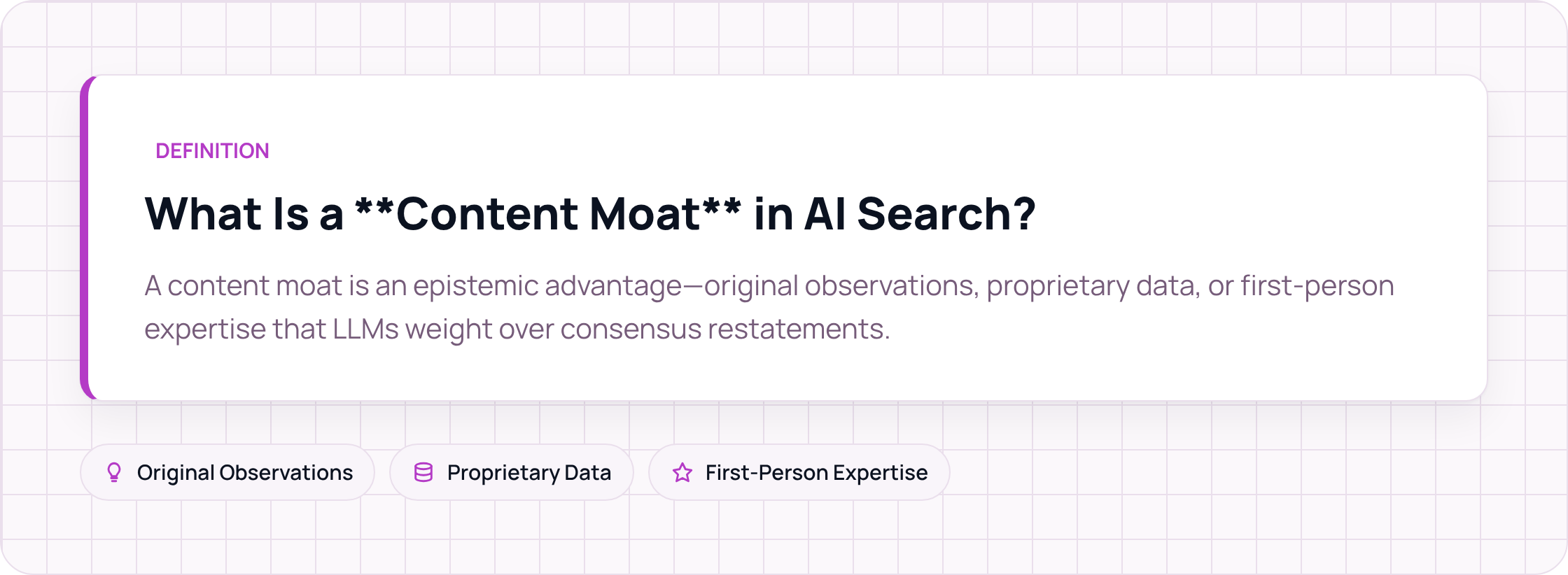
A content moat, in the context of AI search, is the structural gap between what your content knows and what any competitor can produce by rephrasing the same public sources. Large language models are trained to detect that gap. When a retrieval-augmented system pulls sources to answer a query, it weights pages that contain original observations, proprietary data, or first-person expertise over pages that restate consensus. The moat is not a publishing advantage. It is an epistemic one.
Proprietary Data vs. Rephrased Consensus
The structural difference matters at the retrieval layer, not just the ranking layer. An LLM assembling an answer to "what is the average SaaS churn rate by segment" will pull from sources that contain actual measured figures before it pulls from sources that quote other sources quoting other sources. If your article cites your own cohort data from 400 customers, that is a primary source. If it cites an industry average from a report that itself cited a survey, you are three hops from the signal the model wants.
"Start with one proprietary metric or benchmark published quarterly with a branded name that AI can reference, and build from there," Duane Forrester writes in his content moat analysis. The branded metric point is precise: named benchmarks (think "the Drift Conversation Benchmark" or "Intercom's Support Efficiency Index") become citable nouns that AI engines can reference without paraphrasing. Generic observations cannot.
How E-E-A-T Translates into LLM Preference
Google's E-E-A-T framework added the first "E" for Experience in December 2022, specifically to reward content produced by people with direct, first-hand involvement in a topic. That signal has a direct analog in how LLMs weight sources. A post written by a practitioner who ran the experiment, managed the account, or built the product carries structural markers that retrieval systems detect: specific numbers, named edge cases, dates, and outcomes that only someone present would know.
First-person expertise becomes a retrieval asset in a concrete way. A 1,200-word article from a VP of Customer Success describing exactly how their team reduced churn by 18 percentage points in Q2 2024, with the specific playbook they ran, will outperform a 3,000-word "ultimate guide" assembled from secondary research. The guide covers more ground. The practitioner piece contains more signal.
The trade-off is real. First-person expertise content is slow to produce and hard to scale. If your subject-matter experts are customer-facing, pulling them into a quarterly publishing cadence creates friction. Teams that ghost-write practitioner content without genuine input often produce something that reads authoritative but contains no actual proprietary observation. Retrieval systems are increasingly good at detecting that gap, and readers certainly are.
Why Recency Beats Domain Authority for RAG Retrieval
Retrieval-augmented generation systems do not operate like PageRank. A high-domain-authority site with a 2021 article on a fast-moving topic will frequently lose a citation to a lower-authority site with a well-structured 2025 update. The reason is mechanical: RAG pipelines weight recency as a proxy for accuracy on topics where the ground truth shifts. Pricing models, regulatory requirements, API specifications, and benchmark figures all fall into this category.
Assassinsonly's analysis of AI content moat construction makes this explicit: elite agencies now treat update cadence as a core content operation, not an afterthought. Refreshing a cornerstone article with new data every 90 days is not maintenance. It is a retrieval strategy.
A content calendar built around publishing new articles will underperform a calendar that balances new production with structured refreshes of existing high-signal pages. A page that has been cited by AI engines once, then updated with fresh figures, is more likely to be cited again than a new page starting from zero authority. The moat compounds through iteration, not just volume.
Identifying Your Unique Data and Proprietary Insights
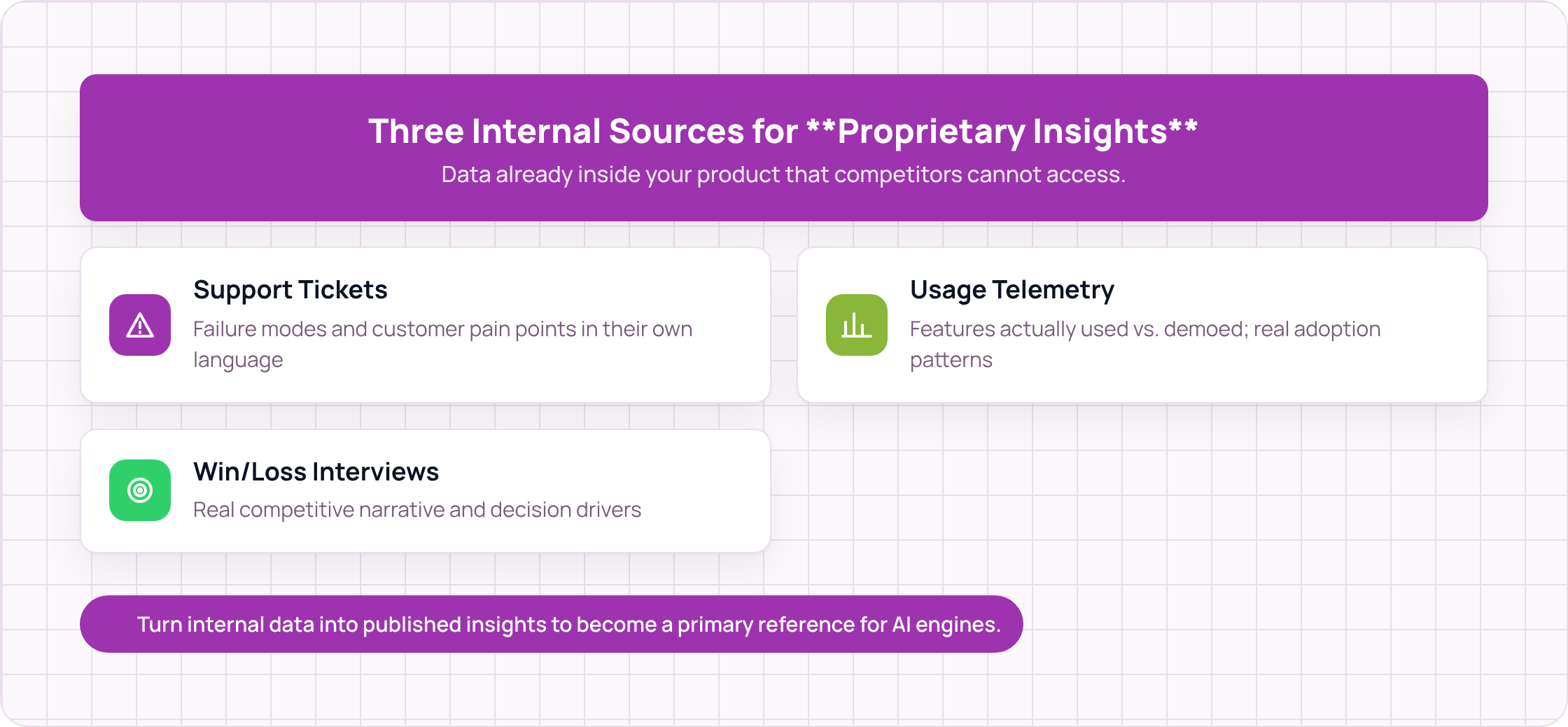
The content AI engines cite most often shares one trait: it contains information no one else could have published. For SaaS teams, that information already exists inside the product. Support tickets reveal where customers get stuck. Usage telemetry shows what features actually get used versus what gets demoed. Win/loss interviews capture the real competitive narrative. Turning those three sources into published insights is the fastest path to content that LLMs treat as a primary reference.
The Three Internal Sources Most Teams Leave Sitting
Support tickets are the most underused data source in B2B content. A single quarter of tickets, tagged by theme, can tell you the exact failure modes your customers hit, in their own language. That specificity is what separates a citable article from a generic "best practices" post. Original research built on proprietary data is described as the moat most B2B SaaS companies never build, precisely because it requires this kind of internal excavation.
Usage telemetry is the second overlooked source. If 68% of your users activate a feature but fewer than 20% use it past day 14, that retention gap is a data point worth publishing. It tells a story about product-market fit that no analyst firm can replicate.
Win/loss interviews are the third. Most teams run them for the sales deck and stop there. A structured analysis of 30 interviews, with themes quantified, becomes a publishable benchmark. Case studies and proprietary research rank among the most effective content types for generating B2B SaaS pipeline, per a SaaS marketing benchmarks analysis, and win/loss data is exactly the kind of proprietary input that makes those assets credible.
The Specificity Threshold
LLMs have a rough filter for what gets cited versus what gets skipped. Vague claims ("many customers struggle with onboarding") get ignored. Specific, falsifiable claims ("43% of support tickets in Q1 2024 referenced the same three-step setup sequence") get extracted and quoted.
The threshold is not about length. A 200-word post with one concrete, sourced finding will outperform a 2,000-word post full of hedged generalities. Every piece of internal data you publish should pass a simple test: could a competitor have written this sentence without access to your systems? If yes, it is not proprietary enough.
Turning Benchmarks into Citable Sources Without Violating NDAs
The trade-off here is real. Customer data is often sensitive, and publishing raw usage numbers or named win/loss outcomes can breach contracts or damage trust. This approach breaks down when teams skip the anonymization step and treat internal data as freely publishable.
The fix is aggregate framing. Instead of "Company X reduced churn by 18%," publish "across 40 mid-market accounts in the HR tech vertical, median churn reduction after implementing [specific workflow] was 18% over two quarters." The insight is preserved. No individual customer is exposed. The benchmark becomes a citable primary source because the methodology is yours, even if the underlying accounts are anonymized.
Frequently Asked Questions
How long does it take to build a content moat for a B2B SaaS company?
Most teams see measurable citation gains in AI-generated results after 9 to 12 months of consistent, proprietary-data-driven publishing. The timeline shortens if you already have a data asset you can publish immediately, such as a usage benchmark or a structured win/loss analysis. Starting with one named, quarterly-updated metric is faster than waiting until you have a full research program in place.
Do I need a large content team to build a content moat?
No. A two-person team publishing four high-specificity pieces per quarter will outperform a ten-person team publishing forty generic posts. The constraint is not headcount. It is access to proprietary data and subject-matter experts willing to put their name on specific claims. One practitioner-authored post with real numbers does more retrieval work than a dozen keyword-optimized overviews.
Can early-stage SaaS companies build a content moat without much customer data?
Yes, but the approach shifts. If your customer base is too small to produce statistically meaningful benchmarks, co-author research with a partner, an analyst firm, or a complementary vendor whose audience overlaps yours. You can also publish structured observations from your own product-building process: what you tested, what failed, and what the numbers showed. That first-person specificity carries retrieval weight even without a large sample size.
What types of content does AI search cite most often?
RAG systems consistently favor content that contains named benchmarks, specific percentages tied to a defined methodology, first-person practitioner accounts with dates and outcomes, and primary research with a stated sample size. Content that restates industry consensus without adding a measurable original observation rarely gets cited, regardless of how well it ranks in traditional search.
How do I know if my content is being cited by AI engines?
Track your brand name and any named benchmarks you publish using tools like Brandwatch, Mention, or manual spot-checks in ChatGPT, Perplexity, and Google's AI Overviews. If a named metric you coined starts appearing in AI-generated answers without a direct link back, that is a citation signal. You can also monitor referral traffic from AI-adjacent sources and watch for branded search volume increases that correlate with AI answer appearances.
Should I update old content or keep publishing new articles?
Both, but the ratio matters more than most teams realize. A reasonable starting point is 60% new production and 40% structured refreshes of existing high-signal pages. Pages that have already earned a citation from an AI engine are your highest-leverage refresh targets. Adding a new benchmark figure or a dated case study outcome to an existing page costs far less than building a new page from zero, and the retrieval probability is higher because the page already has some citation history.
If you want a clearer picture of how your current content stacks up against AI retrieval criteria, see how Seorav can help. The AEO audit identifies exactly which pages have the structural signals to earn citations and which ones are being skipped, so you know where to focus first.
Keep reading
How to Track Which AI Models Are Citing Your Website
Learn how to set up ai search citation analytics across ChatGPT, Perplexity, Claude, and Gemini. Includes tool comparisons, prompt setup, and competitor ga
Enterprise CMS Platforms: What They Are and How to Choose
Compare enterprise CMS platforms by architecture, cost, compliance, and AI features. Learn what separates enterprise-grade tools from standard CMS options.
How to Pick a Geo Optimization Tool That Actually Works for Multi-Region SEO
Compare the top geo optimization tools for multi-location SEO. See which platforms track rankings at city level, fix citation gaps, and scale across 100+ l