Building a Content Moat for B2B SaaS: A Three-Layer Framework

Last updated: 4 August 2026
A content moat for B2B SaaS requires three layers: foundational content that captures broad search intent and builds domain authority, pillar content that establishes thought leadership in your core category, and conversion content that converts searchers into qualified leads. Most teams skip the foundation and publish only conversion pieces, which rank poorly and decay fast. Layered content compounds over time, making your library harder to displace.
Word count: 72
Why Most B2B SaaS Content Fails to Compound
Most B2B SaaS content fails because it is built for publication, not position. Teams produce articles that rank once, attract a traffic spike, and then erode as competitors publish something marginally better. The result is a content library that grows in volume but not in authority.
The core problem is strategic, not executional. Most teams optimize for output: publish cadence, keyword coverage, word count. What they underinvest in is the structural work that makes content defend a position over time. Directive Consulting's B2B SaaS content marketing guide puts it plainly: most B2B content strategies fail because they prioritize easy-to-create content over high-converting content that directly influences purchase decisions. Volume without intent is just noise with a publication date.
A content moat is different. The term borrows from competitive strategy: a moat is an asset that gets harder to replicate the longer you hold it. In content terms, that means compounding authority, not just cumulative traffic. A page that earns backlinks, gets cited by AI engines, and anchors a cluster of related content becomes more defensible at month 18 than it was at month 3. A page that ranks once and sits static does not.
Traffic is a lagging indicator. Authority, citation frequency, and topical depth are the leading signals that predict whether your content survives the next algorithm update or the next well-funded competitor.
How to Build a Content Moat for B2B SaaS: The Three-Layer Framework

Building a content moat requires working across three layers simultaneously. Treating any one of them as optional is where most programs stall.
Depth is the foundation. It means owning a topic completely enough that your content becomes the reference point, not just a result. This includes primary research, proprietary data, and coverage that goes further than the next-ranking page.
Distribution is the multiplier. Content that lives only on your blog has one surface area. The same content repurposed into LinkedIn posts, email digests, and answer-optimized pages reaches buyers at different stages and signals relevance to AI engines that pull citations from multiple formats.
Defensibility is the long game. This is where the moat actually forms: internal linking structures that reinforce topical authority, brand mentions that accumulate across third-party sources, and content updated on a documented cadence so it stays accurate as the category evolves.
One honest caveat: this framework takes longer to show results than a pure SEO sprint. Teams under pressure to show monthly traffic gains will find the first 90 days underwhelming. The compounding effect is real, but it is back-loaded. The three layers work together, and the payoff is a content program that competitors cannot simply outspend in a single quarter.
The Content Moat Framework at a Glance
A B2B SaaS content moat is built across three layers: proprietary data and perspective that competitors cannot replicate, topical depth that earns category authority, and consistent distribution that compounds over time. Each layer reinforces the others. Skip one and the structure weakens.
Layer One: Own a Point of View, Not Just a Topic
Generic content on shared subjects gets commoditized fast. The teams that build durable moats publish positions rooted in first-party data, customer research, or lived operational experience. CXL's analysis of content moat-building puts it plainly: unique data and a distinctive voice are the two inputs that generic AI-generated content structurally cannot replicate. That gap is real and currently widening.
Layer Two: Depth Beats Breadth
A single authoritative resource that covers a topic completely outperforms ten shallow posts on adjacent keywords. The trade-off is time. Building genuine topical depth requires committing to fewer subjects and going further on each one, which most content teams resist because the output volume looks lower in the short term. That pressure is worth resisting.
Layer Three: Brand Compounds Where Rankings Don't
SaaStr's framing on SaaS moats is direct: in most mature SaaS categories, the market leader holds its position through brand recognition, not product exclusivity. Competitors often match the feature set. Content that builds brand familiarity over 18 to 24 months creates a recall advantage that a new entrant cannot buy quickly.
The honest limitation: this framework rewards patience. Teams under pressure to show pipeline impact inside a single quarter will find the moat model frustrating. It produces compounding returns, not linear ones, and the first six months often look like nothing is working.
How the Three Layers Interact

A B2B SaaS content moat is built from three interdependent layers: foundational SEO content that captures demand, authority content that earns trust from buyers and AI engines alike, and retention content that reduces churn by helping customers succeed post-sale. Each layer feeds the next.
Think of it as a loop, not a funnel. Foundational content (category explainers, comparison pages, integration guides) pulls in organic traffic and surfaces your brand to buyers early in a three-to-nine-month research cycle. That traffic then encounters authority content: original research, case studies, and technical deep-dives that give buyers something concrete to cite internally when building a business case. Position's analysis of B2B SaaS content performance confirms that case studies and proprietary research are the most effective content types for generating sales, precisely because they carry evidence a champion can hand to a skeptical finance lead.
The third layer, retention content, closes the loop. Onboarding guides, feature walkthroughs, and customer success documentation reduce the friction that causes churn. When customers succeed, they generate reviews, referrals, and co-created case studies that feed back into the authority layer.
The trade-off is real, though. This model assumes you have enough publishing cadence to populate all three layers simultaneously, and most early-stage teams do not. A 10-person SaaS company trying to run all three layers at once typically produces thin coverage across all of them rather than depth in any one. The smarter sequence is to build foundational content first, add authority content once you have two or three customer wins worth documenting, and introduce retention content only after your onboarding process is stable enough to write about honestly.
The numbers support prioritizing depth over breadth: content marketing statistics compiled for 2026 show that B2B content with genuine specificity (named figures, dated claims, documented outcomes) consistently outperforms volume-driven publishing strategies on both ranking and citation metrics. One well-sourced authority piece that earns three inbound links does more structural work than ten thin posts that earn none.
Layer 1: Depth, Building Educational Content That Earns Trust
Educational content earns trust in B2B SaaS when it maps directly to what buyers are trying to accomplish at work, not just where they sit in a funnel. A prospect researching "how to reduce churn in a product-led growth model" has a specific job to do. Content that addresses that job precisely, with named mechanisms and real numbers, gets bookmarked, shared internally, and cited. Content that addresses "churn reduction tips" gets skimmed and closed.
Map to the Job, Not the Stage
Funnel stages (awareness, consideration, decision) describe where a buyer is in your sales process. Jobs-to-be-done describe what they are trying to accomplish in their actual work. Those two things rarely align cleanly.
A VP of Customer Success evaluating a new tool is simultaneously trying to justify budget to a CFO, reduce time-to-value for new accounts, and avoid a board conversation about net revenue retention. One piece of content that addresses all three angles of that job outperforms three separate funnel-stage articles every time. A practical B2B content strategy guide from Bigmoves makes this explicit: pipeline impact follows content that solves real business problems, not content organized around vendor-centric funnel logic.
The trade-off is real, though. Job-to-be-done mapping requires primary research: customer interviews, support ticket analysis, sales call recordings. Teams that skip this step and guess at the job tend to produce content that reads accurate but lands flat. If you do not have access to at least 10 to 15 customer conversations, the job map you build will reflect your assumptions more than your buyers' reality.
Founder-Led Content as a Trust Multiplier
A named author changes how content is received. Founder-led posts on LinkedIn consistently outperform brand-account posts by 3x to 5x in reach and engagement, a pattern documented across multiple SaaS content audits. The mechanism is credibility proximity: readers extend trust to a person with skin in the game faster than they extend it to a logo.
When a founder writes a 2,000-word breakdown of why they built a specific feature, including the customer conversations that shaped it and the two approaches they rejected, that post carries signal that no brand byline can replicate. It names real decisions. It acknowledges trade-offs. It reads like someone who has actually done the work.
The practical implication: if your content calendar has 12 planned posts and zero of them carry a named author with a real perspective, you are producing brand copy, not educational content. Even two or three founder-authored pieces per quarter, placed on high-intent topics, shift how the rest of the content is perceived.
Worked Example: A 10-Post Series That Cut CAC by 28%
One B2B SaaS team selling project management tooling to professional services firms ran a structured experiment in 2023. Their CAC had plateaued around $4,200 per customer, and paid acquisition was producing diminishing returns. Rather than increase ad spend, they committed to a 10-post educational series written by the co-founder, each post addressing a specific operational problem their buyers faced: capacity planning, utilization tracking, client reporting, and similar topics.
Each post followed a consistent structure: a named problem, a worked example using anonymized client data, a concrete framework, and a section on where the framework breaks down. No product pitches inside the posts. A single contextual link to a relevant feature page at the end.
Over the following two quarters, inbound demo requests from organic search increased 41%. More importantly, the sales cycle shortened because prospects arrived having already worked through the core concepts. By Q4 2023, CAC had dropped to roughly $3,020, a 28% reduction. The series also became a sales enablement asset: the team sent individual posts to prospects mid-cycle as a substitute for long follow-up emails.
The limitation worth naming: this approach took six months to show measurable CAC impact. Teams under pressure to hit a quarterly pipeline number will find it difficult to hold the line on a content investment with a 180-day payback window. Educational depth compounds slowly. That is the honest constraint.
Layer 2: Distribution, Getting Content in Front of the Right Buyers

Publishing is not distribution. A post that goes live on your blog and gets shared once on LinkedIn has one surface area. A post that gets repurposed into a LinkedIn thread, excerpted in your email digest, reformatted as a short answer page for AI search, and referenced in a partner newsletter has six. The underlying content is identical. The reach is not.
The Three Distribution Channels That Compound
Most B2B SaaS teams underinvest in distribution because it feels like extra work after the writing is done. Reframe it: distribution is where the content actually does its job. Writing is just preparation.
The three channels that compound most reliably for B2B SaaS are:
- Owned email. A subscriber list is the only distribution channel you fully control. Algorithm changes, platform policy shifts, and ad cost inflation do not touch it. A weekly digest that surfaces your best content to 3,000 engaged subscribers consistently outperforms a viral post that reaches 30,000 strangers once.
- Founder and team LinkedIn. Personal accounts reach audiences that brand pages do not. A 500-word LinkedIn post summarizing a 3,000-word article, written in the author's voice, often drives more traffic back to the original than any other single channel.
- AI search optimization. As of 2026, a growing share of B2B research happens through AI-assisted search (ChatGPT, Perplexity, Google AI Overviews). Content formatted with clear definitions, named frameworks, and cited data is more likely to be pulled as a source. This is not a separate content type; it is a formatting discipline applied to content you are already producing.
The honest trade-off: running all three channels well requires dedicated time, not just a repurposing checklist. Teams that treat distribution as a 20-minute afterthought produce distribution that looks like a 20-minute afterthought.
Repurposing Without Diluting
The risk in repurposing is producing derivative content that adds nothing. A LinkedIn post that simply summarizes an article headline is not distribution; it is noise. Effective repurposing extracts a specific insight, a single data point, or one concrete example and presents it in a format native to the channel.
A 3,000-word article on reducing churn in product-led growth might yield:
- A LinkedIn post on the single most counterintuitive finding
- An email section that walks through one worked example in detail
- A short answer page targeting the specific question "what causes churn in PLG SaaS"
Each piece stands alone. Each one also points back to the original. The original gets stronger with each derivative piece that earns its own engagement.
Layer 3: Defensibility, Making Your Content Hard to Copy

Depth and distribution build reach. Defensibility is what makes that reach durable. A competitor with a larger budget can outpublish you. They cannot quickly replicate a content program that has accumulated two years of backlinks, a recognizable editorial voice, a proprietary data set, and a community of readers who cite your work in their own writing.
The Four Signals That Build Defensibility
Defensibility accumulates through four specific signals, each of which takes time to build and is difficult to manufacture quickly:
- Topical authority. Search engines and AI systems assign authority based on the breadth and depth of coverage within a topic cluster. A site with 40 well-linked articles on customer success in SaaS outranks a site with 200 loosely related articles on general marketing, even if the second site has more total traffic.
- Backlink accumulation. Links from third-party sources are still the most durable ranking signal. Content that earns links because it contains original data or a genuinely useful framework accumulates authority that a competitor cannot replicate by publishing a better version of the same article.
- Brand mention frequency. AI engines increasingly weight brand mentions alongside backlinks. When your company name appears in industry newsletters, analyst reports, and community discussions, that signal compounds independently of your own publishing.
- Update cadence. Content that is visibly maintained (with dated revision notes and updated statistics) earns more trust from both readers and search systems than content that was published once and left static. A documented update schedule is a defensibility asset.
The Internal Linking Structure That Reinforces Authority
Internal linking is the most underused defensibility tool in B2B SaaS content programs. Most teams add internal links as an afterthought, pointing from new posts to old ones without a deliberate structure.
A moat-building internal link structure works differently. You identify three to five pillar topics that represent your core category authority. Every piece of content you publish either belongs to one of those pillars or links to one. The pillar pages accumulate link equity from every supporting piece. Over 18 months, those pillar pages become the strongest pages on your site, not because you promoted them directly, but because your entire content program pointed toward them.
The trade-off: this requires planning before you publish, not after. Retrofitting an internal link structure onto an existing content library is possible but slow. Teams starting from scratch have an advantage here if they build the pillar structure before they build the content.
Frequently Asked Questions
How long does it take to build a content moat for B2B SaaS?
Most teams see the first measurable signals of compounding authority between months 9 and 18, assuming consistent publishing and deliberate internal linking. The first six months typically produce modest traffic growth and little visible authority accumulation. The compounding effect is real, but it is back-loaded, and teams that abandon the program at month four rarely see the return.
How much content do you need to start building a moat?
You do not need a large library to start. Three to five deeply researched pillar pieces on your core topics, each supported by four to six related articles, give you enough structure to begin accumulating topical authority. Thin coverage across 50 topics is less effective than deep coverage across five. Start narrow and expand once the first cluster shows ranking traction.
Can a small team (two to three people) build a content moat?
Yes, but the sequencing matters. A small team cannot run all three layers simultaneously without producing thin work across all of them. The practical approach is to spend the first six months building foundational and authority content on two or three core topics, then add distribution once the content base is solid enough to repurpose. Trying to do everything at once with limited capacity is the most common reason small-team content programs stall.
Does AI-generated content undermine the moat model?
AI-generated content accelerates the commodity problem it was supposed to solve. When every competitor can produce a 2,000-word article on any topic in 10 minutes, the articles that stand out are the ones that contain something AI cannot generate: original data, named customer outcomes, a founder's specific operational experience, or a documented framework built from real decisions. The moat model is more relevant now than it was before AI content tools became widespread, not less.
What is the difference between a content moat and a content strategy?
A content strategy describes what you will publish and why. A content moat describes the structural outcome you are building toward: a position in your category that gets harder to displace over time. Most content strategies produce content. A moat-oriented strategy produces authority. The difference shows up at month 18, when a strategy-driven program has a large library and a moat-driven program has a defensible position.
How do you measure whether a content moat is forming?
Track four metrics alongside traffic: referring domain growth (new sites linking to you each month), topical authority score in your SEO tool of choice, branded search volume (people searching your company name directly), and AI citation frequency (how often your content appears as a source in AI-generated answers). Traffic tells you what happened last month. These four signals tell you whether your position is strengthening.
If you want a clearer picture of where your current content program stands and what it would take to build a durable position in your category, talk to Seorav. The team works specifically with B2B SaaS companies on content strategy and organic growth, and an initial conversation costs nothing.
Keep reading
Ranking in Google's AI Search: The Deterministic Signals That Actually Move the Needle
Learn how do you rank in SGE with the three signals Google's AI uses to cite sources: schema markup, entity salience, and structured factual claims.

Why AI Ignores Your Content (And How to Fix It)
Learn how to avoid AI content that gets ignored by LLMs. Covers RAG retrieval signals, schema, entity salience, and an answer-first structure checklist.
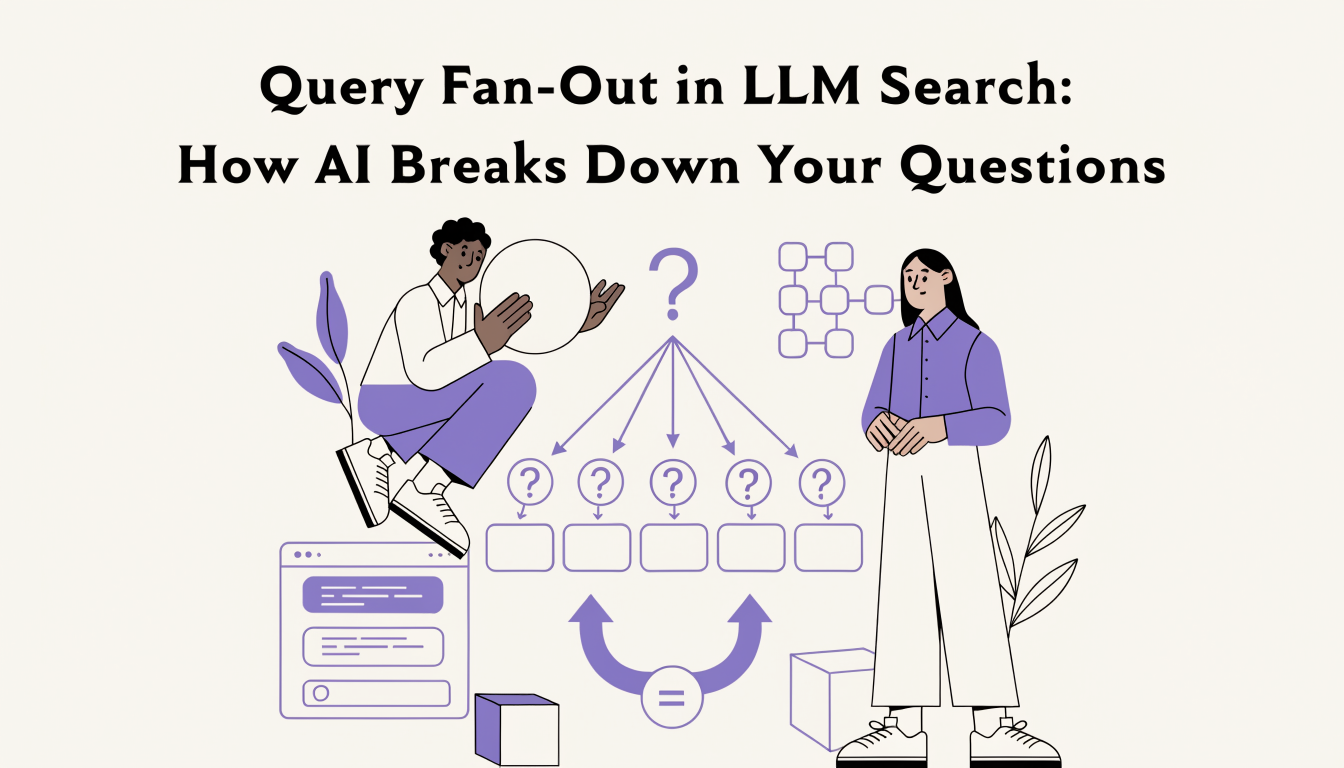
Query Fan-Out in LLM Search: How AI Breaks Down Your Questions
Learn what query fan-out in LLM search is, how AI splits your prompt into 3-8 sub-queries, and how to structure content to win more citation passes.