Brand Voice in AI Search: How Consistency Gets You Cited
Last updated: 19 August 2026
Brand voice is the consistent set of language patterns, tone, and messaging choices that make your content recognizable to both readers and AI systems. When you maintain the same vocabulary, sentence structure, and perspective across all content, search engines pattern-match more reliably on your material, increasing citation likelihood. Research shows companies with consistent brand presentation see revenue uplifts up to 33 percent. Coherence is not optional; it directly shapes whether AI systems quote you or skip past entirely.
Word count: 82
This article covers what brand voice is, what makes it legible to AI retrieval systems, how inconsistency breaks citation patterns, and what a practical consistency framework looks like in production.
What Is Brand Voice, and Why Does It Matter for AI Search
Brand voice, for AI-first content, is a set of documented, repeatable writing behaviors: specific sentence structures, preferred vocabulary, and measurable style rules that produce consistent output across every page you publish. AI engines extract and cite passages that read coherently on their own. A voice document that produces that kind of consistency is a citation asset. One that only describes personality in adjectives is not.
Most brand voice documents stop at adjectives. "Confident. Approachable. Clear." Those descriptors tell a writer how to feel about the content, not how to construct a sentence.
What actually produces consistent output is a layer below tone: style rules. Sentence length caps (under 20 words for key claims). Preferred verb forms (active, present tense). A short list of banned phrases. A ratio of concrete examples to abstract statements. Storyflow's 2026 guide on building brand voice frames this as the difference between "word choices, rhythm, and attitude" and a vague personality sketch. The former is trainable and auditable. The latter is not.
A practical voice document has two columns: what you do, and what you avoid. "Use specific numbers instead of qualifiers" is a rule. "Be data-driven" is an aspiration. Rules produce replicable output. Aspirations produce inconsistency.
How AI Engines Read Voice Signals in Your Content
AI engines do not read your brand voice document. They read the content that document produces.
What they pick up on is structural consistency: whether your articles open with a direct answer, whether your claims are followed by evidence, whether your paragraph rhythm is predictable enough that a passage extracted mid-article still reads as complete. Xlift's analysis of brand profiles for AI output notes that generic AI drafts fail not because they lack personality but because they lack structural fingerprints, the repeating patterns that make a sentence identifiable as yours.
The practical implication: voice consistency is not just a brand exercise. It is a structural signal. An engine deciding whether to cite your definition of "churn rate" will favor the source whose surrounding content is coherent and predictable over one that shifts register between paragraphs.
One real trade-off is worth naming here. Highly distinctive voice, the kind with heavy idiomatic phrasing or unusual syntax, can reduce extractability. A passage that reads well in context may not survive being pulled out and quoted verbatim. The goal is consistency that holds up out of context, not personality for its own sake.
Why Passive Voice Hurts Both Clarity and AI Extractability
Passive constructions bury the agent. "Mistakes were made" tells you nothing about who made them or why it matters. AI engines parsing a passage for a citable claim need a clear subject, a clear action, and a clear object. Passive voice breaks that structure.
This is a mechanical issue, not a stylistic one. When a language model extracts a sentence to include in a response, it needs that sentence to carry its own meaning. "The report was published" requires context. "Forrester published the report in Q1 2025" does not.
Loudscale's 2026 breakdown of brand differentiation in the AI era points to passive constructions as one of the primary signals that content was written to fill space rather than to inform. Readers and engines respond the same way: they move on.
A simple audit: search your draft for "was," "were," "is being," and "has been" followed by a past participle. Each hit is a candidate for rewriting. Not every passive construction is wrong, but most of them are, and the ones that survive the audit should survive because they are genuinely the clearest option, not because rewriting felt like extra work.
Why AI Engines Reward Consistent Voice Signals

AI engines select sources to cite based partly on pattern recognition. A page that uses the same vocabulary, sentence structure, and conceptual framing across multiple published pieces signals that a real editorial perspective exists behind it. That consistency functions as a credibility proxy. When Perplexity or ChatGPT encounters a phrase it has seen attributed to your domain before, it has more reason to treat your content as a reliable, extractable source rather than a one-off page that happened to rank.
How Perplexity and ChatGPT Select Sources to Cite
Neither Perplexity nor ChatGPT publishes a full citation algorithm, but the observable pattern is clear enough: both engines favor sources that answer a specific question directly, use authoritative framing, and appear consistently across the web in related contexts. A single well-optimized page rarely wins a citation on its own. What wins is a body of content where the voice, terminology, and argument structure reinforce each other across dozens of pages.
This maps to what Ecisolutions describes as the "invisible thread" connecting every customer interaction: a consistent brand voice does not just help humans recognize you, it helps AI engines build a stable model of what your domain actually covers and how authoritatively it covers it.
Consistency only helps if the voice is also substantively distinct. If your content sounds like every other vendor in the category because you have optimized for a generic "professional" tone, the signal collapses. AI engines cannot reward a voice they cannot differentiate.
Branded Search as a Proxy for AI Visibility
Branded search volume is one of the cleaner indirect signals for AI citation likelihood. When users search for your company name alongside a topic ("[Brand] + pricing model" or "[Brand] + churn reduction"), it tells AI engines that your domain is associated with that topic in a way that real humans have already validated. Companies that maintain a uniform brand voice across touchpoints see revenue increases between 23% and 33%, per a Lucidpress study, and that same consistency drives the branded search behavior that AI engines use as a trust signal.
The mechanism: branded searches generate click patterns, dwell time, and return visits that feed into the authority signals AI engines pull from the broader web. A fragmented voice, where your blog sounds nothing like your product pages or your LinkedIn posts, dilutes those signals because the content does not cohere into a recognizable entity.
Prompt-Shaped Phrases vs. Head Terms: What Gets Extracted
Head terms ("brand voice," "AI search") are how people used to optimize for Google. AI engines work differently. They extract passages that answer the specific, conversational phrasing of a prompt: "how do I keep my brand voice consistent when using AI to write content?" That is a fundamentally different shape than a keyword.
Your content needs phrases that mirror how a buyer actually asks a question, not just the topic they are asking about. If your brand voice consistently uses the same explanatory framing ("the mechanism here is...", "the practical implication is..."), those phrases start appearing in AI-generated answers because the engine has learned that your domain produces extractable, answer-shaped content.
This breaks down when a brand tries to optimize prompt-shaped phrases without genuine depth behind them. An AI engine that pulls a passage and finds the surrounding content thin or contradictory will deprioritize that domain over time. The voice signal only works when it is backed by substance.
Balancing Conversational Tone With Extractability

A brand voice that reads naturally and one that AI engines can extract are not competing goals, but they require different structural decisions. The key is sequencing: lead with a direct, self-contained answer, then build context around it. Conversational phrasing keeps human readers engaged; sentence-level clarity is what lets an AI engine pull your paragraph verbatim into a cited response.
Step 1: Write the Direct Answer First, Then Expand
Before adding context, examples, or nuance, write one sentence (two at most) that answers the core question your article addresses. This is the passage an AI engine will extract. Everything after it can carry your brand's rhythm, personality, and depth.
The practical test: cover the first paragraph and ask whether the rest of the article still makes sense without it. If it does, the opening is self-contained enough to be cited. If the rest of the article depends on the opener for context, the opener is doing structural work rather than answering work.
NNGroup's research on tone and user perception found that sentence-level clarity measurably increases perceived trustworthiness, independent of whether the tone is formal or casual. Conversational phrasing does not hurt extractability. Buried answers do.
Step 2: Train AI Writing Tools to Match Your Voice
Voice documentation needs to be specific enough that an AI writing tool can reproduce it without guessing. That means named rules, not adjectives. "Write short declarative sentences under 18 words" is a rule. "Be concise" is a preference that every tool will interpret differently.
The format that holds up in practice includes four components:
- A persona statement (one paragraph describing who is speaking and to whom)
- Explicit sentence-level rules (length caps, verb form preferences, banned phrases)
- 5 to 10 positive examples pulled from your best-performing content
- 5 to 10 negative examples showing what the voice is not
Feed this document into your AI writing tool as a system prompt or style reference. Then audit the output against your existing content before publishing. The audit step is where most teams skip, and it is where voice drift actually starts.
Step 3: Audit for Consistency Before Publishing
A voice audit does not require a specialist. It requires a checklist and a sample of your existing content.
Pull five published pieces that represent your brand at its best. Read a new draft alongside them. Ask three questions: Does the sentence rhythm match? Does the vocabulary overlap? Does the level of specificity (numbers, named sources, concrete examples) stay consistent?
If the answer to any of those is no, the draft needs revision before it goes live. A single off-voice page does not break your citation signal, but a pattern of them does. Dash's branding statistics put brand recognition lift from consistent presentation at up to 80%. That recognition effect applies to AI engines parsing your content, not just human readers scanning your site.
Key Takeaways
- Consistency is the citation trigger. AI engines pattern-match across your content before they quote it. A brand voice that shifts between pages looks like multiple authors, not one authoritative source.
- Voice alignment starts with your mission, not your style guide. Tone that reflects actual company values holds together under pressure. Tone built around aesthetic preferences drifts the moment a new writer joins the team.
- The production trade-off is real. Tighter voice consistency can slow content output, especially for teams without documented guidelines. If your brand voice lives in one person's head rather than a shared document, scaling it creates real risk. Plan around that failure mode before you optimize for AI citation.
- Passive voice is a mechanical problem, not a stylistic one. Rewrite it wherever the active form is clearer, which is most of the time.
Frequently Asked Questions
What is brand voice, exactly?
Brand voice is the documented set of writing behaviors your organization uses consistently across all published content. It includes sentence structure preferences, vocabulary choices, and specific rules about what to include and what to avoid. Unlike tone, which can shift by context, brand voice stays stable whether you are writing a product page, a blog post, or a social caption.
How is brand voice different from tone of voice?
Brand voice is fixed; tone is flexible. Your brand voice is the underlying set of rules and patterns that make your content recognizable as yours. Tone is how you apply those rules in a given context: more formal in a legal FAQ, more conversational in a how-to guide. Both should be documented, but they are not the same thing.
Does brand voice actually affect AI search citations?
Yes, and the mechanism is pattern recognition. AI engines like Perplexity and ChatGPT build implicit models of which domains produce reliable, answer-shaped content. A consistent brand voice, one that uses the same vocabulary, framing, and sentence structure across dozens of pages, gives those engines a stable signal to match against. Inconsistent voice fragments that signal and reduces citation likelihood.
How do you document brand voice so a team can actually use it?
Start with rules, not adjectives. Instead of "be clear and confident," write "lead every section with a direct answer in under 20 words" and "avoid passive constructions unless no active alternative exists." Add 5 to 10 positive examples from your best content and 5 to 10 negative examples showing what to avoid. A two-column format (do this / not that) is the most practical structure for writers and AI tools alike.
Can AI tools maintain brand voice, or do they always drift?
AI tools can maintain brand voice reliably if you give them specific rules rather than vague descriptors. The drift happens when teams use adjectives ("professional," "friendly") instead of structural rules ("sentences under 18 words," "no passive constructions," "cite a specific number in every third paragraph"). The more concrete your voice document, the less an AI tool has to guess, and the less it drifts.
How often should you audit your brand voice for consistency?
A quarterly audit is a reasonable baseline for most teams. Pull five recent pieces, compare them against your voice document, and flag any patterns that have drifted. If you are publishing at high volume or using multiple writers and AI tools simultaneously, a monthly audit catches drift before it compounds. The goal is not perfection on every piece; it is catching systematic drift early.
If you want your content to show up in AI-generated answers, voice consistency is one of the few structural levers you actually control. Visit Seorav to see how a documented brand voice strategy can improve your AI search visibility and citation rate.
Keep reading
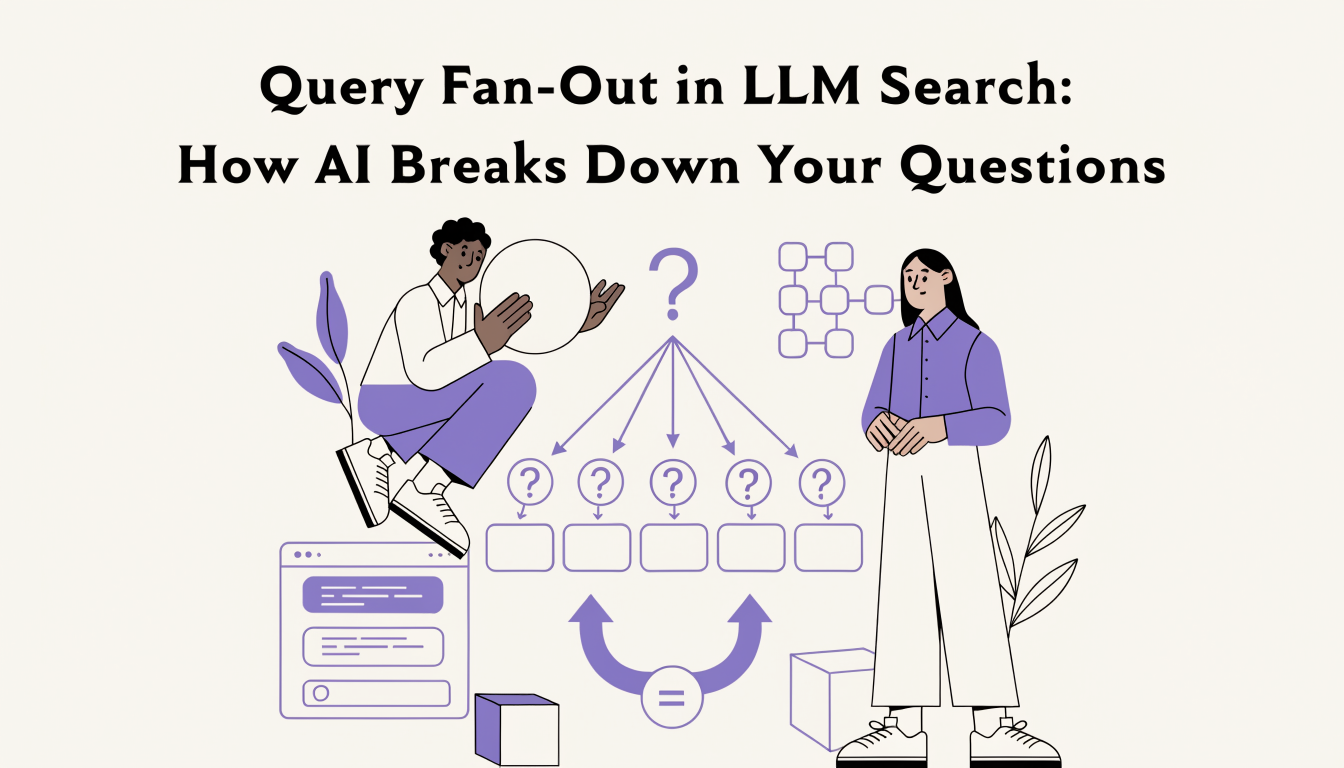
Query Fan-Out in LLM Search: How AI Breaks Down Your Questions
Learn what query fan-out in LLM search is, how AI splits your prompt into 3-8 sub-queries, and how to structure content to win more citation passes.
Reference Rate vs Click-Through Rate: What AI Search Actually Measures
Learn how reference rate vs click-through rate in AI search differ, why CTR can fall while citations rise, and which content formats earn the most AI citat
Writing Answer Paragraphs That AI Systems Will Quote
Learn how to write self-contained answer paragraphs for AI with a four-part structure that improves extraction probability and gets your content quoted by