Backlink Freshness and LLM Citation Frequency: What Actually Matters
Last updated: 22 September 2026
Backlink freshness does matter for LLM citation frequency, but its impact is modest compared to topical authority and content structure. Research across 54 studies shows cited content runs 25.7% fresher than non-cited material on average, yet brand mentions outperform backlinks as a citation signal by 3x. The real question is whether you should prioritize freshness updates over the factors that actually move the needle.
LLMs are not crawling a live link graph the way a search engine does. They weight whether a piece of content clearly owns a topic, whether its paragraphs are structured to answer a specific question, and whether the information density is high enough to quote directly. A recently updated page with thin coverage will lose a citation to an older, well-structured page that answers the question precisely.
One caveat worth naming: this pattern holds across ChatGPT and Perplexity more consistently than across Google AI Overviews, which tracks more closely with traditional organic ranking signals.
To evaluate what actually drives citations, this article applies five criteria to each factor:
| Criterion | What it measures |
|---|---|
| Signal strength | How strongly the factor correlates with citation frequency across engines |
| Engine consistency | Whether the effect holds across ChatGPT, Perplexity, Claude, and Gemini |
| Publisher control | How directly a team can act on the factor without third-party dependency |
| Time to impact | How quickly a change produces a measurable citation shift |
| Evidence quality | Whether the supporting data comes from controlled studies or anecdotal observation |
Where a factor scores well on signal strength but poorly on publisher control (backlink volume is the obvious case), that trade-off gets named directly.
How These Factors Stack Up: A Citation-Driver Matrix
Five signals drive LLM citation frequency more reliably than backlink count: topical authority, link quality, content structure, entity clarity, and recency. Each predicts a different part of the retrieval decision, and a high score in one does not compensate for a low score in another.
| Factor | What a high score predicts | What a low score costs you |
|---|---|---|
| Topical authority | Consistent citation across a subject cluster, not just one page | Sporadic mentions even when your page ranks on Google |
| Link quality | Inclusion in training-adjacent corpora and high-trust crawl pools | Visibility gaps in older model versions |
| Content structure | Direct extraction of your passage as a quoted answer | Paraphrasing that strips your attribution |
| Entity clarity | Brand-level recognition across multiple AI platforms | Page-level citations that don't build brand recall |
| Recency signal | Preference in time-sensitive queries and weekly AI search polls | Displacement by newer pages on fast-moving topics |
Topical authority and entity clarity are the two columns that compound. A page with strong entity clarity gets cited by name. Brand search demand and entity recognition are stronger predictors of citation frequency than backlink volume across AI platforms. Topical authority stacks on top of that, because LLMs weight sources that answer consistently across a subject, not just once.
Content structure is the most actionable column in the short term. A well-structured answer block can move a page from paraphrase territory into direct extraction within a single content revision. Cyrus Shepard's AI citation ranking factors study found domain authority barely registers as a driver, while structural clarity and answer-first formatting show up repeatedly in cited pages.
The recency column is where the real trade-off lives. A high recency score helps on queries with a time dimension ("best practices in 2026," "latest research on X"), but it actively works against you on evergreen topics where LLMs prefer stable, repeatedly-cited sources over freshly published ones. A page updated every few weeks to chase recency signals can lose the consistency markers that build long-term entity recognition. The fix is surgical: update data and dates, but preserve the structural skeleton and entity references that earned you citations in the first place.
Link quality sits in the middle of the matrix for a reason. Co-citations and unlinked mentions now do heavier lifting than raw backlink counts in determining which pages LLMs surface. A high link quality score still matters for crawl inclusion and training data exposure, but it does not override weak entity clarity or poor content structure at the retrieval stage. Teams that over-invest in link acquisition while ignoring the other four columns are optimizing for a signal that influences the top of the funnel but rarely closes the citation.
Does Backlink Freshness Matter for LLM Citation Frequency? What the Mechanics Say
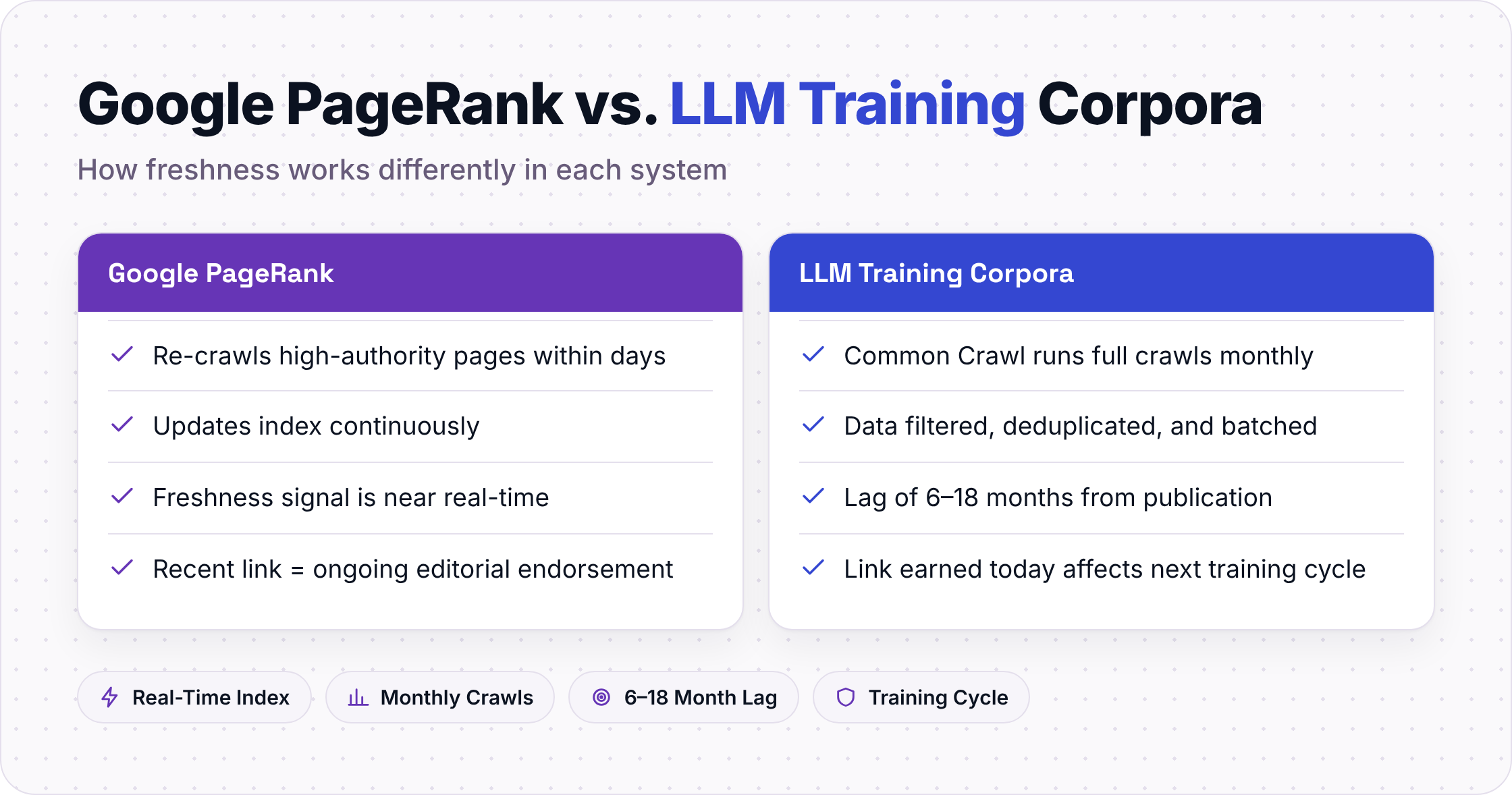
Backlink freshness means two different things depending on which system you're optimizing for. For Google PageRank, a fresh link is one acquired recently, signaling ongoing editorial endorsement. For an LLM's training corpus, freshness refers to when a page was crawled, processed, and ingested into training data, a pipeline that can lag real-world publication by six to eighteen months. A link earned today may not influence an LLM's citation behavior until its next major training cycle.
Google PageRank vs. LLM Training Corpora
Google re-crawls high-authority pages within days and updates its index continuously. The freshness signal is near real-time. LLM training corpora work on a fundamentally different schedule. Common Crawl, which supplies training data to many large language models, runs full crawls roughly monthly, but those snapshots are then filtered, deduplicated, and batched before they reach a model's training run. The gap between a backlink going live and that link's authority signal appearing in an LLM's learned associations is not a matter of weeks. It's closer to a full training cycle, which for most frontier models runs annually or less frequently.
This maps to a pattern Transference's 2026 backlink and AI citation analysis documents directly: AI systems increasingly cite different pages than the ones ranking on Google, partly because the authority signals each system reads are captured at different points in time.
The Crawl-to-Corpus Pipeline
The practical sequence looks like this. A referring domain publishes a link to your page. A search engine crawler picks it up, typically within days for high-authority sites. A Common Crawl bot may or may not capture it in the same monthly window. That crawl snapshot then sits in a queue before it's cleaned and included in a training dataset. The dataset gets used in a fine-tuning or pre-training run. The resulting model is deployed.
Each handoff introduces latency. A link earned in January 2025 might not influence citation behavior in a deployed model until late 2025 at the earliest, and only if the page itself was structurally clear enough to be associated with the right topics during training. Novastacks AI's research on what drives AI citations puts referring domains as the strongest single predictor of ChatGPT citations, with sites holding 32,000 or more referring domains being 3.5 times more likely to be cited. That correlation reflects accumulated authority, not freshness.
The trade-off is real. Chasing new backlinks to improve LLM citation frequency is a slow play with a long feedback loop. You won't see the effect for months, and you can't easily measure it. This approach breaks down entirely for time-sensitive topics, where LLMs with retrieval-augmented generation (RAG) capabilities pull from live sources rather than training data, making the corpus pipeline largely irrelevant.
Decision Tree: New Links or Stronger Existing Ones?
The choice depends on your current authority baseline and your timeline.
| Situation | Better move |
|---|---|
| Fewer than 500 referring domains | Earn new links; baseline authority is the bottleneck |
| 500+ referring domains, low citation rate | Strengthen existing pages: improve structure, update content, add schema |
| Targeting RAG-enabled engines (Perplexity, Bing) | Freshness of the page itself matters more than new links |
| Targeting training-corpus citation (ChatGPT base model) | Domain authority accumulation is the longer-term lever |
| Competing for a specific query cluster | Topical depth on existing pages outperforms new links in the short term |
For most mid-sized publishers, the higher-leverage move is improving the pages that already attract links rather than acquiring new ones. A page with solid referring domains but poor answer-first structure is leaving citation potential on the table right now. LLM-friendly content formatting guidance from Onely makes this explicit: answer-first formatting and structured data are freshness-adjacent signals that influence AI retrieval independent of when a link was built.
New links still matter for building the domain-level authority floor. But if you're optimizing specifically for LLM citation frequency on a six-to-twelve month horizon, structural improvements to existing high-authority pages will move the needle faster than a link acquisition sprint.
How LLMs Evaluate Source Authority and Recency
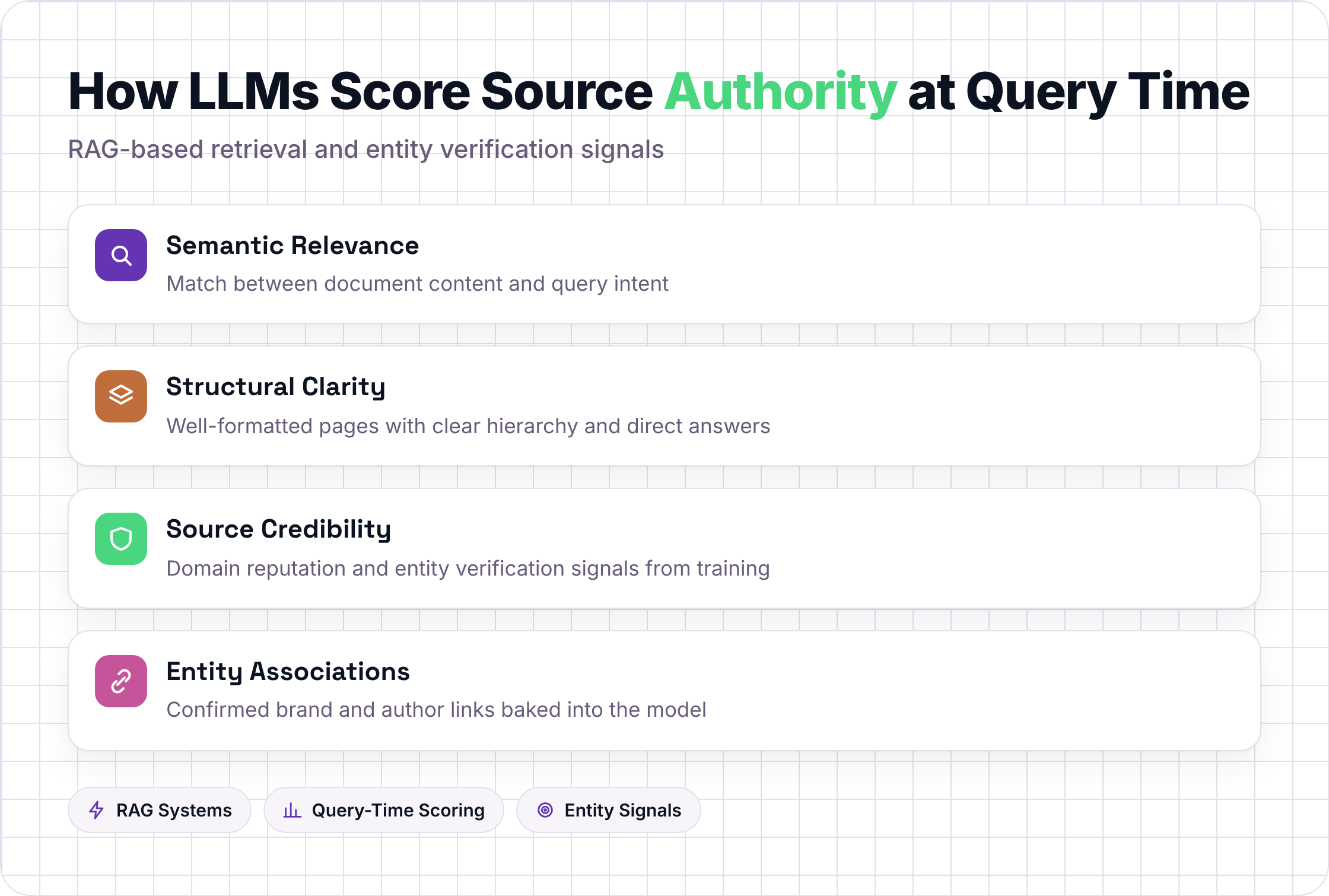
LLMs assign source authority at query time by combining retrieval scores with entity verification signals baked into training. A page earns citation weight through domain credibility, structured markup, and confirmed entity associations, not through backlink count alone. Recency matters, but it is one input among several. A well-structured page with strong entity signals from 2021 will routinely outperform a fresh page that lacks those anchors.
Retrieval-Augmented Generation and Query-Time Scoring
In RAG-based systems, the model does not rely solely on what it learned during training. At query time, it retrieves candidate documents, scores them against the prompt, and selects passages that best satisfy the query's intent. That scoring process weighs semantic relevance, structural clarity, and source credibility simultaneously. A page buried on page four of Google results can still surface as an LLM citation if its content is tightly scoped and its source signals are strong.
A Search Atlas comparative analysis of citation behavior across three major LLMs found that models consistently favored sources with clear topical focus over sources with broader coverage, even when the broader sources had higher domain authority scores. Specificity is a retrieval signal, and it's one you can act on without waiting for a training cycle.
Entity Authority: Wikipedia, Wikidata, and Knowledge Graph Verification
Entity signals are where the age-versus-freshness debate gets concrete. LLMs are trained on corpora that include Wikipedia, Wikidata, and Google's Knowledge Graph. Pages that are referenced by, or structurally consistent with, those entity graphs carry a form of pre-baked credibility that a new page simply cannot replicate overnight.
A brand or topic that appears in Wikidata with verified attributes (founding date, industry classification, notable associations) gets treated differently than an anonymous domain with a high backlink count. The entity graph gives the model a stable reference point. Fresh links don't provide that. Structured data markup on your own pages, particularly schema.org Organization and Article types, helps bridge the gap by giving crawlers and training pipelines the same structured signals that entity graphs provide natively.
Freshness Signals LLMs Actually Read
Not all freshness signals carry equal weight. The ones that consistently show up in cited pages are:
- A visible publication date and a clearly marked "last updated" date in the page's structured data
- Dated statistics and named sources (a figure attributed to "a 2026 study by X" reads as current; an undated figure reads as stale)
- Schema markup that includes
datePublishedanddateModifiedfields - Topical references that align with recent events or updated standards in the field
What doesn't move the needle: changing a page's URL to include the current year, adding a boilerplate "updated for 2026" header without changing the underlying content, or publishing thin updates that don't add new information. LLMs are pattern-matching on content signals, not metadata tricks.
Practical Optimization Priorities
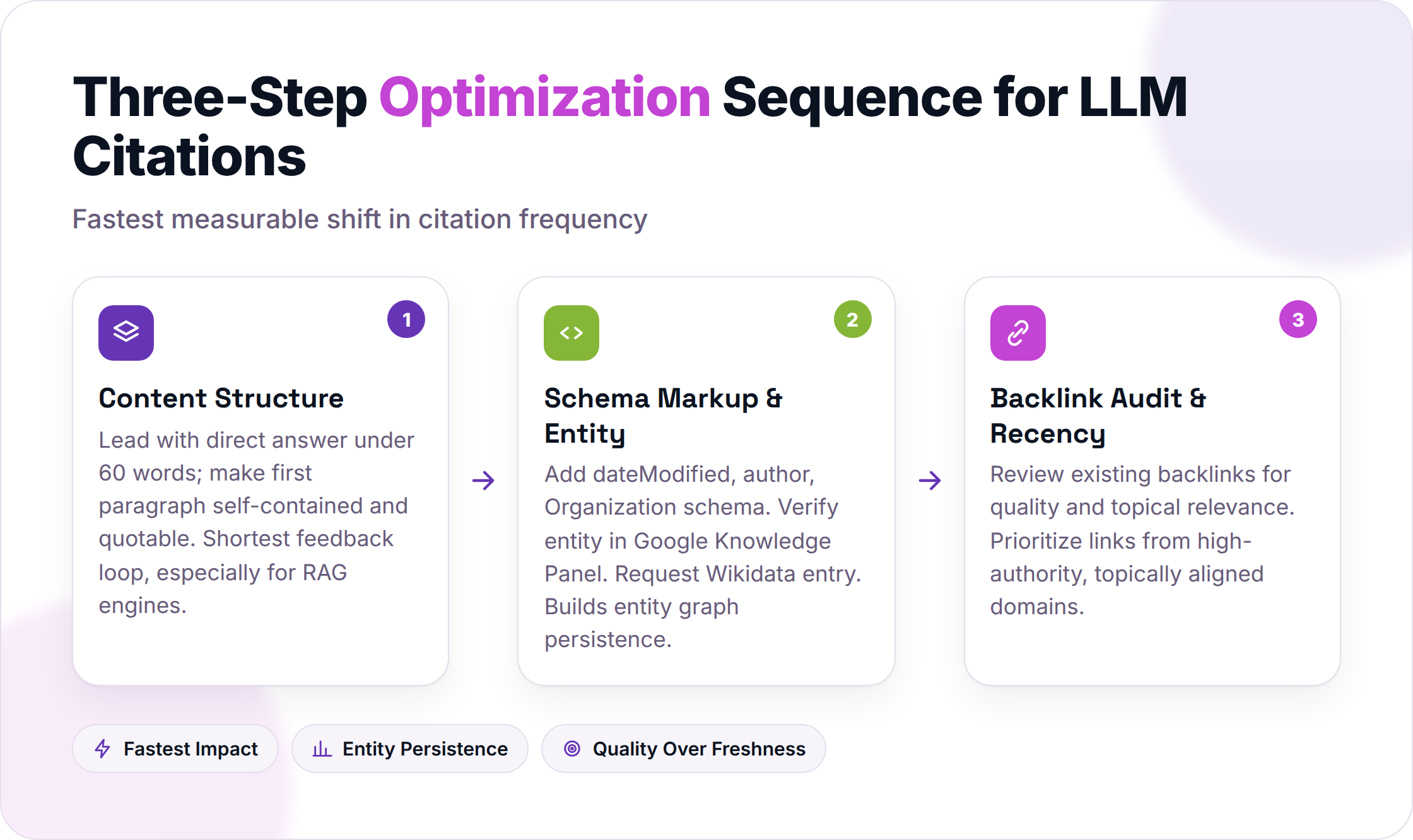
If you're allocating time across a quarter, the sequence that produces the fastest measurable shift in LLM citation frequency looks like this.
Start with content structure. Rewrite your highest-traffic pages to lead with a direct answer to the primary query. Keep the first paragraph under 60 words and make it self-contained enough to quote. This is the single change with the shortest feedback loop, particularly for RAG-enabled engines like Perplexity, which can surface a restructured page within days of recrawling.
Second, audit your schema markup. Add or correct dateModified, author, and Organization schema on every page you want cited. Verify your entity in Google's Knowledge Panel and, if your brand qualifies, request a Wikidata entry or update an existing one. These steps build the entity graph associations that persist across training cycles.
Third, review your existing backlink profile for quality rather than quantity. A referring domain from a topically adjacent, high-trust source does more for your training corpus inclusion than ten links from unrelated directories. Co-citation patterns matter: being mentioned alongside authoritative sources in the same document is a stronger signal than a standalone link.
New link acquisition comes fourth, not first. Build it steadily, but don't expect it to produce citation results on a quarterly timeline. The corpus pipeline is too slow for that.
Frequently Asked Questions
Does backlink freshness matter for LLM citation frequency?
Yes, but it's a secondary signal. Cited content runs about 25.7% fresher than non-cited content on average, but brand mentions and topical authority outperform freshness as predictors. Freshness helps most on time-sensitive queries and in RAG-enabled engines like Perplexity, where live retrieval reduces the training corpus lag.
How long does it take for a new backlink to influence LLM citations?
For training-corpus-based models like the base version of ChatGPT, the lag runs six to eighteen months. The link needs to be crawled by Common Crawl, included in a training dataset, and incorporated into a model update before it affects citation behavior. For RAG-enabled engines, the timeline is shorter because those systems retrieve live content at query time.
Are unlinked brand mentions as valuable as backlinks for AI citation?
Research suggests they may be more valuable in some contexts. Co-citations and unlinked mentions appear to do heavier lifting than raw backlink counts for LLM citation purposes. A mention alongside authoritative sources in a high-trust document can carry more weight than a direct link from a low-relevance domain.
What content changes produce the fastest improvement in LLM citation rate?
Answer-first formatting produces the fastest measurable shift, particularly for RAG-enabled engines. Restructuring your opening paragraph to directly answer the primary query, adding dateModified schema, and tightening topical focus to a specific subject cluster are all changes that can affect citation behavior within weeks rather than months.
Does domain authority still matter for AI citations?
It matters as a floor, not a ceiling. Sites with fewer than 500 referring domains face a baseline credibility gap that structural improvements alone won't close. Above that threshold, domain authority has diminishing returns for citation frequency, and topical depth, entity clarity, and content structure become the differentiating factors.
How does Google AI Overviews differ from ChatGPT in how it weights freshness?
Google AI Overviews tracks more closely with traditional organic ranking signals, so freshness and backlink authority carry more weight there than in ChatGPT or Claude. If your primary target is AI Overviews, standard SEO freshness practices (regular content updates, strong crawl signals) apply more directly. For ChatGPT's base model, entity clarity and training corpus inclusion matter more than recency.
If you want a clearer picture of where your site stands across these citation signals, visit Seorav's GEO analysis tool to see how your pages score on the factors that actually drive LLM citation frequency. The audit covers entity clarity, content structure, and authority signals in one place.
Keep reading
Which LLM Citation Tracking Platform Actually Works for Your Brand
Compare the top llm citation tracking platforms by engine coverage, alert speed, and pricing. Find the right tool for your team size and budget.
Siteimprove for SEO: What It Does (and What It Doesn't)
A clear-eyed look at Siteimprove SEO features, pricing, and gaps versus AI-native platforms. Find out if it fits your team's workflow in 2026.
How AI Overviews Are Reshaping Organic Traffic (And What SEOs Must Do)
AI Overviews now trigger on 30%+ of Google queries. See how zero-click search AI impact on organic traffic is measured, and what SEOs can do about it.