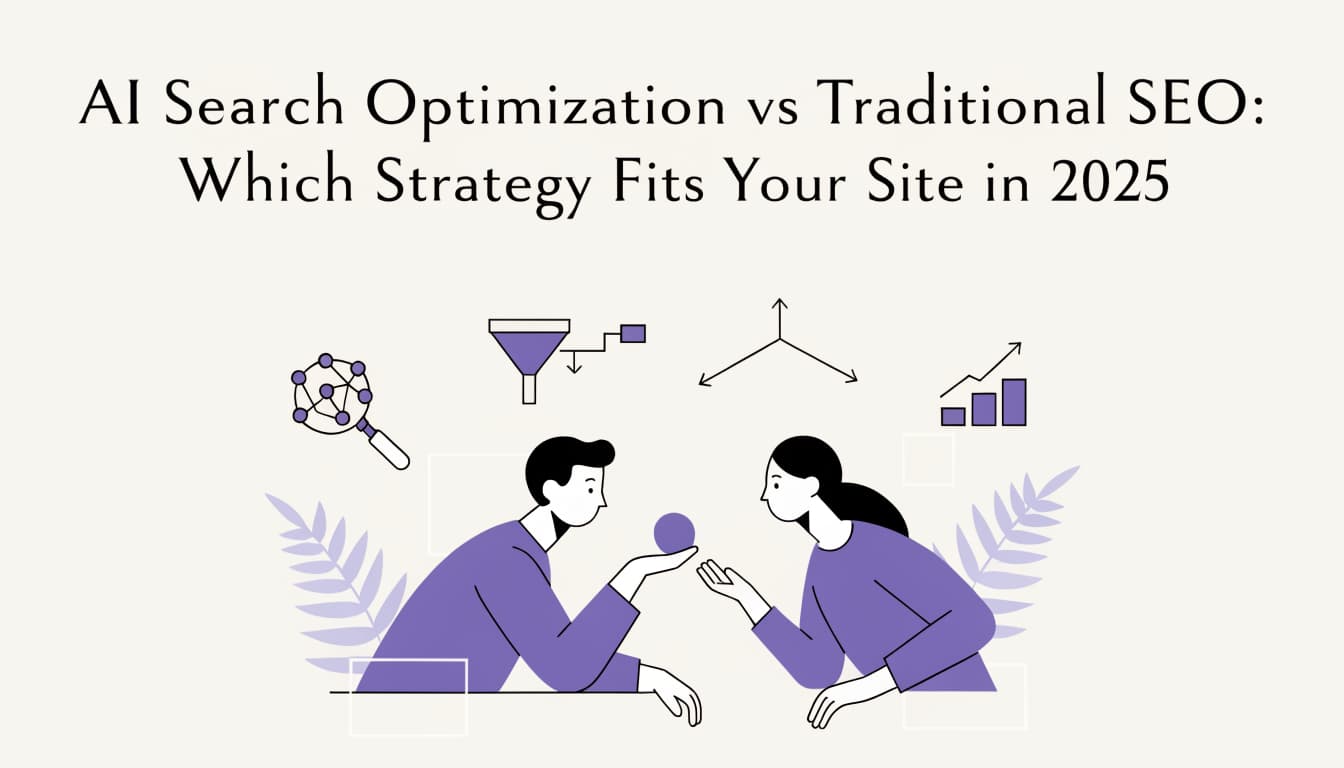
AI Search Optimization vs Traditional SEO: Which Strategy Fits Your Site in 2025
Last updated: 8 August 2026
Traditional SEO still dominates transactional searches where users click through to websites, but AI search optimization has become essential for informational queries that now trigger zero-click answer boxes. Most publishers need both strategies running in parallel: traditional SEO for product pages and service queries, AI optimization for content that answers questions directly. The real challenge is preventing either approach from weakening while you scale both simultaneously across your site.
Word count: 72
If your revenue traces back to product pages, local searches, or branded queries, traditional SEO still delivers. Click-through intent is real on those queries, and roughly 76% of AI Overview citations already come from pages ranking in the top 10 organic results, meaning your rankings still matter for AI visibility too.
If your content is informational, the calculus has shifted. Gartner's forecast puts traditional search volume down 25% by 2026 as users migrate to AI-generated answers. That traffic does not come back once an answer box absorbs the query.
One honest caveat: splitting budget across two strategies is harder to measure and easier to do badly. A split only works if you assign each approach to the query types it actually wins, not spread resources thin across both without a clear ownership model.
AI Search Engine Optimization vs Traditional SEO: At a Glance
Both approaches share the same foundation: crawlability, authority, and structured content. Where they diverge is the end goal. Traditional SEO targets ranking algorithms. AI search optimization targets synthesis engines that quote, summarize, and cite sources rather than list them.
The table below compresses the practical differences into one place.
| Dimension | Traditional SEO | AI Search Optimization |
|---|---|---|
| Primary goal | Rank on SERPs | Get cited in AI-generated responses |
| Best for | High-volume, transactional queries | Research, comparison, and advisory queries |
| Deployment effort | Keyword mapping, on-page edits, link building | Answer-first structure, schema, citation-worthy claims |
| Key feature | Page-level ranking signals | Topic-level authority and synthesis readiness |
| Typical time to results | 3-6 months for organic lift | 4-8 weeks for first AI citations (varies by engine) |
| Winner in 2026 | Still dominant for e-commerce and local | Growing fast for B2B, SaaS, and research-heavy verticals |
One real trade-off: AI search optimization is harder to measure. Search Console tracks impressions and clicks from Google. No equivalent dashboard exists yet for ChatGPT or Perplexity citation frequency, so teams often rely on manual prompt-testing or third-party monitoring to know whether their content is being pulled into responses.
The growth numbers are worth keeping in mind. Digitalsuccess benchmarks AI SEO agencies at delivering 2-3x faster organic growth than traditional counterparts, though that figure reflects agencies optimizing for both channels simultaneously, not a clean A/B split.
The two approaches also serve different query types. Traditional SEO still wins on high-intent, transactional searches where a user wants a product page or a local result. AI search optimization earns its keep on advisory and comparison queries, the kind where a user asks ChatGPT "which CRM fits a 20-person sales team" and expects a synthesized answer, not ten blue links.
What Traditional SEO Still Does Well

Traditional SEO remains the most reliable channel for queries where users want to navigate, compare, or buy. Google's ranking algorithm still weights backlinks, Core Web Vitals, and E-E-A-T signals heavily, and those signals are deterministic: you can measure them, fix them, and watch rankings respond. For product pages, local searches, and branded navigational queries, a well-maintained traditional SEO foundation consistently outperforms AI-generated answer surfaces.
The Signals Google Still Weights
Backlinks remain the clearest proxy Google has for off-site trust. Core Web Vitals, particularly Interaction to Next Paint (INP), became a ranking signal in March 2024, and sites that fail it on mobile lose measurable ground in competitive verticals. E-E-A-T, Google's framework for evaluating Experience, Expertise, Authoritativeness, and Trustworthiness, has grown more consequential since the 2023 Helpful Content updates, especially for health, finance, and legal content.
Damteq's comparison of traditional and AI SEO makes a practical point here: traditional SEO gives you clear attribution through GA4 and Search Console. You can trace a ranking drop to a specific page, a lost backlink cluster, or a Core Web Vitals regression. That auditability matters when you need to justify budget or diagnose a traffic problem fast.
Where Traditional SEO Holds Its Ground
Three query types still favor traditional organic results over AI-generated answers.
Product pages. A user searching "Sony WH-1000XM5 price" or "best running shoes under $100" wants a page they can click, compare, and buy from. AI engines summarize; they don't replace the transaction.
Local search. Google's local pack and Maps results run on a separate signal set: Google Business Profile completeness, proximity, and review velocity. AI search has not meaningfully disrupted this. A restaurant or plumber optimized for local intent still earns the majority of its clicks from traditional results.
Navigational queries. When someone types a brand name or a specific URL fragment, they want the site, not a summary. Traditional SEO owns this category almost entirely.
The Flat Traffic Problem: Ranking Issue or AI Cannibalization?
A traffic plateau is the diagnostic question most teams get wrong. If your rankings held steady in Search Console but sessions dropped 15-25% over the same period, that pattern points toward AI search cannibalization, not a ranking failure. Google is answering the query before the click happens.
Traditional SEO metrics can mask this. Rank tracking shows position 1; GA4 shows declining clicks. The gap between those two numbers is where AI search is eating your traffic. If your rankings slipped and traffic dropped together, that is a conventional SEO problem: lost backlinks, a Core Web Vitals regression, or a content quality issue Google's algorithm caught.
Only 19% of people trust AI search results compared to 45% for traditional search engines, per Ridgemarketing's research on how search behavior is splitting. That trust gap means traditional organic results still convert at a higher rate for many query types, even when AI surfaces an answer first. Don't abandon traditional SEO because traffic dipped. Diagnose which part of the funnel changed before you shift strategy.
How AI Search Optimization Actually Works

AI search optimization is the practice of structuring content so that answer engines, not just crawlers, can extract, trust, and cite it. Perplexity, ChatGPT Search, and Google AI Overviews all pull from live web sources, but they select citations differently from a traditional ranking algorithm. They prioritize passages that are self-contained, factually grounded, and formatted so a language model can lift a clean answer without rewriting it.
How Answer Engines Select and Cite Sources
The selection logic is less about domain authority and more about passage-level clarity. An AI engine reading your page is looking for a sentence or short paragraph that directly answers a query, contains a verifiable claim, and sits in a context that signals expertise through surrounding headings, schema markup, and author credentials. A page ranking fourth on Google can still get cited in a Perplexity response if its prose is cleaner and more direct than the top result.
McKinsey's analysis of AI search behavior makes this structural point explicit: a brand's own website accounts for only 5 to 10 percent of the sources AI search engines reference. The rest comes from third-party coverage, forums, review sites, and editorial mentions. That ratio matters for how you allocate content effort.
On-Page Signals That Actually Move the Needle
Three things consistently improve citation rates in AI answer engines.
Structured data. FAQ schema and HowTo schema give engines a pre-parsed version of your content. If your answer is already in a schema block, the engine doesn't have to infer it from prose.
Direct-answer formatting. Open each section with a 40-to-80-word paragraph that answers the implied question without setup. No "in this section, we will explore..." preamble. The answer comes first, context follows.
Citation-friendly prose. Short declarative sentences. Named figures. Dates. Specific percentages. Vague phrasing ("many experts believe") gives an AI engine nothing to anchor a citation to. A sentence like "conversion rates from AI search visitors ran 4.4 times higher than from traditional organic in a 2024 benchmark" is citable. "AI traffic converts well" is not, and that specific figure is documented in Page One Power's landscape review.
The trade-off is real. Optimizing heavily for direct-answer formatting can compress the depth and narrative flow that keeps human readers engaged long enough to convert. A page structured entirely as Q-and-A blocks may get cited by Perplexity and still produce a high bounce rate for visitors who arrived expecting a fuller explanation. The format serves AI extraction; it doesn't automatically serve the reader. Answer-first openings with substantive supporting paragraphs is the actual craft challenge here.
What Changed Since 2023
Two years ago, AI Overviews were a Google experiment affecting a narrow slice of informational queries. By 2026, the scope has widened considerably. Traditional search volume is projected to drop 25% as zero-click and AI-mediated answers absorb more of the query surface, a shift SEO trend analysis from Circles Studio traces across multiple query categories.
The query types most affected are definitional ("what is X"), comparative ("X vs Y"), and procedural ("how to do X"). Navigational queries, where someone types a brand name to reach a specific site, remain largely outside AI engine influence. Transactional queries are a middle case: AI engines increasingly surface product comparisons and reviews, but the final purchase click still routes through a traditional result or a direct link.
What changed most since 2023 is the competitive frame. In 2023, ranking on page one of Google was the primary distribution channel for most content teams. In 2026, a page that never cracks the top five on Google can still generate meaningful referral traffic if it gets cited consistently in AI responses. That opens a real opportunity for newer sites with strong topical depth but limited domain authority. It also raises the floor: thin content that ranked on authority alone is now more exposed, because AI engines evaluate passage quality independently of the domain it sits on.
Frequently Asked Questions
Is AI search optimization replacing traditional SEO?
No, not in full. Traditional SEO still dominates transactional, local, and navigational queries where users want to click through to a specific page or complete a purchase. AI search optimization is taking share on informational and advisory queries, the kind where users expect a synthesized answer rather than a list of links. Most sites need both running at the same time.
How long does it take to see results from AI search optimization?
First citations in AI-generated responses can appear in as little as 4 to 8 weeks after you restructure content for direct-answer formatting and add relevant schema markup. That timeline varies by engine and query category. Perplexity tends to update its source pool faster than Google AI Overviews, which can lag by several weeks after a page is indexed.
Can a new site compete in AI search without strong domain authority?
Yes, more so than in traditional SEO. AI engines evaluate passage quality at the paragraph level, not just domain-level authority. A newer site with clear, specific, well-structured prose on a narrow topic can earn citations ahead of older, higher-authority domains that write vaguely. The limitation is that third-party mentions still matter: McKinsey's data shows brand websites account for only 5 to 10 percent of AI search citations, so earning coverage on external sites remains important.
What metrics should you track for AI search optimization?
Start with manual prompt-testing: run your target queries in ChatGPT Search, Perplexity, and Google AI Overviews weekly and record whether your domain appears as a citation. Third-party tools like Semrush's AI Toolkit and Profound are building citation-tracking features, though none yet match the completeness of Search Console for traditional SEO. Track referral traffic from AI engines in GA4 as a secondary signal, keeping in mind that some AI-driven visits arrive without a clear referral tag.
Should you write differently for AI search than for Google?
Partly. The fundamentals overlap: accurate information, clear structure, and genuine expertise help in both channels. The difference is in formatting priority. For Google, you optimize at the page level with title tags, meta descriptions, and internal linking. For AI search, you optimize at the passage level, making sure each section opens with a direct, citable answer before adding context. A page can serve both goals if you lead with the answer and follow with depth, rather than burying the answer in the third paragraph.
How do you know if traffic loss is from AI cannibalization or a ranking drop?
Compare your Search Console position data against your GA4 session data for the same period. If your average position held steady or improved while clicks and sessions declined, AI cannibalization is the likely cause: Google is answering the query before the user clicks. If both position and traffic dropped together, the problem is a conventional ranking issue, such as lost backlinks, a Core Web Vitals regression, or a content quality signal that Google's algorithm caught. The two patterns require different fixes.
Where to Go From Here

If you are trying to figure out where your site sits in the AI search engine optimization vs traditional SEO divide, the first step is auditing your query mix, not your rankings. Pull your top 50 traffic-driving queries from Search Console, classify them by intent (transactional, informational, navigational), and check which ones already trigger AI Overviews in Google. That audit tells you where your traffic is most exposed and where traditional SEO is still doing the work.
Visit Seorav to get a structured analysis of your current search visibility across both traditional and AI channels, and a clear plan for where to focus first.
Keep reading
Ranking in Google's AI Search: The Deterministic Signals That Actually Move the Needle
Learn how do you rank in SGE with the three signals Google's AI uses to cite sources: schema markup, entity salience, and structured factual claims.
Why AI Ignores Your Content (And How to Fix It)
Learn how to avoid AI content that gets ignored by LLMs. Covers RAG retrieval signals, schema, entity salience, and an answer-first structure checklist.
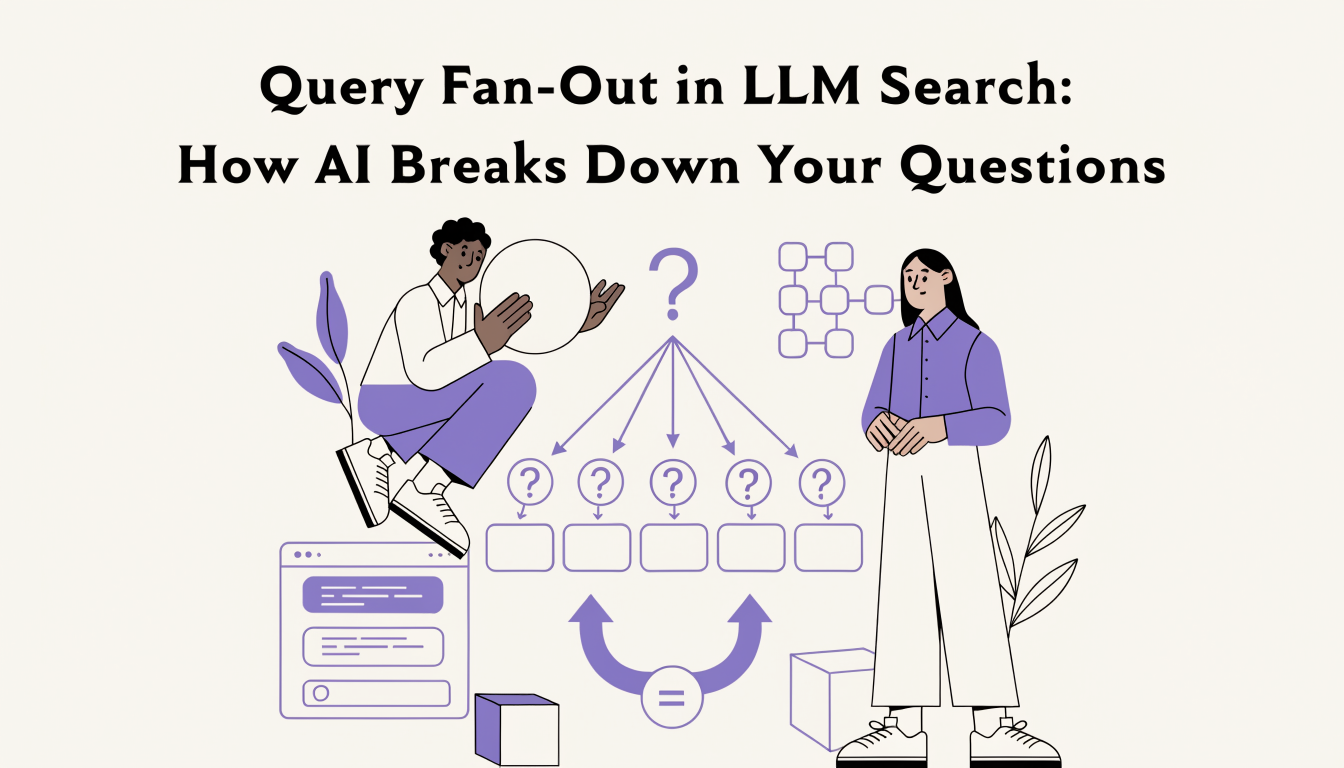
Query Fan-Out in LLM Search: How AI Breaks Down Your Questions
Learn what query fan-out in LLM search is, how AI splits your prompt into 3-8 sub-queries, and how to structure content to win more citation passes.