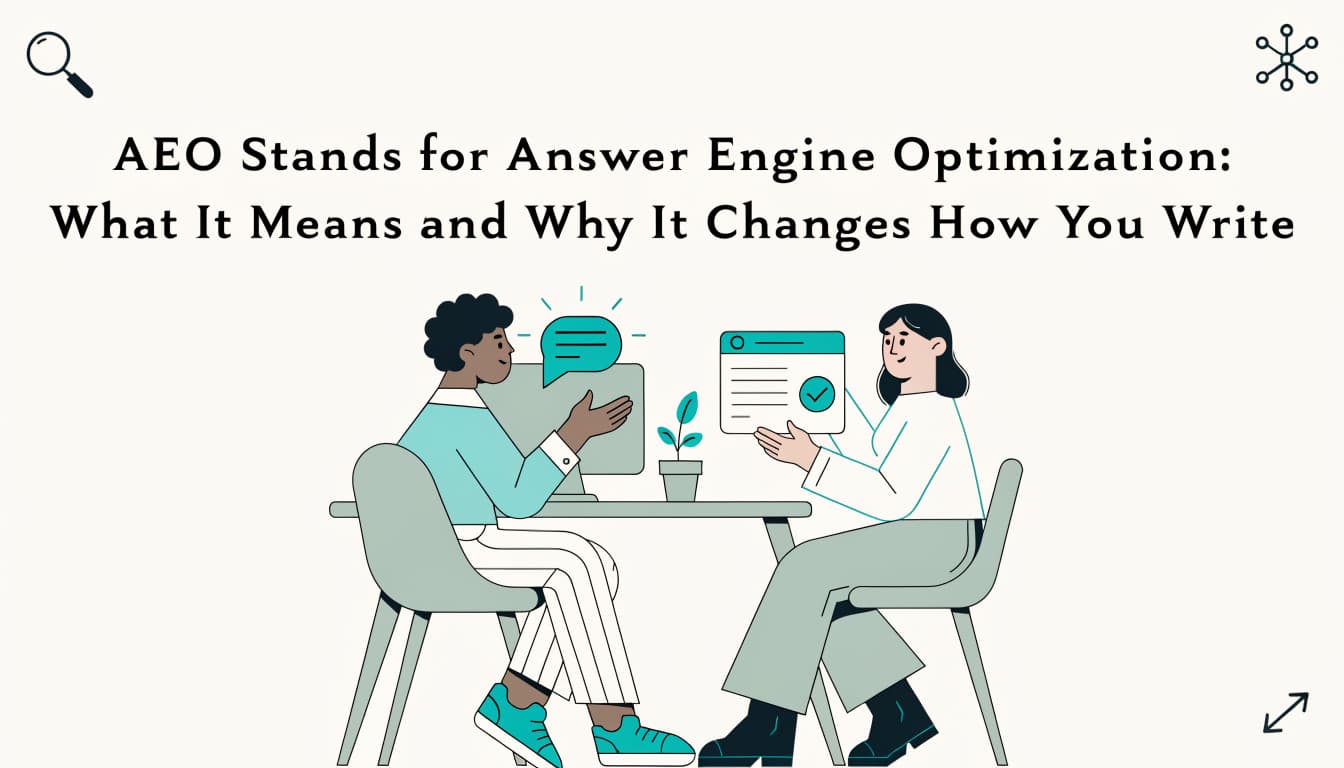
AEO Stands for Answer Engine Optimization: What It Means and Why It Changes How You Write
Last updated: 8 September 2026
AEO stands for Answer Engine Optimization, the practice of structuring content so AI systems like Perplexity and Google's AI Overviews can extract, summarize, and directly quote your work. Instead of competing for a spot on a search results page, AEO positions your content as the source the AI cites when answering user questions. When someone asks a question and receives a single quoted response without clicking through, that's AEO in action. The shift changes everything about how you write and organize information.
Where the Term "AEO" Comes From
The phrase has been circulating in digital marketing circles since roughly 2022, but it sharpened once AI-powered surfaces like Google's AI Overviews, Perplexity, and ChatGPT's Browse mode became real traffic sources. Content strategists, SEO practitioners, and product marketers all use the term now, though definitions still vary depending on who you ask.
Some teams use AEO and GEO (Generative Engine Optimization) interchangeably. Others draw a clear line between them. The practical overlap is real: Writer's breakdown of GEO and AEO frames AEO specifically around featured snippets, knowledge panels, and AI Overviews, while GEO extends to longer generative responses.
One honest caveat: AEO is not a fully standardized discipline yet. There is no governing body, no single measurement framework, and no universal scoring rubric. Teams are still working out what "optimized for an answer engine" actually looks like in practice.
Why AEO Is Already Affecting Your Traffic

The numbers make the shift concrete. Gartner projected that by 2026, traditional search engine volume will drop 25% as AI-powered interfaces absorb more queries. Yotpo's AEO strategy research notes that the goal of AEO is citation, not necessarily a click, reflecting a structural change in how content earns value.
Content that was never written to be extracted and quoted is already losing ground to content that was. If your pages open with "In this article, we will explore...", they are failing the extraction test before an AI engine reads the second sentence.
This is the environment SEORav was built for. Structured content, answer-first openings, and citation-ready claims are not stylistic preferences. They are functional requirements for appearing in an AI-generated response at all.
How AEO Differs From Traditional SEO

Traditional SEO and AEO share some surface-level tactics but operate on different mechanical logic. SEO earns a position in a ranked list by accumulating signals: backlinks, topical authority, page speed, Core Web Vitals. AEO earns a citation inside a generated answer by being the clearest, most directly extractable response to a specific question.
One optimizes for position. The other optimizes for quotability.
Ranking Signals vs. Citation Signals
Google's ranking algorithm weighs hundreds of signals, most of them relational: who links to you, how your domain authority compares to competitors, how long users stay on your page. Citation signals work differently. An AI engine scanning candidate passages asks a narrower question: does this text answer the query without requiring interpretation?
A 2,000-word pillar page with strong backlinks can rank on page one and still never get cited if the answer is buried in paragraph fourteen. Riseatseven's 2025 AEO research found that citation patterns favor concise, structured content over long-form authority pieces, even when the long-form page has more backlinks.
How Answer Engines Decide What to Quote
The selection mechanism is closer to a reading comprehension test than a popularity contest. Perplexity, ChatGPT, and similar engines parse candidate passages for three things:
- Directness: does the first sentence answer the question?
- Self-containment: can the passage be understood without surrounding context?
- Factual density: does it include specific figures, named entities, or verifiable claims?
A page that opens with "In this article, we will explore..." fails all three. A page that opens with a 50-word direct answer, followed by supporting detail, passes immediately. Bol Agency's breakdown of AEO for B2B content makes this explicit: AI systems prioritize content that delivers the answer in the first readable block, not content that builds toward it.
The Trade-Off You Need to Accept
Optimizing for citation often conflicts with optimizing for dwell time. A self-contained answer paragraph does its job so efficiently that some users never scroll further. That is the point for AEO, but it is a real cost for teams whose revenue model depends on page engagement, ad impressions, or on-site conversion flows.
The tension is sharpest for informational content. If a user asks "what is a DSCR loan" and your page gets cited verbatim in a Perplexity response, you may gain brand visibility while losing the click entirely. Teams running ad-supported content models or long-form editorial sites should weigh this carefully before restructuring every page around answer-first formatting. AEO and click-through optimization can coexist, but they pull in opposite directions on the same paragraph.
AEO vs. GEO: Understanding the Distinction

AEO focuses on structuring content so search and AI engines can extract a direct, discrete answer to a specific question. GEO focuses on making content citable within longer, synthesized AI-generated responses. AEO targets the answer box. GEO targets the paragraph that gets woven into a ChatGPT or Perplexity summary.
What GEO Actually Means
GEO emerged as a distinct term around 2023, when generative AI engines started replacing traditional results pages with synthesized prose responses. The goal of GEO is not to win a featured snippet but to be the source a model quotes, paraphrases, or links when constructing a multi-sentence answer. Adobe's breakdown of AEO vs. GEO draws the line clearly: AEO is about extraction, GEO is about synthesis. One is a pull mechanism, the other is an inclusion mechanism.
Where They Overlap, and Where They Split
Both disciplines share a foundation: clear structure, authoritative sourcing, and content that answers real questions without burying the lead. A well-structured AEO page often performs well in GEO contexts too, because generative engines prefer sources that are easy to parse.
The split happens at intent complexity. AEO works best for high-frequency, low-ambiguity queries: "What is the capital of France?" or "What does EBITDA mean?" GEO is better suited to nuanced, multi-part questions where a single extracted answer is not enough. Jasper's analysis of GEO and AEO notes that generative engines tend to synthesize from three to five sources per response, meaning GEO is inherently a competitive, multi-source game rather than a winner-take-all slot.
Optimizing purely for AEO can push you toward short, declarative content that ranks well for simple queries but gets ignored by generative engines handling complex ones. Optimizing purely for GEO can produce thorough, well-sourced content that never wins a direct answer placement because it lacks the tight, extractable structure AI engines need for quick pulls. Most content teams need both approaches running in parallel, applied selectively by content type.
Which One to Prioritize
Match the tactic to the query shape. If your content targets definitional or procedural questions (how-to guides, glossary entries, FAQ pages), AEO structure should lead. If your content targets evaluative or comparative questions ("best," "vs.," "should I"), GEO framing matters more: cite external data, include multiple perspectives, and write in a way that holds up as a quoted passage inside a longer AI response.
A practical rule: if the question has one correct answer, optimize for AEO. If the question has a defensible answer that depends on context, optimize for GEO.
Why Answer Engines Are Reshaping Search Behavior
Users increasingly expect a direct response, not a list of pages to evaluate. When AI systems surface a single cited answer, the incentive to click through drops sharply. That shift changes which content gets read, which brands get named, and how you need to structure every sentence from the first paragraph down.
From 'Find a Page' to 'Get an Answer'
The behavioral change is measurable. Brentonway's AEO statistics roundup puts ChatGPT's monthly active user count at over 100 million, with a growing share of those sessions replacing what would previously have been a Google search followed by three or four tab opens. Users are not browsing to compare sources. They are accepting the first synthesized answer and moving on.
That pattern is most visible in specific verticals. Healthcare, personal finance, legal, and SaaS software are seeing the steepest AEO impact right now, largely because users in those categories ask high-stakes definitional questions ("what does this drug interact with," "how do I dispute a charge") where a single authoritative answer feels sufficient. E-commerce and local search are less affected so far, because those queries still require a click to complete the transaction.
Content that wins an AI citation often sees reduced direct traffic to the source page. A brand can gain visibility inside an answer and lose the session entirely. For teams whose revenue model depends on on-site engagement, ad impressions, or gated content, AEO success can look like a traffic decline in the short term. Any strategy that ignores that tension is incomplete.
Identifying What Gets Cited
The practical question is which content types and domains answer engines actually pull from. Structured content with clear answer-first openings, schema markup, and citations to primary sources tends to surface more consistently. Tracking this requires polling the engines directly on the prompts your buyers use, then parsing which URLs appear in the responses.
Omnibound's AEO research found that a small cluster of high-authority domains captures a disproportionate share of AI citations across most topic categories. Newer or mid-authority sites face a steeper climb even with well-structured content. Understanding that distribution, by prompt, by engine, and over time, is the starting point for any realistic AEO plan.
Core Principles of Answer Engine Optimization

AEO has three structural pillars: making content unambiguous enough to extract, building credibility signals that answer engines treat as trust markers, and auditing existing pages against both. Content that satisfies all three gets cited. Content that satisfies one or two usually does not.
The discipline is less about writing better sentences and more about removing every reason an AI engine might skip your page in favor of a cleaner source.
Structure Content for Extraction
Answer engines parse pages differently from human readers. They look for a clear question-answer relationship, a defined subject in the opening sentence, and supporting claims that can stand alone without the surrounding paragraphs. Practically, this means:
- Open every page with a 40-60 word direct answer to the primary question.
- Use H2 and H3 headings that mirror the exact phrasing of real user queries.
- Keep supporting paragraphs short enough that each one could be quoted independently.
- Avoid throat-clearing introductions that delay the answer by more than one sentence.
Schema markup reinforces this structure at the technical level. FAQ schema, HowTo schema, and Article schema all give engines explicit signals about where the answer lives on the page. Pages without schema are not disqualified, but pages with it give engines less interpretive work to do.
Build Credibility Signals That Engines Trust
Citation patterns in AI engines are not random. Engines weight sources that demonstrate expertise through specific, verifiable claims: named studies, dated statistics, attributed quotes, and links to primary sources. A sentence like "revenue grew significantly" contributes nothing. A sentence like "revenue grew 34% in Q3 2025, per the company's earnings release" gives an engine something to quote and verify.
Author credentials, publication dates, and organizational affiliations all function as trust signals. Pages that lack these markers are harder for an engine to evaluate, so they get skipped in favor of pages that make the sourcing obvious. If your content team does not currently include bylines, publication dates, or source citations, adding them is one of the highest-leverage AEO changes you can make.
Audit Existing Pages Before Creating New Ones
Most sites have more AEO opportunity in existing content than in new pages. A page that already ranks for an informational query is a candidate for AEO restructuring: move the answer to the top, tighten the opening paragraph, add schema, and cite any statistics that are currently uncited. That work typically takes less time than producing a new page and captures traffic the page is already close to winning.
The audit process should start with your highest-traffic informational pages, then move to pages that rank in positions four through ten for question-format queries. Those pages are close enough to the top that a structural improvement can push them into citation range without requiring new link-building.
Frequently Asked Questions
What does AEO stand for?
AEO stands for Answer Engine Optimization. It refers to the practice of structuring web content so that AI-powered search tools like Google's AI Overviews, Perplexity, and ChatGPT can extract and cite a direct answer to a user's question. The term became widely used around 2022 as AI-driven search surfaces began replacing traditional results pages for many informational queries.
How is AEO different from SEO?
SEO optimizes content to rank in a list of links by accumulating signals like backlinks and domain authority. AEO optimizes content to be quoted directly inside an AI-generated answer, where the selection criteria favor directness, self-containment, and factual specificity rather than link equity. A page can rank well in traditional search and still never get cited by an answer engine if the answer is buried deep in the text.
Do I need to choose between AEO and SEO?
No, but you do need to understand where they conflict. Both disciplines benefit from clear structure, authoritative sourcing, and content that answers real questions. The tension appears at the paragraph level: AEO favors self-contained answer blocks that users may not scroll past, while SEO often benefits from longer pages that keep users engaged. Applying AEO structure selectively, on definitional and procedural pages, lets you capture both without sacrificing one for the other.
What types of content benefit most from AEO?
Definitional content (glossary entries, "what is" pages), procedural content (how-to guides, step-by-step instructions), and FAQ pages benefit most from AEO structure. These content types match the query shapes that answer engines handle most directly. Evaluative or comparative content ("best X for Y," "X vs. Y") tends to benefit more from GEO framing, since those queries require synthesized responses rather than a single extracted answer.
Does AEO require technical changes to my site?
Structural changes to your writing matter more than technical ones, but schema markup does help. Adding FAQ schema, HowTo schema, or Article schema gives answer engines explicit signals about where the answer lives on the page. Beyond schema, the most impactful technical change is ensuring your pages load quickly and are fully accessible to crawlers, since an engine cannot cite content it cannot read.
How do I know if my content is being cited by answer engines?
You can check manually by entering the queries your content targets directly into Perplexity, ChatGPT, and Google's AI Overviews, then looking for your domain in the cited sources. Some SEO platforms are beginning to add AI citation tracking as a feature, though coverage is still inconsistent as of 2026. Building a regular polling process, testing your top 20 to 30 target queries monthly, gives you a baseline to measure improvement against.
Is AEO only relevant for large websites?
No, though larger and higher-authority domains do capture a disproportionate share of AI citations right now, as Omnibound's research shows. Smaller sites can compete by targeting narrow, specific queries where the high-authority generalists have not yet produced well-structured answers. Specificity and structural clarity can outperform domain authority on long-tail informational queries, particularly in niche verticals where the major publishers have thin coverage.
If you want to see how your content performs against answer engine citation criteria, visit Seorav to learn more. The page walks through how SEORav approaches AEO structure so your content shows up where your buyers are actually asking questions.
Keep reading
Writing Content That LLMs Actually Want to Cite
Learn how to write distinctive content LLMs will cite: original data, expert attribution, structured formatting, and freshness signals that clear the retri
CMS Platforms With Native Analytics and SEO Tool Integrations
Which vendors provide turnkey connectors to common CMS and analytics stacks? Compare WordPress VIP, HubSpot, Contentful, Webflow, and more in one matrix.
AI-Powered SEO Tools That Actually Move the Needle
Compare the top ai-powered seo tools for content scoring, technical audits, and AI citation tracking. See which platforms actually move traffic in 2026.