AEO GEO and LLM SEO: The Future of Optimization
Last updated: 3 July 2026
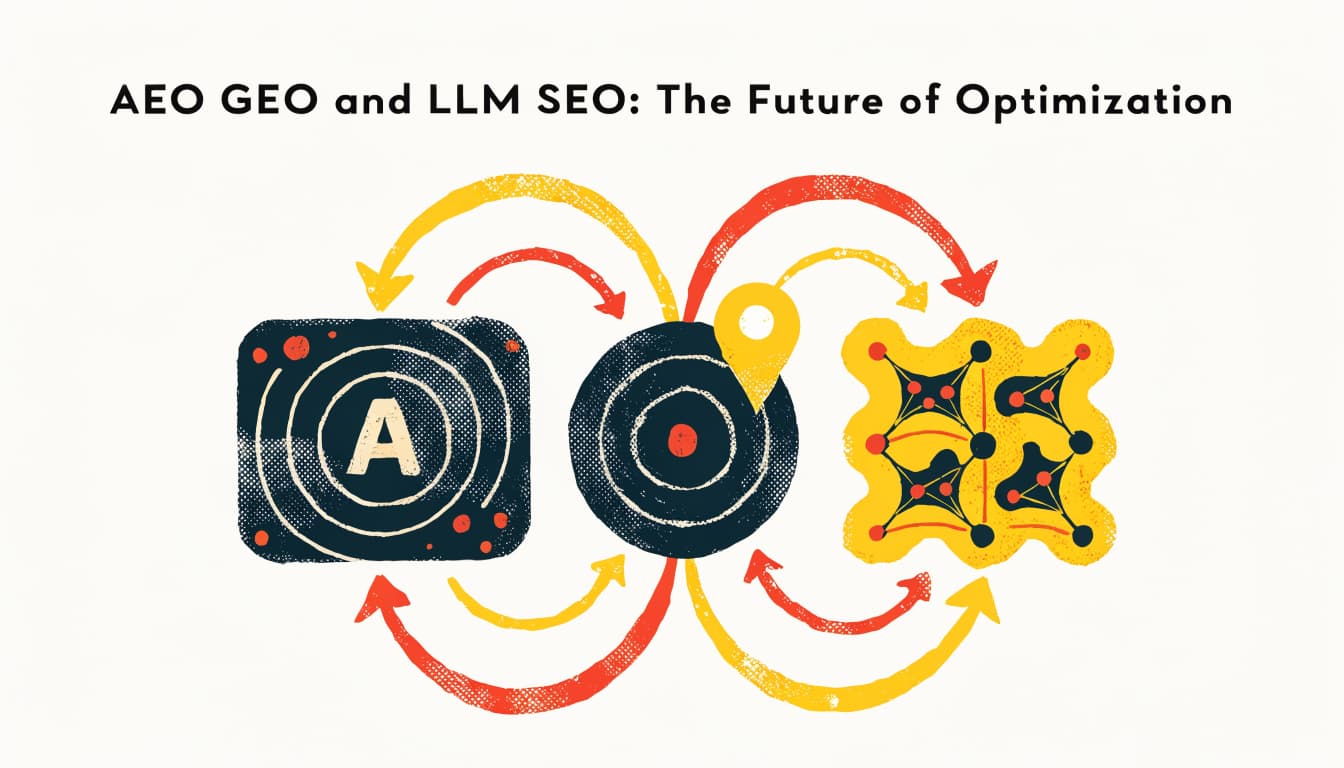
AEO GEO and LLM SEO: The future of optimization is not one strategy — it is three distinct disciplines that overlap but serve different goals. AEO suits sites that want to own zero-click answers. GEO targets citations inside AI-generated summaries. LLM SEO is the broadest play, shaping how large language models represent your brand across every surface.
Why These Three Terms Exist and What Separates Them
Traditional SEO optimizes for a ranked list of blue links. That model still works — Google processes roughly 8.5 billion searches per day — but a growing share of those queries now return AI Overviews, direct answers, or no click at all. AEO, GEO, and LLM SEO each emerged to address a different slice of that shift.
Answer Engine Optimization (AEO) focuses on structured, answer-first content that platforms like Google's AI Overviews, Bing Copilot, and voice assistants can lift verbatim or near-verbatim. The core mechanic is making the answer to a question appear in the first 40–60 words of a section, supported by schema markup (FAQ, HowTo, Speakable).
Generative Engine Optimization (GEO) targets AI systems that synthesize multi-source answers — ChatGPT, Perplexity, Google SGE. The goal is not just to be readable but to be cited. A 2023 study referenced by Digiday noted that GEO/AEO content needs to give AI crawlers enough structured information to answer complex, multi-part questions — a higher bar than a standard featured snippet.
LLM SEO is the umbrella term covering how your brand, product, or entity is represented inside the training data and retrieval layers of large language models. It includes entity building, consistent NAP (name, address, phone) data, Wikipedia presence, authoritative backlinks, and structured data — anything that shapes what a model "knows" about you before a user even types a query.
AEO GEO and LLM SEO: The Future of Optimization — Head-to-Head Comparison
| Criterion | AEO | GEO | LLM SEO |
|---|---|---|---|
| Primary target | Google AI Overviews, voice search, PAA boxes | ChatGPT, Perplexity, Gemini summaries | All LLMs + model training data |
| Content format | Short, direct Q&A; schema markup | Authoritative long-form; cited sources | Entity pages, press, structured data |
| Measurable signal | Featured snippet / AIO inclusion rate | Citation frequency in AI responses | Brand mention share in LLM outputs |
| Time to impact | 4–8 weeks (indexing + AIO refresh) | 8–16 weeks (model update cycles) | 6–18 months (training data lag) |
| Technical requirement | FAQ/HowTo schema, Speakable markup | E-E-A-T signals, outbound citations | Knowledge graph entries, entity disambiguation |
| Best for | Service businesses, FAQ-heavy content | Publishers, SaaS, research-heavy brands | Any brand that wants LLM mindshare long-term |
| Biggest risk | Zero-click cannibalization of organic traffic | No guaranteed citation even with great content | Slow feedback loop; hard to measure |
How AEO Works in Practice
AEO is the most tactical of the three. You write a question as an H2 or H3 heading, answer it in one or two sentences directly below, then expand. Google's AI Overview system pulls from pages it already ranks, so AEO without baseline SEO authority rarely works. Schema markup is not optional — pages using FAQ schema are significantly more likely to appear in People Also Ask boxes than equivalent pages without it.
The real trade-off: AEO success can reduce your click-through rate. If Google shows your answer in full, users may never visit your site. For lead-generation businesses, that is a serious consideration. AEO makes more sense when brand awareness matters as much as traffic, or when you sell high-consideration products where users research before buying.
How GEO Works in Practice
Generative Engine Optimization shares DNA with traditional E-E-A-T (Experience, Expertise, Authoritativeness, Trustworthiness) optimization, but the target audience is a language model's retrieval system, not a human editor. Perplexity, for example, retrieves live web pages and cites sources inline. To appear there, your content needs to be indexed, authoritative, and specific enough to be the best available answer to a narrow query.
One concrete GEO tactic: add a "Sources and Methodology" section to research posts. Models trained to prefer citable content treat explicit sourcing as a trust signal. Another: use precise numerical claims (e.g., "conversion rates dropped 18% after the March 2024 core update") rather than vague generalizations. Specificity is what separates a cited source from background noise.
GEO has a meaningful limitation: you cannot directly audit which AI responses cite you unless you manually query models or use a monitoring tool. The feedback loop is slower and less reliable than checking Google Search Console for featured snippet impressions.
How LLM SEO Works in Practice
LLM SEO operates on a longer horizon than either AEO or GEO. Large language models like GPT-4 and Claude are trained on data with a cutoff date, then updated in cycles that can run six months to a year apart. If your brand is not well-represented in authoritative sources before a training cutoff, you may not exist in the model's baseline knowledge.
The practical levers are entity authority: a Wikipedia page (or at least a Wikidata entry), consistent brand mentions in high-authority publications, structured data on your own site that identifies your organization, products, and people unambiguously. Think of it as reputation management for machines rather than humans.
This is also where traditional SEO and LLM SEO converge most clearly. High-quality backlinks from authoritative domains remain one of the best proxies for "this entity is real and trusted" — a signal that both Google's ranking algorithm and LLM training pipelines respond to.
Which Should You Choose
The honest answer is that most sites need all three, weighted differently by maturity and goal.
- Early-stage sites or local businesses should prioritize AEO first. It produces the fastest measurable results and requires the least domain authority to execute.
- Publishers, SaaS companies, and research-driven brands should invest heavily in GEO. If your content is the primary product, being cited in AI summaries is the new version of ranking on page one.
- Established brands protecting mindshare — or any company where someone asking ChatGPT "what's the best tool for X" should mention you — need LLM SEO as a long-term infrastructure investment.
If you can only do one thing this quarter: audit your most important FAQ-style pages for AEO compliance (clear H2 questions, direct 50-word answers, FAQ schema). That single change addresses both AEO and GEO simultaneously, because the same structured clarity that wins AI Overviews also makes content more citable in generative responses.
Avoid treating these as competing strategies. A page optimized for AEO with strong E-E-A-T signals and entity markup is already doing 70% of the work for GEO and LLM SEO. The remaining 30% — entity building, consistent external citations, training-data presence — requires sustained effort over months, not a one-time fix.
See how seorav.com can help you build an optimization strategy that covers AEO, GEO, and LLM SEO without spreading your resources thin. A focused audit of your current content and technical setup is the fastest way to identify which discipline will move the needle first for your specific site.
Frequently Asked Questions
What is the difference between AEO, GEO, and traditional SEO?
Traditional SEO ranks pages in a list of blue links. AEO (Answer Engine Optimization) targets zero-click answers like Google's AI Overviews and voice search. GEO (Generative Engine Optimization) aims to get your content cited inside AI-generated summaries on platforms like Perplexity or ChatGPT. All three share foundational tactics — quality content, authority signals — but differ in format, target platform, and how success is measured.
Does AEO hurt organic traffic by giving away answers for free?
It can. When Google's AI Overview answers a query in full, users have less reason to click through to your site. Studies consistently show lower click-through rates on queries that trigger AI Overviews compared to standard results. AEO is worth the trade-off when brand visibility matters more than raw traffic, or when your product requires research before purchase and awareness drives eventual conversions.
How do I know if my content is being cited by AI tools like ChatGPT or Perplexity?
There is no direct analytics integration like Google Search Console for AI citations. The practical method is manual: query the AI tools with questions your content targets and check whether your site appears as a source. Some third-party monitoring tools track brand mentions across AI outputs, but none offer the coverage or reliability of Google's own search data. Treat GEO measurement as qualitative for now.
What is LLM SEO and how is it different from GEO?
GEO focuses on getting cited in real-time AI-generated responses that retrieve live web content. LLM SEO is broader: it shapes what a large language model knows about your brand from its training data — think Wikipedia entries, Wikidata records, press coverage, and consistent entity signals across the web. GEO affects retrieval-augmented responses; LLM SEO affects the model's baseline knowledge before any retrieval happens.
Which schema markup types matter most for AEO?
FAQ schema and HowTo schema are the highest-impact types for AEO because they map directly to Google's People Also Ask boxes and AI Overview source selection. Speakable schema helps with voice assistant responses. For product or service businesses, Organization and LocalBusiness schema strengthen entity recognition, which benefits LLM SEO as well. All schema should be validated with Google's Rich Results Test before deployment.
How long does it take to see results from GEO or LLM SEO?
GEO results — appearing as a cited source in Perplexity or Bing Copilot — typically take 8 to 16 weeks, depending on how quickly those platforms index and re-rank content. LLM SEO operates on a much longer horizon: large language models update training data on cycles of six months to over a year, so entity-building work done today may not appear in model outputs until the next major training run.
Keep reading
Which Enterprise CMS Platforms Actually Deliver at Scale
Compare the best enterprise CMS platforms on SEO toolchain fit, analytics depth, and total cost. Contentful, AEM, Sitecore, and WordPress VIP evaluated.
Schema Markup Validators: How to Test and Fix Your Structured Data
Learn how to use a schema markup validator to catch missing properties, type mismatches, and duplicate markup before they cost you rich result eligibility.
AI Visibility Tools for Ecommerce Brands That Actually Move the Needle in 2025
We tested 11 ai visibility tools for ecommerce brands over 8 weeks. See which platforms track citations, cover your catalog, and justify their cost.