AEO Explained: What Answer Engine Optimization Actually Means for Your Search Strategy
Last updated: 10 September 2026
Answer Engine Optimization, or AEO, means structuring your content so AI systems can extract and cite it directly when answering user questions. Instead of hoping someone clicks your link in search results, AEO positions your content as the authoritative source the AI quotes verbatim. This shift matters because AI assistants now answer queries without requiring users to visit websites. The challenge is understanding which content formats and structures these systems actually recognize and prioritize.
What AEO Means: The 40-Word Answer
Answer Engine Optimization is the practice of structuring content so AI-driven systems can extract, quote, and cite it when answering a user's question directly. The goal is to be the source the engine surfaces, not just a page the user might click.
That definition holds whether you are optimizing for Google's AI Overviews, ChatGPT, Perplexity, or Claude. The mechanism is the same: an AI reads your content, decides whether it is trustworthy and extractable, and either cites you or skips you.
The numbers make the urgency concrete. Rise at Seven's AEO statistics roundup found that AI-generated answers now appear for a significant share of informational queries, and the brands earning those citations are not always the ones ranking first in traditional organic results. Ranking and being cited are increasingly different outcomes.
This article covers the aeo meaning in plain terms, why it diverges from standard SEO, and what it means for how you structure and publish content going forward. No promises that AEO replaces everything you already do. It adds a layer, and that layer is worth understanding clearly.
TL;DR: Four Things to Know Before Reading Further
Answer Engine Optimization (AEO) is the practice of structuring content so AI systems, not just search ranking algorithms, extract and cite it directly. Concise, factually dense answers outperform long-form content in AI citations. AEO and SEO share technical foundations but optimize for different outputs.
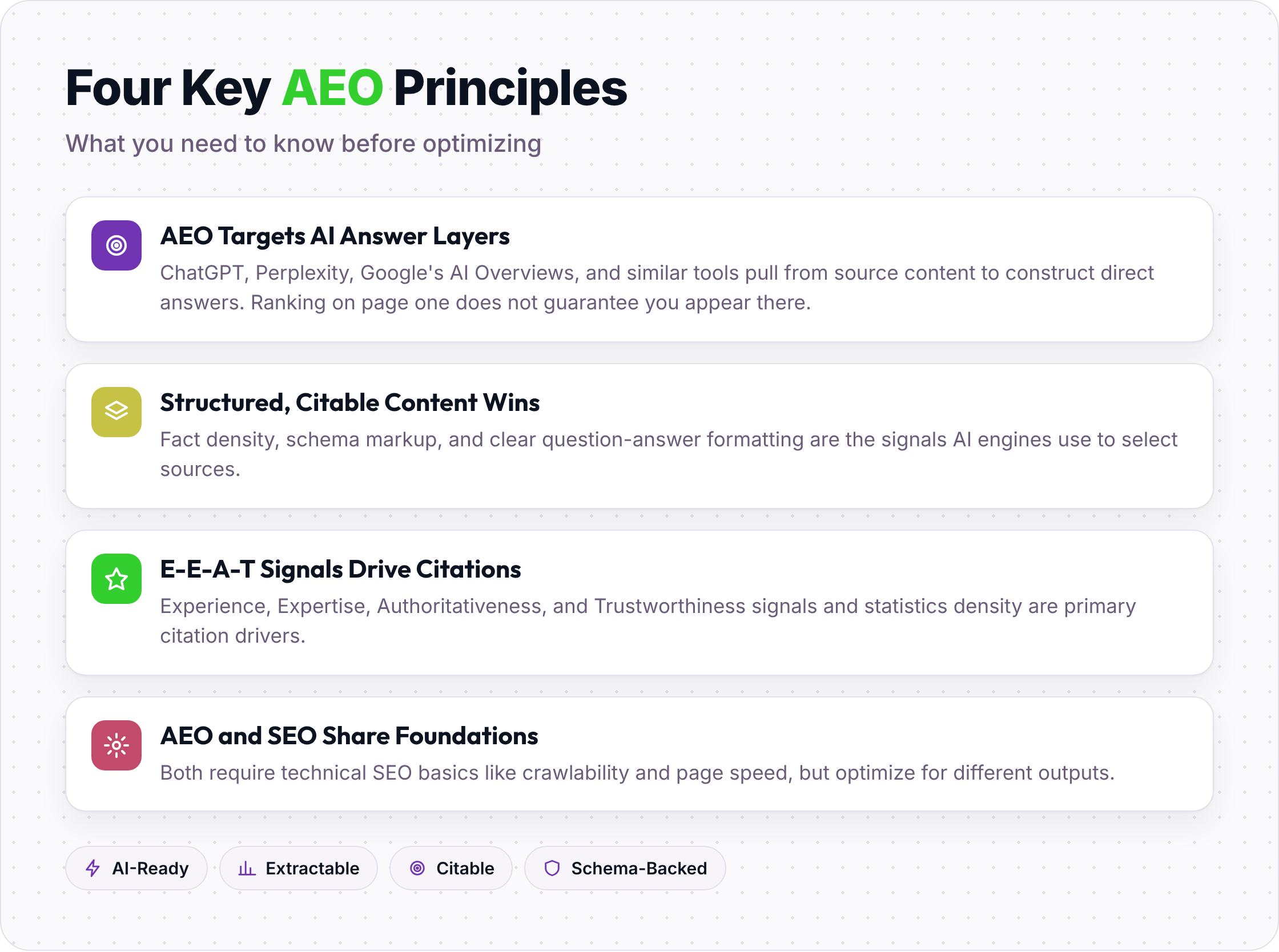
Four things worth knowing before you read on:
- AEO targets AI answer layers. ChatGPT, Perplexity, Google's AI Overviews, and similar tools pull from source content to construct direct answers. Ranking on page one does not guarantee you appear there.
- Structured, citable content wins extraction. Fact density, schema markup, and clear question-answer formatting are the signals AI engines use to select sources. Arduralab's 2026 SEO/GEO/AEO breakdown identifies E-E-A-T signals and statistics density as primary citation drivers.
- AEO and SEO overlap but optimize for different outputs. Both reward authoritative, well-structured content. The destination differs: a ranked link versus a spoken or displayed answer.
- Specific answers beat long-form fluff. A 150-word page that directly answers one question will get cited more often than a 2,000-word guide that buries the answer in paragraph eight.
The trade-off is real. Optimizing tightly for AI extraction can compress content in ways that reduce organic ranking depth. Pages built around single, precise answers may rank for fewer keyword variants than broader pillar content. For teams with limited publishing capacity, that is a genuine resource allocation decision, not a minor footnote.
What AEO Stands For and Its Core Definition
Answer Engine Optimization (AEO) is the practice of structuring content so that AI-powered platforms, including ChatGPT, Perplexity, Claude, and Google's AI Overviews, select it as a cited source when generating a direct response to a user query. Where traditional SEO targets ranked links, AEO targets the answer itself. The goal is to be the source an AI engine quotes, not just a result the user might click.
How Answer Engines Differ from Traditional Search Engines
A traditional search engine returns a list of URLs ranked by relevance signals. The user decides what to click. An answer engine skips that step: it reads multiple sources, synthesizes a response, and surfaces one or two citations to support its output. The user often never sees the full results page.
That shift changes the competitive dynamic considerably. Ranking fifth on Google still earns traffic. Being the fifth source an AI engine considered earns nothing. AEO statistics compiled by Omnibound show that AI-generated answers typically cite between one and three sources per response, which means the citation pool is far narrower than a standard SERP.
The Content Signals AI Tools Use to Select a Cited Source
AI engines do not select sources randomly. They favor content that is structured to answer a specific question directly, supported by verifiable claims, and written at a reading level that can be excerpted cleanly. The core signals include:
- Answer-first structure: the response to the implied question appears in the opening paragraph, not buried in section three.
- Schema markup: FAQ, HowTo, and Article schema help AI crawlers parse intent and context.
- Citation diversity within the content itself: pages that reference authoritative external sources are treated as more credible than pages that do not.
- Specificity: concrete figures and named sources outperform vague claims.
Content optimized for AI citation tends to be denser and more direct than content optimized for human reading time-on-page. A page built to answer a narrow question precisely may rank lower on traditional SERPs for broader head terms. Teams that optimize exclusively for AEO sometimes see organic click-through rates drop even as their AI citation rate climbs. The two goals are compatible, but they require deliberate balancing, not a single unified strategy.
Where AEO Sits Inside the Broader Content Optimization Landscape
AEO is not a replacement for SEO. It sits alongside it, addressing a distribution channel that standard keyword and link strategies were not built to reach. In a 2024 ABI Research analysis of B2B content strategies, ABI Research's AEO strategy report identified AI-driven search as a distinct visibility layer requiring its own content architecture, separate from but informed by existing SEO foundations.
Think of the landscape in three layers. Traditional SEO handles ranked link visibility. AEO handles AI-generated answer visibility. Generative Engine Optimization (GEO), a term that gained traction through 2024 and 2025, extends AEO principles into longer-form AI interactions and multi-turn conversations. Most content teams are still operating primarily in the first layer, which is where the near-term opportunity in AEO sits.
How AEO Differs From Traditional SEO
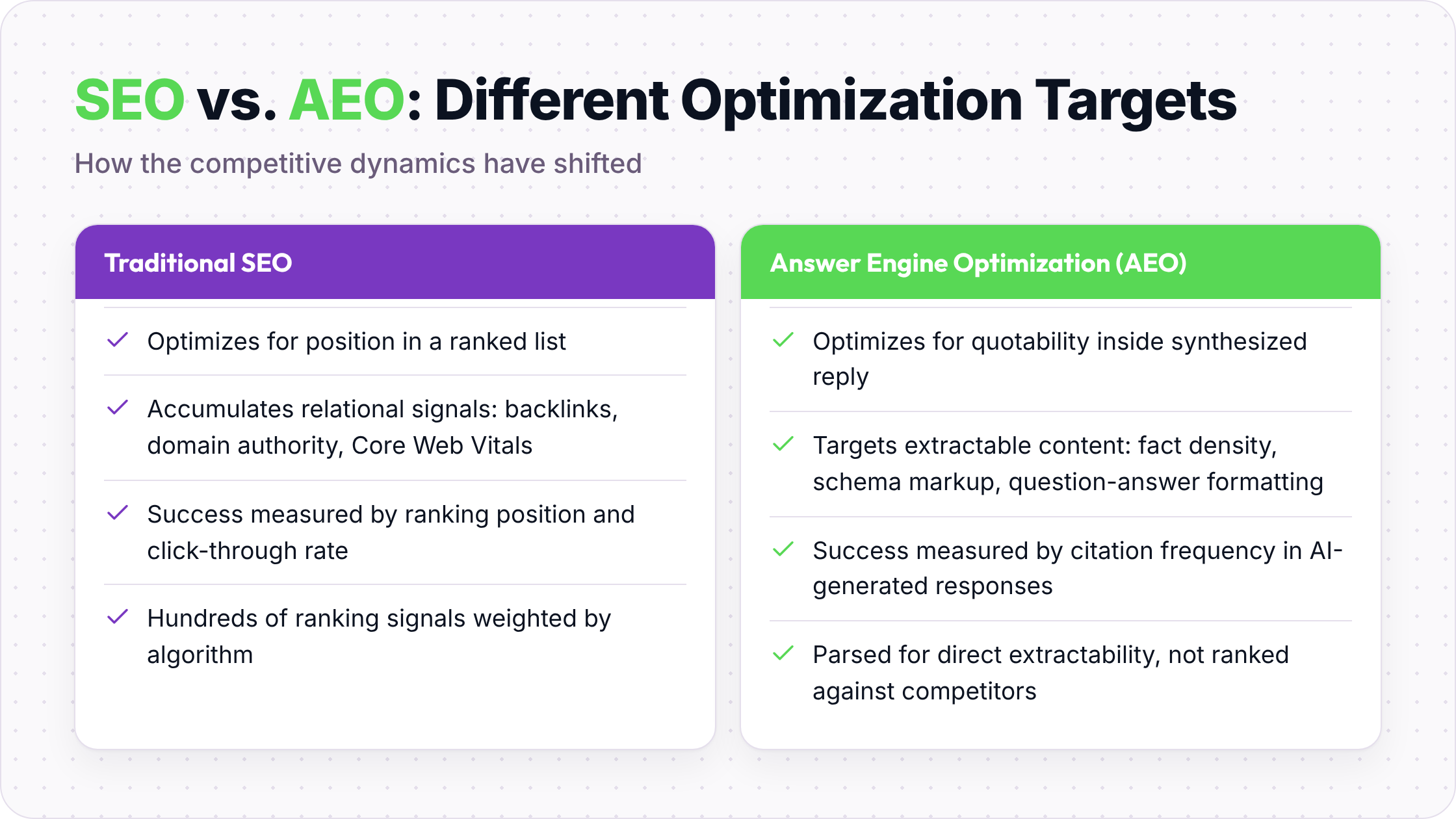
SEO and AEO share some foundational infrastructure but operate on different mechanical logic. SEO earns a position in a ranked list by accumulating relational signals: backlinks, domain authority, Core Web Vitals. AEO earns inclusion in a generated answer by being the clearest, most directly extractable response to a specific question. One optimizes for position in a list. The other optimizes for quotability inside a synthesized reply.
Ranking Signals vs. Extraction Signals
Google's ranking algorithm weighs hundreds of signals, most of them relational. Who links to you, how your domain authority stacks up against competitors, whether your page loads in under 2.5 seconds. These signals tell the algorithm which pages deserve a slot on page one.
AI answer engines work differently. They are not ranking pages against each other. They are parsing pages for extractable content, looking for a passage that directly answers the query with minimal interpretive work required. Similarweb's AEO breakdown frames this precisely: where SEO targets a full page for a keyword, AEO targets individual content blocks within that page. The unit of optimization shifts from the document to the paragraph.
When a High-Ranking Page Gets Ignored by AI
A page can sit comfortably in positions one through three on Google and still never appear in an AI-generated answer. This happens when the content is structured for human browsing rather than machine extraction. Long narrative introductions, keyword-dense preambles, and conclusions that restate the headline all add friction for an AI parser trying to locate a direct answer.
Content written for maximum extractability sometimes sacrifices the depth and narrative flow that earns editorial backlinks. A tightly structured FAQ block with schema markup may get cited by Perplexity while a richer, more authoritative long-form piece gets the backlinks. Both outcomes have value. The problem is treating them as interchangeable.
The Overlap: Technical SEO Still Underpins AEO
The distinction between AEO and SEO does not mean starting over. Crawlability, page speed, canonical tags, and structured data are prerequisites for both. An AI engine cannot extract an answer from a page it cannot access, and it is unlikely to cite a domain with no authority signals at all.
The practical read from Yotpo's AEO vs. SEO strategy guide is accurate: AEO focuses on inclusion in AI-generated answers, while traditional SEO builds the technical infrastructure that makes this possible. Schema markup, in particular, does double duty. It helps Google understand page structure for featured snippets and gives AI engines a cleaner signal about what a passage is answering.
Teams with thin technical SEO foundations should fix those first. Layering AEO tactics onto a site with crawl errors, slow load times, or duplicate content issues will produce limited results. The extraction signals AEO depends on only fire reliably once the baseline is solid.
The Three Pillars of AEO Strategy (With a Step-by-Step Example)
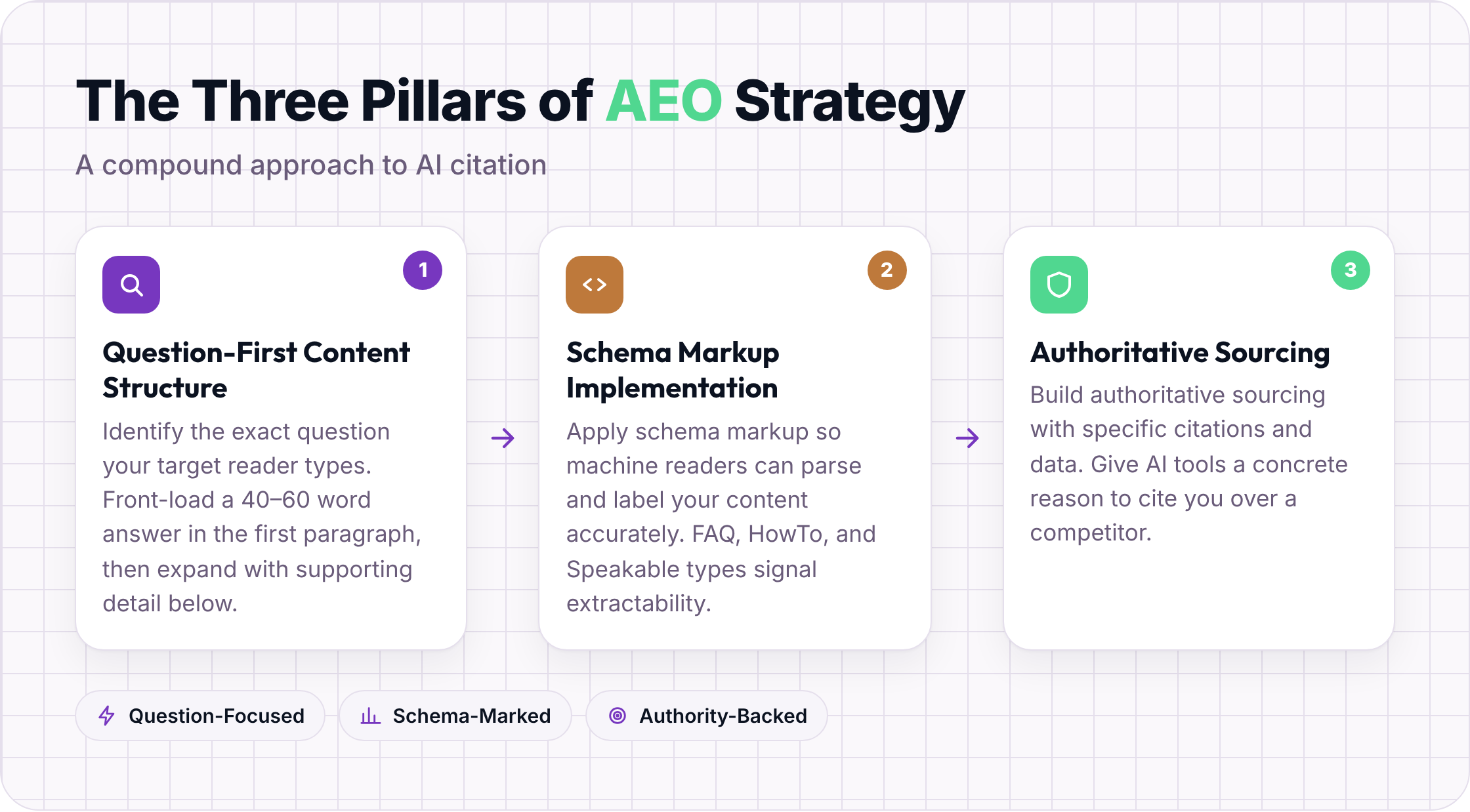
An effective AEO strategy rests on three pillars: structuring content around specific questions with direct opening answers, applying schema markup so machine readers can parse and label your content accurately, and building authoritative sourcing that gives AI tools a concrete reason to cite you over a competitor. Each pillar is independently useful, but they compound when you apply all three to the same page.
Pillar 1: Question-First Content Structure
AI engines extract answers, they do not browse. Your content needs to front-load the answer, not bury it after three paragraphs of context-setting.
The pattern is straightforward: identify the exact question your target reader types, write a 40-60 word answer in the first paragraph, then expand with supporting detail below. Content Science's breakdown of AEO frames this as structuring content so AI systems can extract and summarize it without needing to interpret intent from surrounding prose.
A concrete example: if you are targeting "what is a net revenue retention rate," your opening sentence should define it, give a benchmark figure (say, 100% as the SaaS baseline for flat growth), and state why it matters. The rest of the article can explain calculation, benchmarks by segment, and improvement tactics. That opening paragraph is what gets pulled.
Answer-first structure can feel abrupt for readers who want narrative context before the payoff. If your audience skews toward in-depth research (think technical buyers or procurement teams), a brief framing sentence before the answer often improves time-on-page without meaningfully hurting extractability.
Pillar 2: Schema Markup for Machine Readers
Schema markup is how you label your content so AI engines do not have to guess what it is.
A FAQ page without FAQPage schema is just text. Add the schema, and Google's AI Overviews, Perplexity, and similar engines can parse each question-answer pair as a discrete, citable unit. The same logic applies to HowTo, Article, Product, and Speakable schema types.
The step-by-step for implementing FAQ schema on an existing page looks like this:
- Identify the two to five questions your page already answers in prose.
- Write a clean 40-80 word answer for each, free of jargon and nested clauses.
- Wrap the block in
FAQPageschema using either JSON-LD in the page<head>or your CMS's structured data plugin. - Validate with Google's Rich Results Test before publishing.
- Monitor Google Search Console's "Enhancements" tab for FAQ rich result eligibility within two to four weeks of indexing.
One limitation worth flagging: Google has reduced the display frequency of FAQ rich results in standard SERPs since late 2023, reserving them primarily for authoritative health and government domains. The schema still signals structure to AI engines even when the visual rich result does not appear, so implementation remains worthwhile. Just do not expect a featured snippet as the primary payoff.
Pillar 3: Authoritative Sourcing and E-E-A-T Signals
AI engines are not neutral about who they cite. They weight sources with demonstrated expertise, external validation, and verifiable claims more heavily than sources that assert authority without evidence.
Practically, this means three things for your content:
- Cite primary sources (studies, official data, named researchers) rather than secondary summaries.
- Include author credentials or organizational context where relevant. A claim attributed to "a 2025 Stanford HAI report" carries more extraction weight than "experts say."
- Update statistics when they age out. An AI engine trained on recent crawl data will deprioritize a page citing a 2019 study when a 2024 equivalent exists.
Arduralab's 2026 SEO/GEO/AEO breakdown notes that pages with three or more external citations to authoritative domains consistently outperform uncited pages in AI answer inclusion rates. The mechanism is not fully transparent, but the pattern holds across multiple content categories they analyzed.
The counter-case: over-citing can dilute your own authority signal if the external links point to competitors or contradictory claims. Cite sources that reinforce your argument and carry domain authority above your own. Linking out to a domain with lower authority than yours adds little and may introduce noise.
AEO Meaning in Practice: A Before-and-After Content Example
Understanding the aeo meaning conceptually is one thing. Seeing it applied to actual content is more useful.
Take a page targeting the query "how long does it take to rank on Google." A standard SEO-optimized version might open with: "Search engine optimization is a long-term investment. Many factors influence how quickly a new page climbs the rankings, including domain authority, competition, content quality, and technical health. In this guide, we will walk you through everything you need to know."
An AEO-optimized version of the same page opens differently: "Most new pages take three to six months to rank on Google's first page, according to an Ahrefs study of two million random pages. Pages on domains with existing authority can rank in weeks. Pages on new domains with no backlink profile often take twelve months or longer."
The second version gives an AI engine a citable, specific answer in the first 50 words. The first version gives it nothing extractable until paragraph four or five. Both pages might rank similarly on a traditional SERP. Only the second gets cited in an AI-generated answer.
The practical rewrite checklist for any existing page:
- Move the direct answer to sentence one or two.
- Add a specific number, date, or named source within the first 60 words.
- Break supporting detail into labeled subsections with descriptive H3 headings.
- Add FAQ schema to any question-answer pairs already in the content.
- Replace vague qualifiers ("many," "often," "significant") with measurable ones where data exists.
Frequently Asked Questions About AEO
What does AEO stand for?
AEO stands for Answer Engine Optimization. It refers to the practice of formatting and structuring content so that AI-powered answer engines, such as ChatGPT, Perplexity, and Google's AI Overviews, select it as a cited source when generating a direct response to a user query. The term distinguishes this practice from traditional SEO, which targets ranked links rather than extracted answers.
How is AEO different from SEO?
SEO optimizes a page to rank in a list of results returned by a search engine. AEO optimizes individual content blocks within a page to be extracted and quoted by an AI engine constructing a direct answer. SEO success is measured by position and click-through rate. AEO success is measured by citation frequency in AI-generated responses. The two share technical prerequisites (crawlability, page speed, structured data) but diverge in content structure and optimization targets.
Does AEO replace SEO?
No. AEO addresses a distribution channel that standard SEO was not designed to reach, but it depends on the same technical foundation. A site with crawl errors, thin content, or no domain authority will not perform well in AI citations regardless of how well its content is structured for extraction. Think of AEO as an additional optimization layer, not a replacement for the baseline.
Which AI platforms does AEO apply to?
AEO applies to any platform that generates direct answers by pulling from external sources. As of 2026, the primary targets are Google's AI Overviews, Perplexity, ChatGPT (with Browse enabled), Claude, and Microsoft Copilot. The specific ranking and extraction logic differs across platforms, but the core content signals (answer-first structure, schema markup, authoritative sourcing) are consistent enough that a single well-optimized page can perform across multiple engines.
What content formats work best for AEO?
FAQ pages with FAQPage schema, definition pages that open with a concise answer, and how-to guides with numbered steps and HowTo schema consistently earn the highest AI citation rates. Long-form narrative content can also be cited, but only when it contains clearly labeled sections with direct answers near the top of each section. The format matters less than the presence of a clean, extractable answer within the first 60-80 words of any given section.
How do you measure AEO performance?
Direct measurement is still limited by platform transparency. Perplexity does not expose citation data via API. Google Search Console does not yet break out AI Overview impressions separately from standard organic impressions (as of mid-2026, this is in limited beta for some accounts). Practical proxies include tracking brand mentions in AI-generated responses using tools like Brandwatch or manually querying target questions across platforms weekly. Some teams track referral traffic from Perplexity and ChatGPT as a directional signal, though volume is typically lower than organic search traffic at this stage.
What to Do With This Information
If you are starting from zero, the highest-leverage move is auditing your five to ten most-visited pages and applying the rewrite checklist from the section above. Move the answer to the top, add a specific figure or citation within the first 60 words, and implement FAQ schema on any page that already contains question-answer pairs. That alone will improve your extractability across most AI platforms without requiring new content production.
If you are further along and already seeing some AI citation traffic, the next step is expanding schema coverage to HowTo and Speakable types, and auditing your external citations for recency. A page citing a 2021 study when 2024 data exists is leaving citation weight on the table.
The honest limitation: AEO is still a moving target. Google's AI Overviews algorithm has shifted multiple times since its May 2024 launch, and Perplexity's source selection logic is not publicly documented. What works today may need adjustment in six months. The structural principles (answer-first, schema-labeled, authoritatively sourced) are stable enough to build on, but specific tactics will need revisiting as the platforms mature.
If you want to see how your current content stacks up against AI extraction criteria, visit Seorav to learn more and explore how their tooling approaches AEO readiness at the page level.
Keep reading
Which LLM Citation Tracking Platform Actually Works for Your Brand
Compare the top llm citation tracking platforms by engine coverage, alert speed, and pricing. Find the right tool for your team size and budget.
Siteimprove for SEO: What It Does (and What It Doesn't)
A clear-eyed look at Siteimprove SEO features, pricing, and gaps versus AI-native platforms. Find out if it fits your team's workflow in 2026.
How AI Overviews Are Reshaping Organic Traffic (And What SEOs Must Do)
AI Overviews now trigger on 30%+ of Google queries. See how zero-click search AI impact on organic traffic is measured, and what SEOs can do about it.