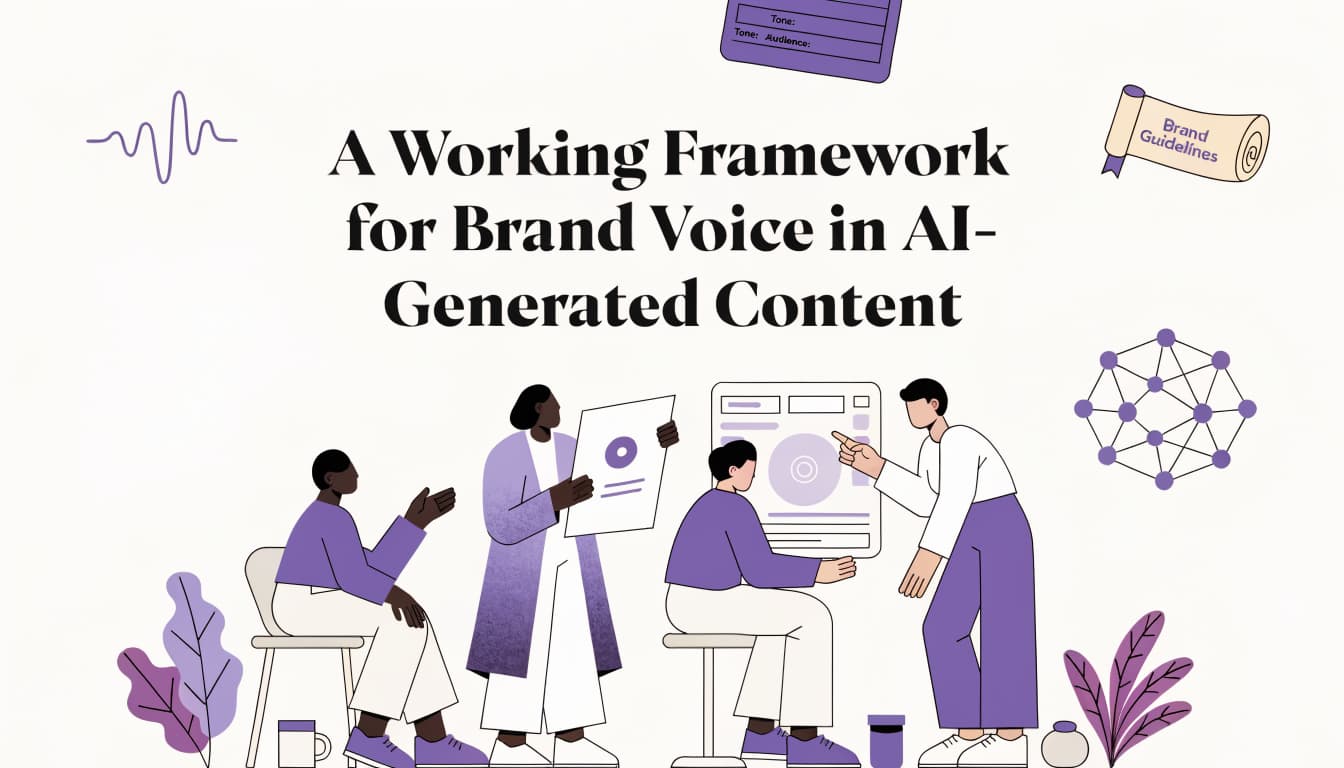
A Working Framework for Brand Voice in AI-Generated Content
Last updated: 12 August 2026
Brand voice guidelines for AI-generated content require structural changes to traditional brand documents. Most style guides describe tone through subjective language like "conversational yet professional," which works for human writers but leaves language models without actionable constraints. Effective AI brand voice documents specify concrete rules: approved word lists, sentence length ranges, prohibited phrases, and tone markers tied to measurable outputs. This framework bridges the gap between human intuition and machine precision, ensuring consistency across AI-generated copy without sacrificing brand identity.
Word count: 79
Why Most Brand Voice Docs Fail AI Tools
Most brand voice documents were written for humans, not machines. A PDF that says "write conversationally but stay professional" gives a copywriter enough to work with. It gives an AI model nothing it can act on. The gap is structural, and closing it requires a different kind of document entirely.
The numbers make this concrete: only 23% of content marketers who have documented brand voice guidelines actually use them to train their AI tools. That means the majority of teams are running AI-generated content against a voice standard their tools have never seen.
The Gap Between Human-Readable and Machine-Usable
A human reads "authoritative but approachable" and fills in the blanks from context, past experience, and editorial judgment. An AI model has none of that. It needs explicit constraints: which sentence lengths to target, which phrases to avoid, what a correct example looks like versus a wrong one. A useful set of brand voice guidelines for AI-generated content, as Glean's guide to AI voice documentation puts it, "helps both people and machines make the same decisions about message, tone, vocabulary, and structure." That last word matters. Structure is what makes a voice document machine-usable.
A PDF style guide can describe a voice. A framework encodes it. A framework produces the same output regardless of who, or what, is applying it.
What a Framework Gives You That a PDF Cannot
A PDF is static. It captures intent at a point in time and then sits in a shared drive while the actual content drifts. A framework is operational. It plugs directly into a content workflow as a repeatable input, not a reference document someone consults once during onboarding.
A framework gives you things a PDF cannot:
- Testable rules. Instead of "avoid jargon," a framework specifies which terms are banned and which are preferred, so outputs can be checked against a list, not a judgment call.
- Positive and negative examples. Real excerpts from approved content, paired with examples of what to reject, give AI tools the contrast they need to calibrate tone accurately.
- A gate, not a guideline. A framework sits at the front of the generation process. A PDF sits at the end, consulted only when something already feels off.
One honest caveat: even a well-structured framework requires a human review step before content publishes. Purdue's AI content guidelines for communicators are explicit on this point: AI-generated text must be revised for brand voice and approved by an accountable human before it goes live. A framework reduces the gap between first draft and final copy, but it does not eliminate editorial judgment.
How This Three-Part Model Maps to a Repeatable Workflow
The framework covered in this article runs in three stages: build structured voice documentation, apply it at the prompt level, and score outputs against defined signals before they ship.
Each stage corresponds to a failure point in the typical AI content process. Stage one fixes the "the AI doesn't know how we write" problem. Stage two fixes the "every prompt produces something different" problem. Stage three fixes the "we only catch voice drift after it publishes" problem.
Run sequentially, these stages turn brand voice from a creative aspiration into a production constraint. Tools like SEORav are built around this logic, running every draft through a scoring layer before it reaches a reviewer, so the gate is automatic rather than manual. The workflow becomes consistent not because everyone follows the same style guide, but because the same structured inputs produce the same structured outputs, every time.
The Brand Voice Specification Framework at a Glance

A brand voice specification framework defines three components: tone tokens (discrete descriptors with measurable boundaries), constraint rules (explicit prohibitions and structural limits), and output validators (criteria that confirm a draft matches the spec before it publishes). Together, these replace vague prose style guides with machine-readable instructions an AI model can actually follow.
What the Framework Defines
Tone tokens are not adjectives. They are bounded descriptors paired with positive and negative examples. "Confident but not arrogant" is a token. "Professional" alone is not. Constraint rules go further: they name specific punctuation patterns to avoid, banned phrases, sentence-length ceilings, and structural tropes that signal generic AI output. Output validators are the final gate, a checklist of signals a reviewer or automated scorer runs against every draft before it ships.
The distinction matters practically. Prose style guides were written for human copywriters who can infer intent from context. AI models cannot infer. They pattern-match. A guide that says "write with warmth and authority" gives a language model almost nothing to constrain its output. A spec that says "max sentence length 22 words, no em-dashes, no rhetorical questions in the hook" gives it a lot. Digitalapplied's 2026 guide to extracting brand voice for AI puts this directly: stop describing your voice and start measuring it.
Why Structured Specs Outperform Prose Guides for AI Prompting
The core problem with prose style guides is ambiguity tolerance. Human writers resolve ambiguity through judgment. AI models resolve it through probability, defaulting to the most statistically common output for a given prompt. That default is almost always generic.
Structured specs reduce the probability space. When a spec names 12 banned phrases, defines paragraph rhythm as "1-3 sentences, varied length," and requires an answer-first opening in the first 40 words, the model has fewer generic paths available. The output drifts less. Consistency across a 20-article program looks like a deliberate editorial voice rather than a random sample from the same base model.
The trade-off is real, though. Building a tight spec takes time upfront, typically 4-6 hours of audit work on existing content before a single token gets written. For teams producing fewer than 10 AI-assisted articles per month, the overhead may not justify the return. The framework also breaks down when a brand's existing content is inconsistent, because the spec can only systematize what's already there. If the source material has no coherent voice, the spec will codify noise.
When to Use This Framework
Two situations call for it most clearly.
The first is a new AI content program. When a team moves from occasional AI-assisted drafts to a structured publishing workflow, voice drift becomes a real operational risk. A spec written before the first article ships sets a baseline every subsequent draft can be scored against. Without that baseline, editorial review becomes subjective and slow.
The second is agency onboarding. When a brand hands content production to an external team or a freelance network, a prose style guide is almost always misread. Branded Agency's framework for brand voice guidelines documents this pattern: the more people involved in content production, the more a style guide needs explicit rules rather than interpreted principles. A structured spec gives an agency the same constraints the internal team works from, without requiring weeks of editorial alignment calls.
Both cases share the same underlying condition: multiple outputs, multiple producers, and a need for consistency that human judgment alone cannot reliably deliver at scale.
Framework Diagram: How the Three Components Connect
A brand voice framework for AI-generated content runs in three sequential layers. Tone tokens define what the voice is. Constraint rules translate those definitions into enforceable boundaries. Output validators confirm the final draft meets both before it ships.
How the Layers Feed Each Other
Tone tokens sit at the input stage. They are the raw vocabulary of your voice: sentence length targets, approved and banned phrases, formality scores, and the structural patterns your brand uses consistently. These tokens do not enforce anything on their own. They feed the constraint rules layer, which converts descriptive voice attributes into conditional logic. A tone token that says "conversational, not corporate" becomes a constraint rule that flags passive constructions above a set frequency or sentences longer than 28 words.
The constraint rules then gate the output validators. Validators are the review checkpoint: they run the draft against the compiled ruleset and return a pass, a flag, or a block. A flagged draft goes to a human reviewer with a specific reason attached. A blocked draft does not reach the queue at all. Growth Rocket's content architecture guide identifies voice characteristics documentation, contextual usage examples, and enforcement checkpoints as the three components a durable brand voice system requires, which maps closely to this token-rule-validator sequence.
Reading the Diagram
Think of it as a pipeline with three named stages:
- Inputs: Tone tokens (phrase lists, structural preferences, banned constructions)
- Processing layer: Constraint rules (conditional logic that converts tokens into testable criteria)
- Review checkpoint: Output validators (automated scoring plus human escalation for flagged drafts)
Each stage depends on the one before it. Validators cannot catch what constraint rules do not define, and constraint rules cannot define what tone tokens have not specified. The dependency runs in one direction only.
Where This Breaks Down
The trade-off is maintenance overhead. Tone tokens need to be updated whenever the brand voice evolves, and constraint rules need to be rewritten to match. Teams that treat the token layer as a one-time setup often find their validators enforcing an outdated voice six months later. Comprehensive AI brand guidelines require ongoing governance, not a single documentation sprint, a point Cloud Campaign's AI brand guidelines overview makes explicit in the context of legal and consistency risk.
This approach also breaks down when the content type changes significantly. A framework calibrated for long-form articles may produce constraint rules that are too rigid for short-form social copy, where sentence-length limits and structural patterns work differently. The three-layer model is sound; the token definitions inside it need to be scoped per format, not applied universally.
Component 1: Tone Tokens, the Atomic Units of Brand Voice

A tone token is a specific adjective-plus-constraint pair that tells an AI model not just what quality to express, but how far to take it and where to stop. Instead of instructing a model to write "friendly," a tone token says "friendly: conversational sentence length under 18 words, no corporate jargon, first-person plural allowed." That constraint layer is what separates a usable instruction from a vague aspiration. Without it, every model interprets "friendly" differently, and your outputs drift.
Why Vague Descriptors Fail
Most brand voice documents read like personality horoscopes: "warm, approachable, authoritative." Those words mean something to a human editor who has read 200 pieces of your content. They mean almost nothing to a model that has read everything and defaults to the statistical center of all of it.
The fix is specificity. A tone token for "authoritative" might read: "authoritative: cite a specific number or named source in the first 60 words, avoid hedging phrases like 'it seems' or 'perhaps,' keep declarative sentences under 20 words." That version gives the model a testable target. The vague version gives it permission to do whatever it was already going to do.
How to Build a Tone Token Set
Start with your three to five core voice descriptors, the ones that appear most often in your existing style documentation or that your editorial team uses most consistently in feedback. For each descriptor, write out:
- A one-sentence definition in plain language
- Two approved examples pulled from published content
- Two rejected examples that show where the descriptor tips into its opposite
- One or two measurable constraints (sentence length, phrase list, structural rule)
The measurable constraints are the part most teams skip, and skipping them is what makes the token useless for AI prompting. "Confident" without a constraint is still a horoscope. "Confident: declarative opening sentence, no passive voice in the first paragraph, no hedging adverbs" is a token.
Tone Tokens in Practice
A SaaS company building brand voice guidelines for AI-generated content might define five tokens: direct, specific, peer-level, skeptical, and concise. Each token gets its constraint set. "Specific" might require a number, a product name, or a named competitor in every second paragraph. "Skeptical" might prohibit phrases like "simply," "easily," or "just" when describing technical processes, because those words signal oversimplification to a technical audience.
The token set does not need to be exhaustive. Five well-defined tokens with measurable constraints outperform fifteen vague adjectives every time. The goal is to reduce the model's decision space, not to describe your brand's entire personality.
Component 2: Constraint Rules, Turning Tokens Into Enforceable Limits

Constraint rules are the operational layer of the framework. They take the descriptive vocabulary of your tone tokens and convert it into conditional logic: if the draft contains X, flag it; if it contains Y more than Z times per 500 words, block it. This is the layer that makes the framework machine-usable rather than human-readable.
The Four Categories of Constraint Rules
Constraint rules fall into four practical categories.
Phrase-level rules cover banned words and required words. Banned words are terms your brand never uses, either because they signal a competitor's voice, because they are overused in your category, or because they conflict with your tone tokens. Required words are terms your brand uses consistently enough that their absence signals a voice mismatch.
Structural rules cover sentence length, paragraph length, and opening patterns. A structural rule might specify that no paragraph exceeds three sentences, that the first sentence of any article must be declarative and under 15 words, or that no section opens with a rhetorical question.
Punctuation rules are more specific than most teams expect. Banning em-dashes, for example, is a concrete punctuation rule that eliminates one of the most common markers of generic AI output. Banning ellipses as a stylistic device is another. These rules sound minor, but they have an outsized effect on whether a draft reads as distinctly yours or as a sample from the base model.
Frequency rules govern how often certain patterns appear. A frequency rule might allow passive voice in no more than 10% of sentences, or require that at least one sentence per section be under eight words. Frequency rules are harder to enforce manually but straightforward to automate.
Writing Constraint Rules That Actually Work
The test for a good constraint rule is whether a non-expert can apply it without interpretation. "Avoid jargon" fails this test. "Do not use the following 14 terms: [list]" passes it. "Write conversationally" fails. "No sentence in the body copy exceeds 22 words" passes.
Write each rule as a conditional statement: if [condition], then [action]. If the draft contains "leverage" as a verb, flag it. If any paragraph exceeds four sentences, flag it. If the opening sentence is a question, block it. This format makes rules automatable and makes the reviewer's job faster, because every flag comes with a specific reason rather than a general impression.
The Maintenance Problem
Constraint rules go stale. A phrase that was banned because it sounded like a competitor two years ago may now be standard industry vocabulary. A sentence-length ceiling that worked for long-form articles may be too restrictive for product descriptions. Build a review cadence into your governance plan, at minimum once per quarter, and assign a named owner to each rule category. Rules without owners do not get updated.
Component 3: Output Validators, the Final Gate Before Publish
Output validators are the review checkpoint where a draft either passes, gets flagged for revision, or gets blocked from the queue entirely. They are not a proofreading step. They are a structured scoring pass that runs the draft against the compiled constraint ruleset and returns a specific result for each rule.
What a Validator Checks
A validator runs three types of checks.
The first is rule compliance: does the draft violate any constraint rule? This check is binary. The draft either contains a banned phrase or it does not. It either opens with a question or it does not. Binary checks can be fully automated.
The second is frequency compliance: does the draft stay within the frequency limits defined in the constraint rules? This check requires counting, which is also automatable, but the thresholds need to be set deliberately. A passive voice frequency limit of 10% is meaningless if your constraint rules never defined what counts as passive voice.
The third is tone alignment: does the draft, taken as a whole, read as consistent with the tone tokens? This check cannot be fully automated. It requires a human reviewer, but the validator can make that review faster by flagging specific passages rather than asking the reviewer to assess the entire draft from scratch.
Automated Scoring vs. Human Review
The practical split for most teams is: automate the binary and frequency checks, escalate the tone alignment check to a human reviewer only when the automated checks pass. This keeps the human review step focused on judgment calls rather than mechanical compliance.
Tools like SEORav are built around this split, running automated scoring on every draft so that human reviewers only see content that has already cleared the rule-compliance layer. The result is faster review cycles and more consistent output, because the mechanical checks happen before the draft reaches a person, not after.
Setting Pass and Fail Thresholds
Thresholds need to be calibrated to your content type and your tolerance for revision cycles. A threshold that blocks 60% of first drafts may be technically correct but operationally unsustainable. Start with thresholds that flag rather than block, collect data on which flags most often lead to revision, and tighten the thresholds over time as your prompt engineering improves.
One realistic expectation: even a well-calibrated validator will produce false positives. A sentence that technically violates a sentence-length rule may be the best sentence in the draft. Build an override mechanism into your workflow, and require the reviewer to document the reason for every override. That documentation becomes the feedback loop that improves your constraint rules over time.
Putting the Framework Together: A Practical Starting Point

You do not need to build all three components simultaneously. Most teams get the fastest return by starting with constraint rules, because rules are the easiest component to write, the easiest to automate, and the most immediately visible in their effect on output quality.
Start with a phrase audit. Pull 10 to 15 published pieces that your editorial team considers representative of your best work. Identify the phrases, sentence patterns, and structural choices that appear consistently. Then pull 5 to 10 pieces that were revised heavily or rejected, and identify what they had in common. The contrast between those two sets is the raw material for your first constraint rule list.
From that list, write your first 10 constraint rules in conditional format. Test them against a new AI-generated draft. Count how many flags the draft produces and whether the flags correspond to actual voice problems or to false positives. Adjust the rules. Run the test again.
Tone tokens come next. Once you have a working constraint rule set, you can reverse-engineer your tone tokens from the patterns the rules are already enforcing. If your rules consistently flag passive voice, hedging adverbs, and sentences over 22 words, your implicit tone token is probably something like "direct and confident." Name it, define it, and pair it with examples.
Output validators are the last component to formalize, because they depend on having stable constraint rules to check against. Build your validator checklist from your constraint rule list, add the tone alignment check as a final human step, and set your initial thresholds conservatively.
The whole process, from phrase audit to first working validator, typically takes 6 to 8 hours of focused work. That is a real cost. For teams running more than 10 AI-assisted articles per month, it pays back within the first publishing cycle.
Frequently Asked Questions
Do brand voice guidelines for AI-generated content replace a human editor?
No. A well-built framework reduces the gap between a raw AI draft and publishable copy, but it does not replace editorial judgment. The output validator flags mechanical violations automatically, but tone alignment, factual accuracy, and contextual judgment still require a human reviewer. Think of the framework as a filter that removes the obvious problems before the draft reaches an editor, not as a substitute for one.
How many tone tokens does a brand voice spec actually need?
Five to seven is a practical ceiling for most brands. Beyond that, tokens start to overlap or contradict each other, and the constraint rules become difficult to maintain. Each token needs at least two measurable constraints and two pairs of approved and rejected examples. If you cannot write those for a token, the token is not specific enough to be useful.
Can you apply this framework to content types other than long-form articles?
Yes, but the token definitions and constraint rules need to be scoped per format. A sentence-length ceiling of 22 words works for body copy but is too restrictive for social posts, where 10 to 12 words is closer to the practical limit. The three-layer structure (tokens, rules, validators) applies across formats. The specific values inside each layer need to be calibrated separately for each content type you produce.
What happens when the brand voice evolves?
The framework needs to evolve with it. Tone tokens and constraint rules should be reviewed at least once per quarter, and any change to a token requires a corresponding update to the constraint rules that enforce it. Assign a named owner to the framework, not a team, a specific person, so that updates happen on a schedule rather than whenever someone notices the output has drifted.
How do you handle content produced by multiple agencies or freelancers?
The framework is most valuable precisely in this situation. Give every external producer the same constraint rule list and the same tone token set, in the same format your internal team uses. Do not translate it into a prose style guide for external use. The structured format is the point. Branded Agency's framework for brand voice guidelines documents how explicit rules outperform interpreted principles when multiple producers are involved. Run every external draft through the same validator your internal team uses before it enters your review queue.
Is this framework specific to a particular AI writing tool?
No. The framework operates at the prompt and review layer, not at the tool layer. Tone tokens and constraint rules can be embedded in system prompts for any large language model, and output validators can be run manually or with any scoring tool that checks text against a defined ruleset. The specific tool matters less than the consistency of the structured inputs feeding it.
Ready to Stop Guessing at Brand Voice Consistency?
If your team is producing AI-assisted content at scale and relying on a prose style guide to keep it consistent, the gap between what you intend and what ships is probably larger than your review process can catch. Visit Seorav to see how automated voice scoring and structured brand specs work together in a real publishing workflow.
Keep reading
Ranking in Google's AI Search: The Deterministic Signals That Actually Move the Needle
Learn how do you rank in SGE with the three signals Google's AI uses to cite sources: schema markup, entity salience, and structured factual claims.
Why AI Ignores Your Content (And How to Fix It)
Learn how to avoid AI content that gets ignored by LLMs. Covers RAG retrieval signals, schema, entity salience, and an answer-first structure checklist.
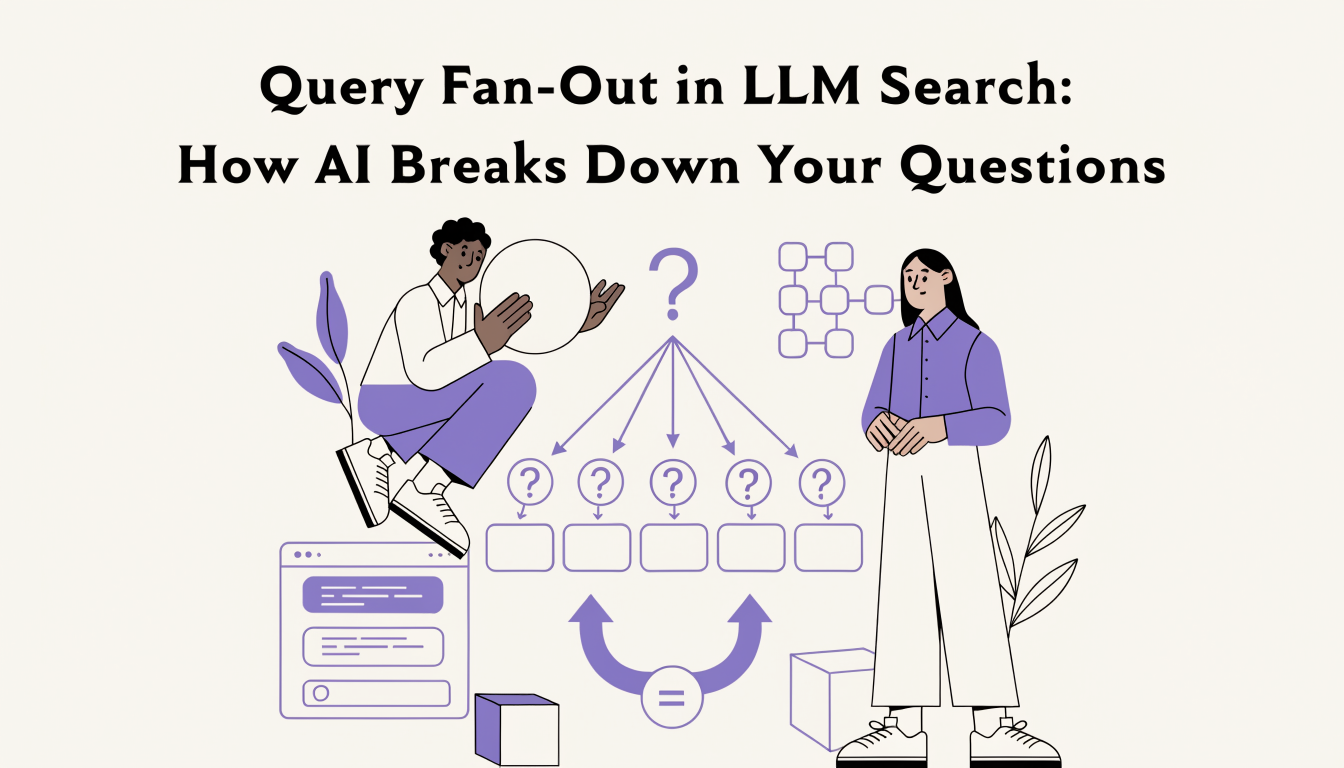
Query Fan-Out in LLM Search: How AI Breaks Down Your Questions
Learn what query fan-out in LLM search is, how AI splits your prompt into 3-8 sub-queries, and how to structure content to win more citation passes.