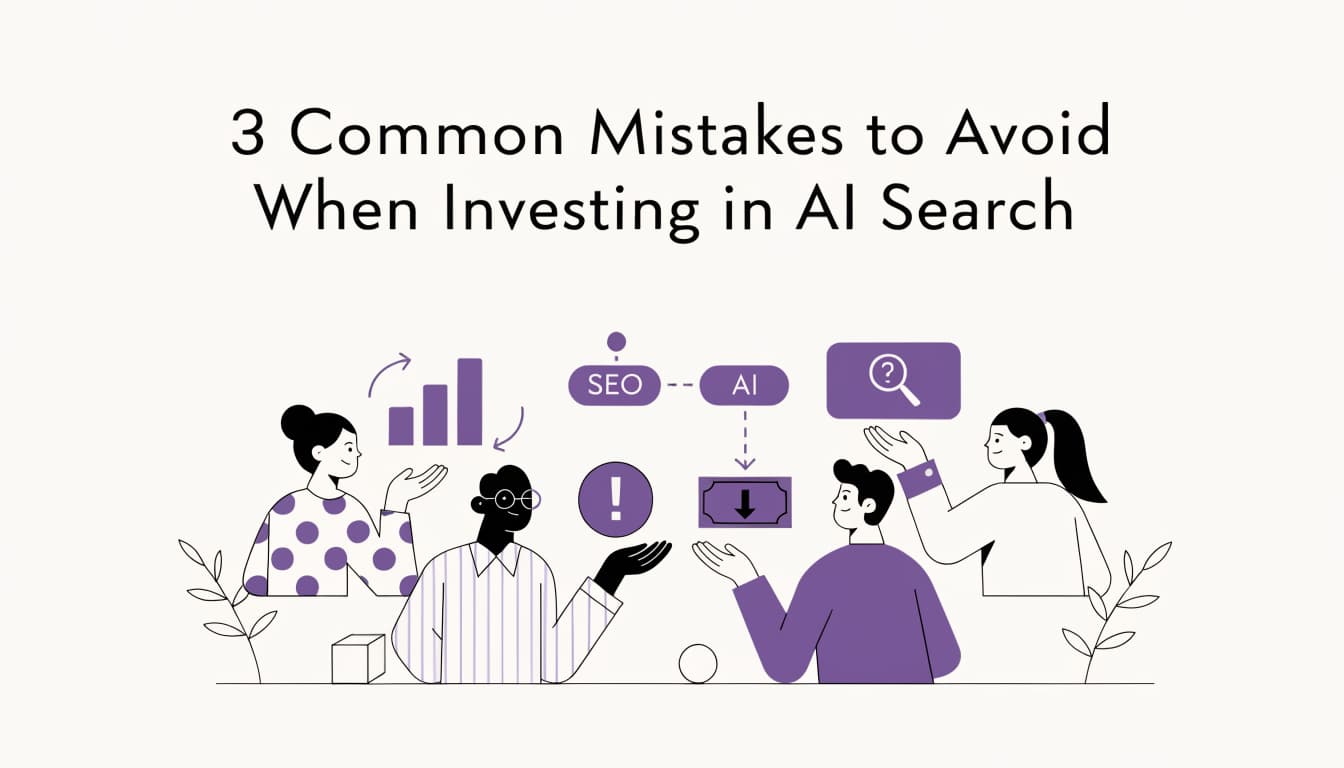
3 Common Mistakes to Avoid When Investing in AI Search
Last updated: 24 July 2026
Brands that treat AI search as a separate channel from SEO almost always waste budget and misread results. The 3 common mistakes to avoid when investing in AI search come down to misaligned metrics, disconnected strategy, and underestimating how differently AI systems surface brands versus traditional search engines.
Why AI Search Demands a Different Strategic Lens
AI search — including Google's AI Overviews, AI Mode, and standalone tools like Perplexity — does not rank ten blue links. It synthesizes an answer, often citing two or three sources, and the user may never scroll further. That changes the economics of visibility entirely.
A brand that holds position three in organic search might receive substantial click traffic. The same brand cited third in an AI-generated answer may receive almost none, because the answer itself satisfies the query. Measuring success the same way you did in 2022 will produce misleading data and bad decisions. Understanding how AI is changing search is not optional — it directly affects how you allocate content and technical resources.
Mistake 1 — Treating AI Search Optimization as a Separate Silo
The most expensive mistake is building a parallel AI search program that does not talk to your existing SEO initiative. Teams end up duplicating keyword research, producing conflicting content briefs, and reporting to leadership with numbers that cannot be compared.
AI search systems draw heavily from the same signals that traditional search engines use: authoritative backlinks, structured data, clear entity relationships, and content that directly answers questions. A 2024 analysis by Search Engine Land found that brands misaligning AI and SEO efforts lose both the efficiency of shared infrastructure and the compounding benefit of consistent topical authority.
What to do instead
Audit your existing SEO content map. Tag every piece by query intent — informational, navigational, commercial, transactional. Then overlay which intents AI Overviews currently absorb in your category. You will find that informational and comparison queries are most at risk of zero-click outcomes. Redirect content investment toward those gaps rather than creating a second, disconnected content calendar.
Mistake 2 — Using the Wrong Metrics to Judge Performance
Traditional SEO metrics — organic sessions, average position, click-through rate — do not capture AI search brand visibility. If an AI answer cites your brand accurately but the user never clicks, your analytics show zero. You conclude the strategy is failing when it may actually be working.
AI search visibility factors include mention frequency in AI-generated answers, citation accuracy (does the AI describe your product correctly?), and sentiment consistency across answer variations. Because AI answers differ by user history, location, and context, a single query can produce meaningfully different outputs for different users. Assuming one canonical answer exists will systematically misrepresent your actual footprint.
A concrete measurement framework
| Metric | Traditional SEO | AI Search |
|---|---|---|
| Primary visibility signal | Rank position | Citation frequency in AI answers |
| Traffic indicator | Organic sessions | Branded direct + dark social traffic |
| Content quality proxy | Dwell time | Accuracy of AI-generated summaries |
| Competitive benchmark | SERP share | Share of AI citations by topic cluster |
Track branded direct traffic as a proxy for AI-driven awareness. When users see your brand in an AI answer and later search for you by name, that shows up as direct or branded organic — not as a referral from an AI platform. Building this attribution model early prevents the false conclusion that AI search delivers no value.
Mistake 3 — Ignoring Brand Visibility as a Ranking Input
Most content teams focus on topical authority signals — word count, keyword density, internal linking — while neglecting the brand signals that AI systems weight heavily. AI models are trained on web-scale data. Brands that appear consistently, accurately, and positively across third-party sources (review sites, industry publications, Wikipedia-adjacent reference pages) are more likely to be cited in AI answers than brands with strong SEO but thin off-site presence.
This is where SEO vs AI search strategy diverges most sharply. A technically perfect page with no external corroboration may rank well in Google's traditional index but get ignored by an AI synthesis layer that cannot find independent confirmation of your claims.
Concrete steps that move the needle here: earn structured mentions on authoritative industry sites, ensure your Google Business Profile and schema markup are complete and current, and actively manage how third-party review platforms describe your products. One brand in the B2B SaaS space increased AI citation frequency by roughly 40% over six months by systematically updating their Crunchbase, G2, and industry association profiles — without publishing a single new blog post.
The risk of over-investing without a plan
There is a real trade-off to acknowledge: AI search optimization is still maturing. Platforms change their citation logic frequently, and tactics that work in Google AI Overviews may not transfer to AI Mode or Perplexity. Brands that over-invest in narrow platform-specific optimizations before the landscape stabilizes risk wasting resources. A balanced approach — roughly 70% effort on durable signals (authority, accuracy, structured data) and 30% on platform-specific testing — provides resilience without abandoning experimentation.
Measuring Success and Recognizing Failure Modes Early
Set a 90-day measurement cadence, not a weekly one. AI search visibility shifts more slowly than rank positions, and weekly noise will drive reactive decisions. The three signals worth tracking consistently are: (1) share of AI citations for your top 20 target queries, (2) accuracy rate of how AI describes your brand, and (3) branded search volume trend as a downstream indicator.
Common failure modes to watch for: a team that reports only traditional SEO metrics will always undercount AI search value; a team that reports only AI citation counts without connecting them to revenue will struggle to justify budget. Both extremes produce bad strategy. The goal is a blended dashboard that shows the full funnel from AI answer to brand awareness to conversion.
Your First 30 Days: A Realistic Action Plan
Weeks one and two are for audit. Map which of your priority queries now trigger AI Overviews or AI Mode responses in Google. Note which sources are being cited and whether your brand appears. This takes manual effort but costs nothing beyond time.
Weeks three and four are for quick wins. Update your schema markup (FAQ, HowTo, and Organization schemas are the highest-leverage types). Correct any inaccurate descriptions of your product on G2, Capterra, or equivalent review platforms. Submit or update your brand's Wikipedia-adjacent reference entries if they exist. These are durable changes that benefit both traditional SEO and AI search visibility — no parallel program required.
Month two onward, run a small content experiment: produce three to five tightly scoped, question-answering pieces targeting informational queries where you currently have no AI citation presence. Measure citation frequency at 60 days. Use that data to calibrate how much content investment is warranted before scaling.
See how seorav.com can help you build a measurement framework and content strategy that covers both traditional SEO and AI search visibility — without duplicating effort or misreading results.
Frequently Asked Questions
What are the most common AI search mistakes brands make?
The three most common mistakes are running AI search optimization as a separate silo from existing SEO, using traditional metrics like click-through rate that do not capture AI citation visibility, and neglecting off-site brand signals that AI systems rely on to verify authority. Each mistake independently wastes budget; together they make it nearly impossible to measure real performance.
What is the 30% rule in AI search investment?
A practical allocation principle suggests spending roughly 70% of AI search optimization effort on durable, platform-agnostic signals — structured data, authoritative backlinks, accurate brand mentions — and reserving about 30% for platform-specific testing. Because AI search platforms update their citation logic frequently, over-indexing on narrow tactics risks wasting resources when those platforms change.
What are the risks of investing in AI search optimization?
The main risks are platform volatility (citation logic changes without notice), misattribution of results (AI-driven brand awareness rarely shows as a direct referral), and opportunity cost if budget is pulled from proven SEO programs prematurely. Brands that invest without a measurement framework often cannot distinguish genuine progress from random fluctuation, leading to premature cancellation of effective strategies.
How does AI search differ from traditional SEO in terms of brand visibility?
Traditional SEO rewards page-level signals — keyword relevance, backlinks, technical health — and delivers traffic through clicks. AI search rewards entity-level signals — how consistently and accurately a brand is described across independent sources — and delivers awareness even when no click occurs. Brands need both a content strategy and an off-site brand accuracy program to compete in AI search.
How can I optimize content for AI search without abandoning my existing SEO strategy?
Start by auditing your existing content map and tagging pieces by query intent. Identify which intents AI Overviews currently absorb in your category. Then redirect new content investment toward those gaps rather than building a parallel program. Shared infrastructure — structured data, topical authority clusters, authoritative backlinks — benefits both traditional SEO and AI search simultaneously.
What metrics should I track for AI search brand visibility?
Track citation frequency for your top target queries in AI-generated answers, the accuracy of how AI describes your brand, and branded direct traffic as a downstream proxy for AI-driven awareness. Traditional metrics like organic sessions and average position remain useful for traditional search but will systematically undercount AI search value if used in isolation.
Keep reading
Ranking in Google's AI Search: The Deterministic Signals That Actually Move the Needle
Learn how do you rank in SGE with the three signals Google's AI uses to cite sources: schema markup, entity salience, and structured factual claims.
Why AI Ignores Your Content (And How to Fix It)
Learn how to avoid AI content that gets ignored by LLMs. Covers RAG retrieval signals, schema, entity salience, and an answer-first structure checklist.
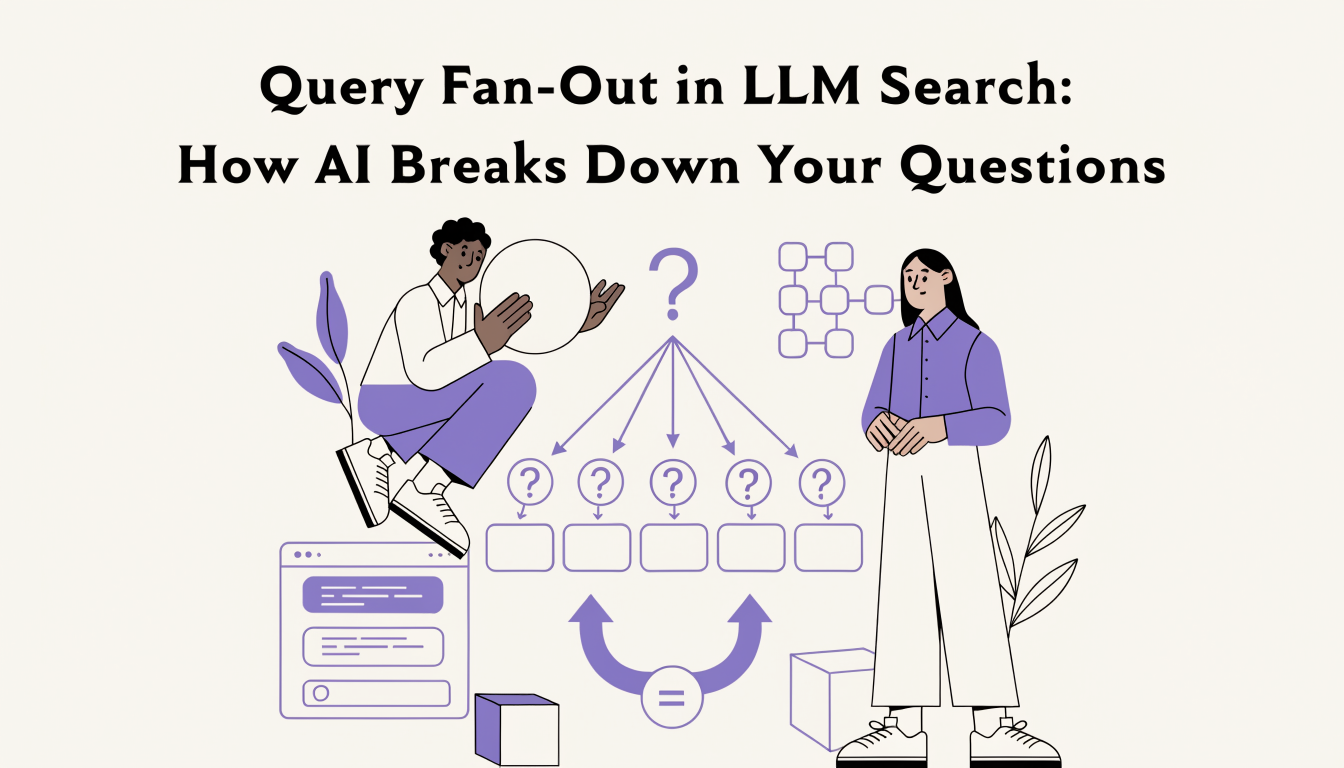
Query Fan-Out in LLM Search: How AI Breaks Down Your Questions
Learn what query fan-out in LLM search is, how AI splits your prompt into 3-8 sub-queries, and how to structure content to win more citation passes.