10 Best AI SEO Tools and LLM Tracking in 2026: A Strategy Guide
Last updated: 25 July 2026
The 10 best AI SEO tools and LLM tracking in 2026 are not just about ranking on Google anymore. Search behavior has fractured: a growing share of queries now resolve inside ChatGPT, Perplexity, and Google's AI Overviews before a user ever clicks a link. The tools that matter most right now track both traditional rankings and AI-generated citations simultaneously.
Why AI Visibility Now Sits Alongside Traditional SEO
Google's AI Overviews appeared in roughly 47% of US search results by mid-2024, according to tracking published by SE Ranking. That number has only grown. At the same time, Perplexity's monthly active user base crossed 15 million by late 2024. These are not fringe behaviors — they represent a structural shift in how people get answers.
Traditional SEO still works. Organic blue-link rankings drive real traffic, and that is not changing overnight. What has changed is that a page can rank #2 on Google and still lose the informational battle if a competitor's content is the one cited inside an AI-generated answer. Tracking both dimensions is now a baseline requirement, not an advanced tactic.
What to Look for Before Choosing a Tool
Not every tool in this category does the same job. Before committing to a platform, map your needs against three axes:
- LLM mention tracking — Does the tool query ChatGPT, Gemini, Perplexity, or Claude directly and log when your brand or content is cited?
- Content optimization — Does it help you write or restructure content to increase the probability of being cited?
- Traditional rank tracking — Does it still cover keyword positions, SERP features, and backlink data?
Some platforms are strong on all three. Many are strong on one. Paying for overlap you will not use is a common waste.
The 10 Best AI SEO Tools and LLM Tracking in 2026
Below is a practical breakdown of the leading options, grouped by primary strength. Pricing tiers shift frequently, so treat any figure here as a directional estimate rather than a quote.
Tools Built Around AI Visibility First
1. Profound — Designed specifically to track brand mentions inside LLM outputs. It queries multiple AI models on a schedule and surfaces which competitors are being cited more often than you, and for which topics. Best for brand-heavy queries.
2. Otterly.ai — Monitors AI-generated answers across ChatGPT and Perplexity for a defined keyword set. Lightweight and focused; less suited to full-scale content workflows.
3. Peec AI — Tracks "share of voice" inside AI answers, similar to how traditional tools track rank share. Useful for competitive benchmarking in a specific niche.
4. Athena — Positions itself as an AI visibility intelligence layer. It identifies which content attributes (structure, source authority, entity coverage) correlate with LLM citations in your vertical.
Tools That Combine Traditional SEO with AI Tracking
5. Semrush AI Toolkit — Semrush added an AI Overviews tracking module to its existing suite in 2024. For teams already inside the Semrush ecosystem, this is the lowest-friction way to add AI visibility data without switching platforms. The trade-off: LLM tracking depth is shallower than dedicated tools.
6. SE Ranking — Offers AI Overview monitoring alongside standard rank tracking at a mid-market price point. Strong for agencies managing multiple client accounts.
7. Surfer SEO — Primarily a content optimization platform that uses NLP-based scoring to align content with what both Google and AI models tend to surface. Its AI visibility features are newer and still maturing, but the content editor remains one of the most practical on the market.
8. Writesonic (with GEO tracking) — Combines a content generation suite with Generative Engine Optimization (GEO) tracking. Useful for teams that produce high content volume and want to optimize for AI citation at scale. The all-in-one nature means depth on any single feature is a trade-off.
Tools Built for Content Operations at Scale
9. Frase AI — Strong at content briefing and semantic gap analysis. It identifies which questions and entities your existing content is missing relative to what ranks and what gets cited. A comparative review of AI visibility tools places Frase alongside Surfer and Profound as a top-ten option across use cases.
10. AirOps — Focused on scaling content workflows using AI, with integrations that let SEO teams build repeatable pipelines for brief creation, drafting, and optimization. Less of a tracking tool and more of a production infrastructure layer.
Free and Low-Cost Options Worth Knowing
Several teams ask about the 10 best AI SEO tools and LLM tracking in 2026 free or near-free options. The honest answer: genuine LLM tracking at scale has infrastructure costs that make fully free tiers rare. That said, a few practical starting points exist:
- Google Search Console remains free and now surfaces AI Overview impression data in some markets.
- Manual LLM querying — building a spreadsheet of 20-30 brand or product queries and running them weekly inside ChatGPT and Perplexity costs nothing but time. It is not scalable, but it is a valid proof-of-concept before paying for a dedicated tool.
- Several platforms above (Frase, SE Ranking, Writesonic) offer limited free trials that are long enough to validate fit.
Measuring Success and Common Failure Modes
The metrics that matter depend on the goal. For AI visibility specifically, track:
| Metric | What It Measures | Tool Examples |
|---|---|---|
| LLM citation rate | % of tracked queries where your brand/URL is cited | Profound, Otterly.ai, Peec AI |
| AI Overview impressions | Appearances in Google AI Overviews | Google Search Console, Semrush |
| Share of voice in AI answers | Your mentions vs. competitors across a keyword set | Athena, Peec AI |
| Organic CTR from AI-adjacent SERPs | Click-through rate on pages that appear near AI Overviews | Google Search Console |
| Content gap coverage | % of key entities and questions covered per page | Frase, Surfer SEO |
The most common failure mode is tracking LLM mentions without acting on the data. A tool tells you that a competitor is cited 3x more often than you for "best [category] software" — but if no one on the team is tasked with restructuring content to close that gap, the data sits unused. Assign ownership before buying a platform.
A second failure mode: optimizing exclusively for AI citation at the expense of traditional search. Pages that rank well on Google still drive the majority of attributable organic traffic for most businesses. Abandoning keyword strategy to chase AI visibility is premature for most teams.
Is SEO Dead or Evolving in 2026?
SEO is evolving, not dying. The discipline has absorbed every previous disruption — mobile-first indexing, featured snippets, voice search — and expanded. What is dying is the narrow version of SEO that treats keyword stuffing and link quantity as the primary levers. The version that survives, and thrives, combines entity-based content structure, genuine topical authority, and LLM-aware optimization. That is a harder job than it was in 2018, but it is also a more defensible one.
Your First 30 Days: A Realistic Action Plan
Avoid buying five tools simultaneously. Instead, run a focused 30-day sprint:
- Week 1 — Audit your current AI visibility manually. Pick your 25 most important queries and run them in ChatGPT and Perplexity. Log whether your brand or content appears.
- Week 2 — Identify the top 3 pages that should be cited but are not. Analyze what the cited competitors have in common: more structured headers, more specific data, more direct answers to the query.
- Week 3 — Rewrite or restructure those 3 pages. Add a clear direct-answer paragraph in the first 100 words. Cover related entities and questions that your current draft omits.
- Week 4 — Re-run your manual queries. Measure change. Use that data to decide which paid tool, if any, is worth the investment for ongoing tracking.
This sprint costs nothing but time and gives you a real baseline before any tool purchase.
See how seorav.com can help you build an AI visibility strategy that connects LLM tracking to content action — not just dashboards. Getting the data is step one; knowing what to do with it is where most teams need support.
Frequently Asked Questions
What are the top 10 AI SEO tools in 2026?
The leading options in 2026 span two categories: AI visibility trackers (Profound, Otterly.ai, Peec AI, Athena) and combined SEO-plus-AI platforms (Semrush AI Toolkit, SE Ranking, Surfer SEO, Writesonic, Frase AI, AirOps). The right choice depends on whether your priority is tracking LLM citations, optimizing content, or scaling production. Most teams benefit from one tool per function rather than one platform for everything.
What is the best SEO tool for 2026?
There is no single best tool for every team. Semrush remains the most comprehensive traditional SEO platform with added AI Overview tracking. Profound leads for dedicated LLM citation monitoring. Surfer SEO and Frase AI are strongest for content optimization. The practical approach is to identify your primary gap — visibility tracking, content quality, or production scale — and choose accordingly, rather than defaulting to the most-marketed option.
Is SEO dead or evolving in 2026?
SEO is evolving, not dead. Organic search still drives the majority of attributable web traffic for most businesses. What has changed is the definition of 'ranking' — a page now needs to appear in Google's blue links AND be cited inside AI-generated answers to capture the full opportunity. Teams that treat traditional SEO and LLM optimization as separate disciplines will underperform those that integrate both.
Are there free AI visibility tracking tools in 2026?
Fully free LLM tracking tools with automated querying are rare because the infrastructure costs are real. Google Search Console provides free AI Overview impression data in supported markets. Manual querying — running your key questions inside ChatGPT and Perplexity on a weekly schedule — is a zero-cost starting point. Most paid platforms offer limited free trials long enough to assess fit before committing to a subscription.
How is LLM tracking different from traditional rank tracking?
Traditional rank tracking measures where a URL appears on a search engine results page for a given keyword. LLM tracking measures whether your brand, URL, or content is cited inside an AI-generated answer when a user asks a related question. The two metrics do not always correlate — a page can rank on page one of Google and never appear in a ChatGPT response, and vice versa. Both signals now matter.
How quickly can content changes improve AI citation rates?
There is no guaranteed timeline, and this is an important limitation to acknowledge. LLMs are updated on their own training and retrieval schedules, which vary by model. Changes that improve how clearly and directly your content answers a question can show results in Perplexity (which retrieves live content) within days. For ChatGPT's base model, changes may take weeks or months to reflect, depending on when the model is next updated or fine-tuned.
Keep reading
Ranking in Google's AI Search: The Deterministic Signals That Actually Move the Needle
Learn how do you rank in SGE with the three signals Google's AI uses to cite sources: schema markup, entity salience, and structured factual claims.
Why AI Ignores Your Content (And How to Fix It)
Learn how to avoid AI content that gets ignored by LLMs. Covers RAG retrieval signals, schema, entity salience, and an answer-first structure checklist.
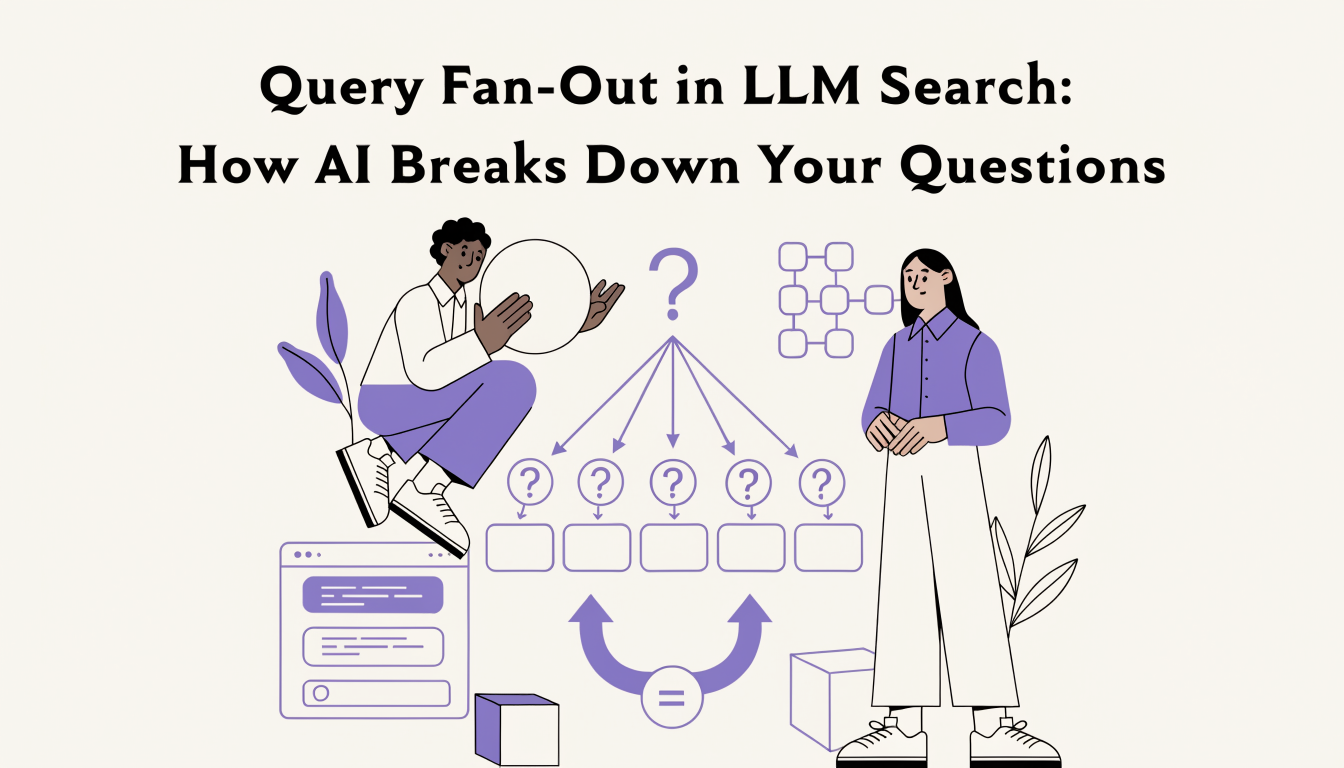
Query Fan-Out in LLM Search: How AI Breaks Down Your Questions
Learn what query fan-out in LLM search is, how AI splits your prompt into 3-8 sub-queries, and how to structure content to win more citation passes.