Measuring the Real Value of Zero-Click Visibility in AI Search
Last updated: 27 September 2026
Zero-Click Visibility Yield measures how often AI systems cite your content in generated answers, weighted by whether users remember your brand as the source. A piece surfaced in 100 AI responses but attributed to a competitor has lower yield than content cited 40 times with strong brand recall. This metric captures real influence in an environment where traffic and clicks no longer signal authority. Understanding your actual yield requires tracking both citation frequency and attribution accuracy across multiple AI platforms.
Clicks are no longer a reliable proxy for reach. Semrush's zero-click research identifies branded search growth and AI visibility scores as the practical signals teams should track when click-through data goes quiet. That quiet is spreading fast. In a 2024 SparkToro study, 58.5% of U.S. searches ended without a single click, and the trajectory has continued upward since.
AI-generated answers differ from featured snippets in one important way. Snippets surface a fragment and invite the user to verify by clicking. AI answers synthesize, conclude, and often resolve the query entirely. Users leave with an answer and, if your brand was cited, a faint but real association with having provided it. That association is what Zero-Click Visibility Yield tries to capture.
One honest caveat: attribution is imprecise. Brand recall from an AI citation is harder to measure than a session in your analytics dashboard, and the methodology is still maturing across the industry.
What Zero-Click Visibility Yield Actually Measures
Zero-Click Visibility Yield is a composite score. It aggregates citation frequency across AI engines, estimated impression volume, and downstream brand recall into one number. No single metric captures all three, and anyone selling you a single-number solution is skipping at least one of those legs.
AI citations move brand perception even when nobody clicks. Similarweb's zero-click marketing analysis puts zero-click searches at 68% of all Google queries. That is a large audience receiving brand impressions with no click ever recorded in your analytics.
Standard SEO dashboards are blind to most of this. Organic CTR, session counts, and ranking positions do not register a citation inside a ChatGPT or Perplexity response. The measurement gap is structural, not a reporting lag you can fix with a filter.
ROI calculation requires two data streams. Citation tracking tells you when and where your brand appears. Brand lift surveys tell you whether those appearances changed recall or preference. Neither stream is sufficient on its own.
The trade-off worth acknowledging: brand survey data is slow and expensive to collect at meaningful sample sizes. For smaller brands or early-stage programs, the lag between citation activity and measurable lift can stretch several months, long enough that the two data streams are hard to correlate cleanly. This approach works best when survey cadence is set up before citation tracking begins, not retrofitted afterward.
How AI Search Changes the Economics of Zero-Click Traffic
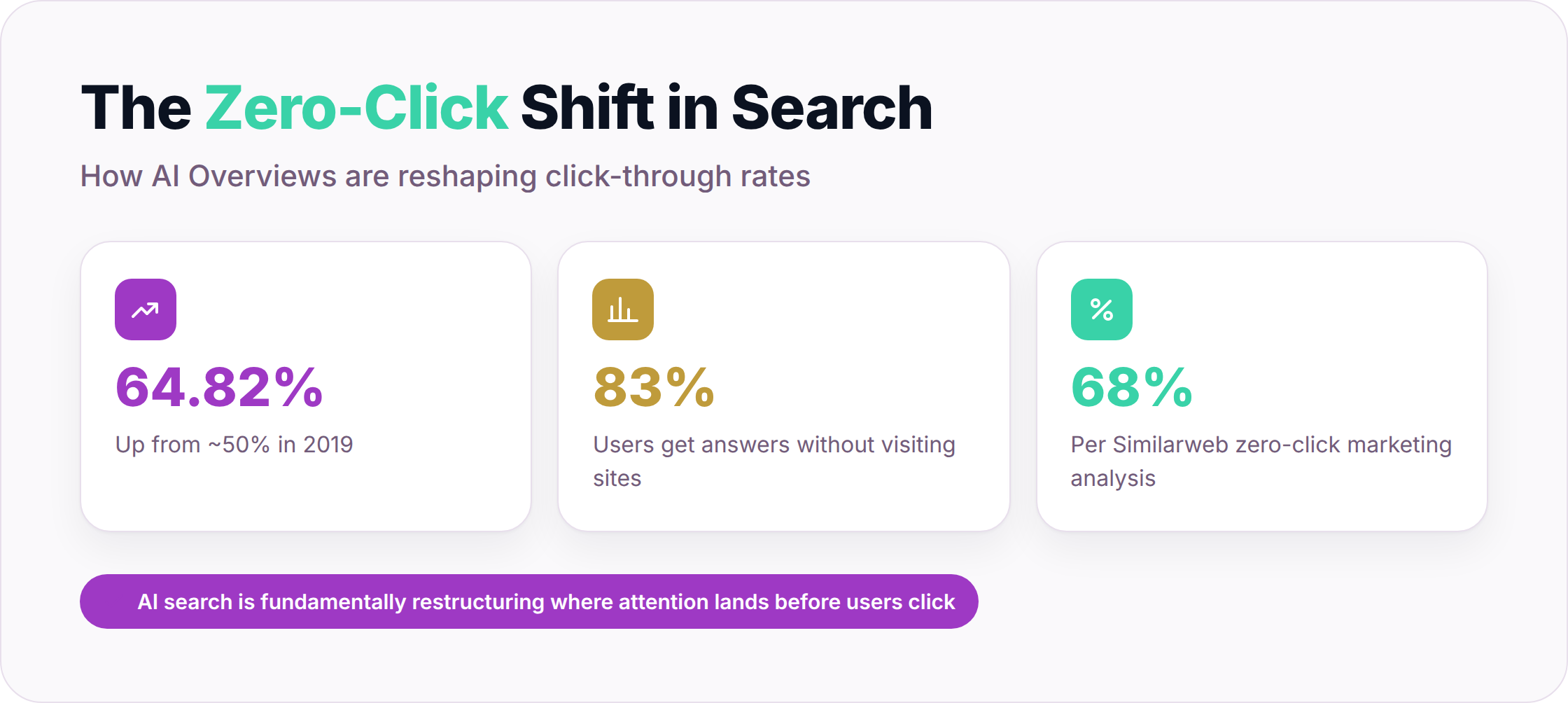
AI search is restructuring where attention lands before a user ever decides to click. As LLMs synthesize answers directly inside the search interface, the traditional click-through becomes optional rather than necessary. Brand exposure now happens at the answer layer, not the results layer. Visibility inside a generated response carries real commercial weight even when it produces zero referral sessions in your analytics.
The Click Decline Is Already Measurable
The numbers are not ambiguous. Zero-click data compiled across 2024 and 2025 shows 64.82% of Google searches now end without a click, up from roughly 50% in 2019. When an AI Overview is present on the page, that figure climbs to 83%. The user got their answer. They just never visited anyone's site.
This is not a temporary plateau. SparkToro's tracking of U.S. search behavior found a 7.5 percentage-point increase in clickless queries between 2022 and 2024 alone, the steepest two-year acceleration on record. Referral traffic from Google is declining in absolute terms for many informational content categories, and the replacement is not another traffic source. The replacement is impression-based brand presence inside AI-generated text.
Impressions Inside an LLM Answer vs. a Blue Link
A blue link delivers attention only if the user clicks. An impression inside an LLM answer delivers attention unconditionally: the model reads your source, synthesizes from it, and the user reads the synthesis. Your brand name or your claim appears in the response whether or not the user ever touches your URL.
That changes the economics considerably. A citation in a ChatGPT or Perplexity answer reaches a user who is already reading, already engaged, and already receiving your framing of a topic. A blue link on page one of Google reaches a user who may scroll past it entirely. The attention quality per impression is higher at the LLM layer, even if the raw session count is lower.
The trade-off is real. Impression-based visibility is genuinely harder to measure than a session in Google Analytics. If your business model depends on last-click attribution, a citation in an AI answer looks like nothing in your reporting stack even when it is shaping purchase intent. This also breaks down for transactional queries where users still click through to complete an action. A cited source for "best project management software" carries weight; a cited source for "buy project management software" matters far less if the user never reaches your pricing page.
Query Fan-Out Multiplies Your Surface Area
LLM-based search engines do not process a single query and fetch one page. They decompose the user's question into multiple sub-queries, retrieve candidate sources across each, and synthesize a unified answer. A user asking "how do I reduce SaaS churn in enterprise accounts" might trigger sub-queries around churn benchmarks, retention playbooks, customer success org structures, and pricing model research. Each sub-query is a separate retrieval event.
For content teams, this matters structurally. A single well-structured article that covers a topic with enough depth and specificity can surface across several of those sub-queries simultaneously, earning multiple citation opportunities from one user intent. Topical depth and precise claim-making are not just good writing practice. They are the mechanism by which a single piece of content earns disproportionate presence inside AI-generated answers.
Quantifying Brand Lift from AI Citations Without Clicks
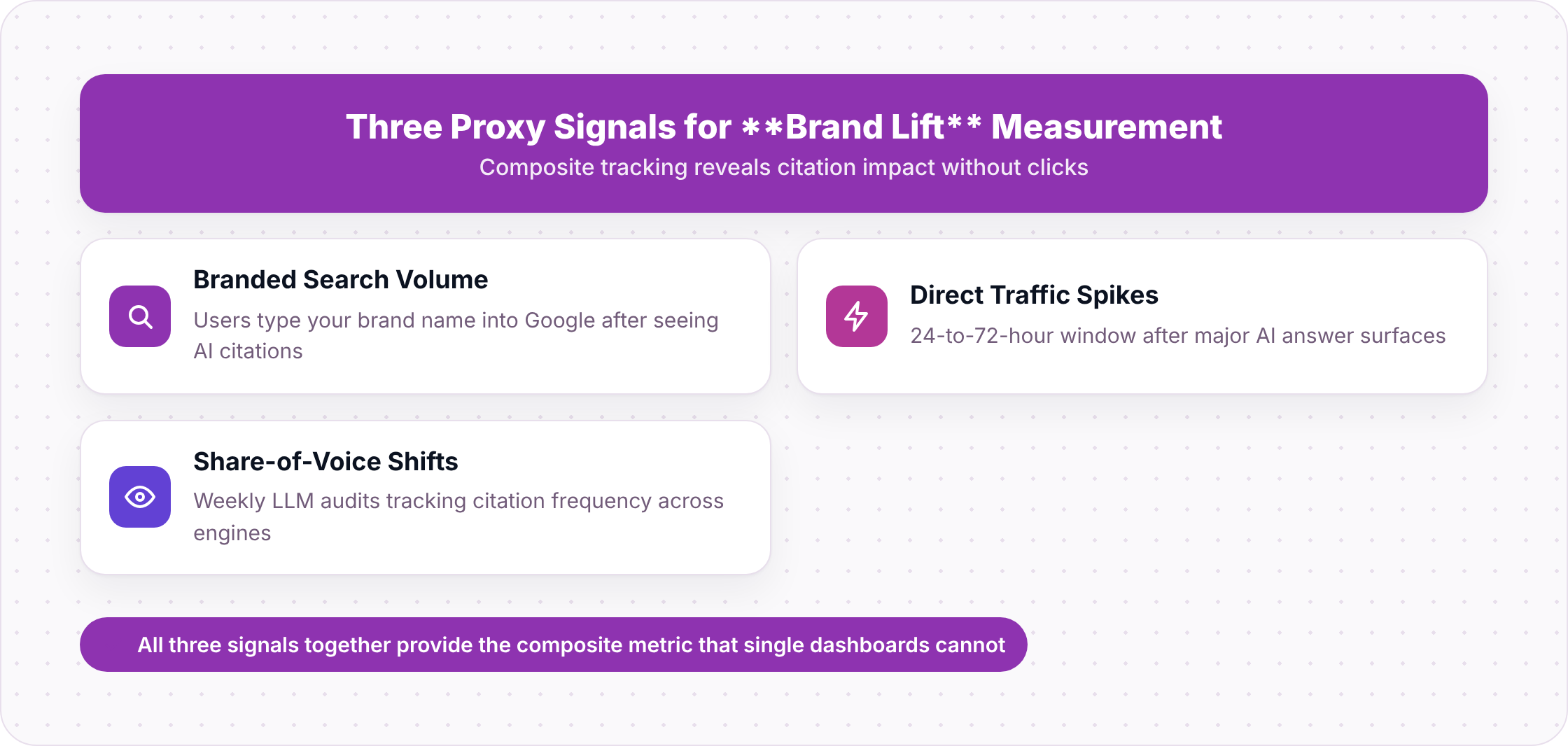
Brand lift from AI citations is measurable even when no click fires. Three proxy signals correlate reliably with citation frequency: branded search volume in Google Search Console, direct traffic spikes in the 24-to-72-hour window after a major AI answer surfaces, and share-of-voice shifts in weekly LLM audits. Tracking all three together gives you a composite signal that no single metric can provide alone.
The Three Proxy Signals
Branded search volume is the most accessible starting point. When ChatGPT or Perplexity names your product in a conversational answer, a portion of those users type your brand name directly into Google rather than clicking a link. That behavior registers as branded search with no referral string attached. Bain's consumer research puts roughly 80% of consumers in the zero-click category for at least 40% of their searches, which means the population generating this branded search signal is large enough to be statistically meaningful.
Direct traffic spikes work as a secondary confirmation. If branded search rises and direct sessions spike in the same 48-hour window, the probability that an AI citation drove both is high. Neither signal alone is conclusive. Together, they form a correlated pair worth flagging in your attribution model.
Share-of-voice in LLM audits is the third leg. Running weekly prompt polls across ChatGPT, Perplexity, Claude, and Gemini on your target queries lets you track how often your brand appears versus competitors. When your citation share rises 10 percentage points in a given week, check whether branded search and direct traffic moved in the same direction. If they did, you have a defensible case for brand lift.
Running a Controlled Brand Lift Study
The cleanest method is a geo-split or audience-split test. Hold one segment unexposed to any AI-optimized content changes, run your LLM optimization work in the other, and compare branded search growth over a 60-to-90-day window. This is the same structure used in traditional brand lift studies, applied to a new measurement layer.
The trade-off is time. Sixty days is a long feedback loop when content teams are shipping weekly. A faster proxy is to correlate citation frequency from your LLM audit logs against branded query volume in 14-day rolling windows. It is not a controlled experiment, but it surfaces directional signal quickly enough to inform prioritization decisions.
This approach breaks down when your brand is already a high-volume search term. If users search your brand name thousands of times per day for reasons unrelated to AI answers, a 3% lift from citations will be invisible in the noise. In that case, direct traffic spikes and LLM share-of-voice become your primary instruments, and branded search becomes a lagging confirmation rather than a leading indicator.
E-E-A-T and LLM Optimization Are the Same Lever
The signals Google uses to assess Experience, Expertise, Authoritativeness, and Trustworthiness (E-E-A-T) overlap substantially with what AI engines use to decide which sources to cite. Both reward first-hand evidence, named authors with verifiable credentials, citations to primary sources, and structured content that answers a specific question directly. Optimizing for one now optimizes for the other.
This convergence matters for measurement. If your E-E-A-T improvements lift your Google rankings and your LLM citation share simultaneously, you cannot cleanly attribute brand lift to either channel in isolation. The practical response is to track both in parallel and report them as a combined visibility metric rather than trying to separate them. Teams that insist on clean attribution often end up under-investing in content quality because the signal looks weaker than it actually is.
Calculating ROI on Content Optimized for AI Citation
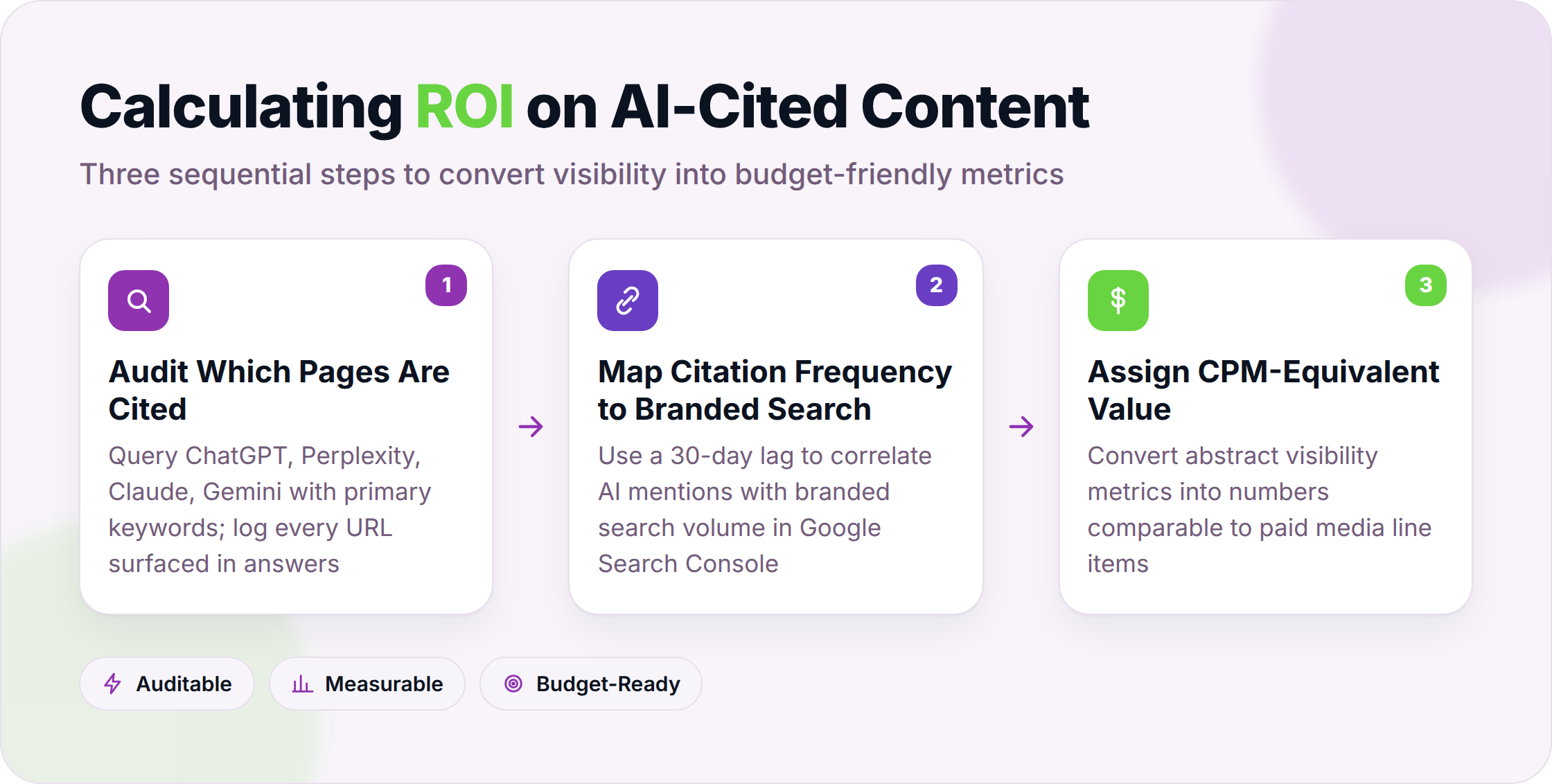
Calculating ROI on AI-cited content requires three sequential steps: auditing which pages already appear in AI-generated answers, mapping citation frequency to branded search volume using a 30-day lag, and assigning a CPM-equivalent value to AI impressions. Done in order, these steps convert an abstract visibility metric into a number that sits comfortably next to a paid media line item on a marketing budget.
Step 1: Audit Which Pages Are Already Getting Cited
Start with what you have. Pull your top 50 organic pages by traffic, then manually query ChatGPT, Perplexity, Claude, and Gemini with the primary keyword for each page. Log every URL each engine surfaces in its answer. This is tedious at scale, but the output is concrete: a list of pages that already carry citation weight and a list of pages that do not, despite ranking well in traditional search.
Pages that rank on page one of Google but never appear in LLM answers are a specific type of problem. They are usually too thin, too hedged, or structured in a way that makes it hard for a model to extract a clean, citable claim. Those pages are your highest-priority optimization targets, because the traffic infrastructure is already there and the citation gap is a content quality issue, not a domain authority issue.
Step 2: Map Citation Frequency to Branded Search Volume
Once you have a citation log, pull 30 days of branded query data from Google Search Console and look for directional correlation. You are not trying to prove causation at this stage. You are looking for a pattern: weeks when your LLM citation share was higher should show modest but consistent upticks in branded search volume 2-to-4 weeks later.
The 30-day lag is a rough estimate. For high-frequency queries where AI answers update daily, the lag may compress to 7-to-14 days. For niche B2B topics where the AI answer is more stable, the lag can stretch to 6 weeks. Calibrate the window to your query category before drawing conclusions.
Step 3: Assign a CPM-Equivalent Value to AI Impressions
This is where Zero-Click Visibility Yield becomes a budget-ready number. Take your estimated monthly AI impressions (citation frequency multiplied by the average monthly query volume for each cited query), and apply a CPM benchmark from a comparable paid channel. Display CPMs for your industry are a reasonable floor. Branded keyword CPCs are a reasonable ceiling.
If your content earns 400,000 estimated AI impressions per month and your industry display CPM is $8, the floor value of that visibility is $3,200 per month. If your branded CPC is $4.50 and you estimate a 2% click-equivalent conversion rate from AI impressions, the ceiling value is higher. The range gives you a defensible ROI band rather than a single number that will be challenged in the next budget review.
One limitation to flag: estimated query volume figures from keyword tools are built for traditional search and may not reflect actual LLM query frequency. Treat the CPM calculation as a directional benchmark, not a precise revenue attribution.
Frequently Asked Questions
What is Zero-Click Visibility Yield and how is it different from traditional SEO metrics?
Zero-Click Visibility Yield measures how often your brand is cited inside AI-generated answers and how reliably users associate those citations with your brand, without requiring a click to occur. Traditional SEO metrics like organic CTR and session counts only register when a user visits your site, so they miss the entire layer of brand exposure happening inside ChatGPT, Perplexity, and similar tools. The two measurement systems are tracking different things, and you need both to understand your full search presence.
Can small brands realistically track Zero-Click Visibility Yield?
Yes, though the methodology scales down. A small brand can run weekly manual audits across two or three AI engines, track branded search volume in Google Search Console, and watch for direct traffic spikes after notable AI answer appearances. The formal brand lift study (geo-split, 90-day window) is harder to execute at small sample sizes, but the proxy signals are accessible to any team with basic analytics access. Start with the audit and the branded search correlation before investing in survey infrastructure.
How do I know if an AI citation actually drove a branded search, rather than some other source?
You cannot know with certainty, and anyone claiming otherwise is overstating the methodology. What you can do is look for correlated movement: branded search rises and direct traffic spikes in the same short window, your LLM audit shows a citation share increase in the same period, and no other obvious cause (a press mention, a paid campaign, a viral post) explains the pattern. When all three align, the citation is the most probable driver. When only one signal moves, treat it as inconclusive.
What content changes most reliably increase AI citation frequency?
Specific, citable claims outperform general advice. A sentence like "enterprise SaaS churn averages 6-8% annually according to Bain's 2024 benchmark study" is far more likely to be pulled into an AI answer than "churn is a significant problem for SaaS companies." Named authors with verifiable credentials, primary source citations, and direct answers to specific questions (rather than hedged overviews) are the structural features that AI engines consistently favor. These are the same features that improve E-E-A-T scores, so the optimization work compounds across both channels.
How long before AI citation optimization produces measurable brand lift?
Expect 60-to-90 days before branded search movement is statistically distinguishable from baseline noise, assuming you are tracking from the start. Content changes that earn citations quickly (within 2-to-4 weeks of publication) can compress that timeline, but the brand recall effect accumulates gradually. If you are retrofitting measurement onto a program that has been running for months without a baseline, the correlation work becomes significantly harder. Set up your tracking before you start optimizing, not after.
Is Zero-Click Visibility Yield relevant for e-commerce or only for informational content?
It is most directly relevant for informational and consideration-stage content, where AI answers resolve queries without requiring a transaction. For pure transactional queries ("buy X now"), the user still needs to click somewhere to complete the purchase, so traditional conversion tracking remains the primary metric. The overlap zone is product research and comparison queries, where an AI citation can shape brand preference before the user reaches a transactional page. E-commerce brands with strong informational content (buying guides, comparison articles, category explainers) have real exposure to Zero-Click Visibility Yield even if their product pages do not.
Start Measuring What AI Search Is Actually Doing to Your Brand
Zero-Click Visibility Yield will not show up in your current analytics stack on its own. You have to build the measurement layer deliberately, starting with a citation audit, layering in branded search correlation, and eventually pairing both with brand lift survey data. The brands that build this infrastructure now will have 12-to-18 months of baseline data by the time the rest of the market catches up.
If you want help building that measurement framework, visit Seorav to see how they approach GEO. The methodology covers citation tracking, LLM share-of-voice auditing, and the CPM-equivalent valuation model described in this article.
Keep reading
Making Your Website RAG-Compatible: A Technical Playbook
Learn how to make your website RAG-compatible with semantic HTML, schema markup, metadata, and robots.txt settings that AI retrieval systems actually use.

SEO Agency Services in London: Pricing, Packages, and How to Pick the Right One
Compare London SEO agency pricing, packages, and AEO services. Real data from 24 agencies reviewed. Find the right seo services agency for your budget.
Reference Rate vs. Click-Through Rate: Which Metric Actually Drives Growth in AI Search
Learn how reference rate vs. click-through rate differ in AI search, why citations now outweigh clicks for informational content, and how to measure both.