How to Track Your Brand's Mentions Across AI Search Results
Last updated: 28 September 2026
Brand mention share measures the percentage of AI-generated responses that name your brand when answering relevant queries. If ChatGPT answers 100 prompts in your industry and your brand appears in 23 responses, your mention share is 23%. This metric reveals how often AI systems volunteer your name to potential customers before they search your website or competitors' sites. Tracking it matters because AI-driven discovery now shapes buyer awareness.
What Brand Mention Share Means in AI Search
Brand mention share is the percentage of AI-generated responses, across a defined set of tracked prompts, that name your brand at least once. If ChatGPT answers 100 relevant queries and your brand appears in 23 of those answers, your mention share is 23%. That single number tells you how often an AI engine volunteers your name to a buyer before they ever visit your site.
The mechanism behind that number is worth understanding. Large language models do not rank pages the way Google does. They synthesize answers from patterns absorbed during training and retrieval, then surface brands that appear consistently across high-authority sources, structured data, and corroborating references. The numbers back this up: brands mentioned across four or more distinct platforms are 2.8 times more likely to appear in AI responses than brands concentrated on one or two. Breadth of presence, not depth on a single channel, is what moves the needle.
That makes this metric structurally different from traditional organic share of voice. Organic share of voice measures how often your domain appears in a ranked list of blue links. Brand mention share measures whether a model treats your brand as a credible answer to a question. A competitor can hold the top organic position and still be absent from every AI summary if their content lacks the citation density and cross-platform corroboration that LLMs weight.
One honest caveat: mention share is prompt-dependent. The same brand can score 40% on "best project management software" and 5% on "project management software for remote teams." Tracking a narrow prompt set gives you a misleadingly clean number. The metric is only useful when the prompt library reflects the actual range of queries your buyers type.
Why Brand Mention Share Is Replacing Traditional Rankings
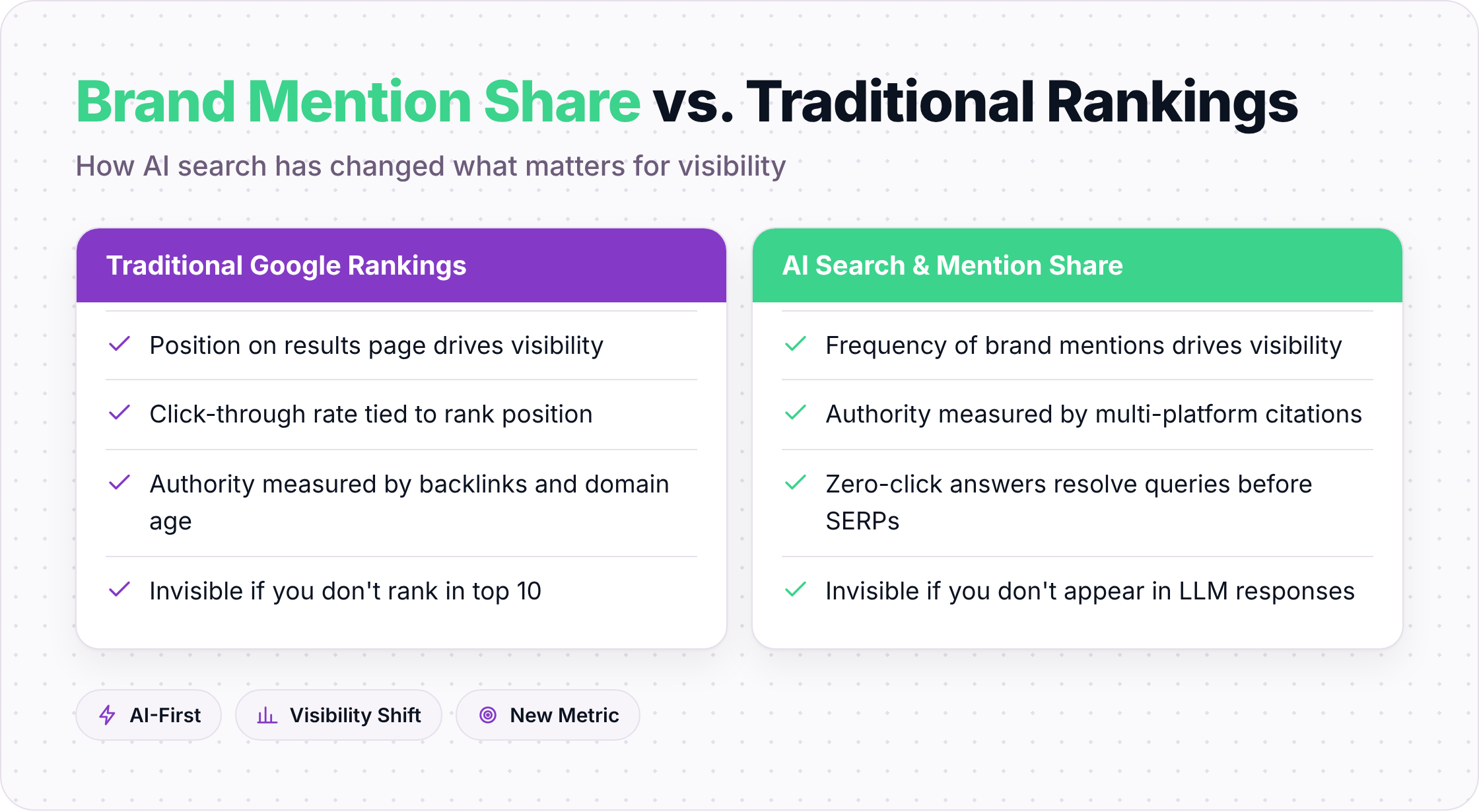
Brand mention share measures how often your brand appears in AI-generated answers relative to competitors, across engines like ChatGPT, Perplexity, Claude, and Gemini. As AI search absorbs more of the query volume that once drove clicks to ranked pages, a brand that ranks number one on Google but never appears in an LLM response is effectively invisible to a growing share of its audience. Mention frequency, not page position, is becoming the primary signal of perceived authority in AI outputs.
The traffic shift is already measurable. Zero-click AI answers now resolve a significant portion of informational queries before a user ever reaches a search results page. HubSpot's marketing benchmarks show that organic click-through rates have been declining steadily as AI-generated summaries absorb the top of the results page. A brand that holds a first-page ranking but earns no mention in those summaries is losing the impression without knowing it.
Mention frequency compounds this effect at the model level. LLMs are trained on large corpora of web content, and brands that appear consistently across authoritative sources get reinforced as credible entities during training. Seer Interactive's research on what drives brand mentions in AI answers found that brands cited across multiple trusted domains were surfaced more reliably in LLM responses than brands with strong single-source coverage. Breadth of mention, not depth on one platform, is what moves the needle.
High mention share does not guarantee accurate representation, and this is the trade-off most brand tracking frameworks miss entirely. An LLM can mention your brand frequently while consistently associating it with the wrong product category, an outdated pricing model, or a competitor comparison that no longer reflects reality. Semrush's analysis of brand mentions and AI trust signals makes this explicit: trustworthiness in AI systems depends not just on mention volume but on the consistency and accuracy of the context surrounding each mention. A brand appearing in 40% of relevant AI answers but mischaracterized in half of those appearances may be doing more reputational damage than a brand with a 15% mention share and clean, accurate framing.
Tracking mention share without auditing mention quality is a half-measure. Both metrics need to run in parallel.
How to Measure Your Brand Mention Share Across AI Platforms
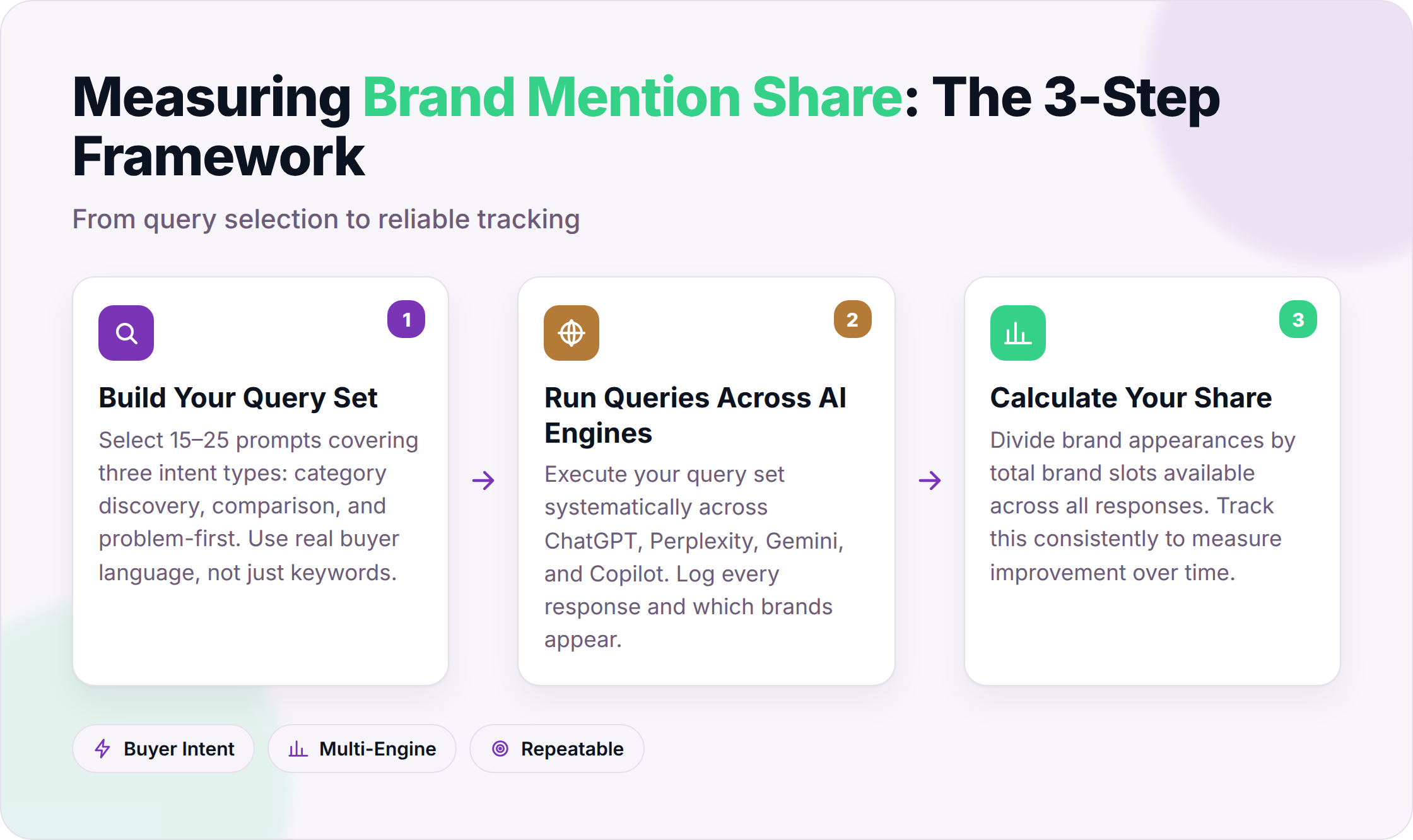
Brand mention share across AI platforms is calculated by dividing the number of times your brand appears across a defined set of AI-generated responses by the total brand slots available in those same responses. To get a reliable number, you need a consistent query set, a systematic way to run those queries across ChatGPT, Perplexity, Gemini, and Copilot, and a simple spreadsheet to log what each engine returns.
Building a Query Set That Represents Your Category
Start with the prompts your buyers actually type, not the keywords you rank for. There is a meaningful difference. A buyer evaluating project management software types "best project management tools for remote teams," not "project management software." Aim for 15 to 25 prompts that cover three intent types: category discovery ("what is the best X for Y"), comparison ("X vs Y"), and problem-first ("how do I solve Z"). Weight them toward the middle of the funnel, where AI engines tend to name specific brands rather than explain concepts.
The share of model visibility metric, defined by researchers tracking AI-generated responses, measures how often your brand appears in AI responses compared to competitors across a representative query set. That "representative" qualifier matters. A query set skewed toward branded terms inflates your score. A set skewed toward generic category terms deflates it. The goal is a mix that reflects how real buyers enter your category.
Running Systematic Checks Across Four Engines
Each engine behaves differently. Perplexity cites sources explicitly. ChatGPT in browsing mode sometimes names brands without linking. Gemini pulls from its own index. Copilot leans on Bing's web results. Because of this, you cannot run a query on one engine and assume the others agree.
The practical approach: run each prompt on all four engines in the same session, on the same day, and log the results in a shared spreadsheet. Columns should include prompt, engine, brands mentioned (comma-separated), whether your brand is present (yes/no), position of your brand mention (first, second, third, or not present), and date. Do this weekly, not monthly. AI engine behavior shifts faster than most teams expect, and a monthly cadence misses short-term drops that are easy to recover from if caught early.
Manual checks work at small scale. Brand24's analysis of AI brand monitoring notes that automated tools query ChatGPT, Gemini, and other platforms on a schedule and log every response, removing the human error that creeps into manual tracking after a few weeks. If your query set exceeds 20 prompts across four engines, that is 80-plus individual checks per week. Automation becomes less optional at that volume.
Calculating Your Share
The formula is straightforward. Take your total brand mentions across all responses in a given week. Divide by the total number of brand slots across those same responses. A "brand slot" is one brand named in one response. If a single response names five brands, that response contains five slots.
Example: you run 20 prompts across four engines, generating 80 responses. Across those 80 responses, AI engines collectively name brands 240 times, an average of three per response. Your brand appears 36 times. Your mention share is 36 divided by 240, or 15%.
Track this number weekly and watch the trend, not the absolute figure. A 15% share in a crowded category with eight named competitors is a reasonable starting position. The same 15% in a two-player category is a problem.
One trade-off worth naming: this method treats all mentions as equal, and they are not. A brand mentioned first in a response carries more weight than one buried in a list of six. A citation with a linked source carries more authority than a passing name-drop. Raw mention share is a useful directional metric, but it does not capture position or context. Teams that want a more granular picture track "first-mention rate" alongside overall share, which adds about 10 minutes to the weekly logging process but produces a materially better signal.
Tools and Dashboards for Tracking Brand Mentions in LLM Outputs
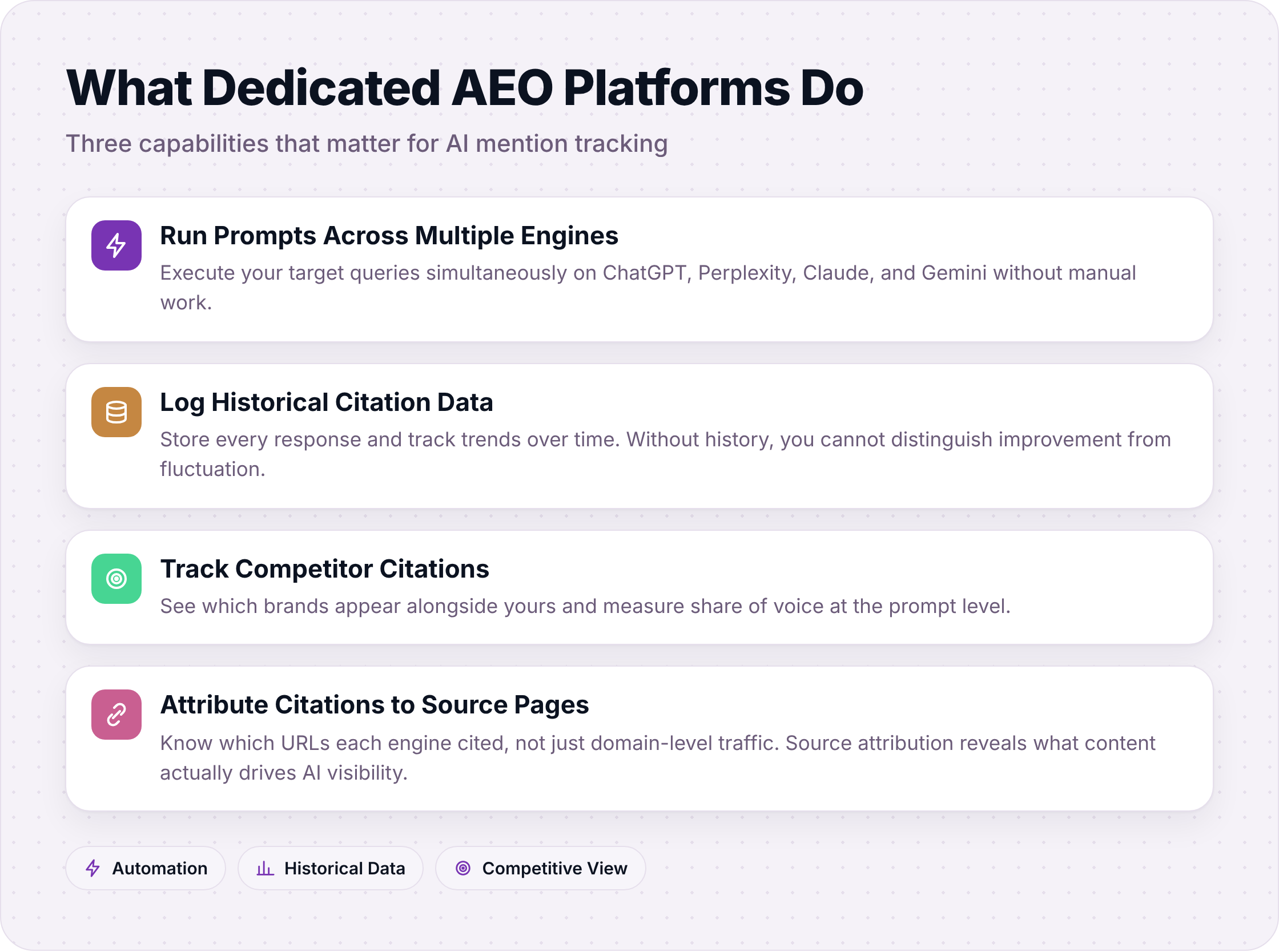
Dedicated AEO platforms log historical AI citation data by polling ChatGPT, Perplexity, Claude, and Gemini on a scheduled basis, storing every response, and surfacing which URLs each engine cited. That historical record is what separates a real tracking setup from a one-off spot check. Without it, you cannot tell whether your visibility is improving, declining, or just fluctuating with model updates.
Dedicated AEO Platforms
Purpose-built LLM tracking tools do three things a generic analytics stack cannot: they run your target prompts against multiple AI engines simultaneously, they log competitor citations alongside your own, and they attribute citations to specific source pages rather than just domain-level traffic. A 2026 roundup of LLM visibility platforms identifies source attribution and prompt-level share of voice as the two features that separate genuinely useful tools from dashboards that only count brand name appearances.
Source attribution matters because knowing your brand was cited is less useful than knowing which article earned the citation. That distinction shapes your next content decision.
Signal AI's research on AI citations frames it clearly: the narratives that drive LLM visibility are often different from the pages that rank well in traditional search, meaning your SEO-optimized content and your AI-cited content can be entirely separate sets of pages. Tracking them in the same dashboard is the only way to see the gap.
When a Spreadsheet Is Still the Right Call
Manual tracking with a spreadsheet is not obsolete. For teams running fewer than 20 tracked prompts, a weekly log of AI engine outputs, citation URLs, and competitor mentions is often faster to set up and easier to share with stakeholders than onboarding an enterprise platform. The trade-off is obvious: manual logs do not scale past a single person's time budget, and they miss citation events between logging sessions. If a model update shifts your visibility overnight, a weekly spreadsheet catches it a week late.
The spreadsheet approach also breaks down when you need competitor data. Manually querying four AI engines across 20 prompts and logging every competitor citation is roughly four hours of work per week. At that point, a dedicated tool pays for itself quickly.
What to Look For in Any Tracking Setup
Three capabilities separate a tracking setup worth building from one that produces noise:
- Historical citation logs: point-in-time snapshots are nearly useless. You need a time-series record to detect trends.
- Competitor visibility: knowing who else gets cited on your tracked prompts is as important as knowing when you do.
- Source attribution: citation counts at the domain level hide which specific articles are doing the work.
GWI's comparison of brand tracking tools for 2026 notes that the tools teams find most actionable are those that connect citation data to specific content assets, so you can see exactly which pages are earning AI mentions and which are not.
Frequently Asked Questions
What is a good brand mention share percentage?
There is no universal benchmark because the number depends entirely on how many brands your tracked prompts typically surface. In a category where AI engines routinely name five to seven brands per response, a 20% share is competitive. In a two-player category, 20% is a weak position. Set your baseline first, then measure movement against it rather than against an abstract target.
How often should you check your brand mention share?
Weekly is the right cadence for most teams. AI engine behavior can shift after model updates, and a monthly check misses drops that are easy to correct if caught within a week or two. If you are running a content campaign specifically aimed at improving AI visibility, check twice a week during the campaign window so you can see what is working before the budget runs out.
Does brand mention share affect actual website traffic?
Indirectly, yes. AI-generated answers that name your brand without linking to your site still create brand awareness that can drive direct searches later. However, the more direct traffic benefit comes when an AI engine cites a specific URL from your site, since some users do click through to cited sources. Tracking citation URLs alongside mention share gives you a clearer picture of which mentions are likely to produce visits versus which are awareness-only.
Can you improve brand mention share without changing your SEO strategy?
Yes, though the two strategies overlap more than they diverge. The fastest levers for improving AI mention share are increasing the number of authoritative third-party sources that reference your brand (press coverage, analyst reports, review platforms) and ensuring your brand is described consistently across all of them. SEO-focused content on your own site matters less to LLMs than the breadth of external corroboration. A brand mentioned accurately across 10 trusted external sources will typically outperform a brand with 50 well-optimized internal pages and minimal external presence.
How do different AI engines weight brand mentions differently?
Perplexity tends to cite sources explicitly and favors pages it can retrieve in real time, so recent, linkable content matters more there. ChatGPT in browsing mode behaves similarly. Gemini draws on Google's index, so traditional SEO signals carry more weight in its outputs. Copilot leans on Bing's web results. Because of these differences, a brand that performs well on one engine may score significantly lower on another, and tracking all four separately is the only way to spot those gaps.
If you want to move beyond manual spreadsheets and start tracking your brand mention share across ChatGPT, Perplexity, Gemini, and Copilot in one place, visit Seorav's GEO tracking tool to see how it logs citations, surfaces competitor visibility, and connects mention data to the specific pages earning your AI presence.
Keep reading
Measuring the Real Value of Zero-Click Visibility in AI Search
Learn how to calculate Zero-Click Visibility Yield, track AI citations across ChatGPT and Perplexity, and convert brand impressions into defensible ROI num
Making Your Website RAG-Compatible: A Technical Playbook
Learn how to make your website RAG-compatible with semantic HTML, schema markup, metadata, and robots.txt settings that AI retrieval systems actually use.

SEO Agency Services in London: Pricing, Packages, and How to Pick the Right One
Compare London SEO agency pricing, packages, and AEO services. Real data from 24 agencies reviewed. Find the right seo services agency for your budget.