How to Improve Content Discoverability: Actionable SEO Tactics
Last updated: 8 June 2026
What Content Discoverability Actually Means
Content discoverability is the structural property that determines whether a user or AI engine can find and surface a piece of content. It depends on technical accessibility, semantic clarity, and citation signals, not just search ranking. A page can rank first on Google and still never appear in a Perplexity answer.
The 40-Word Answer
Discoverability is how findable your content is across every surface where your audience looks: search engines, AI chatbots, social feeds, and referral links. Improve it by fixing technical access, writing with clear intent signals, earning citations, and formatting answers so engines can extract them directly.
Four Things to Know Before Reading Further
- Ranking and discoverability are separate problems. A high-ranking page can still be invisible to AI engines if it lacks the structural signals those engines need to quote it.
- AI answer engines are now a real discovery channel. The Reuters Institute's 2026 journalism and media trends report defines Answer Engine Optimisation as a distinct practice for getting visibility inside AI chatbots, separate from traditional SEO.
- Most teams are already spending here. 61% of marketers increased SEO budgets heading into 2025, up from 44% the prior year, though much of that spend still targets Google rankings rather than broader discoverability signals.
- There is no single fix. Discoverability is a system: technical health, content structure, and off-site authority all interact. Fixing one while ignoring the others produces limited gains.
How Content Discoverability Works
Content discoverability depends on three core signals: crawlability (whether engines can access the page), relevance (whether content matches query intent), and authority (whether external signals confirm trustworthiness). AI engines add a fourth requirement: passage-level extractability that allows them to quote your content directly.
The Three Signals Search Engines Use to Surface Content
Crawlability is the floor. If Googlebot cannot access a page due to a blocked robots.txt rule, a noindex tag, or a broken internal link chain, relevance and authority become irrelevant.
Relevance sits above that. Search engines parse entity relationships, topical depth, and query-to-content alignment, not just keyword frequency. A page covering "content discoverability" without addressing crawl structure, schema, or intent mapping will score poorly on relevance even if the writing is strong.
Authority is the third layer. Coveo's content discovery research identifies fragmented metadata and weak cross-linking as primary reasons enterprise content fails to surface, even when the underlying material is high quality.
How AEO Layers on Top of Traditional SEO Signals
Answer Engine Optimization adds a fourth requirement: passage-level extractability. AI engines like Perplexity and ChatGPT pull discrete passages, not rank pages. A page at position one in Google can still never appear in an AI-generated summary if its answers are buried inside long paragraphs without clear structural markers.
Schema markup, answer-first paragraph structures, and explicit entity labeling make content extractable. This is a meaningful shift from optimizing for a ranked list to optimizing for a quoted passage.
The trade-off is real. Structuring content for AI extraction (short, self-contained paragraphs, direct answers near the top) can reduce the narrative depth that earns backlinks and dwell time. The practical fix is layering: answer-first openings for extractability, followed by deeper analysis for engagement and link acquisition.
Where Internal Site Architecture Fits Into the Equation
Internal linking directly affects all three primary signals. A well-structured site passes crawl equity to deeper pages, reinforces topical relevance through anchor text, and concentrates authority signals on the pages that need them most.
Progress's guide to content discoverability notes that treating content as interconnected nodes rather than isolated pages is the structural shift most teams skip. Flat site architectures, where most pages are reachable within two to three clicks from the homepage, consistently outperform deep hierarchies on crawl coverage and internal authority distribution.
When Discoverability Problems Actually Hurt Traffic
Real traffic loss occurs when content sits in a structural blind spot: missing schema, weak internal links, poor crawl coverage, or formatting that AI engines cannot parse into a citable answer. Well-written pages still receive near-zero organic visits without the signals that help search and AI systems decide they are worth surfacing.
The Specific Scenarios Where Low Discoverability Kills Organic Reach
The clearest cases involve orphaned content (pages with no internal links pointing to them), posts published without structured data, and articles that answer a question but bury the answer three scrolls down. Martech's 2026 search and discovery report notes that brand visibility is now mediated by AI assistants, meaning a page that cannot be read cleanly by an AI engine is effectively invisible to a growing share of users.
How Content Age and Freshness Signals Affect Visibility Over Time
Older content loses discoverability gradually. Google's freshness signals weight recent updates for queries where recency matters, so a 2021 article on a fast-moving topic can drop out of both traditional results and AI citations even if the core information is still accurate. Refreshing old content takes editorial time, and a light update without revising substance can hurt credibility with AI engines that evaluate content coherence.
Why High-Quality Content Can Still Go Undiscovered Without Structural Support
Quality is necessary but not sufficient. A detailed, well-researched article without answer-first structure, without schema markup, and without citations to authority sources gives crawlers and AI engines very little to work with. Only 23% of marketers currently invest in GEO measurement, which means most teams cannot tell whether their content is being cited by AI engines at all.
A Step-by-Step Process to Improve Content Discoverability
Improving content discoverability follows a repeatable sequence: audit what search engines can already see, add structured data so AI engines can parse and cite your content, then build internal link paths that route authority toward pages that need it.
Step 1: Audit Existing Content for Indexation Gaps Using Google Search Console
Open Search Console and pull the Coverage report. Filter for "Excluded" pages and sort by reason. Soft 404s, "Discovered but not indexed," and "Crawled but not indexed" are the three statuses that kill discoverability before any other optimization matters.
Cross-reference those excluded URLs against your Performance report. Pages with impressions but zero clicks are often indexed but structurally weak. Pages with zero impressions are invisible. Prioritize the second group first.
One caveat: Search Console data lags by 48 to 72 hours and samples at scale, so low-traffic pages sometimes show misleading zero-impression counts. Verify with a direct site: query before writing a page off entirely.
Step 2: Apply Structured Data Markup to Target Answer Engine Features
Schema markup makes content machine-readable for both Google's featured snippets and AI answer engines like Perplexity and ChatGPT. BCG's discoverability framework puts schema implementation alongside entity linking as the two highest-leverage structural changes a content team can make.
Use Article, FAQPage, or HowTo schema depending on content type. Validate every implementation with Google's Rich Results Test before publishing. One malformed property can suppress the entire schema block.
Step 3: Build Topical Clusters with Strategic Internal Linking
A topical cluster groups a pillar page with supporting articles that each target a narrower query. Internal links from the supporting pages pass authority back to the pillar, and forward to each other where the topics genuinely connect.
Kentico's content structure research identifies internal link architecture as one of the primary factors separating discoverable sites from ones that rank well in isolation but fail to surface across related queries. Each supporting article should link to the pillar using descriptive anchor text, not "click here" or "read more."
Clusters built around low-volume topics can take six to nine months to show measurable movement in Search Console. Teams expecting faster returns often abandon the structure before it compounds.
Common Confusions Around Discoverability vs. Ranking
Discoverability and ranking are related but measure different things. A page ranks when an algorithm scores it highly against a query. It gets discovered when a user or engine actually encounters it, which can happen at position one or never happen at all.
Why a Page Can Rank Without Being Discoverable
A page at position three in Google can still be invisible to Perplexity, absent from AI Overviews, and never shared in any feed. Ranking reflects a score within one algorithm. Discoverability reflects reach across all the surfaces where your audience actually looks. The Scholarly Kitchen's 2025 content discoverability analysis makes this explicit: optimizing for a single discovery channel leaves most of the available surface area unaddressed.
Indexation vs. Visibility
Being crawled is not the same as being seen. A page can be indexed, technically accessible, and still absent from any result a real user encounters. Indexation is a prerequisite, not an outcome. Visibility requires that the content is structured clearly enough for an engine to extract and surface it in context.
Adding schema and entity markup improves machine-readability, but it also increases the maintenance burden. Every schema block you add needs to stay accurate as the page content changes. A stale FAQPage schema with outdated answers can trigger a manual review flag in Search Console.
Frequently Asked Questions
What is the fastest way to improve content discoverability?
Fix indexation gaps first. Run a Coverage report in Google Search Console, identify pages with "Discovered but not indexed" or "Crawled but not indexed" status, and resolve the underlying cause before touching anything else. Schema and internal linking only help pages that are already in the index.
Does social media affect content discoverability in search engines?
Social signals are not a direct Google ranking factor, but they influence discoverability indirectly. Content that circulates on social platforms earns more backlinks over time, and backlinks remain one of the strongest authority signals. The effect is real but slow, typically playing out over months rather than days.
How do I know if AI engines are citing my content?
Search for your brand name and key phrases inside Perplexity, ChatGPT with web browsing enabled, and Google's AI Overviews. Manual spot-checking is the most reliable method right now. Dedicated GEO tracking tools are emerging, but only 23% of marketers use any formal measurement for AI citation visibility.
Is schema markup required to appear in AI-generated answers?
Schema is not strictly required, but it significantly improves the odds. AI engines extract passages from well-structured content regardless of schema, but explicit markup gives them cleaner signals about what a passage represents. Think of schema as reducing the ambiguity an AI engine has to resolve on its own.
How often should I update old content to maintain discoverability?
For topics where recency matters (industry news, tool comparisons, regulatory changes), a substantive review every six to twelve months is reasonable. Changing a publication date without revising the actual content can backfire: AI engines that evaluate coherence between metadata and substance may treat the mismatch as a credibility signal against the page.
What is the difference between SEO and AEO?
SEO optimizes content to rank in a list of results. AEO (Answer Engine Optimization) optimizes content to be quoted as a passage inside an AI-generated answer. The structural requirements overlap but diverge at the passage level: AEO rewards short, self-contained answers near the top of a page, while traditional SEO also rewards depth, dwell time, and backlink acquisition.
Keep reading
AI citation patterns: ChatGPT, Claude, Perplexity Explained
Learn how AI citation patterns: ChatGPT, Claude, Perplexity differ — and what content signals each platform favors so your site gets referenced more often.
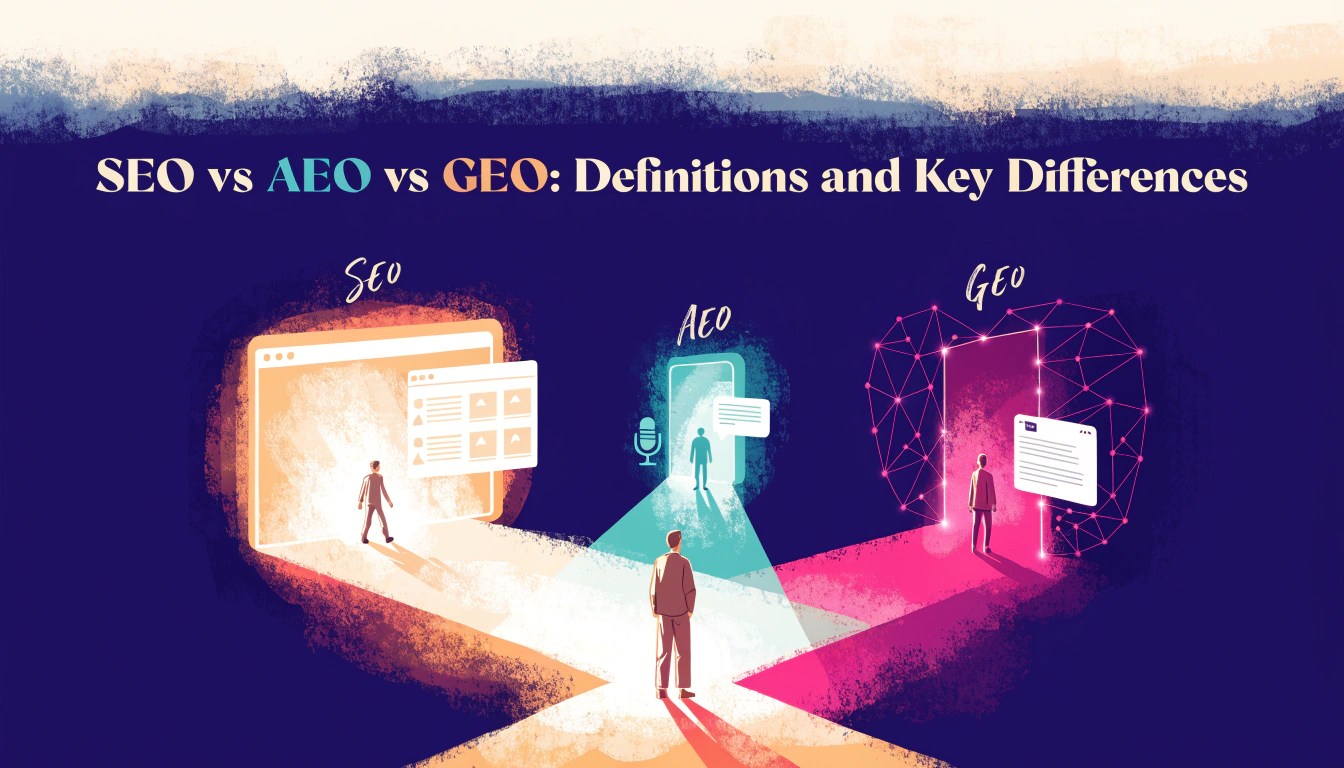
SEO vs AEO vs GEO: Definitions and Key Differences
SEO vs AEO vs GEO: Definitions and Key Differences explained clearly. Learn what each discipline targets, how they're measured, and which one your strategy needs.
How to Optimize Content for ChatGPT Answers: Deterministic Tactics
Learn how to optimize content for ChatGPT answers with heading audits, citable claims, FAQ schema, and E-E-A-T signals that get your pages cited by LLMs.