SEO vs AEO vs GEO: Definitions and Key Differences
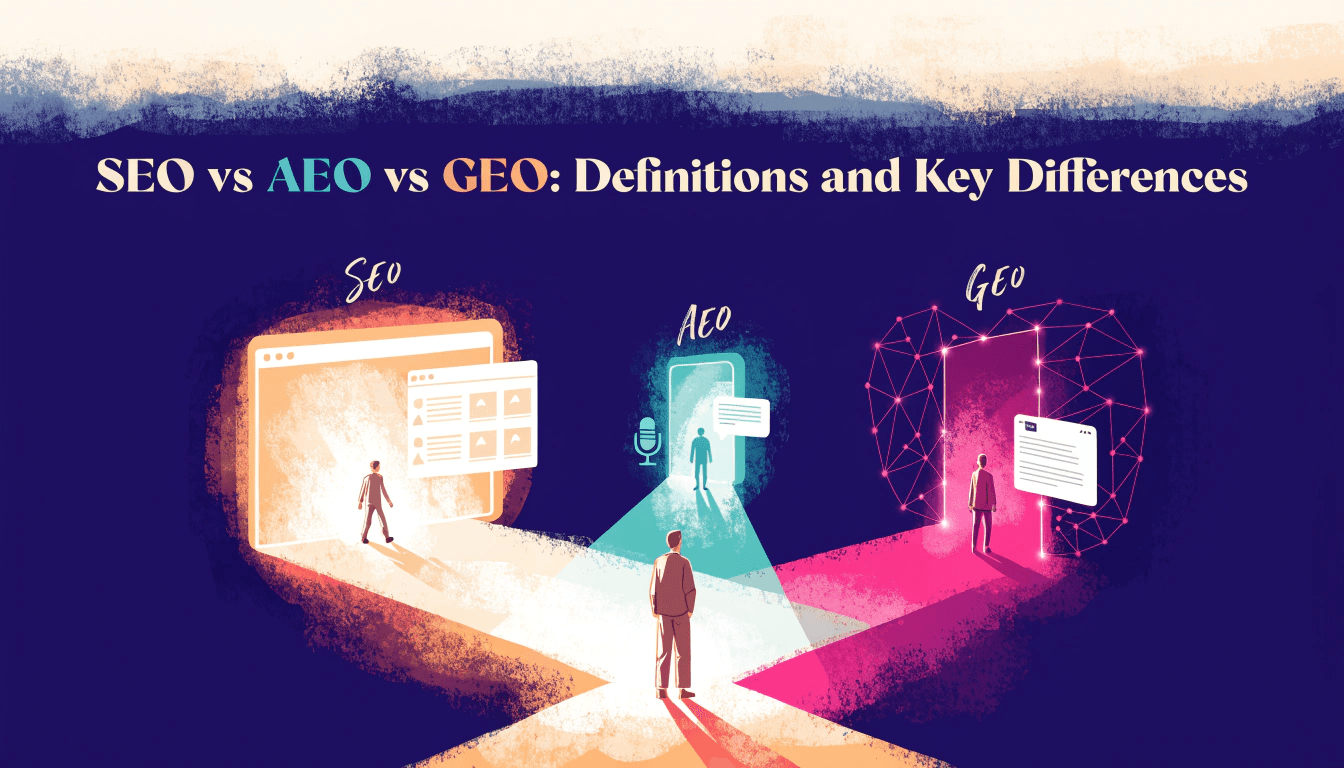
SEO vs AEO vs GEO definitions and key differences come down to where you want to be found and how an algorithm decides to surface you. SEO earns ranked links in traditional search. AEO earns the direct answer box or voice result. GEO earns mentions inside AI-generated responses. Most content strategies need all three, but they require different tactics and different success metrics.
Why These Three Disciplines Exist Side by Side
Search behavior has fractured. A decade ago, almost every query ended with a user clicking a blue link. By 2024, Google's AI Overviews were appearing on roughly 15% of all searches in the United States, according to tracking data from SE Ranking. Voice assistants field hundreds of millions of queries daily. Generative tools like ChatGPT and Perplexity now answer questions without sending users to any website at all.
Each shift created a new optimization discipline. SEO is the oldest and best understood. AEO emerged as featured snippets and voice search grew after 2015. GEO is the newest, coined to describe how publishers and brands try to appear inside large language model outputs, a context where a URL ranking means nothing if the model never cites your content.
Understanding the three is not academic. Choosing the wrong one as your primary focus can mean investing heavily in keyword rankings while your actual audience gets answers from an AI that never mentions your brand.
SEO vs AEO vs GEO at a Glance
| Criterion | SEO (Search Engine Optimization) | AEO (Answer Engine Optimization) | GEO (Generative Engine Optimization) |
|---|---|---|---|
| Primary goal | Rank high in organic search results to earn clicks | Become the direct answer in featured snippets, voice results, or AI Overviews | Be cited or referenced inside AI-generated responses |
| Target platform | Google, Bing, and other traditional search engines | Google featured snippets, Siri, Alexa, Google Assistant | ChatGPT, Perplexity, Google Gemini, Bing Copilot |
| Content format | Long-form pages, keyword-optimized headers, internal linking | Concise Q&A blocks, schema markup, structured data | Authoritative, citable prose, statistics, named experts |
| Key technical tactic | Backlinks, Core Web Vitals, crawlability | FAQ schema, HowTo schema, speakable markup | E-E-A-T signals, original data, brand mentions across the web |
| Primary success metric | Organic ranking position, click-through rate, traffic | Snippet ownership rate, voice result share | AI citation frequency, brand mention rate in LLM outputs |
| Traffic outcome | Direct referral traffic to your site | Partial. Voice often gives no URL, snippets sometimes do | Indirect. Brand awareness, some tools link, many do not |
| Maturity level | Very mature, 25+ years of best practices | Established, best practices settled since 2019 | Emerging, no universal standard as of 2025 |
SEO: Still the Foundation
Traditional SEO optimizes web pages so that search engine crawlers index them accurately and ranking algorithms place them near the top of results pages. The core levers are on-page signals (keyword placement, heading hierarchy, meta data), off-page authority (backlinks from trusted domains), and technical health (page speed, mobile-friendliness, structured crawl paths).
Google's algorithm uses well over 200 ranking factors. That complexity is also SEO's main strength: it is measurable. Tools like Google Search Console give you exact impression counts, average position, and click-through rates. You can A/B test a title tag change and see the result in two weeks.
Where SEO falls short: it cannot help you if the user never reaches the search results page. Zero-click searches, where Google answers the query directly in the SERP, have grown steadily. For informational queries, a top-three ranking may still deliver far fewer clicks than it did in 2018. SEO also does nothing for queries resolved entirely inside an AI chat interface.
AEO: Optimizing for the Answer, Not the Click
AEO targets the moment a search engine or voice assistant decides to read a passage aloud or display it as a featured snippet. The discipline demands that your content answer a specific question in a tight, standalone paragraph, typically 40 to 60 words, immediately after the question is posed on the page. Google's own documentation recommends using FAQ and HowTo schema to help its systems identify answer candidates.
Structured data is the main technical investment. Adding FAQPage schema to a page signals to Google that the content is formatted as questions and answers, increasing the chance of a rich result. Speakable schema, though less widely supported, flags content specifically for voice assistant delivery.
AEO's real limit: winning a featured snippet does not always win traffic. Voice results give no clickable URL, the assistant reads your answer and moves on. For brand-building that is still valuable, but if your business model depends on page visits, ad revenue, lead forms, e-commerce, AEO alone will not deliver that.
GEO: Appearing Inside AI-Generated Responses
GEO is the newest of the three and the least standardized. The core idea: large language models are trained on web content and retrieve supplementary information at query time (retrieval-augmented generation, or RAG). If your content is authoritative, specific, and widely referenced, models are more likely to surface it, either as a direct citation or as the source of a factual claim.
A Princeton and Georgia Tech study published in 2024 found that adding statistics, quotations, and fluent prose to content increased its citation rate in AI outputs by up to 40% compared with thin, generic pages. That finding points to the practical GEO playbook: publish original research, cite primary sources, include named authors with verifiable credentials, and earn brand mentions on third-party authoritative sites.
GEO also intersects with E-E-A-T (Experience, Expertise, Authoritativeness, Trustworthiness), Google's quality framework. A page that scores well on E-E-A-T tends to be the kind of page an LLM trusts enough to reference.
The honest trade-off with GEO: you cannot directly audit which AI model cites you, how often, or in what context. Measurement tools are immature. You can run manual spot-checks, prompt ChatGPT or Perplexity with your target queries and note whether your brand appears, but this is not scalable. GEO investment is partly a long-term brand play with delayed, indirect returns.
AEO vs GEO: The Distinction Most Guides Miss
AEO and GEO are frequently conflated, but they target different systems. AEO targets deterministic retrieval: Google reads your structured markup and decides whether to display it in a specific UI slot. GEO targets probabilistic generation: an LLM synthesizes an answer from many sources and may or may not reference yours. The former is more controllable, the latter is more pervasive.
A useful example: if someone asks Google Assistant "What is the capital of France?", the answer comes from a featured snippet, that is AEO territory. If someone asks ChatGPT "Which blockchain development firms are worth considering for an enterprise project?", the model synthesizes a response from its training data and any retrieved sources, that is GEO territory. Yext's breakdown of the three disciplines frames this well: SEO drives clicks, AEO drives direct answers, GEO drives AI-mediated brand presence.
Which Should You Choose?
The honest answer is that these are not mutually exclusive. Strong SEO content, specific, well-structured, authoritative, also tends to perform well for AEO and GEO. But if you have limited resources, the priority order depends on your situation:
- Early-stage site with low domain authority: start with SEO fundamentals. You need crawlable pages and some backlink equity before any other optimization layer matters.
- Local service business or FAQ-heavy site: invest in AEO early. FAQ schema and concise answer blocks can earn featured snippets even on sites with moderate authority, and voice search drives real local intent.
- B2B brand, SaaS product, or professional services firm: GEO deserves serious attention. Buyers increasingly use AI tools for vendor research. If your brand does not appear in those outputs, you are invisible at a critical decision point.
- Publisher or media site: SEO and GEO together. Traffic still matters, but AI citation builds the long-term authority that sustains rankings.
- E-commerce: SEO first, AEO second for product FAQs, GEO third. Direct purchase intent still resolves mostly in traditional search.
No single framework covers every channel. A strategy that ignores GEO in 2025 is ignoring a fast-growing share of how people find information. A strategy that abandons SEO for GEO is abandoning the most measurable, highest-volume traffic source still available.
If you want to build a content and visibility strategy that accounts for all three disciplines, traditional search, answer engines, and generative AI, sign-up on SEORav Today to see how a structured approach can be mapped to your specific goals and audience.
Frequently Asked Questions
What does AEO mean in SEO?
AEO stands for Answer Engine Optimization. It refers to structuring your content so that search engines and voice assistants select it as the direct answer to a user's query, appearing in featured snippets, Google's AI Overviews, or voice responses from assistants like Siri or Alexa. It differs from traditional SEO because the goal is to be the answer, not just a ranked link.
What is GEO meaning in marketing?
In digital marketing, GEO stands for Generative Engine Optimization. It describes tactics that increase the likelihood of your content being cited or referenced inside AI-generated responses from tools like ChatGPT, Perplexity, or Google Gemini. Key tactics include publishing original data, earning authoritative third-party mentions, and building strong E-E-A-T signals so language models treat your content as a trustworthy source.
Can you do SEO, AEO, and GEO at the same time?
Yes, and the tactics overlap significantly. A well-structured, authoritative page that answers a specific question clearly tends to perform across all three. The differences lie in emphasis: SEO prioritizes backlinks and keyword placement, AEO adds structured schema markup, and GEO focuses on original research, named authorship, and brand mentions across the wider web. A unified content strategy can address all three without tripling your workload.
How do you measure GEO performance?
GEO measurement is still immature compared to SEO. The most practical approach is manual spot-checking: run your target queries in ChatGPT, Perplexity, and Bing Copilot and note whether your brand or content is cited. Some enterprise tools are beginning to track AI mention share. Indirect signals include growth in branded search volume and referral traffic from AI-enabled browsers, but no single universal metric exists yet.
Does winning a featured snippet (AEO) always increase traffic?
Not always. Voice results typically read the answer aloud without providing a clickable URL, so brand awareness may increase without a traffic gain. Text-based featured snippets on desktop do include a link and can drive clicks, but zero-click behavior means some users read the snippet and leave. The traffic benefit depends heavily on the query type and whether the user needs more detail than the snippet provides.
What is the difference between AEO and GEO with a real example?
AEO targets structured retrieval: Google reads your FAQ schema and displays your 50-word answer in a featured snippet for a voice or text query. GEO targets generative synthesis: ChatGPT pulls from multiple sources to write a paragraph about blockchain development firms and mentions your brand because your content is authoritative and widely cited. AEO is more controllable, GEO is broader and harder to audit directly.
Keep reading

Do Backlinks Matter for ChatGPT Citations? What the Evidence Actually Shows
Do backlinks matter for ChatGPT citations? Data from 54 studies shows brand mentions beat links 3x. Learn what actually drives LLM citation share.

SEO Content Strategy: A Pillar Guide to Planning, Creating, and Ranking Content That Lasts
Learn how to build an SEO content strategy that connects keyword intent, content architecture, and revenue goals so your content compounds over time.

What Is GEO (Generative Engine Optimization) and How Does It Work?
Learn what GEO (generative engine optimization) is, how AI engines decide what to cite, and which content changes improve your visibility in ChatGPT, Perpl