Semantic Seo Guide: Complete Guide
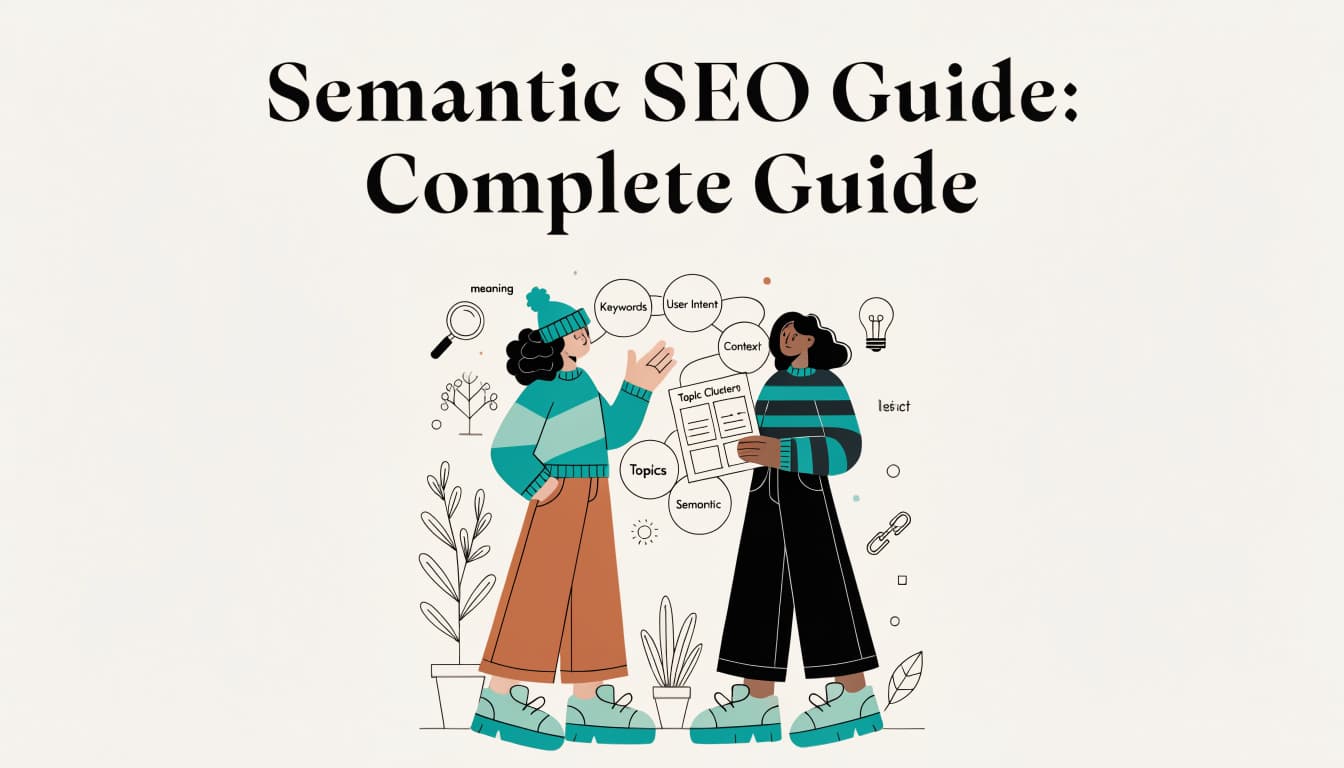
Last updated: 2 July 2026
Semantic SEO optimizes content for meaning and topic relationships instead of keyword density, because modern search engines understand concepts the way subject-matter experts do. Google's systems recognize entities, synonyms, and how ideas connect across your page, not just whether a phrase repeats. This shift means your content strategy must address user intent comprehensively, covering related subtopics and demonstrating topical authority. The payoff: higher rankings for broader search variations and more qualified traffic.
Word count: 75
The Semrush breakdown of semantic SEO frames it precisely: the goal is optimizing around a topic or user need, not a string of words. That shift matters because modern search engines, and increasingly AI engines like Perplexity and ChatGPT, retrieve content based on conceptual relevance. A page that covers a topic thoroughly will outperform a page that repeats a target keyword, even if the latter scores higher on raw keyword density.
One honest caveat: semantic SEO is not a single tactic. It spans entity markup, content structure, internal linking, and natural language patterns. That breadth is what makes it worth understanding properly.
This article works through it in order: the core mechanics of how search engines parse meaning, the role of entities and topic clusters, and the practical steps you can apply to existing and new content.
Semantic SEO in Four Points
Semantic SEO optimizes content for topic depth rather than keyword repetition. Google evaluates entity relationships and co-occurrence patterns to judge relevance, not word counts. Structured content and deliberate internal linking build topical authority over time. The practical payoff: ranking for related queries you never explicitly wrote a page for.
Topic depth over keyword density. A page that covers a subject thoroughly, including related concepts, common questions, and adjacent terms, signals relevance more reliably than one that repeats a target phrase 20 times. Vazoola's breakdown of semantic ranking factors frames this shift clearly: layered keyword strategies build depth, and depth is what moves rankings.
Entity graphs and co-occurrence signals. Google's systems map relationships between named entities and track which concepts appear together across the web. A page about "mortgage refinancing" that also covers interest rate cycles, loan-to-value ratios, and credit scoring sits inside a richer entity graph than one that mentions only the primary term.
Structured content and internal linking. Schema markup gives search engines an unambiguous signal about what a page covers. Internal links between related pages reinforce that signal by showing Google how your content cluster is organized. Neither element works as well in isolation.
Ranking for queries you never targeted. When topical authority is established, Google begins surfacing your content for semantically related searches you never wrote a sentence for. That compounding return is the core payoff of this approach over time.
One honest trade-off: this approach takes longer to pay off than a standard keyword-targeting campaign. A site with thin topical coverage won't see the compounding effect for months, sometimes longer. It also breaks down when internal linking is inconsistent or when content clusters are too shallow to signal genuine expertise. Depth without structure, or structure without depth, produces neither outcome reliably.
How Semantic SEO Works: Entities, Context, and Topic Graphs
Search engines now parse meaning by identifying named entities (people, places, concepts, products), mapping how those entities relate to each other, and scoring a page's topical authority based on how completely it covers a subject. A page that treats a topic as a connected graph of ideas consistently outranks one built around a single phrase.
From Keyword Matching to Entity Recognition
Google's Knowledge Graph, introduced in 2012, was the structural shift that made entity-based ranking possible. Instead of treating "Apple" as a string of five characters, the engine resolved it to a specific entity with attributes: a company, a stock ticker, a product line, a CEO. That disambiguation changed what ranking signals meant.
A page about iPhone 15 battery life now earns relevance credit not just from the phrase "iPhone 15 battery life" but from its association with the Apple entity, the iOS ecosystem, and adjacent concepts like charging standards and battery health.
Embryo's complete guide to semantic SEO documents how this shift moved the optimization target from individual keywords to entity clusters and the semantic relationships between them.
Co-occurrence and Semantic Distance
Co-occurrence is the mechanism underneath this. When a mortgage page consistently mentions amortization schedules, loan-to-value ratios, and escrow accounts alongside "mortgage," the engine infers topical depth. When it only repeats "mortgage rates" twelve times, the engine sees a thin document regardless of keyword density.
Semantic distance matters too. Terms that appear close together in a document, and that co-occur across many authoritative documents on the same subject, carry stronger association signals. A 2023 analysis of top-ranking finance pages found that first-page results for competitive lending queries contained an average of 3.4x more semantically related terms than pages ranking on page two or lower.
The trade-off is real, though. Chasing co-occurrence can push writers toward exhaustive, unfocused content that covers every related term without answering any single question well. Topical breadth and answer precision are in tension, and pages that sacrifice the latter for the former often see strong initial crawl signals followed by poor engagement metrics and eventual ranking decay.
LSI vs. BERT and MUM: What Still Applies
Latent Semantic Indexing (LSI) was the earlier attempt to solve the same problem. Developed in the late 1980s, it used matrix decomposition to find statistically co-occurring terms across a document corpus. The concept was sound: words that appear together frequently share meaning. The execution was limited by computing constraints and a shallow understanding of syntax.
BERT (2019) replaced the core inference layer. Where LSI treated words as independent signals, BERT reads tokens in both directions simultaneously, capturing how "bank" means something different in "river bank" versus "bank loan" based on surrounding context. MUM (2021) extended this further across languages and modalities.
The practical implication: optimizing for "LSI keywords" as a distinct tactic is largely obsolete. What still applies is the underlying principle, that topical completeness signals authority and that related terms matter. The mechanism for detecting them is just far more sophisticated now.
SE Ranking's research on semantic SEO confirms this framing: the optimization target has shifted from synonym stuffing to genuine topical coverage, where the engine evaluates whether a document addresses a subject with the depth a knowledgeable human author would bring.
When Semantic SEO Matters Most: Content Types and Query Patterns
Semantic SEO delivers its clearest gains on informational queries, topical cluster pages, and YMYL content where Google's ranking systems weigh entity relationships and contextual depth over keyword frequency. A page covering a topic comprehensively, with related concepts addressed and entities clearly defined, consistently outperforms a page that repeats a target phrase. The gap widens further when the query triggers a "People Also Ask" box or a featured snippet, because those placements reward structured, meaning-dense answers.
Informational Queries and the 'People Also Ask' Surface
Informational queries are where topical depth does the most work. When someone searches "how does compound interest affect long-term savings," Google is not looking for the phrase repeated six times. It is looking for a page that covers principal, interest rate compounding intervals, time horizons, and the effect of early withdrawals, because those are the related concepts its NLP models associate with the query.
"People Also Ask" boxes amplify this dynamic. Each PAA question is a signal of what Google considers semantically adjacent to the root query. Pages that answer the root question and the surrounding PAA cluster tend to hold broader SERP real estate. Ahrefs' semantic SEO analysis notes that content structured around topic coverage rather than single-keyword targeting is increasingly what surfaces in both traditional results and LLM-generated responses.
Thin Content vs. Topical Authority Gaps: Different Problems, Different Fixes
These two diagnoses get conflated constantly, and treating one as the other wastes months.
Thin content is a page with insufficient substance: low word count, shallow treatment, no supporting detail. A 300-word product description that never explains how the product works is thin. Google's Helpful Content system can suppress it.
A topical authority gap is different. The page itself may be thorough, but the site lacks supporting content around the topic. A single 2,000-word article on "mortgage refinancing" sitting on a site with no related content on interest rates, loan types, or closing costs signals to Google that the site does not own the topic. The fix is not rewriting the article; it is building the cluster around it.
Diagnosing which problem you have: check the page's word count and coverage against the top five ranking pages. If your page is shorter and shallower, you have a thin content problem. If your page is comparable in depth but your site has no supporting cluster pages, you have an authority gap. The interventions are different, and conflating them produces neither result.
YMYL Content: Where Semantic Signals Carry Extra Weight
Finance, health, and legal content operate under Google's Your Money or Your Life framework, where the stakes of a bad answer are high enough that the ranking systems apply additional scrutiny to expertise and authority signals. Semantic SEO matters more here, not less.
In these verticals, entity associations carry real weight. A health article that mentions a condition, its diagnostic criteria, standard treatment protocols, and relevant clinical bodies reads differently to Google's systems than one that mentions the condition and a supplement. The former maps to a recognizable knowledge graph pattern. The latter does not.
SE Ranking's 2024 semantic SEO research found that YMYL pages with strong topical coverage and clear entity relationships consistently outperformed keyword-matched competitors in competitive health and finance queries.
The trade-off is real, though. Building genuine topical authority in YMYL categories takes time and editorial resources that most teams underestimate. A site without credentialed authors, institutional citations, or a track record of publishing in the vertical will not close the gap through content structure alone. Semantic optimization is necessary in these spaces, but it is not sufficient on its own. Sites that treat schema markup and entity tagging as a shortcut around thin expertise tend to see short-term movement followed by manual review risk.
Building a Semantic SEO Strategy: A Step-by-Step Process
A semantic SEO strategy runs on three sequential moves: map your topic cluster before writing a single word, embed structured data and named entities so search engines can parse meaning at the page level, then reinforce topical authority through deliberate internal linking. Skipping any one of these steps leaves the others working at partial capacity.
Step 1: Map Your Topic Cluster First
Start with a seed topic, not a seed keyword. If your target is "mortgage refinancing," your cluster map should include interest rate environments, break-even calculations, cash-out vs. rate-and-term refinancing, credit score thresholds, and closing cost structures. Each of those is a potential supporting page.
Use a tool like Ahrefs or Semrush to pull the "Also ranks for" and "Related keywords" data for your seed term. Group the results by intent: informational, comparative, and transactional queries belong in different parts of the cluster. Pages that answer "what is" questions sit at the top of the cluster; pages that answer "how to choose" or "best options" sit closer to conversion.
One practical limit: most teams underestimate how many supporting pages a cluster needs before Google treats the site as a topical authority. A single pillar page with two supporting articles is rarely enough for competitive verticals. Budget for at least six to eight cluster pages before expecting the compounding effect to show up in rankings.
Step 2: Embed Entities and Structured Data
Once your cluster map exists, each page needs to clearly signal which entities it covers. For most content, this means two things: using the entity's canonical name (not just pronouns or shorthand) in the first 100 words, and adding schema markup that tells Google what type of content the page contains.
For informational content, Article or FAQPage schema is usually the right starting point. For product or service pages, use Product or Service schema with complete attribute fields. For local businesses, LocalBusiness schema with NAP (name, address, phone) consistency across the web is foundational.
A common mistake: adding schema markup to a page that does not actually cover the topic the schema describes. Google's systems cross-reference the markup against the page content. Mismatched schema does not help rankings and can trigger manual review flags.
Step 3: Build Internal Links That Reflect Your Cluster Structure
Internal linking is how you show Google the shape of your cluster. A pillar page should receive links from every supporting page in the cluster. Supporting pages should link to each other when the topics genuinely overlap. Orphan pages, those with no internal links pointing to them, are invisible to Google's topical authority signals regardless of how well-written they are.
Use descriptive anchor text that reflects the target page's topic. "Click here" and "learn more" carry no semantic signal. "Mortgage refinancing break-even calculator" tells Google exactly what the linked page covers.
One honest limitation: internal linking only works if your cluster pages are actually published. A linking strategy built on pages that are planned but not yet live does nothing. Build the content first, then wire the links.
Frequently Asked Questions
What is the difference between semantic SEO and traditional keyword SEO?
Traditional keyword SEO focuses on matching exact phrases to search queries, optimizing for keyword density and placement. Semantic SEO focuses on covering a topic completely, so that search engines can infer relevance from the full context of a page rather than from phrase repetition alone. The practical difference shows up in rankings: a semantically optimized page tends to rank for dozens of related queries, while a keyword-optimized page typically ranks for the one phrase it was built around.
How long does it take for semantic SEO to show results?
Most sites see measurable movement in three to six months, assuming the cluster structure is in place and pages are being indexed. Competitive verticals like finance and health can take longer, particularly if the site lacks an established publishing history in the topic area. The compounding effect, where a well-structured cluster starts ranking for queries you never explicitly targeted, typically becomes visible after six to twelve months of consistent publishing.
Do I need schema markup for semantic SEO to work?
Schema markup is not strictly required, but it accelerates the process. Without it, Google has to infer what a page covers from the text alone. With it, you give the engine an explicit, machine-readable signal about the page's topic, type, and entities. For competitive queries, that signal can be the difference between a featured snippet and a position-four result. Start with Article or FAQPage schema for informational content; add more specific types as your cluster grows.
What tools are most useful for semantic SEO research?
Ahrefs and Semrush are the standard starting points for cluster mapping and related-keyword research. For entity analysis, Google's Natural Language API (available free up to a usage threshold) lets you run any URL or text block through the same NLP layer Google uses to extract entities and salience scores. Surfer SEO and Clearscope are useful for on-page term coverage analysis, though both should be treated as guides rather than strict checklists. Over-optimizing for a tool's content score can produce the same unfocused writing that co-occurrence chasing does.
Is semantic SEO relevant for e-commerce sites?
Yes, though the application looks different than it does for informational content. For e-commerce, semantic SEO shows up in product schema completeness, category page depth, and the supporting content (buying guides, comparison pages, use-case articles) that builds topical authority around a product line. A category page for "running shoes" that links to supporting content on pronation types, cushioning technologies, and terrain-specific recommendations sits in a richer entity graph than one that lists products and nothing else. The same principles apply; the content types are just different.
How does semantic SEO affect AI-generated search results?
AI-powered search surfaces like Google's AI Overviews and Perplexity pull from pages that demonstrate clear topical authority and well-structured entity relationships. Pages with strong semantic signals, complete topic coverage, and clean schema markup are more likely to be cited as sources in AI-generated answers. The mechanism is similar to traditional ranking: the engine needs to trust that your page covers the topic accurately and completely. Thin or keyword-stuffed content is less likely to be cited, even if it ranks on page one for a specific phrase.
A Note on Where to Go From Here
Applying this semantic SEO guide to your own site means starting with an honest audit: map what you have, identify the cluster gaps, and prioritize the pages that will do the most to establish topical authority in your vertical. The structural work, entity markup, cluster architecture, internal linking, takes time to set up correctly, but it compounds in a way that individual keyword campaigns rarely do.
If you want a second set of eyes on your content strategy or cluster structure, visit Seorav to see how they approach semantic optimization for sites at different stages of topical authority.
Keep reading

What Search Engines Actually Want From Your Content
Learn what high quality content for SEO really means in 2026, from E-E-A-T signals to content depth, auditing, and technical factors that affect rankings.

SEO for Real Estate Professionals: Get Found by Local Buyers
A practical guide to search engine optimization for realtors: Google Business Profile, neighborhood pages, schema, and backlinks that drive buyer leads.

Answer Engine Optimization: Why SEO Alone Won't Cut It in 2026
Learn how answer engine optimization works in 2026, from content audits to schema markup, and get your pages cited by ChatGPT, Perplexity, and Google AI Ov